O.K., but it's terribly confusing
pp. 27-29 · Read in the full issue
Rose, by any other name, may smell O.K., but it's terribly confusing
“His name is Joe,” said the battle-axe behind the counter severely, indicating the young Papuan counter-hand whom I greeted in the language of his home village.
HIS name is Aisi,” I replied.
“It isn’t, it’s Joe,” said the attle-axe firmly.
“Dash it all,” I said, “I ought to now what his name is. I baptised im when he was so big.”
In my irritation I extended my ands to a position which suggested tat my former pupil had been born -ematurely; but fortunately this jsture went unnoticed. The con jrsation ended on a cold note.
Joe’s case is typical of many young apuans who come to the big smoke oking for work. Unable to bear e mispronunciation of their names r careless or contemptuous Euro ;ans, they re-christen themselves ith an English name, choosing the tine of some European they have town and liked at home —a issionary maybe, or a patrol officer, a trader.
Sometimes the re-christening is per rmed by the employer. “Oh, I’ll ver remember that”, he will say hearing his new employee’s name. 11 call you Bill”.
For business only
This practice often has the effect making me appear to have a poor ;mory or be much dumber than eally am. “One of my boys says went to your school”, a European ;nd will say to me. “His name Kevin”. (For some obscure reason vin is a very popular choice), is leaves me up in the air, as I )bably knew the lad as Heni or >rea. n most cases these young people their English name for business poses only, and continue to be >wn by their Papuan name among ir one-talks. Among Papuan ents the practice is growing of ing children two names, one man and one English, in infancv. sonally I think that this is a good a.
Vhile I have no objection at all the giving of English names to man and New Guinean children, am not too happy about the ctice of one branch of the church ch confers the names of saints on
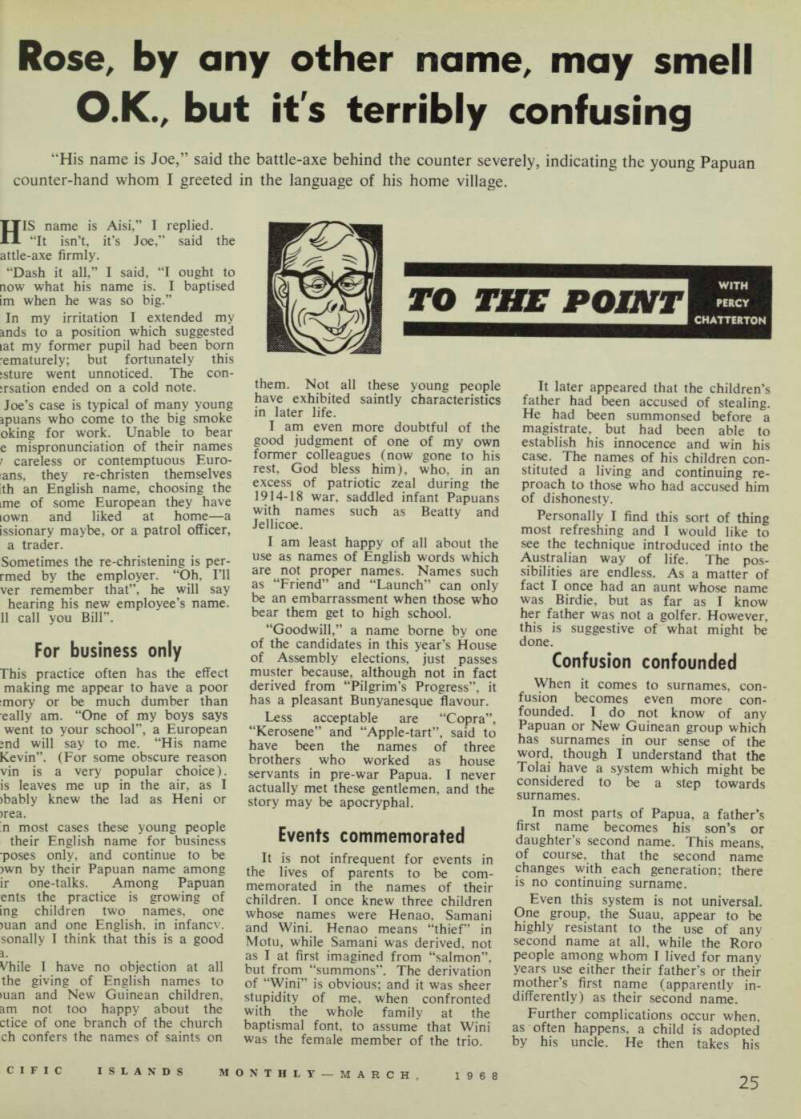
To The Point
With
Percy
Chatterton
them. Not all these young people have exhibited saintly characteristics in later life.
I am even more doubtful of the good judgment of one of my own former colleagues (now gone to his rest, God bless him), who, in an excess of patriotic zeal during the 1914-18 war, saddled infant Papuans with names such as Beatty and Jellicoe.
I am least happy of all about the use as names of English words which are not proper names. Names such as “Friend” and “Launch” can only be an embarrassment when those who bear them get to high school.
“Goodwill,” a name borne by one of the candidates in this year’s House of Assembly elections, just passes muster because, although not in fact derived from “Pilgrim’s Progress”, it has a pleasant Bunyanesque flavour.
Less acceptable are “Copra”, “Kerosene” and “Apple-tart”, said to have been the names of three brothers who worked as house servants in pre-war Papua. I never actually met these gentlemen, and the story may be apocryphal.
Events commemorated
It is not infrequent for events in the lives of parents to be com memorated in the names of their children. I once knew three children whose names were Henao, Samani and Wini. Henao means “thief” in Motu, while Samani was derived, not as I at first imagined from “salmon”, but from “summons”. The derivation of “Wini” is obvious; and it was sheer stupidity of me, when confronted with the whole family at the baptismal font, to assume that Wini was the female member of the trio.
It later appeared that the children’s father had been accused of stealing.
He had been summonsed before a magistrate, but had been able to establish his innocence and win his case. The names of his children con stituted a living and continuing re proach to those who had accused him of dishonesty.
Personally I find this sort of thing most refreshing and I would like to see the technique introduced into the Australian way of life. The pos sibilities are endless. As a matter of fact I once had an aunt whose name was Birdie, but as far as I know her father was not a golfer. However, this is suggestive of what might be done.
Confusion confounded
When it comes to surnames, con fusion becomes even more con founded. I do not know of any Papuan or New Guinean group which has surnames in our sense of the word, though I understand that the Tolai have a system which might be considered to be a step towards surnames.
In most parts of Papua, a father’s first name becomes his son’s or daughter’s second name. This means, of course, that the second name changes with each generation; there is no continuing surname.
Even this system is not universal.
One group, the Suau, appear to be highly resistant to the use of any second name at all, while the Roro people among whom I lived for many years use either their father’s or their mother’s first name (apparently in differently) as their second name.
Further complications occur when, as often happens, a child is adopted by his uncle. He then takes his
uncle’s name as his second name, and, as often as not, his uncle gives him a new first name.
In such circumstances the tracing of a pupil’s academic record through a series of school rolls or examina tion lists may present problems. I remember one occasion on which a young examinee wrote a different variant of his name at the head of each of three successive pages of answers. Fortunately the pages were firmly clipped together.
The confusion to end all confusion comes when a form to be filled in says “Write surname first”.
I once had two students who were sitting for an examination sponsored by the Department of Education.
One was named UME MIRIA. The name of the other was MIRIA UME.
The question paper said: Write your name at the head of your answers, surname first.
One student obeyed this instruc tion. The other didn’t understand it and wrote his name in the ordinary manner. This was not noticed until the department discovered that two sets of answers sent to it for evalua tion were both headed UME MIRIA. One passed; the other failed. But which was which?
Hotch-potch
Recently, as a candidate in the House of Assembly elections, I have had occasion to make a good deal of use of the Moresby electoral roll.
European names are entered with the surname first. Names of indigenes are a complete hotch-potch, some one way round and some the other.
Many of them have the first name first, but followed by a comma, thus giving the erroneous impression that it is the second name.
Authority takes the view that the advancing march of western-style civilisation demands the use of surnames which stay put and don’t change with each generation. How valid this assumption is I don’t know.
But under its aura the more sophisticated sector of the indigenous
population has been urged to adopt surnames.
Some have done so, mainly in Hanuabada, the large, almost com pletely urbanised, village which fringes the shore of Port Moresby Harbour. Generally the name chosen as surname has been that of the father or grandfather of the genera tion currently in middle age. If everybody adopted this plan it might work fairly well; but with some using old-style and some new-style names the area of confusion is considerable.
A contributing factor to the con fusion is the fact that among some tribal groups the range of possible, or at any rate of commonly used, names is quite limited. The Motu people of the Port Moresby area have quite a large range; but a little further to the west the Roro have a much more restricted one.
Suggestion
At one stage, when I was living in that area, I had a primary school of about 70 pupils. The 20 girls in the school shared three names.
There were 10 Avia’s, six Aiva’s and four Taita’s. Of the 50 boys, one third were named Aisi.
A suggestion which I have put forward from time to time and which I still think has some merit is in effect a combination of the two systems. Papuans would be en couraged to use three names—their own given name, their father’s given name, and the agreed family surname.
The only trouble with this idea is that, when combined with the practice, to which I have already referred, of some parents who give a Papuan and an English name to their children, it will load the children of the next generation with four names each, and the admission register of the humblest Primary T School will resemble the rolls of Winchester and Eton.
One finds oneself wondering just how far the contention that you can’t have a civilised society without fixed surnames is true, and how far it is just part and parcel of our
British obsession that the way we d( things must necessarily be the bes way for Papuans and New Guinean to do them?
Example after example comes t< mind. For instance, there is th obsession that, in spite of Dina] Frank’s school “under the mangi tree”, you can’t have a proper schoc unless you have desks and staff room and admission registers and te breaks and what-have-you.
There is the obsession that yo can’t have economic developmer without first converting commune land titles into individual ones— convenient ploy for those who war to see the creation of a landless clas as a potential labour pool, bi palpable nonsense all the same.
There is the obsession that yo can’t have a legislature without Wes minster-type trappings bewigge speaker and clerks, mace, membei uncomfortable in unaccustome lounge suits, first, second and thh readings of bills which in fact ai not read at all, and standing orde: which allegedly protect the rights ( minority groups, but which in fa> lend themselves to the execution ( all sorts of intricate and sometim< disreputable tricks and manoeuvres I am a complete rebel in the; matters.
I had given hundreds of youi Papuans a reasonably good schoolii before admission registers and t< breaks were thought of. I think th Papuans and New Guineans will 1 crazy if they abandon their cor munal land rights. And as far
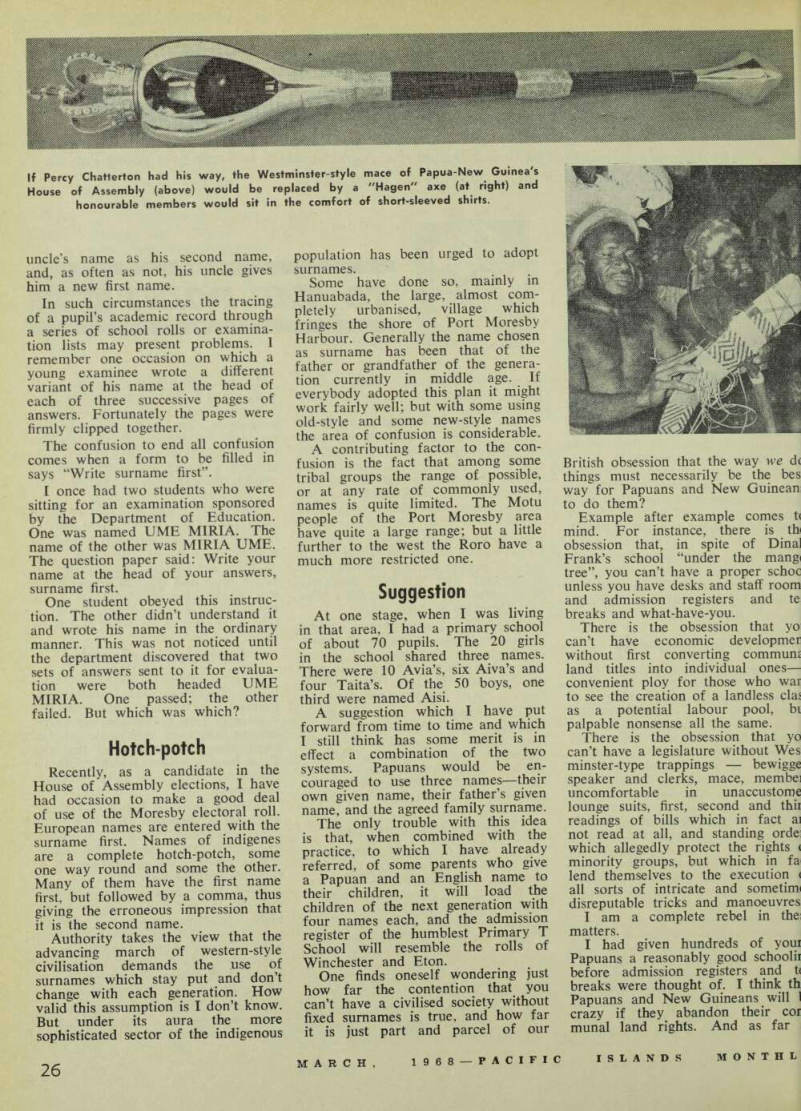
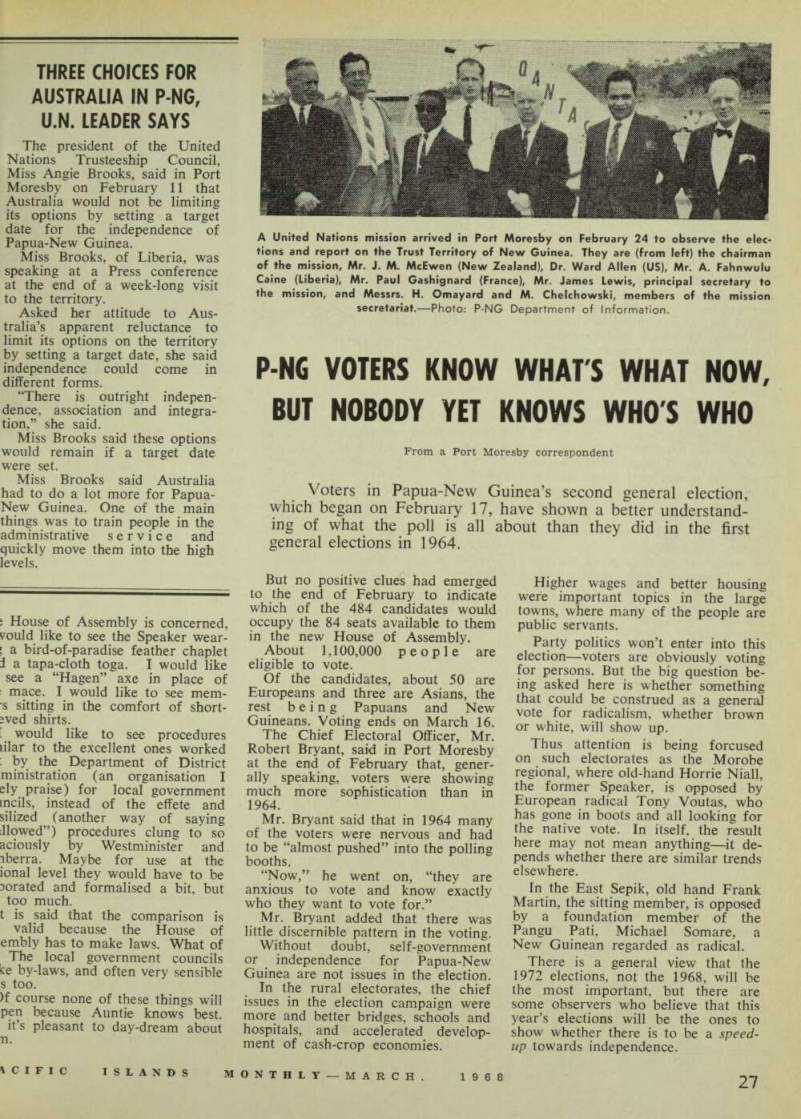
If Percy Chatterton had his way, the Westminster-style mace of Papua-New Guinea's House of Assembly (above) would be replaced by a "Hagen" axe (at right) and honourable members would sit in the comfort of short-sleeved shirts.
‘ House of Assembly is concerned, vould like to see the Speaker wear ; a bird-of-paradise feather chaplet i a tapa-cloth toga. I would like see a “Hagen” axe in place of mace. I would like to see mem s sitting in the comfort of short sved shirts. would like to see procedures tilar to the excellent ones worked ; by the Department of District ministration (an organisation I ely praise) for local government incils, instead of the effete and silized (another way of saying Bowed”) procedures clung to so aciously by Westminister and iberra. Maybe for use at the ional level they would have to be and formalised a bit, but too much. t is said that the comparison is valid because the House of embly has to make laws. What of The local government councils k;e by-laws, and often very sensible s too. )f course none of these things will pen because Auntie knows best, it’s pleasant to day-dream about n.