shares hit the big time
pp. 24-135 · Read in the full issue
South Seas mining and oil shares hit the big time
By staff writer KEN McGREGOR
Pacific Islands mining and oil shares reached their highest levels for several years on Australian stock exchanges in January and February.
Gold shares reacted optimistically to news about new explorations in Fiji and Papua and also persistent rumours that the United States would devalue its dollar and double the price of gold the world-wide monetary yardstick.
Oil shares rose after natural gas with a very high flowing intensity was discovered early in February by an offshore drilling rig in the Gulf of Papua.
The boom in Islands mining and oil shares corresponded with a similar boom in the two types of shares in companies operating in Australia.
This was the happy picture of Islands shares on the Sydney Stock Exchange in January and Feb ruary:— • The 50 cent shares in Oil Search Ltd. rose to 90 cents—their best since 1959 but still a long way behind the 1954 high of $3.46 which followed the discovery of oil in Western Australia by Ampol. • The 35 cent shares in New Guinea Goldfields Ltd. rose to 75 cents —their highest-ever level since the firm revalued its assets in 1935 —33 years ago. • The 10 cent shares of Emperor Mines Ltd. (the Melbourne-run Fiji goldmine) rose to $1.06 their
highest for five years and edging towards their all-time high of abou $1.30. • The 25 cent shares of Pacific Islands Mines Ltd. rose to 72 cent! —their best since October, 1963 when they reached 93 cents. • The 50 cent shares in Papuai Apinaipi Petroleum rose to 50 cents This was the company’s best figure since 1964, but well below its all-time high of about $l.lO in the mid 1950’5, The discovery of natural gas ii the Gulf of Papua was made onb a few miles from permit areas whicl Oil Search and Papuan Apinaipi have interests in.
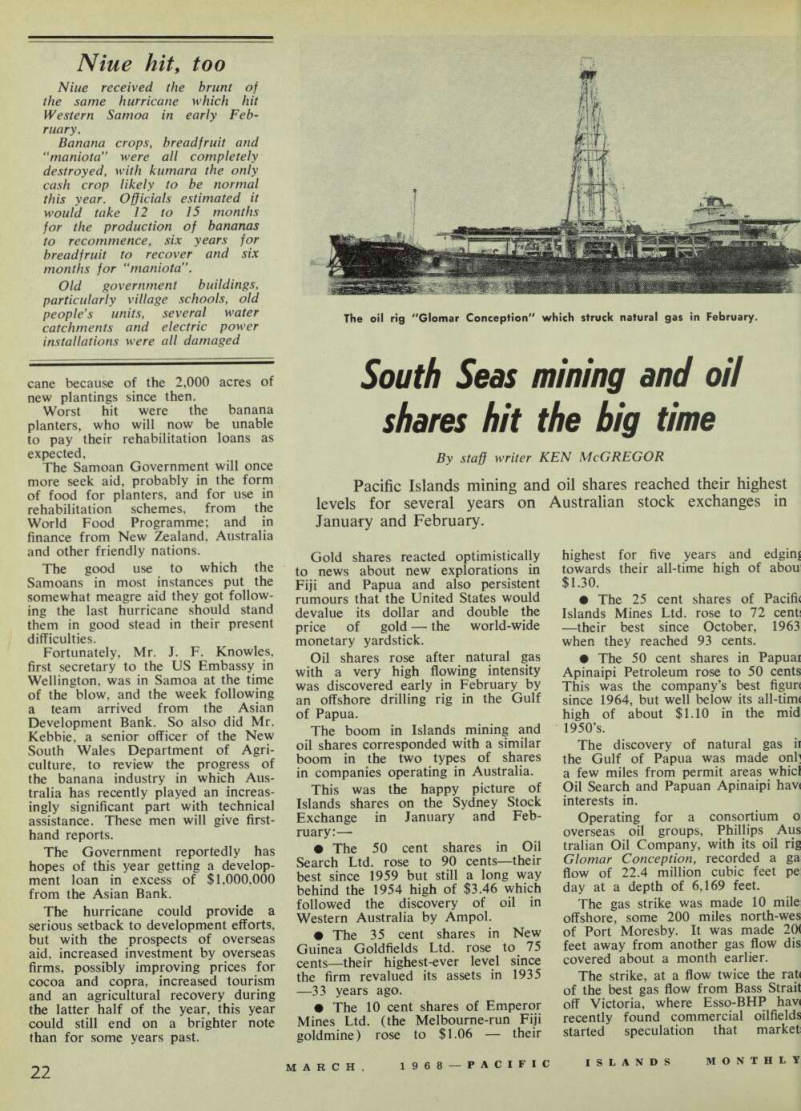
Operating for a consortium o overseas oil groups, Phillips Aus tralian Oil Company, with its oil rig Glomar Conception, recorded a ga flow of 22.4 million cubic feet pe day at a depth of 6,169 feet, The gas strike was made 10 mile offshore, some 200 miles north-wes of Port Moresby. It was made 201 feet away from another gas flow dis covered about a month earlier.
The strike, at a flow twice the rat< of the best gas flow from Bass Strait off Victoria, where Esso-BHP hay< recently found commercial oilfields started speculation that market
The oil rig "Glomar Conception" which struck natural gas in February.
could be found in Tokyo or even London for liquefied Papuan gas.
The Phillips gas strike started heavy buying from England and in Australia of Oil Search shares, and steady selling from New Guinea.
Oil Search
Nearly a million shares were jought and sold in Australia follow ng the strike.
From January to November last 'ear Oil Search issued scrip for [3,862,000 shares. This year, in its Sydney office alone, the company has aken on six extra staff to handle crip.
Esso and British Petroleum, be ween them, have committed SlO nillion in drilling funds under agree nents with Oil Search.
A spokesman for Oil Search said lis company was waiting on seismic urveys that Esso was carrying out ti February on its Papua leases. It /as up to Esso to decide where to [rill.
New Guinea Goldfields
A New Guinea Goldfields spokes lan told PIM he did not know of ny sound reason for the jump in is company’s shares. But it was ossible that speculators were gambl ig on the price of gold going up— diich had been rumoured for many ears without result.
NG Goldfields’ shares were re alued from £AI to A 5- in 1935 'hen the company revalued its ssets. A further 1/6 was paid off le 5/- shares in the form of ividends to shareholders soon after ards, making them 3/6.
Since 1935 the company’s shares ave remained around the 3/- to /- mark, dropping at times as low 5 1/4.
In January, NG Goldfields treated ,597 tons of ore for 1,294.7 oz I gold from its Golden Ridges mill.
Today the company is not wholly on goldmining. It is also trader, timber merchant and coffee •ower.
Emperor Mines
Emperor treated 95,403 long tons P ore for 35,024 oz of gold from last jptember to January 10.
Sydney financial circles believe iat the reason for the greatly iproved prices for Emperor Mines lares is that the company has arted an interesting exploration pro amme with substantial Fiji Gov nment financial assistance, at its atukoula mine.
However, increased costs and lower
(Continued on p, 129)
quantities of gold gave the company an unattractive return last year, and dividend was omitted.
Pacific Islands Mines chairman, Mr. G. W. Noe, told PIM the current popularity in his company’s shares was either speculation on a gold price rise or conjecture that a copper prospect at the company’s project at Misima Island, Papua, would be a good one.
PI Mines, which has been looking for commercial gold on Misima for the past nine years—the last three in conjunction with Cultus Explora tion Ltd., of Canada—announced an “interesting” copper prospect on Misima last December.
There were two new developments in February.
PI Mines began a four-month physical and geochemical survey to examine the copper prospect.
Cultus formed a new company, Cultus Pacific NL, to take over its existing operations in Australia and the Pacific, the main operation being the Misima gold-copper prospect.
Cultus Pacific was formed with a nominal capital of $2.5 million, of which, it is understood, $250,000 is paid-up.
This led to speculation that a public float would be announced in March to exploit Misima’s mines. (A PI Mines subsidiary, Oceanic
Minerals Development Pty. Ltd., holds mining rights over the 22 square-mile mineralised region of Misima.) If a float does eventuate it is expected that the faithful share holders of PI Mines, who have been given optimistic exploratory reports for nearly 10 years without any re turn for their money, will get priority to new shares.
Nearly two years ago Cultus issued a circular to shareholders say ing that gold and silver worth SA3O million was indicated on Misima.
Papuan Apinaipi
A spokesman for Papuan Apinaipi told PIM that the improved showing for his company’s shares was due to developments in Queensland as well as the Gulf of Papua gas strike.
Papuan Apinaipi, a member of the Associated Oil group, transferred its oil exploration lease in the Gulf of Papua, adjacent to Oil Search’s permit, to an American oil company.
Marathon Continental, several years ago.
However, the company still has a minor Papuan interest because if Marathon finds oil in commercial quantities, Papuan Apinaipi is entitled to an overriding royalty.
In Queensland, the Associated Oil group recently took part in increased exploration for gas, oil and minerals.