Pacific Shipping And Cruising Yachts
pp. 107-111 · Read in the full issue
Cruising Yachts
Fiji may get hovercraft for coastal waters
Fiji may acquire a small hovercraft for use in coastal vaters as a result of a visit to Britain recently by its Minister : or Communications, Works and Tourism, Mr. Charles Stinson.
lr. Stinson returned to Suva in October after discussing the l of a 38-seater hovercraft, with peed of 45 knots, with British officials. The hovercraft Id be used to pick up and set m tourists at hotels and resorts ig Fiji’s coasts. l six-week trial of the hovercraft r be made in Fiji after samples coral rock and close-up photo 3hs of bare reefs have been sent England so that engineers can :ss the hazards that the craft ild face in the colony.
Ir. Stinson said on his return to a: “There is urgent need in Fiji the rapid development of our isport system because of its iortance to our tourist industry, ch is such a vital factor in our nomy. We must do all we can expand it as speedily and effec ly as possible”.
Jr. Stinson’s statement did not le the type of hovercraft which had discussed with British cials. But the indications are that
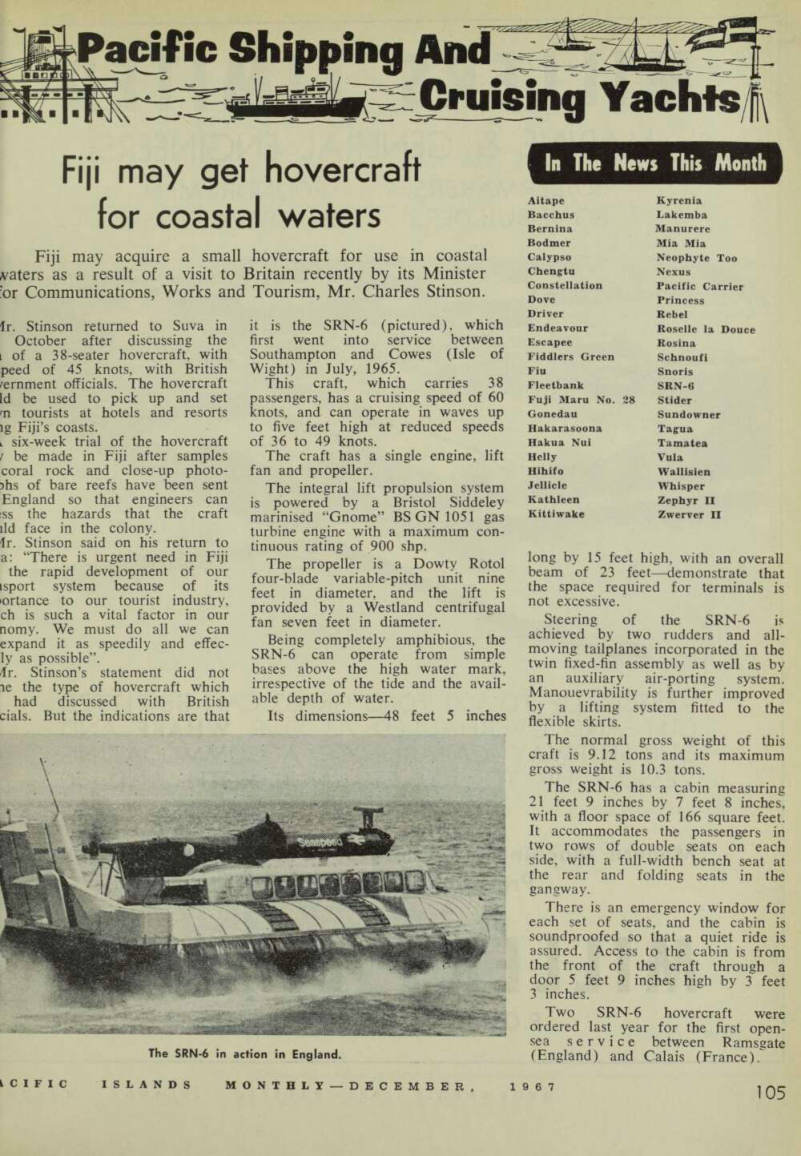
it is the SRN-6 (pictured), which first went into service between Southampton and Cowes (Isle of Wight) in July, 1965.
This craft, which carries 38 passengers, has a cruising speed of 60 knots, and can operate in waves up to five feet high at reduced speeds of 36 to 49 knots.
The craft has a single engine, lift fan and propeller.
The integral lift propulsion system is powered by a Bristol Siddeley marinised “Gnome” BSGNIOSI gas turbine engine with a maximum con tinuous rating of 900 shp.
The propeller is a Dowty Rotol four-blade variable-pitch unit nine feet in diameter, and the lift is provided by a Westland centrifugal fan seven feet in diameter.
Being completely amphibious, the SRN-6 can operate from simple bases above the high water mark, irrespective of the tide and the avail able depth of water.
Its dimensions—4B feet 5 inches
long by 15 feet high, with an overall beam of 23 feet—demonstrate that the space required for terminals is not excessive.
Steering of the SRN-6 is achieved by two rudders and all moving tailplanes incorporated in the twin fixed-fin assembly as well as by an auxiliary air-porting system.
Manouevrability is further improved by a lifting system fitted to the flexible skirts.
The normal gross weight of this craft is 9.12 tons and its maximum gross weight is 10.3 tons.
The SRN-6 has a cabin measuring 21 feet 9 inches by 7 feet 8 inches, with a floor space of 166 square feet.
It accommodates the passengers in two rows of double seats on each side, with a full-width bench seat at the rear and folding seats in the gangway.
There is an emergency window for each set of seats, and the cabin is soundproofed so that a quiet ride is assured. Access to the cabin is from the front of the craft through a door 5 feet 9 inches high by 3 feet 3 inches.
Two SRN-6 hovercraft were ordered last year for the first open sea service between Ramsgate (England) and Calais (France).
The SRN-6 in action in England.
Nnel Blasting Goes On
\Sau Wharf
ie New Zealand navy supply Endeavour at the end of October aded another 50 tons of jsives that will hopefully com the blasting of a channel that allow large ships to berth at the itly completed Asau Wharf, ern Samoa. ie Asau and Apia deep water ves were mainly financed by a 2 million loan raised in New md and guaranteed by the New md Government, They cost a deal more than originally [ated and because of unexpec hard lava rock, the channel at is still not deep or wide enough lable ships to use the wharf, e New Zealand Government is [ying the explosives in the form quid bombs and torpedo war s, plus a naval diving and dition team as assistance towards ig the wharf operational. It was d to complete the blasting in t five or six weeks. The debris then be dredged and the wharf Id be ready for use before the le of next year—about 18 hs later than scheduled, ie provision of a wharf is tial to plans by the US firm otlatch Forests Inc. to develop timber industry in Savaii with quarters for the project at Asau.
Fisher Still On
Reef
vo attempts early in November I to remove the Japanese fisher, Maru No. 28, from a reef near i Point, Fiji. ie attempts were made by the is Philp inter-island trader, lyr 11, with the tides at flood, 30 p.m. on November 4 and 7.30 on November 5. ie master of Zephyr 11, Captain V, Sandys, said later that the Maru No. 28 “shook a bit”, ie Fuji Maru No. 28, is now td by McNicholl Industries Ltd., , who bought her from the h Pacific Co-op. Fishing Associa ic went aground on July 29 while he way to her base at Levuka 50 tons of fish.
Many Aboard
hen the inter-islands cutter irasoona was stopped recently t miles off Honiara, Guadal 1, on the way to Malaita. orities found 39 passengers and crewmen aboard, while the ;r’s certificate allowed for only passengers and two crewmen, ccording to the BSIP News
Sheet, Hakarasoona’s boSun, Joe Topi, was fined $7B in the Centra/ District Court for overloading, in default, three months’ prison.
Three Times Unlucky
For "Bodmer"
In her third such incident this year, the 278-ton Cook Islands motor vessel Bodmer broke down with engine trouble 11 miles north of Rarotonga on a trip to Aitutaki on October 2.
Bodmer radioed for help and the fishing vessel Hakua Nui, owned by Island Foods Ltd., was sent to try to tow her back to Rarotonga.
Hakua Nui was guided u Hie stricken ship by Bodmer’s searchlight and a towline was attached before the two ships started towards Raro tonga at a half knot. However, a SSE wind freshened and Bodmer again radioed for further help.
When a Union Steam Ship Com pany launch arrived on October 3, the two small boats towed together.
Rising winds and heavy seas ma*f progress again minimal and when it was found that Hakua Nui’s would not last the time require,' to reach port, help was again needed.
It came, fortunately, in the form
of the tanker Pacific Carrier, which was discharging fuel at Avatiu.
Pacific Carrier towed the Bodmer to Avatiu harbour and two Union Steam Ship launches helped her to berth on October 4.
Bodmer first broke down earlier this year on January 3, when she was 50 miles south of Manihiki and had to be towed to Tahiti by the Bank Line vessel Fleetbank ( PIM, Feb p 107) On a May voyage, from Rarotonga to Suva, she broke down off Niue and was towed by MV Wando River to Pago Pago (PIM, June, p 111) . , , , p '■ , . The trader reversed the process in late August and towed MV
Holmburn, which had broken down off Rarotonga, In 1966, Bodmer underwent major engine and general repairs in New Zealand at an estimated cost of $NZ36,000. Captain J. M. Lyon has been her master since March, 1964.
Criticism Over
"Lakemba" Sinking
The decision by Fiji and overseas authorities not to hold a full-scale inquiry in Fiji into the complete loss of the 7,500-ton passenger-freighter Lakemba near Vatulele in early October has caused critical comment.
In a letter to The Fiji Times in early November, Mr. S. R. M.
Douglas, of Ovalau, said the Fi Department of Marine, by not hole mg an inquiry, was “not fulfilling th purpose for which it originally cam into being”. This brought a lon reply from the Fiji Minister for Con munications, Mr. Charles Stinson.
Captain E. W. Lamberty, of Vih New Hebrides, in a letter to PB this month (see letters column questions why there will be no it quiry into the Lakemba disastei Captain Lamberty was master of th 530-ton MV Wallisien when she ra aground on Nukutolo reef, Fiji, i May {PIM, June, p. 101).
At the end of November it wa still not known whether or not ther would be an inquiry, but if there i to be one it is likely to be in Hon Kong and not Fiji. Certainly it wouli be an extraordinary thing if an in quiry was not held into such a loss especially in view of some of th rumours surrounding the occurrence The Lakemba, carrying 80 passen gers and a timber cargo worth nearl l £F300,000, hit a reef off Vatuleli Island, Viti Levu, on October 4 Passengers and crew fortunately wen got off quickly, with no loss of life before she sank in about 600 fathomi of water {PIM, November, p. 103).
The Lakemba was owned by Pacifi< Shipowners Ltd., which is a Fij registered subsidiary of W. R. Car penter Holdings, and was making j final trans-Pacific run from Vancouvei to Sydney.
Registered in Hong Kong, she wa! fully insured with Lloyds of London Lakemba’s insurance value has noi been disclosed but shipping source; told PIM it would exceed SAI million Mr. Douglas said in his letter: “The decision of the Director oJ Marine in exercising his prerogative not to hold an inquiry into the strand ing and subsequent sinking of the Lakemba leads to the inevitable con clusion that the Department of Marine, which he heads, is not ful filling the purpose for which it originally came into being, fol lowing the recommendation of a Board of Inquiry into the loss of the Kadavulevu three years ago . . .
“Now that the responsibility as to whether any action should be taken in the Lakemba’s. case has been passed on to the Hong Kong marine authors ties, it will be a closed book as far as we in Fiji are concerned, but this decision gives little consolation and solace to the inhabitants of Vatulele, whose beaches have been despoiled by baulks of oil impregnated timber and inches deep accumulations of thick oil sludge, vitally affecting the cleanliness of their villages and with prospects of contamination of their!
food and generally disrupting r day-to-day existence.” our days later, Mr. Stinson, >se ministerial responsibilities in le marine matters, issued a state it in reply to Mr, Douglas’ letter, ppeared in The Fiji Times.
Ir. Stinson said the decision to 1 any preliminary inquiry into the emba in Hong Kong, where the \ was registered, was not for the Director of Marine alone.
The decision was taken after con ation within Fiji and equally im ;ant, after communication with ropriate authorities overseas,” he 1 would like to believe that in the >rtunate event of a Fiji registered becoming a casualty whilst on a age overseas, the marine authority :erned would show similar cour and give the Fiji Director of ine the opportunity of expressing views, safeguarding our interest the matter and exercising our ts to hold an inquiry in Fiji—the itry of registration . . .
Much as the damage and un santness caused by oil pollution to be deplored, they will not be oved by any inquiry, wherever it tit be held, or however exhaustive light be. having sent the full documenta of the loss of the Lakemba to the eminent of Hong Kong, we are fied that should the evidence :ate that a useful purpose would served by further investigation, Hong Kong Government can be d upon to hold an inquiry and fy us in due coure of the results.” r. Stinson’s statement did not fy many Fiji residents who were curious to know how a enger-freighter of the Lakembo’s and value managed to hit Cakau leka Reef to start with—on a r en path she had been plying for /ears.
And if a ship goes down, is it up to the port where the vessel is registered, be it thousands of miles away, to decide if an inquiry will be held?
New Equipment
For Fiji Fisher
The Gonedau, the new fisheries ship for Fiji’s Department of Agri culture, was on a Suva slip in November being fitted out with specialised hydrographic and fishing equipment. Gonedau was built by the Fiji Public Works Department ( PIM , Oct., p. 111). She will be fitted with a bathythermograph, which takes temperatures at various
depths, a constant reading surface thermometer, which tells the type of fish likely to be caught, and a dredge, which will collect samples of mud and sand from the sea-bed.
Gonedau will make her first voyage early in 1968.
New Guinea Patrol Boat
Commissioned
HMAS Aitape, a 107 ft, 100-ton Royal Australian Navy patrol boat to be based at Manus Island with the Navy’s Papua-New Guinea division, was commissioned in Bris bane on November 13 by the Minister for Navy, Mr. Don Chipp.
HMAS Aitape will be one of five patrol boats to be based at Manus Island.
Comfort
The marine division of P-NG’s Department of Trade and Industry took delivery of a $14,000 26 ft luxury cruiser in early November.
With a top speed of about 20 mph, the cruiser has twin diesel engines, a double bunk and twin single berths, a wall-to-wall carpet, refrigerator and a small washroom.
Bsip Landing Craft
Vula, a new 100 ft landing craft for the BSIP Marine Department, was launched in Brisbane in early October and arrived in the Solomons in mid-November,
Bougainville's
First
The first wharf on Bougainville capable of accommodating overseas ships was nearing completion at Kieta recently.
With the develop ment of copper min ing on Bougainville, Kieta is expected to become an increas ingly busy port as time goes on.
NEW MADANG FACILITIES: Although Madang has one of the most attractive harbours in New Guinea, it was rather poorly off for wharf space until the new wharf, pictured here, was built recently. Madang is a major port for the shipment of copra and for the transhipment of goods to and from the Highlands.