Book Reviews
pp. 101-103 · Read in the full issue
Clear Facts On A
Variety Of New
Guinea Problems
Book Reviews
Readers and collectors of New uineana can’t these days
spend on getting a regular flow
: anthropological reports of the nd put out by the Papuan Ad inistration from 1921 until the te 19305. More’s the pity, as ose reports —most of them by e industrious F. E. Williams—
ade fascinating reading.
Today’s readers can, however, find bargain in the New Guinea Re arch Unit’s regular series of lletins, the first of which was issued early 1963, and which now number . Since these may be obtained r only $1 each or for a subscrip ►n of $3 for all bulletins issued a year, they are certainly a better ancial bargain than the William’s pers, which frequently were avail le only in groups and published hard covers by the Oxford Un'i rsity Press.
The subjects covered by the re arch unit’s series are wider than ase of the Papuan anthropological ?orts. The New Guinea Research lit, established in 1961, by the ssearch School of Pacific Studies the Australian National University, /estigates all kinds of P-NG ablems, of both practical and entific interest. The investigations i designed for people who want :ts on a particular problem.
The format of the bulletins (printed : set from typescript) was designed get the publications into the nds of people interested, in the eapest way and in the shortest le. The preparation was not to an undue burden on field workers mting to get on with the next job dead of wasting time putting pers through the press.
Clarity
The bulletins have been successful th their objectives. After a some lat shaky start they are now pearing in increasing numbers, and 1 doubt there is a backlog of papers be published.
Although some of the papers will of more interest to the general :w Guinea resident than others, d there is also a variation—par
ticularly in the early stages—in the quality of the material, the most notable aspect of the bulletins is their clarity. Nobody seriously interested in New Guinea affairs should be without a set, and even those with only passing interest will find sub jects to interest them.
Here is a full list of the bulletins (which are available from the ANU Press, PO Box 4, Canberra): No. I —The Erap Mechanical Farming Project, by R. G. Crocombe and G. R. Hogbin, April, 1963. No. 2— Land, Work and Productivity at Inonda, by R. G. Crocombe and G.
R. Hogbin, August, 1963. No. 3 Social Accounts of the Monetary Sector of the Territory of Papua and New Guinea, 1956/57 to 1960/61, by R. C. White, January, 1964. No. 4 —Communal Cash Cropping Among the Orokaiva, by R. G. Crocombe, May, 1964. No. 5— A Survey of Indigenous Rubber Producers in the Kerema Bay Area, by G. R. Hogbin, October, 1964. No. 6 —The Euro pean Land Settlement Scheme at Popondetta, by D R. Howlett, April, 1965. No. 7 The M’buke Co operative Plantation, by R. G.
Crocombe, August, 1965.
No. B— Cattle, Coffee and Land Among the Wain, by Graham Jack-
son, December, 1965. No. 9 — An Integrated Approach to Nutrition and Society; The Case of the Chimbu, ed. E. Hipsley, January, 1966. No. 10— The Silanga Re settlement Project, by Olga van Rijswijck, February, 1966. No. 11 —Land Tenure and Land Use Among the Mount Lamington Orokaiva, by Max Rimoldi, April, 1966.
No. 12 — Education Through the Eyes of an Indigenous Urban Elite, by Karol van der Veur and Penelope Richardson, August, 1966. No. 13— Orokaiva Papers: Miscellaneous Papers on the Orokaiva of North East Papua, November, 1966. No. 14— Raia Camp: a Port Moresby Migrant Settlement, by Nancy E.
Hitchoook and N. D. Oram, January, 1967. No. 15— Bulolo: A History of the Development of the Bulolo Region, New Guinea, by Allan Healy, February, 1967.
No. 16 — Papuan Entrepreneurs.
Papers by R. G. Crocombe, W. J.
Oostermeyer and Joanne Gray, J. V.
Langmore, April, 1967. No. 17— Land Tenure Conversion in the Northern District of Papua, by David Morawetz, May, 1967. No. 18— Social and Economic Relation ships in a Port Moresby Canoe Settlement, by N. D. Oram, July, 1967.
ANOTHER publication of New Guinea interest recently avail able is The Death of Bishop Loerks and His Companions, by Rev.
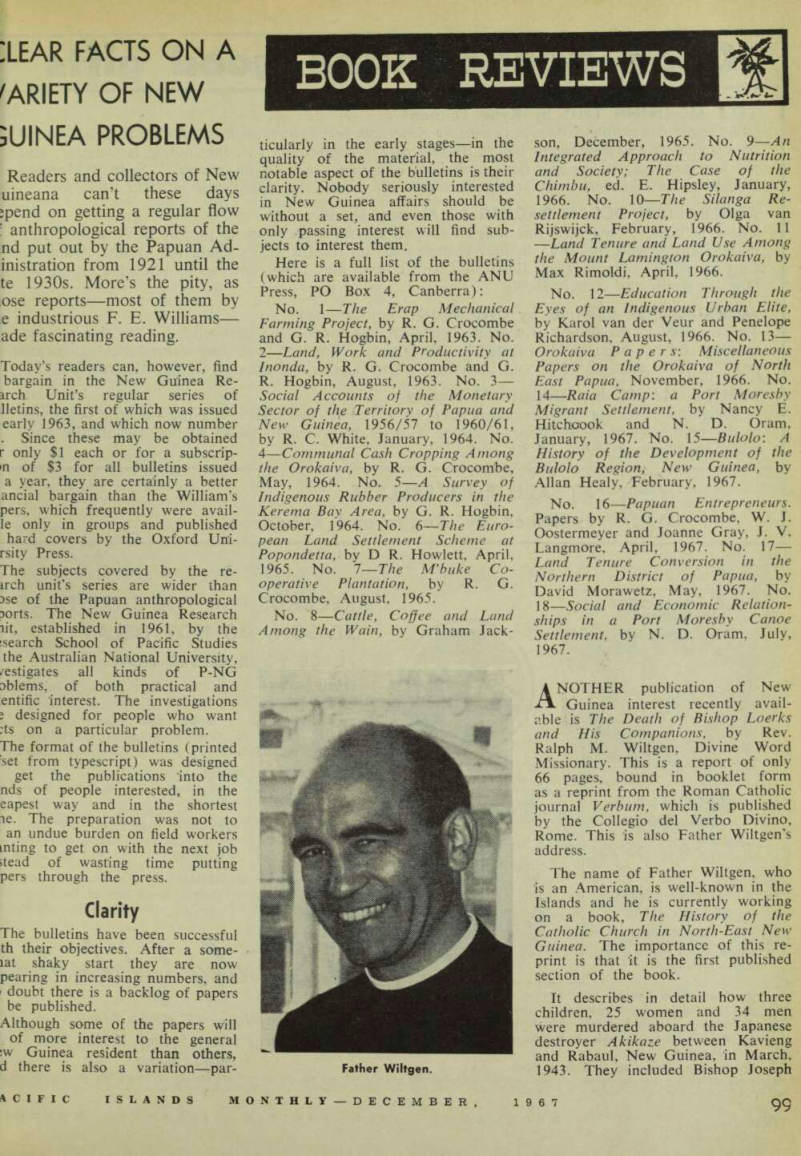
Ralph M. Wiltgen, Divine Word Missionary. This is a report of only 66 pages, bound in booklet form as a reprint from the Roman Catholic journal Verbum, which is published by the Collegio del Verbo Divino, Rome. This is also Father Wiltgen’s address.
The name of Father Wiltgen, who is an American, is well-known in the Islands and he is currently working on a book, The History of the Catholic Church in North-East New Guinea. The importance of this re print is that it is the first published section of the book.
It describes in detail how three children, 25 women and 34 men were murdered aboard the Japanese destroyer Akikaze between Kavieng and Rabaul, New Guinea, in March, 1943. They included Bishop Joseph
Father Wiltgen.
:rks, 66, head of the Central New inea Vicariate, then at Kairiru nd, north west of Wewak.
Umost all of the group were sionaries, including missionary »rs, and their nationalites in ied German, American, Austrian Dutch. Most were German, h was bound, taken to the stern the destroyer and shot in par larly horrifying circumstances. : children were simply thrown rboard. ather Wiltgen’s booklet contains tils of the massacre from official rces, and a long report of the sequent war crimes trial. The 1 report is surely unnecessarily de ;d, even for a history.
OW that it is Christmas, and the glossy books that make good istmas presents are flooding in, eems a good time to point out books on Australian fauna are f coming from so many publishers so many different prices that the ket must surely be glutted. If it , then buyers looking for some g on fauna (many Australian 5 touch on New Guinea fauna » should make a point of seeing ything available at their book ;rs before making a choice, ome books seem to be of an un »sarily high standard, with ex five plates and bindings and long of scientific information of little le to the average reader. Other ks cover only a restricted range rild life, while some go the whole , and price doesn’t always bear relation to the range of contents.
New Guinea tortoises
mong the wild life books we have i lately are Birds of the Sun, by hael Sharland (Angus and Robert s3.9s), Marsupials and Mono tes of Australia, by Gordon Lyne gus and Robertson, $3.50) and diwater Tortoises of Australia and f Guinea, by John Goode (Lans ne, $8.50). he book on tortoises is one nple of a specialised work at a y high price. But if you are :ing for a book on Australian and f Guinea tortoises this is what will have to buy. Although it icarly 200 years since the first ige long-neck tortoises were dis
covered in Australia by Sir Joseph Banks, this is the first full length book devoted to them.
The author is an enthusiastic amateur, whose interest in tortoises began some years ago when his sons asked for one as a pet. He found there was no literature on Australian tortoises and their care and what began as a matter of curiosity with him developed into a major research project and finally this book.
The information on how Australian and New Guinea tortoises may be maintained as pets will be of special interest.
A cheap one
Another amateur of sorts —that is, he is not a scientist producing an academic work—has been responsible for writing a book on Australian wild life which ought to be mentioned be cause you probably won’t find any thing as useful for the price. It is Harry Frauca’s The Book of Aus tralian Wild Life, which is the first in a series of Australiana to be pub lished by Panther Books ($1.35, distributed by Gordon and Gotch).
Harry Frauca photographs and des cribes Australian wildlife for his living and his new paperback con
tains 48 pages of photographs wrapped around text which is as entertaining as it is informative. The book describes the whole gamut of Australian wildlife, including crabs, frogs, birds and seals. You could buy it as a guide to the complicated decision on which of the more ex pensive books you should have.—Sl.
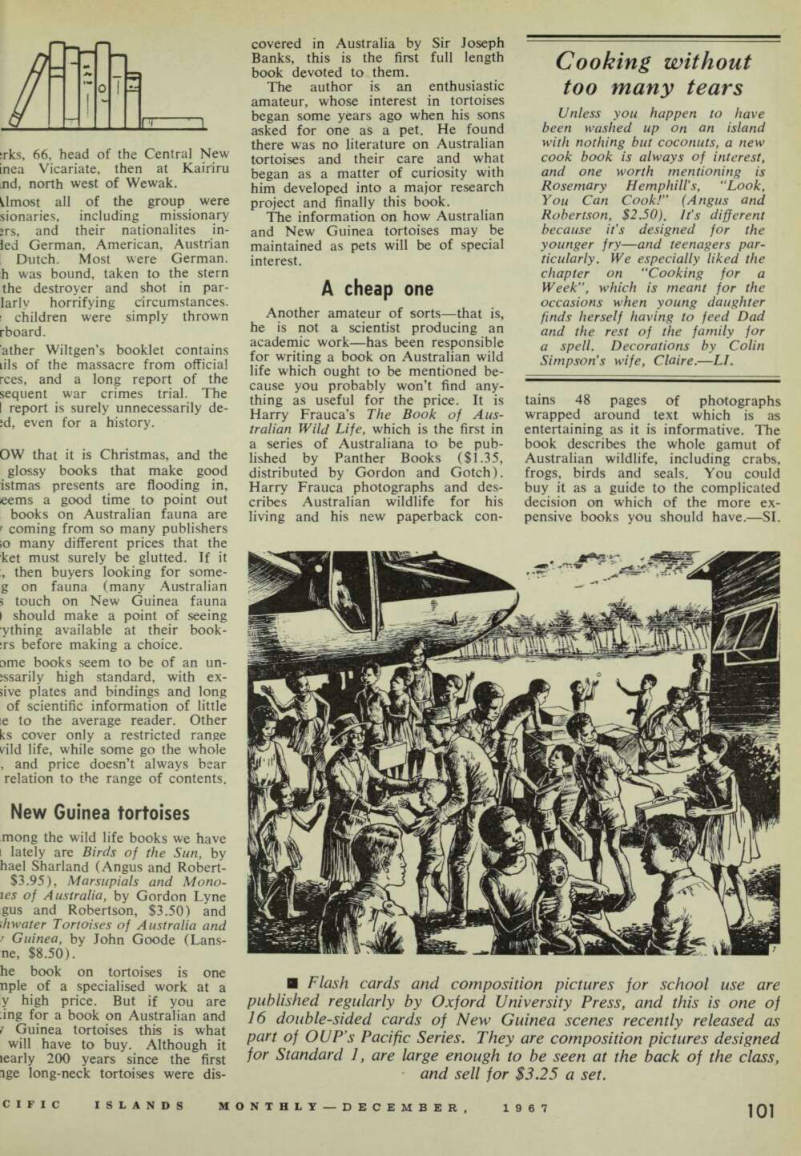
Flash cards and composition pictures for school use are published regularly by Oxford University Press, and this is one of 16 double-sided cards of New Guinea scenes recently released as part of OUP’s Pacific Series. They are composition pictures designed for Standard 1, are large enough to be seen at the back of the class, and sell for $3.25 a set.