Magazine Section
pp. 91-95 · Read in the full issue


Pacific Islands Monthly
Misunderstanding Over
One Word Sent French
Expedition On Tragic
Wild Goose Chase
By Robert Langdon
If you searched through the history books long enough md hard enough, I daresay you might find an example of how, it some time in the past, the destiny of an entire army depended )n the flicker of somebody’s eyebrow, or how a whole city was viped out because someone sneezed at the wrong time.
doubt whether you would find such cases in the history of the th Pacific. But you would—if read the records carefully jgh—find a case where the fate an important French naval ex tion was tragically changed be ie of a misunderstanding over a le word. he misunderstanding over the ning of the word “habits”— irred at Batavia, in the Dutch Indies in 1791, between an lishman and two Frenchmen, s a result, the French expedition t on a wild goose chase of isands of miles round Australia New Guinea; the commander, second-in-command, and many of • men prematurely lost their lives; the man who became the ex tion’s ultimate leader did not get : to France for 17 years.
iunter meets La Perouse
ie expedition was one of the : unfortunate in Pacific history, /as led by the French admiral )ine-Raymond-Joseph de Bruni trecasteaux, who was sent out i France to search for his miss :ountryman La Perouse. le de’Entrecasteaux tragedy had beginnings in Botany Bay on ary 26, 1788, when La Perouse ed in that ample harbour in his ; Boussole and Astrolabe in the se of an extensive voyage of in the Pacific, overnor Arthur Phillip’s First :, which had arrived in the bay w days earlier with Australia’s convicts, was preparing to move
to the present site of Sydney at the time. But Phillip, as an act of courtesy, sent his second-in-command, Captain John Hunter to greet La Perouse and to offer him any assist ance he could give.
This meeting between Hunter and La Perouse gave Hunter a more than ordinary interest in the fate of La Perouse, when, many months after the French explorer had left Botany Bay, news reached Sydney that his ships were overdue and were apparently lost.
In France, meanwhile, the
news of La Perouse’s disappearance had occasioned much grief and despondency, and even though the country was in the throes of revolu tion, the government decided to fit out an expedition to go in search of him.
The expedition was given two ships —the Recherche under d’Entre casteaux and the Esperance under Captain Huon de Kermadec.
Possible clue
D’Entrecasteaux’s instructions were to follow the route La Perouse in tended to take after leaving Botany Bay— to Tonga, New Caledonia, the Solomons, the Louisiade Archipelago of Papua, and through the strait separating New Guinea from Aus tralia. He sailed for Cape Town on September 28, 1791.
Meanwhile, Captain Hunter, who had met La Perouse in Botany Bay, was on his way to England in the Dutch ship Waaksamheyd. He had kept his eyes peeled for traces of La Perouse almost from the moment he left Sydney.
But it was not until the morn ing of May 31, 1791, when the Waaksamheyd reached the Admiralty Islands, north of the New Guinea mainland, that Hunter saw anything that seemed like a possible clue.
On that particular morning, he
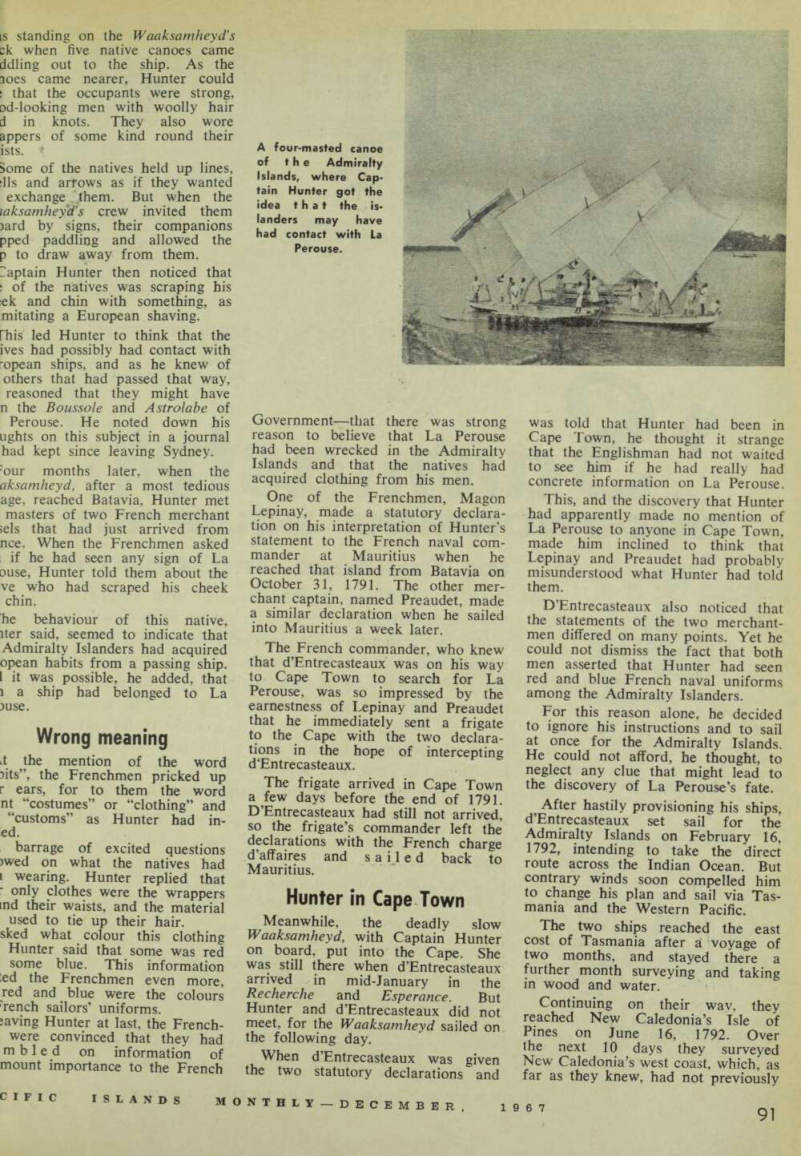
Captain John Hunter.
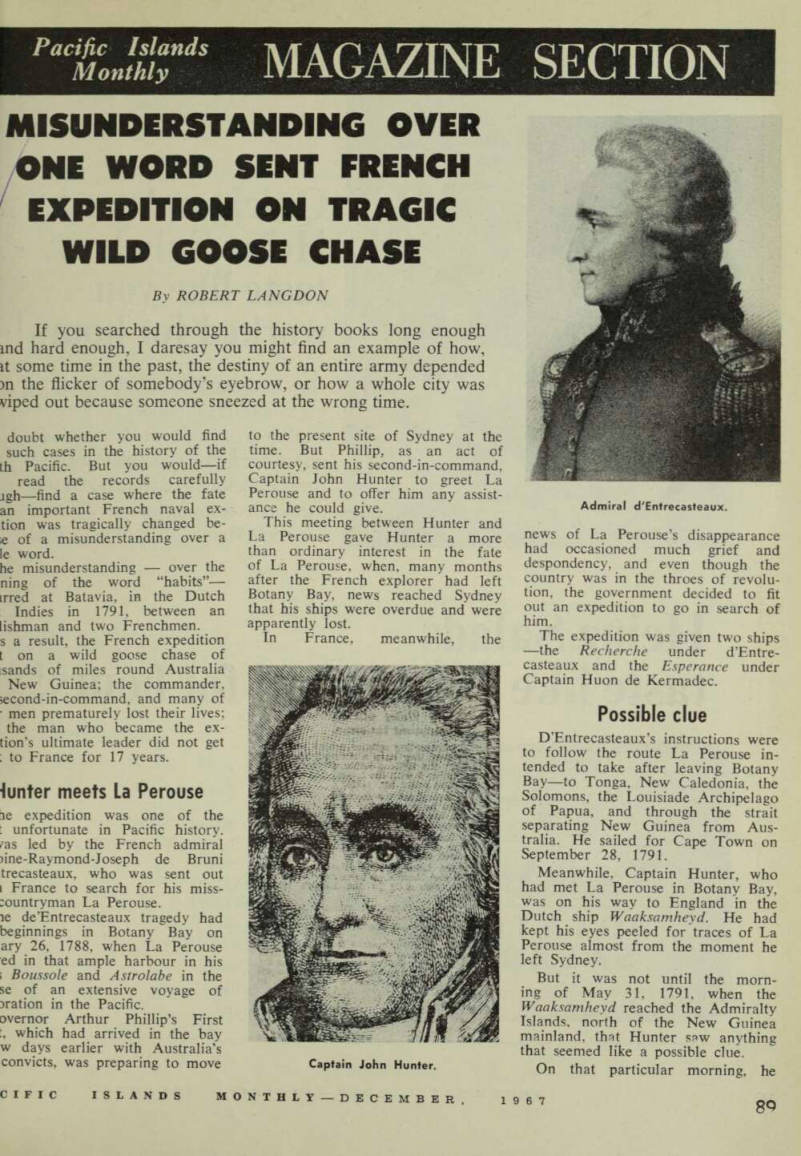
Admiral d'Entrecasteaux.
is standing on the Waaksamheyd’s ck when five native canoes came ddling out to the ship. As the aoes came nearer, Hunter could s that the occupants were strong, ad-looking men with woolly hair d in knots. They also wore appers of some kind round their ists. * Some of the natives held up lines, :11s and arrows as if they wanted exchange them. But when the xaksamheyd’s crew invited them )ard by signs, their companions pped paddling and allowed the p to draw away from them, "aptain Hunter then noticed that : of the natives was scraping his ek and chin with something, as mitating a European shaving. [his led Hunter to think that the ives had possibly had contact with 'opean ships, and as he knew of others that had passed that way, reasoned that they might have n the Boussole and Astrolabe of Perouse. He noted down his ughts on this subject in a journal had kept since leaving Sydney. ’our months later, when the aksamheyd, after a most tedious age, reached Batavia, Hunter met masters of two French merchant >els that had just arrived from nee. When the Frenchmen asked if he had seen any sign of La ouse, Hunter told them about the ve who had scraped his cheek chin. he behaviour of this native, iter said, seemed to indicate that Admiralty Islanders had acquired opean habits from a passing ship.
I it was possible, he added, that i a ship had belonged to La mse.
Wrong meaning
t the mention of the word ?its”, the Frenchmen pricked up r ears, for to them the word nt “costumes” or “clothing” and “customs” as Hunter had in ed. barrage of excited questions )wed on what the natives had i wearing. Hunter replied that only clothes were the wrappers md their waists, and the material used to tie up their hair, sked what colour this clothing Hunter said that some was red some blue. This information :ed the Frenchmen even more, red and blue were the colours Tench sailors’ uniforms. ;aving Hunter at last, the French were convinced that they had mbl e d on information of mount importance to the French
Government—that there was strong reason to believe that La Perouse had been wrecked in the Admiralty Islands and that the natives had acquired clothing from his men.
One of the Frenchmen, Magon Lepinay, made a statutory declara tion on his interpretation of Hunter’s statement to the French naval com mander at Mauritius when he reached that island from Batavia on October 31, 1791. The other mer chant captain, named Preaudet, made a similar declaration when he sailed into Mauritius a week later.
French commander, who knew that d’Entrecasteaux was on his way to Cape Town to search for La Perouse, was so impressed by the earnestness of Lepinay and Preaudet that he immediately sent a frigate to the Cape with the two declara tions in the hope of intercepting d’Entrecasteaux.
The frigate arrived in Cape Town a few days before the end of 1791.
D’Entrecasteaux had still not arrived, so the frigate’s commander left the declarations with the French charge d’affaires and sailed back to Mauritius.
Hunter in Cape Town
Meanwhile, the deadly slow Waaksamheyd, with Captain Hunter on board, put into the Cape. She was still there when d’Entrecasteaux arrived in mid-January in the Recherche and Esperance. But Hunter and d’Entrecasteaux did not meet, for the Waaksamheyd sailed on the following day.
When d’Entrecasteaux was given the two statutory declarations and
was told that Hunter had been in Cape Town, he thought it strange that the Englishman had not waited to see him if he had really had concrete information on La Perouse.
This, and the discovery that Hunter had apparently made no mention of La Perouse to anyone in Cape Town, made him inclined to think that Lepinay and Preaudet had probably misunderstood what Hunter had told them.
D’Entrecasteaux also noticed that the statements of the two merchant men differed on many points. Yet he could not dismiss the fact that both men asserted that Hunter had seen red and blue French naval uniforms among the Admiralty Islanders.
For this reason alone, he decided to ignore his instructions and to sail at once for the Admiralty Islands.
He could not afford, he thought, to neglect any clue that might lead to the discovery of La Perouse’s fate.
After hastily provisioning his ships, d’Entrecasteaux set sail for the Admiralty Islands on February 16, 1792, intending to take the direct route across the Indian Ocean. But contrary winds soon compelled him to change his plan and sail via Tas mania and the Western Pacific.
The two ships reached the east cost of Tasmania after a voyage of two months, and stayed there a further month surveying and taking in wood and water.
Continuing on their wav, they reached New Caledonia’s Isle of Pines on June 16, 1792. Over the next 10 days they surveyed New Caledonia’s west coast, which, as far as they knew, had not previously
A four-masted canoe of the Admiralty Islands, where Cap tain Hunter got the idea that the is landers may have had contact with La Perouse.
;n visited by Europeans (see lel). However, no landings were de because of the difficult reefs, th water in both ships desperately /, the Frenchmen pressed on to ugainville, Buka and New Ireland, illy reaching the Admiralty Islands July 28 after a passage of six nths from Cape Town.
No traces found
D’Entrecasteaux made a thorough rch among these islands for traces La Perouse, but was soon con ced that he had not been near m.
Disappointed, he now decided to ert to his original instructions. ; as the prevailing winds prevented i from turning about and heading k into the Pacific, he had to sail to the Dutch East Indies port of iboina to prepare for the trebly g voyage round the west and th coasts of Australia. -caving Amboina in October, '2, the ships reached Cape uwin, near the present city of th, in two months. They then jstigated the western half of the ;at Australian Bight until a short of water forced them to run in for Tasmania. Here the nchmen continued their explora is of the previous year and added ly new names to the map, some which still survive.
Vessing on to Tonga via the th of New Zealand, the French i came to a group of islands ch were named the Kermadec
Islands, after the Esperance’s com mander.
In Tonga, d’Entrecasteaux found that the Tongans clearly remembered the visits of Captains Cook and Bligh, but they knew nothing of La Perouse.
By this time, the expedition had been on its way for nearly two years, and the long periods at sea with poor water and little but salt provisions were taking their toll.
Dozens of men were down with scurvy and other diseases, but d’Entrecasteaux sailed on in the hope of finding some new islands to the west of Tonga and perhaps a clue to the fate of his countryman.
Kermadec dies
Soon after reaching New Cale donia again early in May, 1793, Captain Huon de Kermadec died of a “malignant fever” that had troubled him since leaving Tasmania.
His companions buried him in the dead of night on a small, off-shore islet to prevent the natives, who were thought to be cannibals, from disinterring his body. They then sailed northwards to the Santa Cruz Islands.
Here they sighted three islands— Utupua; an island which was un marked on their charts and which they called Recherche Island; and the large island of Ndeni. At Ndeni, a keen look-out was kept for any signs of La Perouse: but Recherche Island was left unvisited.
Not seeing any white men or
articles of French manufacture at Ndeni, the expedition pressed on via the Solomons Archipelago to the Louisiades, which La Perouse had proposed to visit.
Here began three weeks’ naviga tion through virtually uncharted waters, during which numerous places and names were added to the map.
Most of the names that d’Entre casteaux gave to individual islands have since been superseded by their native names. But his names for island groups and other major land marks still survive—e.g., Bonvouloir Archipelago, d’Entrecasteaux Group, Trobriand Islands, Lusancay Islands, Huon Gulf, Willaumez Peninsula and Rossel Island.
Having passed through Dampier Strait and skirted the northern coast of New Ireland, d’Entrecasteaux again reached the Admiralty Islands where, worn out and ridden with scurvy, he died on July 21, 1793.
Command of the expedition then passed to Lieutenant d’Auribeau and Lieutenant Rossel became his deputy.
However, d’Auribeau, himself, was so sick that Rossel was in effective command.
Hope gone
With all hope gone of discovering the fate of La Perouse and with 60 men down with scurvy, Rossel made all haste to get his ships to a Dutch East Indies port. This they did on September 3 when the port of Caieli on the island of Buru was reached.
Here some of the scurvy-ridden men recovered; but dysentery soon struck down 50 others, killing five, and the expedition hastened on to Surabaya.
At Surabaya, the Dutch authorities provisioned the ships, but refused for some time to allow the Frenchmen to land because Holland and France were at war. Later on, the French men learned that England and France were also at war, and that King Louis XVI had been executed in the revolu tion at home.
News of the king’s death caused the French crews to split into two mutually hostile parties royalists and republicans. D’Auribeau, a royalist, hoisted the white flag of the monarchy and asked for Dutch protection.
The Dutch authorities granted his request and immediately arrested all the republicans and imprisoned them in unhealthly fortresses. Many of them died there.
D’Auribeau, himself, died of fever on August 23, 1794, and the com mand of the expedition, such as it then was, devolved again on Rossel.
By this time, nearly half of the