New Caledonia
pp. 44-50 · Read in the full issue
First win for New Caledonia in 1969 Games
From Fred Dunn, in Noumea, and PlM’s Port Moresby correspondent “New Caledonia’s first win in the 1969 Games” is how Noumea’s newspapers greeted the news in November that Mr.
Andre Henry, 37, had won the open competition for an emblem for the Third South Pacific Games in Port Moresby. What was more to the point, the win was Mr. Henry’s second in succession, as he was the successful designer of the emblem for the Second Games, held in Noumea in 1966.
Mr. Henry is a different bachelor, who insists that “there is nothing very interesting to say about myself”.
But there are several interesting things than can be said about him.
To start with, despite his shyness, he heads Noumea’s biggest publicity firm, Signe Publicite. He comes from Montparnasse, Paris, and Mont parnasse is, of course, one of the world’s best known art quarters. He spent a great deal of his life in that romantic atmosphere. He then did much travelling before he dropped
anchor in Noumea about eight years ago.
Another interesting fact about Mr.
Henry is that he is completely self taught, both as an artist and as a publicity director. His only hobby is his work.
His publicity work is noted for its extremely good taste. It is very effective publicity, leaning perhaps towards the whimsical. This trait peeps out from his face—it’s in his wide smile and his eyes. One can see a future cartoonist of the calibre of a David Low should he ever care to take up caricaturing.
Mr. Henry’s interest in art shows preference for the abstract. He cherishes a desire to go to Australia one day to extend his publicity work, but he has no immediate intentions.
Of his win, Mr. Henry said he first heard of it from a friend, who had heard it from Radio Australia.
“Naturally I am overjoyed at winning for the second time,” he said. “And I have great hopes of attending the Port Moresby Games.
“Before entering I studied New Guinea in a French encyclopaedia and immediately decided that the Bird of Paradise should figure in the emblem. My decision was strengthened when a friend loaned
me some colour slides of Birds of Paradise taken in New Guinea.”
Mr. Henry explains that the Bird of Paradise in some ways replaces the dove of peace, “because the ultimate aim of the Games is to bring the Pacific people closer together in understanding”.
Design described
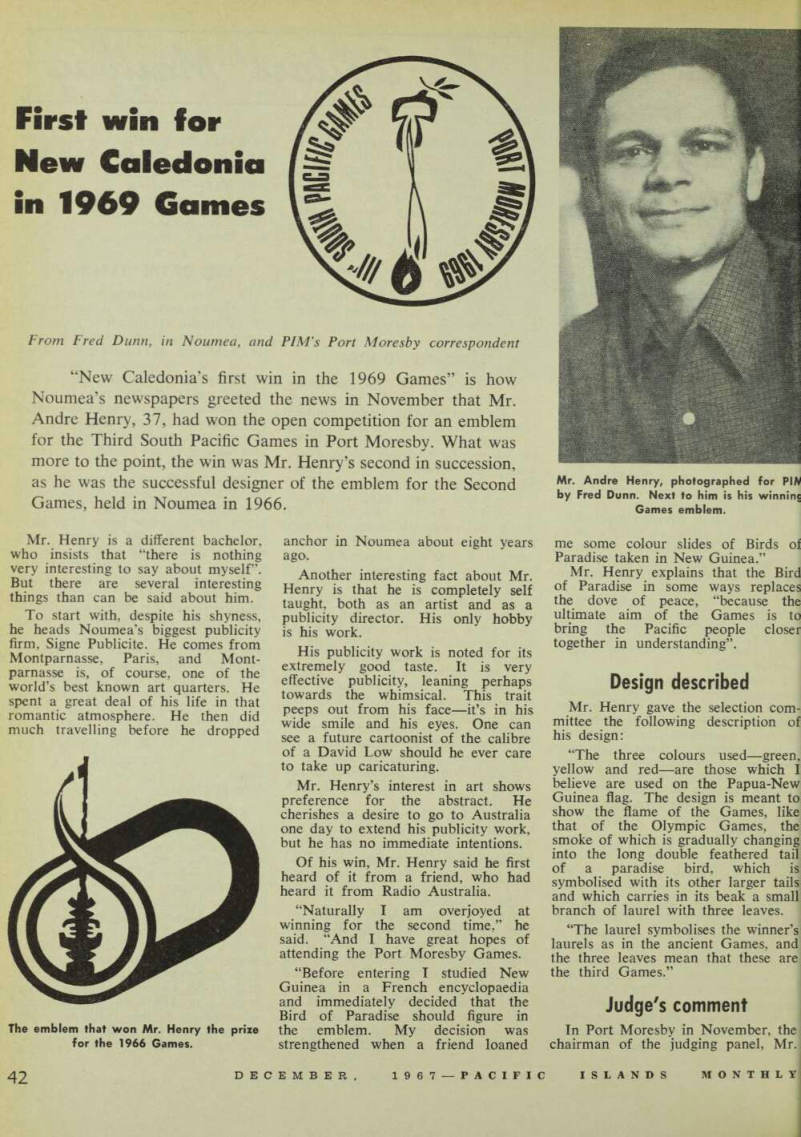
Mr. Henry gave the selection com mittee the following description of his design; “The three colours used—green, yellow and red—are those which I believe are used on the Papua-New Guinea flag. The design is meant to show the flame of the Games, like that of the Olympic Games, the smoke of which is gradually changing into the long double feathered tail of a paradise bird, which is symbolised with its other larger tails and which carries in its beak a small branch of laurel with three leaves.
“The laurel symbolises the winner’s laurels as in the ancient Games, and the three leaves mean that these are the third Games.”
Judge's comment
In Port Moresby in November, the chairman of the judging panel, Mr.
The emblem that won Mr. Henry the prize for the 1966 Games.
Mr. Andre Henry, photographed for PIV by Fred Dunn. Next to him is his winning Games emblem.
>ort Moresby gets going on Games plans
. A. Miller, said the colours used y Mr. Henry were not those of ic P-NG flag, but “this did not ;tract in any manner from the orth of the design”.
He said Mr. Henry’s entry was eally designed for use in either part • whole and was the most flexible : the designs submitted. It gained e unanimous vote of the five judges ter a small group had been selected •r final judging.
Mr. Miller said in reaching their scision the judges had placed nphasis on the suitability of the ssign for emblem purposes. In neral the standard of designs sub itted was very high, but many were o complicated in design for the -iking of badges and the general e to be made of the emblem.
But many of these designs were * no means lost. Some were cellent material for poster designs, id would no doubt be considered r use by the organising committee, nong artists whose work could be ed this way were Messrs. J. Lely dd, G. L. Vasarhelyi and J. M. jmesszeghy.
Date of the Games
He said others who should be /en mention for design merit were iptain Brett Hilder, Mrs. Yvonne chocki and Mr. Joseph M. Malo.
For his win Mr. Henry receives l 1 50.
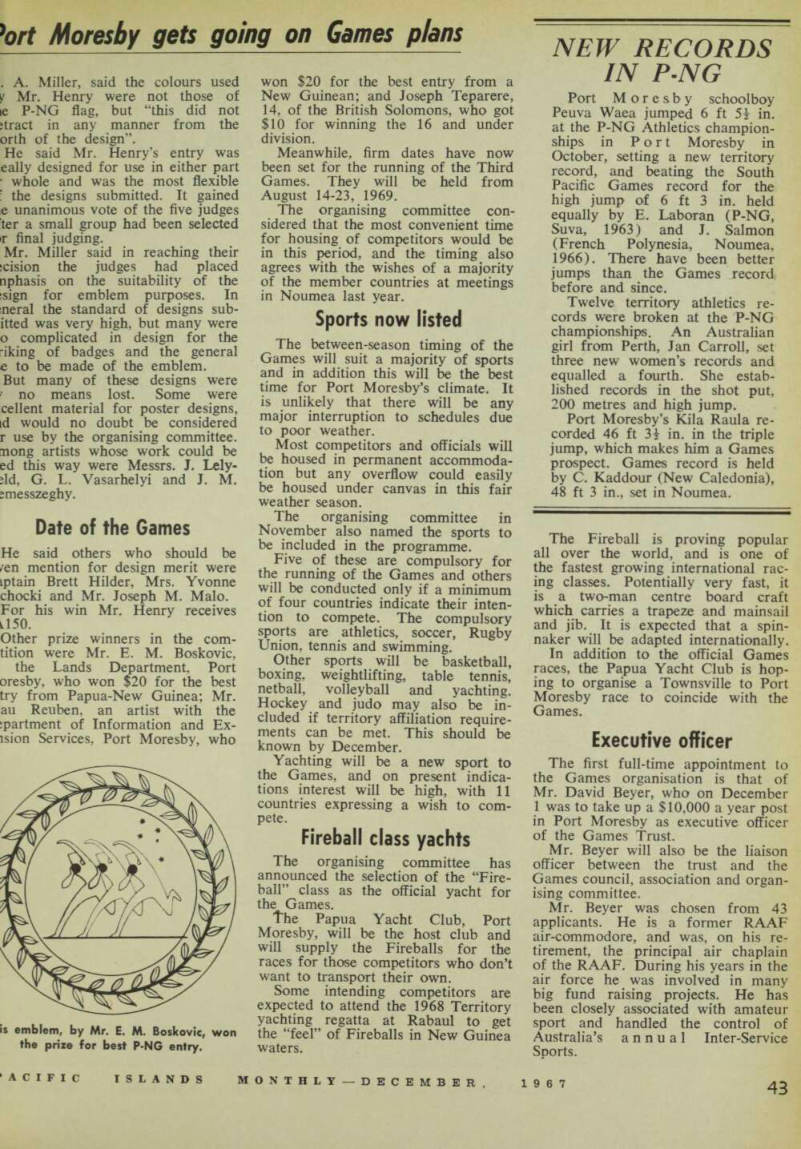
Other prize winners in the com tition were Mr. E. M. Boskovic, the Lands Department, Port oresby, who won $2O for the best try from Papua-New Guinea; Mr. au Reuben, an artist with the spartment of Information and Ex ision Services, Port Moresby, who
won $2O for the best entry from a New Guinean; and Joseph Teparere, 14, of the British Solomons, who got $lO for winning the 16 and under division.
Meanwhile, firm dates have now been set for the running of the Third Games. They will be held from August 14-23, 1969.
The organising committee con sidered that the most convenient time for housing of competitors would be in this period, and the timing also agrees with the wishes of a majority of the member countries at meetings in Noumea last year.
Sports now listed
The between-season timing of the Games will suit a majority of sports and in addition this will be the best time for Port Moresby’s climate. It is unlikely that there will be any major interruption to schedules due to poor weather.
Most competitors and officials will be housed in permanent accommoda tion but any overflow could easily be housed under canvas in this fair weather season.
The organising committee in November also named the sports to be included in the programme.
Five of these are compulsory for the running of the Games and others will be conducted only if a minimum of four countries indicate their inten tion to compete. The compulsory sports are athletics, soccer, Rugby Union, tennis and swimming.
Other sports will be basketball, boxing, weightlifting, table tennis, netball, volleyball and yachting.
Hockey and judo may also be in cluded if territory affiliation require ments can be met. This should be known by December.
Yachting will be a new sport to the Games, and on present indica tions interest will be high, with 11 countries expressing a wish to com pete.
Fireball class yachts
The organising committee has announced the selection of the “Fire ball” class as the official yacht for the Games, the Papua Yacht Club, Port Moresby, will be the host club and will supply the Fireballs for the races for those competitors who don’t want to transport their own.
Some intending competitors are expected to attend the 1968 Territory yachting regatta at Rabaul to get the “feel” of Fireballs in New Guinea waters.
The Fireball is proving popular all over the world, and is one of the fastest growing international rac ing classes. Potentially very fast, it is a two-man centre board craft which carries a trapeze and mainsail and jib. It is expected that a spin naker will be adapted internationally.
In addition to the official Games races, the Papua Yacht Club is hop ing to organise a Townsville to Port Moresby race to coincide with the Games.
Executive officer
The first full-time appointment to the Games organisation is that of Mr. David Beyer, who on December 1 was to take up a $lO,OOO a year post in Port Moresby as executive officer of the Games Trust.
Mr. Beyer will also be the liaison officer between the trust and the Games council, association and organ ising committee.
Mr. Beyer was chosen from 43 applicants. He is a former RAAF air-commodore, and was, on his re tirement, the principal air chaplain of the RAAF. During his years in the air force he was involved in many big fund raising projects. He has been closely associated with amateur sport and handled the control of Australia’s annual Inter-Service Sports.
is emblem, by Mr. E. M. Boskovic, won the prize for best P-NG entry.
travel
A Regular Piaa Department
Reporting News Of South
Seas Tourism And Travel
From The Inside
ONE of the most unusual hotels and airstrips in Papua-New Guinea is at Tapini—an 80 mile, half-hour flight by Papuan Airlines from Port Moresby. The flight, in itself, is quite an experience.
After take-off from Jackson Field, Port Moresby, you begin to climb straight away to get above the Owen Stanley Ranges—then it’s a case of flying through valleys and gorges.
The pilot tells you when he is about to land. By this stage you are beginning to wonder where on earth an airstrip would be in this valley; He takes a sudden left bank around the corner of the next hill and there it is! It’s built uphill, with a 2,000 ft drop to the valley floor at one end and a huge mountain at the other.
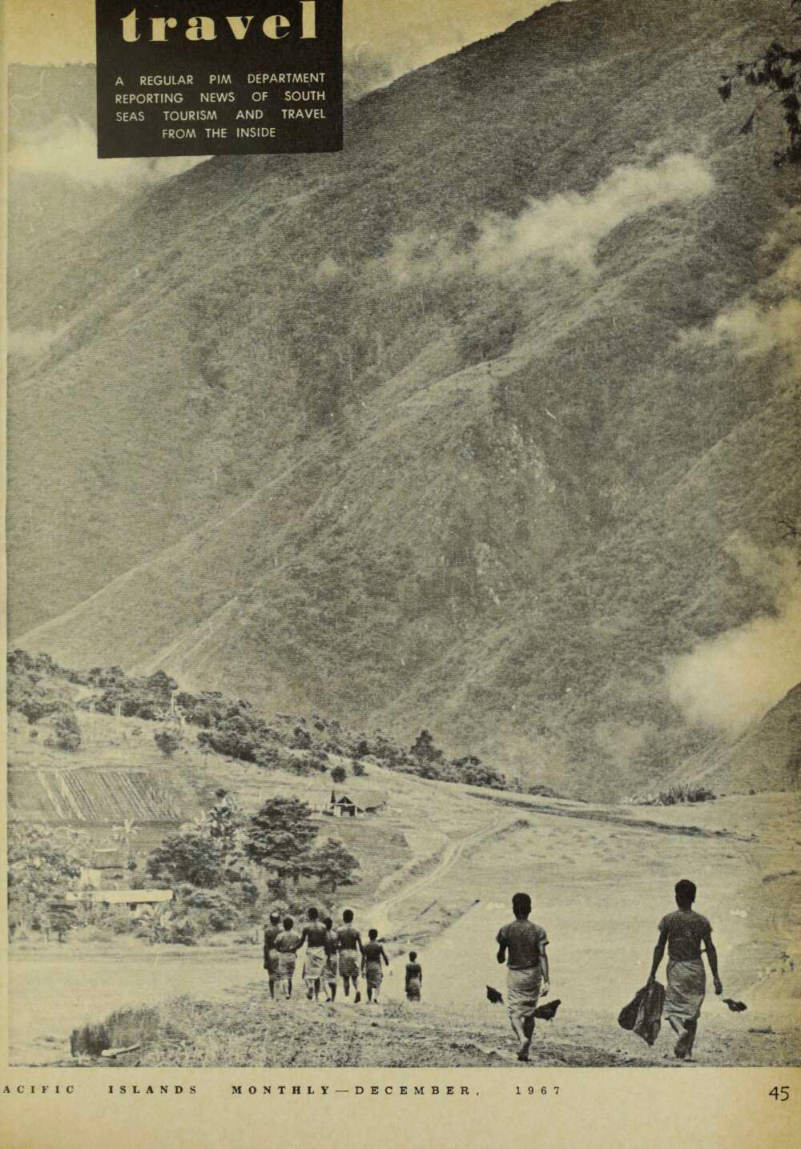
Tapini is completely surrounded by mountains—and the climate isj much cooler than is the coastal areai around Port Moresby.
At the airstrip, you’re met by Frederick Anderson, the owner and builder of Tapini’s only hotel, i Frederick (“Andy”) Anderson was al patrol officer back in the 40’s and 50’s, but then went into private enterprise for himself. He had been officer in charge of the Tapini area.] Soon Andy started to select timber
If you're looking for something off the beaten track, try Papua's cloud-pierced Tapini, built around the crazy airstrip seen above and on the previous page. You land on it after a dog-leg turn from the valley at the bottom end, and you go out the way you came in with your heart in your mouth. Below, mine host Andy Anderson at the portals of his unusual Tapini Hotel.
r the hotel, and it took him two ars to build it.
All the timbers are natural —the ning room and tables have a autiful polished finish. The hotel commodates 14, and two unusual atures are its 24-hour electric >wer and hot and cold showers.
Outside the hotel is a tennis mrt and—unexpectedly—a beautiful dmming pool with its own natural aterfall. Andy built the pool. He und the waterfall when he pushed e jungle back.
Breathtaking tours
Andy conducts tours in his Land aver around the surrounding strict. It has chains fitted to the res and you can see why after a p. The roads are built into the les of mountains, and some drop /ay for hundreds of feet. The mery there is breathtaking.
After driving for one hour you me down into the valley to the iloipa River. This crystal clear, st flowing river runs on past Tapini.
There are three different groups natives in the area and tours can arranged to visit their villages, ic of the tribes—the Goilalas— ve sorcery bags, containing human mes. Down on to the coast, the ekeo people are very colourful, it that’s a separate trip after you ave Tapini.
An amazing thing about Tapini the way you can stand on top of e hills and watch the clouds form the valley below. If you stand ere long enough, they pass around iu on the way up.
Andy’s hotel has a fine selection Australian and Continental wines, le bar is separate from the hotel, d from deck chairs on the randah, you can see into the lley. The coffee is locally grown the plantation also being owned by ndy. The plantation is just a few iles from the hotel and. worth the sit.
To get to Tapini you first reach )rt Moresby via Sydney or Fiji id the Solomons. TAA, Ansett and antas all have services. Take the lily Papuan Airlines service to ipini (the return fare $24.50 from oresby). Accommodation at Andy’s $9 per day single, $lB double, ipuan Airlines have package tours ery weekend for $37.00, including res and accommodation. —Pictures id story by Bruce Adams.
Please turn over
Andy Anderson, top, lunches with a guest in the hotel dining room, richly panelled with local timbers.
Note crystal goblets.
At right, this man is one of the colourful Mekeo people of the coastal region im mediately below mountainous Tapini.
A flight of a few minutes gets you there.
Andy Anderson surveys the unexpected swimming pool he built close to a waterfall near his hotel.