Sterling Devaluation Means A Tougher
pp. 22-155 · Read in the full issue
Life For Some Islands
Britain’s decision of November 18 to devalue the pound sterling by 14.3 per cent, caused a dramatic chain reaction in the South Pacific, the effects of which will take months to assess. The decision brought about a momentous scrambling of economic eggs, and brought dismay and confu sion to many Island territories that are now faced with serious cost of living increases. These are likely to be worsened by higher transport costs soon.
Much of the damage was due to the decision of New Zealand, whose currency was on a par with sterling, to devalue to the Australian dollar.
This affected the Cook Islands and Niue, which use NZ currency.
Independent West Samoa held firm at the old NZ rate, although not without some misgivings both there and in NZ.
Australia, with a much stronger economy than New Zealand, and less dependent on exports to Britain, had no difficulty in holding firm, and thus users of her currency, in New Guinea, the Solomons, Nauru, Norfolk Island, the New Hebrides and the GEIC, found themselves in less trouble than they otherwise would be.
Tonga’s currency, on a par with Australia’s, remained unchanged but the kingdom will suffer loss of in come from its important banana exports to New Zealand.
These reports from PIM corres pondents in the Pacific describe the situation up to December I;
Fiji
Prom a Suva correspondent Britain’s devaluation took this British colony by surprise. Immedi ately Mr. Wilson made his announce ment Fiji’s currency was devalued by the same amount —14.3 per cent.
But there were misgivings. It took the Government four days to make a statement on the serious effects devaluation would have on Fiji.
Then, on November 27, most of the arguments presented in the state ment became so much history be cause Fiji announced another change —appreciating her pound by about 6,5 per cent., thus making Fijian currency virtually equivalent to Aus tralian.
One Fijian pound is now equiva lent to $A2.05 or SUS2.3O. The new relation to sterling is £F 104.5 to £Stg.loo, compared with the old, pre-devaluation relationship of £FIII to £lOO.
The November 27 appreciation means that Fiji has depreciated over all by slightly more than seven per
cent, and that most of the currency now being used in the South Pacific (outside the French areas) is virtu ally on a par.
The appreciation has been wel comed in Fiji. Most people were unhappy at the first drop, which took Fijian currency below Australian, The Fiji Government statement which followed the first devaluation predicted there would be a rise in the gross income of farmers and in living costs for urban workers. But it said an increase in tourism could be expected from Australia and the US which had not devalued and that importers could be expected to switch their buying to countries which had devalued, thus cushioning the ad ditional costs of imports from Aus tralia, the statement added.
Inflation fear
The fact is, though, that Australia and not Britain is Fiji’s main supplier, and devaluation at the first figure meant inflation. This undoubtedly was one of the main reasons for the November 27 decision (which had to be approved by Britain) not to re main so closely tied to sterling, but in fact to compromise.
Fiji will have to pay more for Australian supplies than she did a month ago, but not nearly as much as she would if she had stuck to the original devaluation.
In introducing his Budget on November 27 the Minister for Finance, Mr, Harry Ritchie, set about giving even further relief to con sumers by removing the port and customs service tax on a variety of foodstuffs and lowering import duties on others.
Mr. Ritchie said that if Fiji had had to meet the cost of full devalua tion the new annual import bill would be about £2.6 million. With the revised currency, the new cost would be about $700,000 —that is, an in crease of about three per cent, com pared with about 11 per cent.
The primary object of the new measure was to reduce the import bill as much as possible, thus keep
ing down costs for consumers a: manufacturers, even though tl entailed some sacrifice of exp< earnings. He stressed that even n< Fiji’s economy would be under soi difficulties.
He said, “It must be admitted tl a definite risk is taken in devaluatk If world prices of Fiji exports decli in the months to come our export : come will suffer. . . . Certain < porters of minor products to speci markets will lose income even existing prices”.
Cook Islands
Prom a Rarotonga correspondent Devaluation is not good news. T Cooks, whose citizens are N Zealanders, are hit by NZ’s currer drop. Apart from taro and soi other agricultural produce produc locally, everything is imported. 1 imports are now expected to r slightly.
There will be price increases such goods as cars, louvres, roofii iron and rice from Australia, cotl piece goods from Hong Kong a India, Japanese motor cycles, cars a trucks, kerosene refrigerators, c metics and most wines and spirits Fares by Matson from Rarotoi to NZ will also be higher, but fe\ islanders travel by Matson now, pn ably because of the economic sque< in NZ.
The higher prices won’t hit i public until present stocks are hausted, which is expected to be April.
Meanwhile freight rates from i UK to NZ have risen per ce since devaluation and this will hi a further effect on costs in the Coc
Niue
From a Niue correspondent As New Zealand currency < culates on Niue it has therefore N devalued and all New Zealan effects will be felt here. As in F the cost of living is expected to ri as all items from other than 1
rces will cost more, e.g,, petrol, led fish, rice, and the popular cabin bread biscuits.
'he new cost of living will be dis cing, as it has already sharply n this year due to an increase freight rates and the removal of sidies on flour and butter in NZ. hue’s major exports of bananas, ra and kumaras are sold to NZ, prices will be unaffected, hue’s trade with Australia, which mall, is likely to become smaller, mports to Niue from Australia for 6 totalled £NZ5,832, comprising roximately only two per cent, of 1 Niue imports, compared with per cent, from NZ.
Exports to Australia last year were and for the last five years they e averaged only £NZB7 per um, this being plaited ware— cets, etc. Niue has an imbalance rade with Australia but has noth to sell except baskets.
IZ, and therefore Niue, has a mic shortage of overseas funds, Niue purchases from anywhere ;pt NZ are subject to strict import trol. /ith devaluation, Australian books e become more expensive. Niue s bought Australian-assembled or vehicles for many years, but ier this year, due to the shortage Dverseas funds, instructions were ived from NZ that NZ-assembled cles had to be bought in future, .ustralian beer was once ex icly popular here, but five years its import was prohibited by the eminent because beer was avail from NZ which did not require seas funds. ustralian flour is sometimes ght from Fiji when NZ flour ments have not arrived, and it is d by housewives because it is er than NZ flour. But it is jrally not permitted as an import :pt in emergencies such as this.
Estern Samoa
Prom an Apia correspondent fter two days of intense delibera closeted in an air-conditioned n the Western Samoan Cabinet ded not to devalue, i announcing the decision in a ch broadcast over 2AP, Prime ister Fiame Mataafa said the eminent was mindful of the ever easing costs of consumer goods the rise in the cost of living had placed a burden on the jlation when efforts were being !e to recover from last year’s icane. He said Western Samoa a different economic structure
and faced problems different from Britain and NZ.
The Government’s decision will quickly result in a substantial fall in living costs, as NZ is a major supplier of Western Samoan imports, and this will also enable NZ to regain a share of the market often lost to Australia because of higher NZ prices.
About the only Samoans who are worried are the banana planters, who still don’t know whether NZ will pay more for their bananas or whether growers will lose. Generally, then, the Government’s decision is a popular one.
Solomons, Geic,
New Hebrides
From a Honiara correspondent These British territories, which come under the control of the Western Pacific High Commission, use Australian currency and are not devaluing. It is possible some grants from Britain will be trimmed, but which these are and by how much they will be trimmed was not known here by the end of November. By that time no noticeable changes were visible in the Solomons due to devaluation, but Britain had just made a post-devaluation special grant of £5tg.4,500 to aid the victims of Cyclone Annie, in the Western Solomons, with the possibility of more if needed.
Most supplies come from Australia, and the copra export situation will probably be similar to that in New Guinea.
Tonga
From a Nukualofa correspondent It’s been decided that Tonga, which is on a par with Australian currency, will not devalue. The big problem now faced by the kingdom is the loss from its banana trade with NZ. This could be serious.
Fruit Distributors Ltd., the sole importers of Tongan bananas to NZ, has said it will not raise the price to make up Tonga’s exchange loss.
On the 1966 export figures this means that Tonga will lose $267,000, and the Acting Premier and Minister of Finance, Mahe Tupouniua, said it was too much to expect Tonga to agree to a loss of this magnitude. A dele gation from the Tonga Copra Board will go to NZ to press for a price adjustment.
The Acting Premier said Tonga had suffered “quite a loss” with its sterling reserves in Britain, which were higher than normal. The same was true in NZ, where the loss was greater. At the same time, the king-
dom would be able to buy machinery and motor vehicles from the UK more cheaply, and Nukualofa’s new deepwater wharf, financed by a 5500.000 loan from Britain, would now be paid off more quickly.
Most of Tonga’s imports come from Australia, but NZ is in second place.
Papua-New
Guinea
Prom a Port Moresby correspondent Mr. F. C. Henderson, Papua-New Gui n e a’s Assistant Administrator (Economic Affairs) told a questioner in the P-NG House of Assembly in November that the devaluation of sterling would mean that territory growers would receive a lower price in terms of Australian dollars for primary products sold in England.
“The fall need not necessarily be the full 14 per cent., because there will be a tendency in the United King dom for the price of such produce in sterling to increase,” he said. “But generally speaking I would say that prices for primary produce sold in the United Kingdom will fall.
“On the reverse side of the coin, the imports of goods from the United Kingdom into this territory will be come cheaper.”
In a later statement, in Canberra, the Minister for Territories, Mr.
C. E. Barnes, pointed out that the bulk of the territory’s overseas trade was with Australia. More than half the territory’s imports came from Australia. Nearly half the territory’s exports were sold to Aus
(Continued on p. 151)
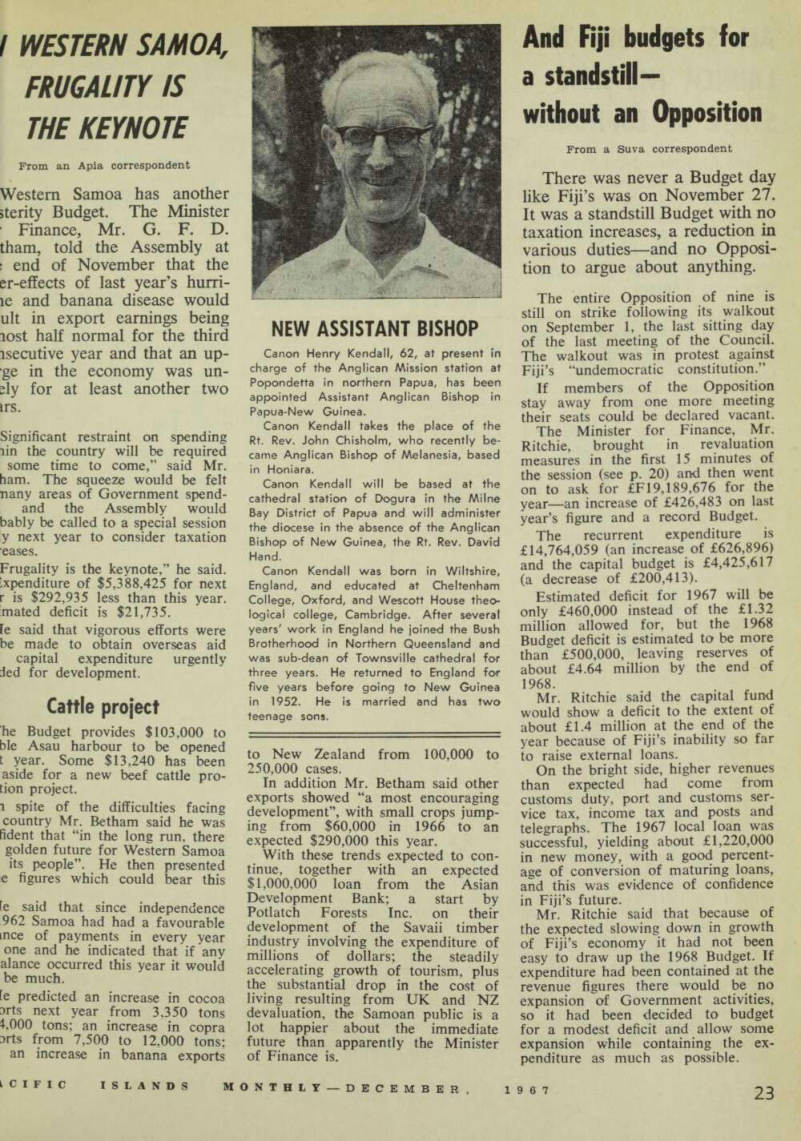
Cook Islands Premier, Mr. Albert Henry, is one Islands leader who will be faced with some serious problems following devaluation.
a, where some important pro s enjoyed preferential treatment. was an important stabilising Dr in the territory’s export trade, fhe significance of the devalua » for particular territory export stries cannot be fully assessed at stage,” said Mr. Barnes. “Such issessment will have to wait until situation has settled down.”
Copra position
evaluation should have no serious t on the overseas marketing of a by the P-NG Copra Marketing •d, although there will be an im iate and fairly substantial loss in ange on two shipments, totalling it 8,000 tons, already delivered ritain but not paid for. le board has a contract with evers for the sale of 40,000 tons 968, but there is an exchange clause in the contract, as there the 1967 contract. NG’s copra • for the UK is fixed for each th on the average of the daily ppines prices obtained during the ious month; and there has been :hange in either Australian or ppines currency. is not yet known what effect luation will have on the future md for P-NG copra, or what • effects on the copra market will from Britain’s decision. is likely, for instance, that there be an increase in freight charges G copra being carried to Europe ssibly as much as 15 per cent, present board contract ends on mber 31.
NG’s Unilever contract guarantees for 1968, and in any case the is not the main user of P-NG i—or in fact a major world user, in takes only about four per cent, or Id copra exports. :nerally, though, producers who lot devalue, such as P-NG, the nons and the Gilbert and Ellice ds, will find it harder to sell i to those countries which did lue. Britain could also make er use of substitute oils from countries which have devalued, is not known yet what effect de mon will have on the coconut old to Britain by Carpenter’s nut Products Ltd., of Rabaul.
Idly enough, since devaluation copra price on the European et has increased by about 10 «nt. in price, and this will help ; up New Guinea’s devaluation on the two shipments and help th out other price fluctuations.