New Moves On Internal
pp. 19-21 · Read in the full issue
Self-Government In
French Polynesia
Lively and sometimes bitter exchanges on the subject of internal self-government were a feature of the inaugural session n Papeete in November of French Polynesia’s newly-elected 50-member Territorial Assembly.
here were three major develop its on the self-government question ing the session: > The Governor, Mr. Jean Irani, declared that France was in prepared to allow the territory iiave a ministerial form of Gov nent—as it did until October, 8, when political disturbances in king the now-exiled radical leader, vanaa a Oopa, brought an end t. ) The political parties of Messrs, ticis Sanford and John Teariki, :h won 16 of the 30 Assembly s at the recent election on a form of internal self-government M, Oct., p. 25), agreed to join es. They thus have control of Assembly, even without the sup ; of one of the six independents ' has thrown in his lot with them.
'By 17 votes to 10, with three entions, the Assembly decided that of its committees—the consti-
tutional commission—should study the question of internal self-govern ment and submit a plan for con stitutional reform to the French Gov ernment.
The inaugural sitting of the Assembly was held on November 1.
Mr. Alfred Poroi, as the Assembly’s doyen d’age (longest sitting member) made the opening speech.
Part of France
Mr. Poroi is French Polynesia’s senator in the French Parliament and leader of the Union Tahitienne Demo cratique which has three seats in the Assembly.
Mr. Poroi said he thought he was expressing the opinion of the whole Assembly when he said that French Polynesia was an integral part of the French Republic, as had been confirmed in the 1958 referendum, and that the Assembly did not again wish to discuss the question of be longing to the French family.
He said it was erroneous to in terpret certain statements in the recent election campaign as either secessionist or semi-secessionist.
The election manifestoes of certain candidates did not advocate a break ing away from France or independ ence, but they did urge that the people of French Polynesia should handle their own internal affairs.
Major speech
“That which appears necessary to us, now that French Polynesia, of its own accord, is supporting the most gigantic national scientific operation that a small country has ever known, is that the council of government should be given back the powers which it had originally,” Mr. Poroi said. [French Polynesia’s council of government consists of five members, plus the Governor as ex-officio pre sident, who act as the territory’s cabinet or executive council. The members are elected by the Assembly, but they need not necessarily be mem bers of it. At present, they have only
collegial authority—their individual functions as ministers with port folios having been suspended in the interest of public order in October, 1958, at the time of the Pouvanaa a Oopa disturbances].
Governor Sicurani, who spoke im mediately after Mr. Poroi, said in a major speech that French Polynesia already enjoyed a large measure of autonomy; and he hinted that it could scarcely have much more so long as its economy depended so largely on financial aid from France.
Prosperity
Mr. Sicurani also stressed the fact that the territory’s current prosperity was largely due to the French nuclear testing project at Mururoa Atoll.
Mr. Sicurani gave a series of facts and figures to illustrate the spec tacular growth in the territory’s economy over the past five years.
In 1962, he said, the State’s ex penditure in the territory did not amount to 1,000 million Pacific francs (SA 10 million), whereas last year the figure was 9,000 million francs, and this year it would be about 10,000 million, of which 7,000 million would be spent on the nuclear testing project.
In the same five-year period, local revenue had risen from 920 million francs to 2,330 million. ‘‘Thus while the territory’s own contribution has increased two and a half times, that of the State has multi plied by 10,” the Governor said.
“In other words, the budget of the territory, of which the total in 1962 more or less equalled the expenses of the State, now represents only a
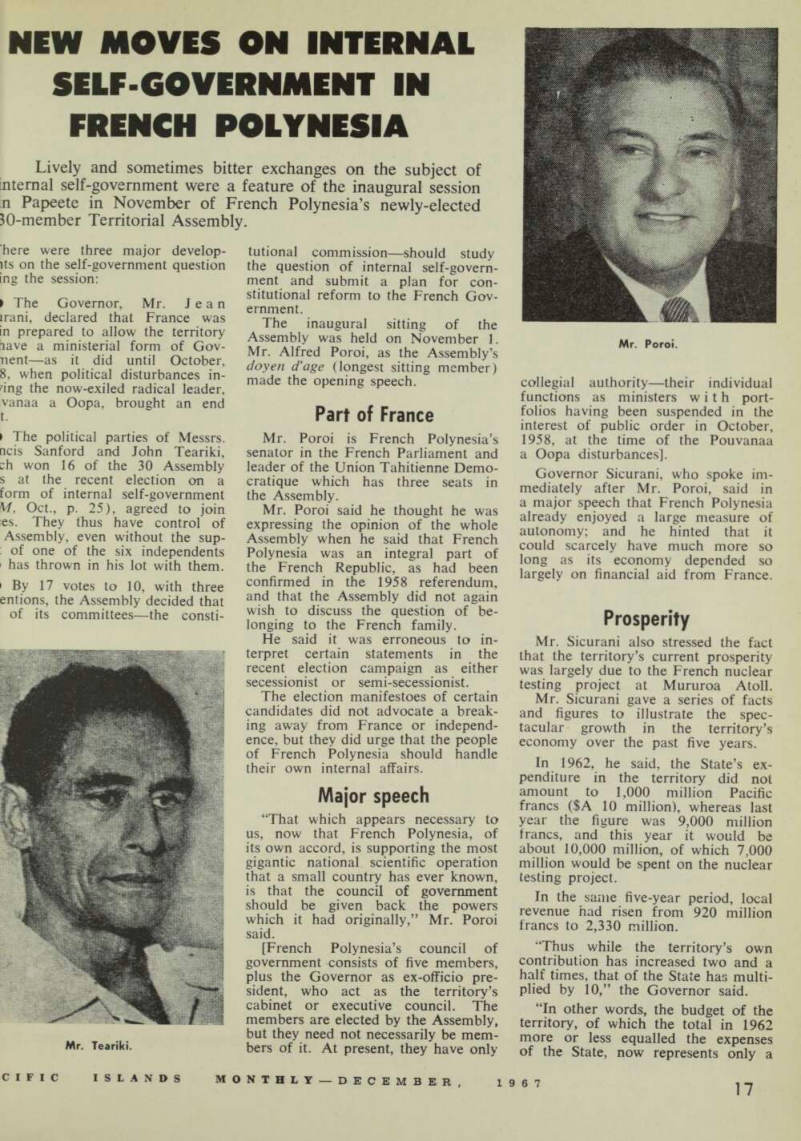
Mr. Teariki.
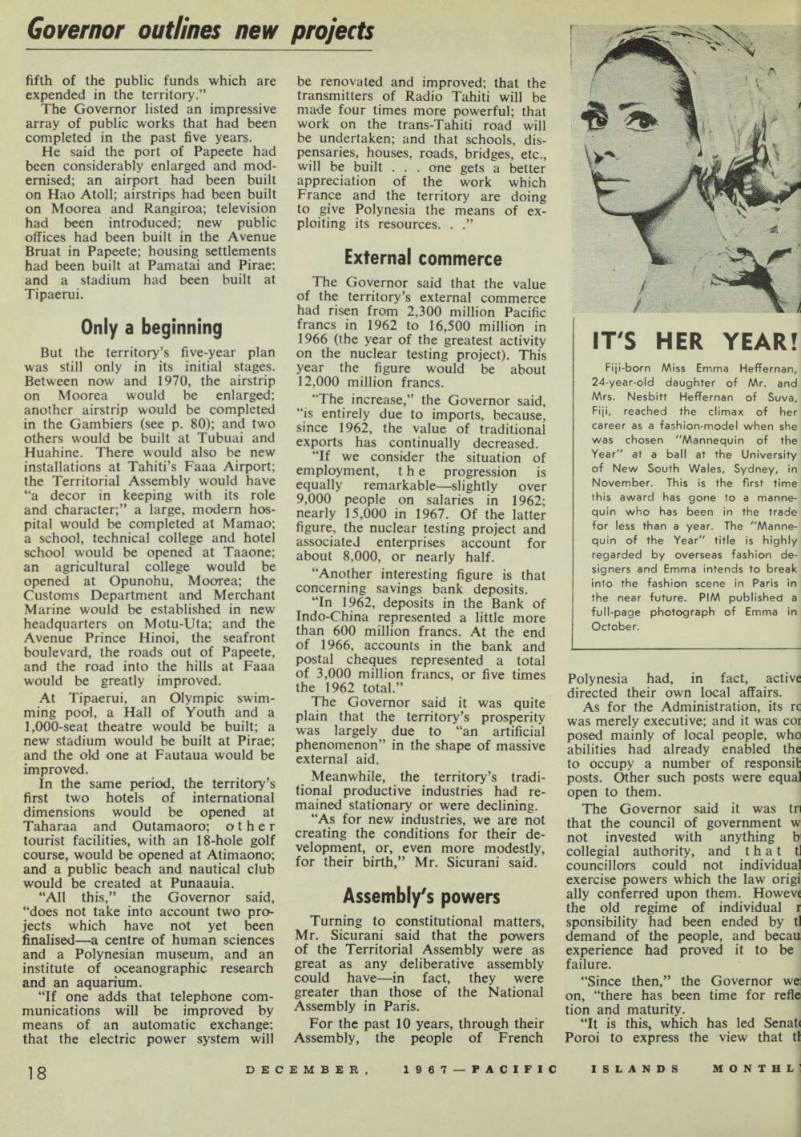
Mr. Poroi.
Governor outlines new projects
fifth of the public funds which are expended in the territory.”
The Governor listed an impressive array of public works that had been completed in the past five years.
He said the port of Papeete had been considerably enlarged and mod ernised; an airport had been built on Hao Atoll; airstrips had been built on Moorea and Rangiroa; television had been introduced; new public offices had been built in the Avenue Bruat in Papeete; housing settlements had been built at Pamatai and Pirae; and a stadium had been built at Tipaerui.
Only a beginning
But the territory’s five-year plan was still only in its initial stages.
Between now and 1970, the airstrip on Moorea would be enlarged; another airstrip would be completed in the Gambiers (see p. 80); and two others would be built at Tubuai and Huahine. There would also be new installations at Tahiti’s Faaa Airport; the Territorial Assembly would have “a decor in keeping with its role and character;” a large, modern hos pital would be completed at Mamao; a school, technical college and hotel school would be opened at Taaone; an agricultural college would be opened at Opunohu, Moorea; the Customs Department and Merchant Marine would be established in new headquarters on Motu-Uta; and the Avenue Prince Hinoi, the seafront boulevard, the roads out of Papeete, and the road into the hills at Faaa would be greatly improved.
At Tipaerui, an Olympic swim ming pool, a Hall of Youth and a 1,000-seat theatre would be built; a new stadium would be built at Pirae; and the old one at Fautaua would be improved.
In the same period, the territory’s first two hotels of international dimensions would be opened at Taharaa and Outamaoro; other tourist facilities, with an 18-hole golf course, would be opened at Atimaono; and a public beach and nautical club would be created at Punaauia.
“All this,” the Governor said, “does not take into account two pro jects which have not yet been finalised—a centre of human sciences and a Polynesian museum, and an institute of oceanographic research and an aquarium.
“If one adds that telephone com munications will be improved by means of an automatic exchange; that the electric power system will
be renovated and improved; that the transmitters of Radio Tahiti will be made four times more powerful; that work on the trans-Tahiti road will be undertaken; and that schools, dis pensaries, houses, roads, bridges, etc., will be built . . . one gets a better appreciation of the work which France and the territory are doing to give Polynesia the means of ex ploiting its resources. .
External commerce
The Governor said that the value of the territory’s external commerce had risen from 2,300 million Pacific francs in 1962 to 16,500 million in 1966 (the year of the greatest activity on the nuclear testing project). This year the figure would be about 12.000 million francs.
“The increase,” the Governor said, “is entirely due to imports, because, since 1962, the value of traditional exports has continually decreased.
“If we consider the situation of employment, the progression is equally remarkable—slightly over 9.000 people on salaries in 1962; nearly 15,000 in 1967. Of the latter figure, the nuclear testing project and associated enterprises account for about 8,000, or nearly half.
“Another interesting figure is that concerning savings bank deposits.
“In 1962, deposits in the Bank of Indo-China represented a little more than 600 million francs. At the end of 1966, accounts in the bank and postal cheques represented a total of 3,000 million francs, or five times the 1962 total.”
The Governor said it was quite plain that the territory’s prosperity was largely due to “an artificial phenomenon” in the shape of massive external aid.
Meanwhile, the territory’s tradi tional productive industries had re mained stationary or were declining.
“As for new industries, we are not creating the conditions for their de velopment, or, even more modestly, for their birth,” Mr. Sicurani said.
Assembly's powers
Turning to constitutional matters, Mr. Sicurani said that the powers of the Territorial Assembly were as great as any deliberative assembly could have—in fact, they were greater than those of the National Assembly in Paris.
For the past 10 years, through their Assembly, the people of French
Polynesia had, in fact, active directed their own local affairs.
As for the Administration, its rc was merely executive; and it was coi posed mainly of local people, who abilities had already enabled the to occupy a number of responsib posts. Other such posts were equal open to them.
The Governor said it was tn that the council of government w not invested with anything bi collegial authority, and that tl councillors could not individual exercise powers which the law origi ally conferred upon them. Howeve the old regime of individual r sponsibility had been ended by tl demand of the people, and becau experience had proved it to be failure.
“Since then/’ the Governor wei on, “there has been time for refle tion and maturity.
“It is this, which has led Senat< Poroi to express the view that tl
eeds "growing faster than resources"
ernment councillors could again given individual portfolios by way an experiment. . .
On this matter, I am authorised the Minister of State for Terri es to say that such an experiment aid be by common agreement, that if this is the wish of the ted members of the territory, the ernment councillors will again be n individual portfolios. . .
Limits
But it is possible that certain ale would still not be satisfied, it is to them that I address my now. ’ would remind them that if the nomy of action which the terri now enjoys still has its limits, e limits are not in the actual tutions which already permit tally everything—but in natural economic realities. ! rom my review of the territory’s omy, it emerges clearly that ch Polynesia is not in a position r ovide for its own needs, and that ; needs are increasing faster than resources of the country are ing.
External aid is therefore more ssary today than it was yester and it will remain so until new trees enable the territory’s amy to find an equilibrium, he path to that situation is not ess discussion or vain reforms, stability and continuity.” r. Sicurani said that various vers had “run off the rails” in sing the political situation in :h Polynesia. : said it was true that the Poly as were jealous—and for good n—of their rights and their icness. t their “particularism” had never ed the point where they felt it tradiction to be Polynesian, and, ic same time, to belong to a n which respected their free and which felt in communion them.
Alliance dominant
lowing the Governor’s speech, Dns were held for membership ic various commissions which e the detailed work of the ibly. :ause of the dominance of the rd-Teariki alliance, every seat ese commissions went to San and Teariki-ites, except in the >f the constitutional commission,
where they desired a fully represent ative committee.
However, although Mr. Poroi’s Union Tahitienne Democratique agreed to participate in the consti tutional commission, the five mem ber UT-UNR and five of the six in dependents declined.
Mr. Poroi’s UTD also voted with the Sanford-Teariki forces when the election for the council of govern ment was held. The successful can didates—all non-members of the Assembly—were Messrs Leon Assaud, Jacques Laurey, Jean Roy Barn bridge, Jean Juventin and Andre Lonfevre.
The debate and vote on a Sanford- Teariki motion that the constitutional commision should study the question of internal self-government and sub mit a plan for constitutional reform to the French Government was held on November 3. A large crowd filled the Assembly chamber to hear the debate.
After Mr. Frantz Vanizette had bitterly opposed the motion, Mr.
Poroi moved that the words “in ternal self-government” should be deleted from it so that the motion only used the term “constitutional re view.”
Apprehension
Mr. Poroi said that the words “in ternal self-government” excited appre hension since it was not clear what they meant.
Mr. Henri Bouvier (a Teariki man) retorted that his party did not wish to emasculate its motion so that it would have everyone’s agreement.
And Mr. Sanford added that in ternal self-government expressed the will of the people and “they elected us for that.”
After a series of further exchanges in similar vein, Mr. Poroi’s amend ment was defeated by 17 votes to 13, and the original motion was voted through 17-10, with three absten tions.
The 10 who voted against the motion subsequently sent a telegram to the Minister for Overseas Terri tories, General Billotte, protesting about various technicalities associ ated with it.
This, in turn, provoked a telegram of protest from Messrs. Sanford and Teariki, and a reply, eventually, from General Billotte.
All this telegraphic activity pro vided the Papeete Press with many columns of political “copy”, but did not in any way alter what the Assembly had decided upon.
Return to Kokoda
About 200 P-NG and Australian war veterans returned to Kokoda, Papua, in November in a pilgrimage marking the 25th anniversary of its recapture. A handful had even walked for seven days across the famed Kokoda Trail to be present. Among those present were Lieut.-Gen. Sir Edmund Herring, former New Guinea army commander, and (above), Baki Tarupa, one of the original carriers of Australian wounded on the Trail, and (below) Akai Kok (left) who helped organise the carrier lines, seen with Bert Kienzle, MBE, MID, of nearby Yodda, and Gabriel Ehava Karava, MM, MHA. The photographs are by N. Moderate.