No-Panic Approach Needed On
pp. 147-151 · Read in the full issue

Buisiness and
Development
No-Panic Approach Needed On New Guinea Cocoa Troubles
From Don Barrett, in Rabaul New Guinea cocoa producers are still gravely concerned at the spread of “die back”—or Botryodiplodia, to give its scientific name.
THIS virulent disease has caused widespread damage to cocoa plantings in New Britain, and in the Madang and Morobe districts of the New Guinea mainland.
Dr. Dorothy Shaw, the principal plant pathologist of P-NG’s Depart ment of Agriculture, has spent most of her time over the last two years on research into the disease. Dr.
Shaw is highly regarded internation ally as a competent plant pathologist.
She is held in high regard, too, by New Guinea planters, but to date a solution to the die back problem has eluded her and her fellow workers.
In New Britain’s Gazelle Peninsula, long the country’s main cocoa-pro ducing centre, growers’ feelings have ranged through casual contempt (“the disease couldn’t affect me”), to grave concern, with periods of optimism when seasonal conditions have favoured cocoa trees, interspersed with periods of deep depression when the disease has flared.
Many Problems
It seems that seasonal conditions have a great bearing on the virulence of die back, but just what the con ditions are that so favour its spread is the riddle the plant pathologists cannot yet solve.
That it is spread by wind-borne spores seems certain, and most growers point to the fact that first signs of the disease are usually among trees close to roads. From there the spread in a particular area seems haphazard.
It is quite common to see a badly affected tree—perhaps beyond saving — among a group of healthy trees bearing fruit normally. Some trees seem to have an inbuilt resistance and while the extremists may be affected no great harm is done.
Pathologists claim that if they can
ascertain what are the optimum con ditions for the release of spores they can devise a programme of spraying or dusting with fungicides which should inhibit the spread of spores.
They point to a similar problem which was faced by the stone fruit industry in Victoria’s Goulburn Valley some years ago. Here re search eventually broke through and now growers can be informed well in advance of the most effective time for spraying or dusting with fungi cides. However, they also point out that there is no short cut to a solu tion—unless by a stroke of luck some researcher stumbles on the answer.
All this is small comfort to the grower who sees healthy trees sud
denly smitten and is forced, in an effort to save his trees, to a pro gramme of drastic pruning. From this pruning some trees may not re cover despite the use of fertiliser (which many smallholders cannot afford). At the best he is cutting away bearing wood and his produc tion will fall drastically.
Then there is the problem of re planting. In many instances young trees planted to replace those killed by die back become affected in less than one year. Some growers have replanted areas three times, and eventually given up in despair.
In those plantings where coconuts are used for shade the double crop softens the blow of reduced cocoa production. However, most of the cocoa planted by settlers in develop ment areas is “sole” planted. These men are now turning to other crops.
Spices are commanding attention.
Others who can afford a long wait are planting coconuts—and regret ting that they did not do this initially.
It is difficult to get an overall picture of the real effect the disease has had on production.
Bougainville and New Zealand seem virtually unaffected to date, and in Bougainville particularly cocoa production is rising steadily and
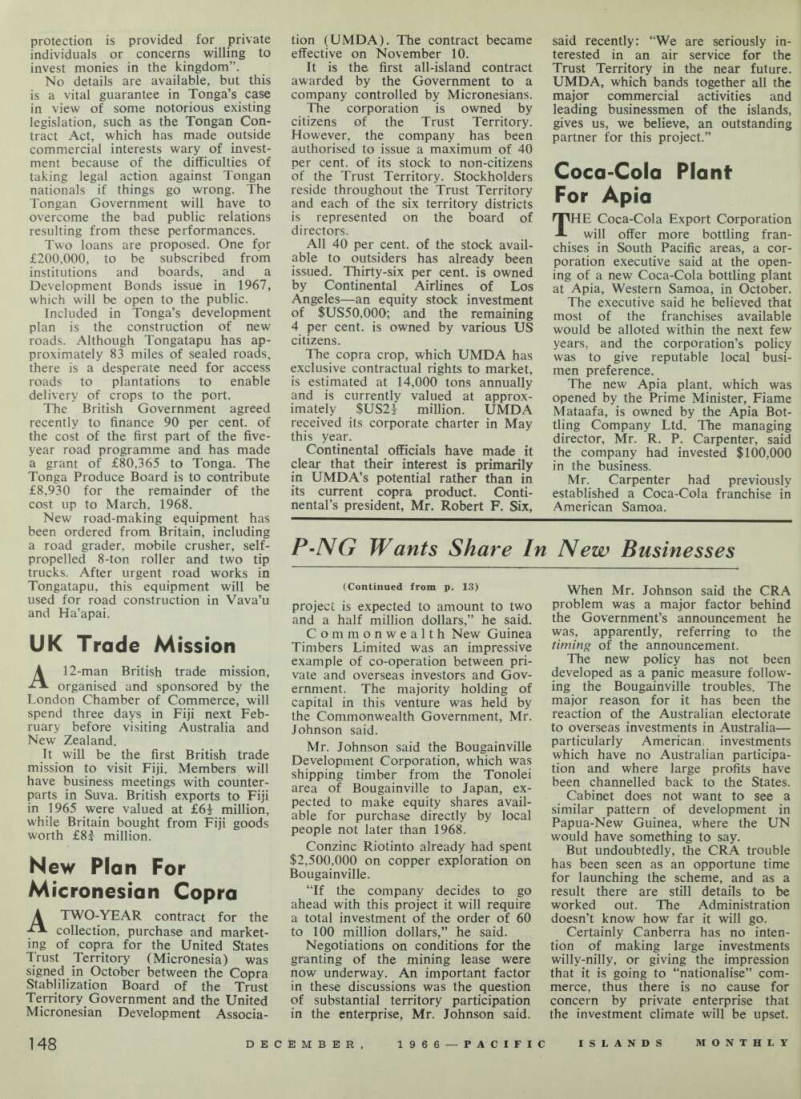
Business
Leader
Honoured
Leading New Guinea businessman Mr. B.
C. Goodsell, general manager of Burns Philp (New Guinea] Ltd., receives the OBE at the hands of the Administrator, Sir Donald Cleland in Port Moresby on October 25. Mr.
Goodsell was named in the Queen's Birth day honours list for his many services in the public interest in New Guinea.
should continue to do so as new areas are opened up.
There has been talk of “learning to live with die back”. Growers could do this if it were just a matter of careful husbandry, judicious prun ing and fertilising and speedy replant ing of “misses”.
But die back is becoming a killer and one cannot live happily with a killer.
Individual growers have expressed dissatisfaction at the research pro gramme of the Department of Agri culture, and more recently the Planters’ Asssociation of New Guinea has been pressing the department hard.
The Director of Agriculture has stated that the department is to ex pand its research programme. It is sxpected that details of this pro gramme will be made known shortly —certainly growers will demand to enow what is planned.
It would be a foolish planter who nade any long term forecast. Re ;earchers may find a solution at any ime, or may never find one. Some rees almost certainly will develop ;ome degree of immunity. No doubt iropagation from these trees would n time produce a partial answer. >eed from such trees might be ex 3ected to produce plants with a legree of immunity but this could lot be guaranteed.
Other Crops Sought
But it is the short term with which he grower is most vitally interested, fhis is why many growers in the worst affected areas are seeking a uick-growing alternate crop. Mean while they struggle to husband those rees which seem to best resist the lisease—and hope for better seasons.
If die back can be contained in hose districts where it is now pre ent the normal growth of the cocoa idustry in other areas would not be ffected. It is up to the Department £ Agriculture to make every effort d ensure this containment while at he same time most actively develop ing alternate crops for the stricken reas.
The Administration should treat he matter as serious. A sane, no anic approach is needed.
The “no problem” statement will ot hold. Facts should be made nown and faced. To the grower hese would seem to be that the idustry in some areas faces a grave ituation.
The spread of the disease to non ffected areas must be prevented at 11 costs, and these areas encouraged i expand production.
Editor's Note: A leading specialist on the aerial distribution of plant disease left New Guinea in November after completing a tour of cocoa areas.
Dr. J. M. Hirst, of Rothamsted Experimental Station, England, and a colleague, Dr. Gregory, have been assisting the P-NG Department of Agriculture with spore trapping studies relating to die back disease in territory cocoa.
Copra Prices Lose
Further Ground
DURING October, Philippine FM copra prices lost further ground to an average £Stg.6l, compared with £Stg.6l/7/6 in September.
Opening prices for November were down a further £Stg., and although there was a slight gain during the first week of trading, indications were that the average for the month might well go lower than £Stg.6l.
Chairman of the P-NG Copra Marketing Board, Mr. lan McDonald, said in Port Moresby on November 17 that the collapse of copra prices had been caused primarily by the increase in copra and coconut oil coming from the Philippines and Malaya and, to a lesser extent, by the increased competition from synthetic raw materials in the in dustrial sector of coconut oil con sumption in the US.
Some slight recovery in price could be expected within the next few months because of the temporary decline in production in the Philip pines following adverse seasonal con ditions towards the end of last year.
But he warned that in the long term a predominantly weak market in copra and coconut oil was likely, owing to the sharp expansion which is coming up in Philippine production.
This was the result of the increase in planting which had been going on quietly in the Philippines since 1961.
Tonga To Launch
First Loan
the first time in its history Tonga is to raise public loans.
They will assist in the kingdom’s new five-year development plan.
Legislation permitting loans has been passed by the Assembly in the form of a General Loan and Stock Act, and a report from Nukualofa says that a feature of it is that “full
protection is provided for private individuals or concerns willing to invest monies in the kingdom”.
No details are available, but this is a vital guarantee in Tonga’s case in view of some notorious existing legislation, such as the Tongan Con tract Act, which has made outside commercial interests wary of invest ment because of the difficulties of taking legal action against Tongan nationals if things go wrong. The Tongan Government will have to overcome the bad public relations resulting from these performances.
Two loans are proposed. One for £200,000, to be subscribed from institutions and boards, and a Development Bonds issue in 1967, which will be open to the public.
Included in Tonga’s development plan is the construction of new roads. Although Tongatapu has ap proximately 83 miles of sealed roads, there is a desperate need for access roads to plantations to enable delivery of crops to the port.
The British Government agreed recently to finance 90 per cent, of the cost of the first part of the five year road programme and has made a grant of £80,365 to Tonga. The Tonga Produce Board is to contribute £8,930 for the remainder of the cost up to March, 1968.
New road-making equipment has been ordered from Britain, including a road grader, mobile crusher, self propelled 8-ton roller and two tip trucks. After urgent road works in Tongatapu, this equipment will be used for road construction in Vava’u and Ha’apai.
UK Trade Mission
A 12-man British trade mission, organised and sponsored by the London Chamber of Commerce, will spend three days in Fiji next Feb ruary before visiting Australia and New Zealand.
It will be the first British trade mission to visit Fiji. Members will have business meetings with counter parts in Suva. British exports to Fiji in 1965 were valued at £6i million, while Britain bought from Fiji goods worth £Bf million.
New Plan For
Micronesian Copra
A TWO-YEAR contract for the ** collection, purchase and market ing of copra for the United States Trust Territory (Micronesia) was signed in October between the Copra Stablilization Board of the Trust Territory Government and the United Micronesian Development Associa
tion (UMDA). The contract became effective on November 10.
It is the first all-island contract awarded by the Government to a company controlled by Micronesians.
The corporation is owned by citizens of the Trust Territory.
However, the company has been authorised to issue a maximum of 40 per cent, of its stock to non-citizens of the Trust Territory. Stockholders reside throughout the Trust Territory and each of the six territory districts is represented on the board of directors.
All 40 per cent, of the stock avail able to outsiders has already been issued. Thirty-six per cent, is owned by Continental Airlines of Los Angeles—an equity stock investment of SUSSO,OOO; and the remaining 4 per cent, is owned by various US citizens.
The copra crop, which UMDA has exclusive contractual rights to market, is estimated at 14,000 tons annually and is currently valued at approx imately SUS2i million. UMDA received its corporate charter in May this year.
Continental officials have made it dear that their interest is primarily in UMDA’s potential rather than in its current copra product. Conti nental’s president, Mr. Robert F. Six,
said recently: “We are seriously in terested in an air service for the Trust Territory in the near future, UMDA, which bands together all the major commercial activities and leading businessmen of the islands, gives us, we believe, an outstanding partner for this project.” /■* /"'I Dl a.
V*Ocq"V#Oiq R I Chit
A Dio
rwr T'HE Coca-Cola Export Corporation A will offer more bottling fran chises in South Pacific areas, a cor poration executive said at the open ing of a new Coca-Cola bottling plant at Apia, Western Samoa, in October, The executive said he believed that most of the franchises available would be alloted within the next few years, and the corporation’s policy was to give reputable local busi men preference, The new Apia plant, which was opened by the Prime Minister, Fiame Mataafa, is owned by the Apia Bot tling Company Ltd. The managing director, Mr. R. P. Carpenter, said the company had invested $lOO,OOO in the business, Mr. Carpenter had previously established a Coca-Cola franchise in American Samoa.
NG Figures Help
Carpenters
CHAIRMAN of W. R. Carpenter Holdings Ltd., Mr. R. B.
Carpenter, made these points on group activities in his address to the annual meeting in Canberra on November 11: • Because of the company’s wide spread activities it had a satisfactory year. Fiji hurricane damage and drought resulted in a decline in that group’s activities, but this was more than offset by an increase in the earnings of the New Guinea group. ® High prices for copra gave a substantial boost to earnings in the first half of the subsidiaries’ years, but since then prices have fallen. • The Fiji group’s turnover probably won’t improve until the drought breaks and sugar and copra prices recover. Good returns are ex pected from inter-island shipping in Fiji. • In New Guinea there was a buoyant economic climate and group merchandising companies had sub stantial sales increases. Plantation re sults were again satisfactory. • The first New Guinea tea factory should be in production in 1968. On the three estates all planting would be completed in about six years instead of the 10 years which are a condition of the lease. • No new agricultural develop ment involved in the opening up of owned land or leasehold land was con templated. The immediate object was to maintain developed properties and to redevelop those requiring atten tion.
Record Profit
For Burns Philp
THE first Burns Philp and Company financial report to be issued since Mr. P. T. W. Black took over as general manager shows a net profit of $5,159,589—a best ever result despite difficulties of severe drought, hurricane damage, finance and import controls and a decline in purchasing power.
The period is for 15 months, ended June 30. In the previous term, of 12 months, ended March 31, 1965, profit was $3,468,248.
The dividend for the 15 months is 12i per cent., maintaining the 10 per cent, annual rate paid for the last 14 years.
The directors considered that returns from plantations, investments and sundry ventures were normal, “having regard to prevailing con
ditions”, but the shipping services operated at a loss.
“The main line vessels maintaining the Pacific Island services and operating under Australian conditions based on a 40-hour week, have once again shown up badly and the out look for any improvement is not encouraging,” said the chairman, Mr.
James Burns.
To cope with increasing com petition in the retail field, an ex tensive programme of modernisation and expansion of premises and facilities was begun with gratifying results in increased patronage and sales.
The group’s shipping properties are shown at a book value of $1,893,000 at June 30 cost $8,947,366, less depreciation $7,054,366.
This value is less than the $2,082,382 progress payments on the new ship (the Moresby), which are included in the cost.
Book value of listed investments was $26,731,800 at June 30, $435,530 higher than at March 31, 1965.
Market value dropped $656,599 to $40,525,201.
The annual accounts show that Burns Philp have 21 subsidiary companies in Australia (in NSW, Queensland and the ACT), four in Fiji, one in the New Hebrides, four in New Zealand, 13 in Papua-New Guinea and one in the United States,