Pacific Shipping
pp. 109-117 · Read in the full issue
Cruising Yachts
New "Kon Tiki"
Voyage Begins In Ecuador
A balsa-wood raft, with a crew
of four, pushed off from Guaya
quil, Ecuador, on October 23 on a new Kon Tiki style drift voy age across the Pacific.
THE crew hope to prove that Huancavilca Indians from Ecuador, and not Indians from Peru, could have peopled the islands of Polynesia a couple of thousand years ago. A couple of Ecuadorean anthropologists apparently support this theory.
The leader of the expedition is Vital Alzar, of Santander, Spain, a 32-year-old professor of languages and commerce, and a bachelor. The others members are Manuel Camino, 30, another single, language profes sor, from Madrid; Marc Modena, 32, a painter and decorator, from Frejus, France, who is married with two sons; and Ruben Landazuri, of Ecuador.
An Ecuadorean Army Band played the national anthems of Spain, France and Ecuador as the raft moved out into the Rio Guayas bound for the sea, after having been launched with a bottle of fermented Indian liquor. A crowd of several
thousand cheered and waved hand kerchiefs.
The raft is made of 11 trunks of balsa set lengthwise and nine later ally, with others set diagonally. Its area is about 46 ft by 30 ft.
Only materials available in pri mitive times were used in its con struction. The mast and crosstree are of mangrove, the sail is Egyptian cotton, and the cabin is of cane with a straw roof. There are eight steering devices called guaras, which have been used in Ecuador since earliest times as combined keel and helm.
Reports from Ecuador have given three different names for the raft— Equatoriana, Balsa Pacifico and Pacifica.
Whatever its true name is, its voyage is about the sixth of its kind since the Kon Tiki voyage from Callao to Raroia in the Tuamotu Archipelago in 1947.
Other trans-Pacific raft voyages were performed by William Willis (in the Seven Little Sisters from Callao to Samoa, and in the Age Unlimited from Samoa to Queens
land, Australia); by a Peruvian ex pedition in the Cantuta; and by two expeditions headed by the Frenchman Eric de Bisschop De Bisschop made an unsuccessful attempt to sail from Tahiti to the coast of Chile in 1957 in the raft Tahiti-Nui, which almost sank under him in the vicinity of Juan Fernandez He then drifted back to Polynesia in the Tahiti Nui 11, but was drowned while trying to get ashore at Raka hanga in the Cook Islands, R cip TDAniMr wcccn
!/ * I L V!Ssei
Runs Aground
The 50 ft BSIP trading vessel Maris Stella went aground on the 50 ft high Rua Dika Rock, between Santa Ysabel and the Russell Tslands > on th e night of October 11 Forty-five minutes after a distress 5?" was P icked U P in Honiara, the Government vessel Leili left Honiara to 8° to the aid of ‘he damaged ship T u he radio message had said that the S ?!i P h u d been holed on the s‘ a rboard side, that she was taking in water and
that the propellers had been stripped away.
Before the Leili reached the stricken ship, the Maris Stella floated off the rock and started to drift. The six-man crew spent the rest of the night baling to keep her afloat, and on the instructions of the Honiara Duty Search Master, they launched the ship’s life rafts in case the vessel sank without warning.
Meanwhile, Captain Hall of Megapode Airways, accompanied by Peter Kakai, the Solomon Islands radio operator who had picked up the distress signal, took off from Honiara at first light to help locate the drifting ship.
However, the Leili had the Maris Stella in tow by 6.30 a.m. and was heading for the Buena Vista Islands where the damaged ship was beached a few hours later.
The Maris Stella is owned by Quan Hong Pty. Ltd. She was built in Hong Kong and was commissioned in the BSIP last May.
Changes At The Top In
Union Steam Ship Co.
Mr. David Graham, of Suva, has been appointed assistant manager of the Union Steam Ship Co. of New Zealand. He has held managerial appointments with the company in three Pacific Islands groups since 1955—the Cook Islands, Western Samoa and Fiji.
His successor in Suva is Mr, Jack St. Julian, Fiji-born, who has been with the company since 1941, the last four years of which were at Apia as the company’s manager there.
Mr. Graham brought a “new look” to the company when he was
transferred to Suva from Apia in 1962.
Traditionally the company’s man agers in NZ, Australia and elsewhere, had been of the “starchy” type, reluctant to say anything about the company’s affairs.
Mr. Graham changed all that by his refreshing willingness at all times to talk to reporters on items of public interest.
He took the attitude that each public mention of his company was a free advertisement, and instructed his staff accordingly.
He never tried to hide anything which could apparently be damaging as one of his predecessors did when
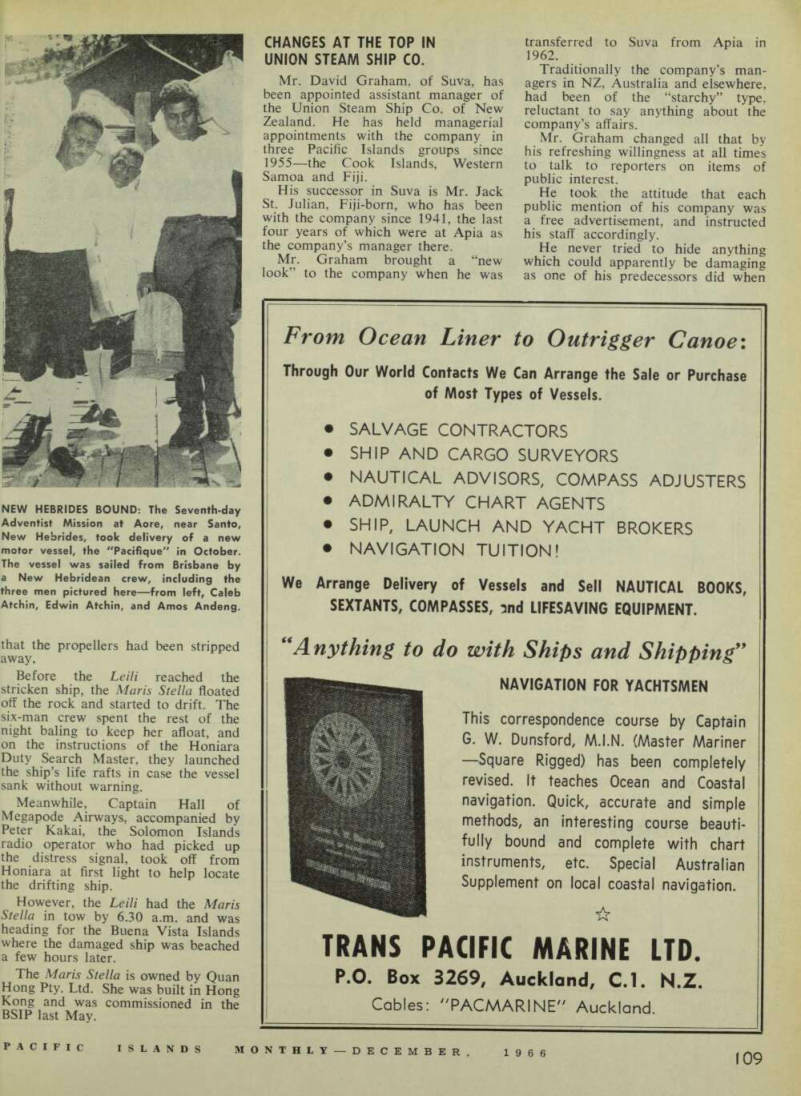
NEW HEBRIDES BOUND: The Seventh-day Adventist Mission at Acre, near Santo, New Hebrides, took delivery of a new motor vessel, the "Pacifique" in October.
The vessel was sailed from Brisbane by a New Hebridean crew, including the three men pictured here —from left, Caleb Atchin, Edwin Atchin, and Amos Andeng.
anything happened to a USS Co. ship, and who invariably left Suva for the day if he thought he was likely to be questioned by reporters.
Mr. Graham took an active part in community affairs in Suva. He was president of the Suva branch of the Fiji Crippled Children Society, a member of the Fiji Visitors’ Bureau board, a member of the Suva Port Advisory Committee, and the Hibiscus Festival Committee.
His first association with Fiji was in 1953 when he was a purser in the Tofua.
Mr. St. Julian’s return to Suva will be we l T omed by his many friends there.
Dangerous Night
Sailings Criticised
The Fiji Marine Board has again criticised the practice of ships sailing in darkness in dangerous and con fined waters. The board president, Captain Peter Hough, expressed the board’s concern after an inquiry into the grounding of the Viani Princess on a reef off Lekubi, Bua, on Sep tember 14.
The master, Sunia Vosaki, said the Viani Princess went aground at 5.15 a.m. in rain, and in darkness.
He had left his overnight anchorage to make sure of reaching Labasa that night.
Romaic Waqa Qiokata, the mate, said the visibility was good enough for the Viani Princess to move in safety.
Captain J. M. D. Florian, of the Degei 11, which pulled the Viani Princess off the reef, said there was a strong current and he did not con sider it safe to get under way before sunrise that day.
Captain Hough, after announcing that the board did not consider a formal inquiry expedient or neces sary, added: “But at the same time the board again condemns the practice of vessels being under way in dangerous and confined waters during the hours of darkness”.
"Positive Action" Sought On
Lae Wharf Congestion
Congestion at the Lae wharf has reached the stage where the Papua and New Guinea Harbours Board das asked the Administration to take “early positive action” to ease the problems.
The Lae Chamber of Commerce das been active recently in moves 107) official action Nov., p.
The board chairman, Captain G.
A. Hawley, has told the chamber that he is “keenly aware” of the growth in cargo passing over the
wharf at Lae, and recognises the need for transit shed space.
Captain Hawley wrote that con struction of a new transit shed was one of the top priorities in the board’s 1967 budget; a port manager would be appointed to Lae early in January; but stevedoring methods would have to improve before berth ing capacity at the wharf was increased.
Captain Hawley said the port manager would ensure that the present storage space was used to capacity and that cargo handling methods were improved.
More Formosan Fishermen
Reported "Out Of Bounds"
Mr, Ray Vivian, a Lae fisherman has alleged that Formosan fishermen landed on Long Island, east of Madang recently, and exchanged cigarettes for coconuts, according to a report in the New Guinea Times- Courier.
Mr. Vivian owns the fishing trawler, Jawani.
He said he was near Long Island when a Formosan ship pulled along side. Men on board called to him in Chinese. There were two ships in the area—the mother ship and a small boat, like a Chinese junk.
The matter was reported to the Administration and investigation was ordered.
Several other cases have been reported in PIM recently of Formosan ships violating territorial waters in Papua-New Guinea. Court proceed ings have been instituted against the
ships’ masters and their crews, generally under the Immigration Ordinance.
Marine Training
Vessel For G.E.I.C.
A training vessel for the GEIC merchant marine training school (PIM, Sept., p. 12) has been bought on behalf of the colony by the Crown Agents in London.
She is the Barcy, a Norwegian vessel, which has been bought for £92,000.
The vessel will be converted for training purposes in the yards of Messrs. Thorneycroft in Southampton and is expected to reach the colony late in January when the training school is scheduled to open.
Nine-tenths of the cost of the vessel has been met from Colonial
Development and Welfare Funds, made available by the United Kingdom Government.
Launch Commemorates
"Mother" To Lepers
A new 25 ft launch for use at the Leprosy Hospital at Makogai, Fiji, has been named the Mary Agnes in memory of the Rev. Mother Mary Agnes who devoted more than 50 years of her life to caring for patients at the hospital.
The launch, built by the Fiji Public Works Department in Suva, replaces one which was built by the patients many years ago and had reached the end of its working life.
Work To Begin Soon
On New Rabaul Wharf
Pile driving for a new wharf for Rabaul is expected to start towards he end of the current financial year.
Fhe allocation for the project for this year is $12,000.
It is planned to spend a further 5500,000 in 1967-68, and $1.25 million in future years.
New Launch For Fiji
Beetle Patrols
The Fiji Coconut Pests and Diseases Board will soon have a : ast new launch for patrol work.
Fhe new launch, the Adi Caginitoba, vill replace the much smaller Tui Babasiga.
The Adi Caginitoba will be used o maintain a constant patrol between he Yasawas and Lomaiviti, where
some islands are infected with the rhinoceros beetle, through the Koro Sea and south to include Kadavu, which is not infected.
She will be able to reach nine knots.
The launch was built at Suva by Millers Ltd. to a design by Mr.
Colin White.
The solidly constructed Adi Caginitoba has clean lines, and a deep draught, which should make her a good sea boat.
She is named after the daughter of a former Tui Cakau, who was paramount chief of Cakaudrove.
Burns Philp Trader
On Coral Patch
Zephyr 11, an inter-island trader owned by Burns Philp (SS) Co.
Ltd. spent two days on a coral patch off the coast of Bua, Fiji, early in November.
She was refloated under her own steam and apparently undamaged continued her trip along the Macuata coast to Labasa. She was under the command of Captain Edwin Sandys.
Contract Awarded For
Petrol Storage Facilities
Engineering Equipment, Inc., Philippines, has been awarded a contract for the construction of petroleum storage facilities through out the United States Trust Territory.
The construction schedule calls for new facilities to be completed in the Marianas, Truk and Palau Districts within 12 months; and additions to existing facilities in the Marshalls, Yap and Ponape Districts.
Matthew Island
Erupts Again
Matthew Island, the small volcanic island to the south of the New Hebrides, which was annexed to New Caledonia in November last year (PIM, Jan., p. 76), has blown its top again.
The eruption took place in August.
It caused a quickening of the pulse to at least two people in the Pacific —Dr. Claude Blot, of New Caledonia, and Mr. John Grover, of the BSIP, both of whom have been doing re search into the forecasting of volcanic eruptions.
Dr. Blot reported in Noumea in October that the Matthew Island eruption had been correlated with intermediate shocks which took place in April at a depth of 100 kilometres, and which, in turn, originated from deep earthquakes to the east of the Santa Cruz Islands over two years previously.
The time delays between the deep and the intermediate depth shocks, and the Matthew Island eruption corresponded with the delays recorded in other eruptions in the Santa Cruz and New Hebrides areas, and were a factor of great significance.
14 Whales Seen
In G.E.I.C. Waters
Fourteen whales were reported seen in waters of the Gilbert and Ellice Islands Colony in October by the master of the colony vessel Moana Raoi.
The whales were either hump-back or sperm, and were all heading in a northerly or nor’-westerly direction.