yesterday
p. 101 · Read in the full issue
There wasn’t a great deal of Christmas cheer about in the Pacific 20 years ago this month. In spite of the fact that the war had been officially over for 15 months, problems of reconstruction had scarcely been tackled.
Greatest discontent was in the S-W Pacific, which had been devastated by war and where governments seemed to be deliberately hampering the return of European enterprise.
These items of interest are from PIM for December, 1946: r 1 HE Western Samoans rejected A the proposal that they should become a trusteeship territory of the United Nations, administered by New Zealand. Through their Fono they asked for self-govern ment at once, with NZ acting as “protector and adviser”, and that “the unnatural division of the islands of the Samoan group, en forced by the three powers in the past without the consent of the Samoans, be left in abeyance until a meeting can be arranged be tween Eastern and Western Samoa”.
A FTER one year of silence from the Resident Agent on Puka Puka, Northern Cdoks, during which time no one knew whether the atoll was still there or not, communication had been re established. Mr. R. C. Savage, the RA, reported that the silence was caused by the radio breaking down soon after the last ship had called.
The atoll had no airstrip, and only one ship a year, leaving radio the sole means of communication. Al though their diet had been mainly fish and coconuts, the Puka- Pukans’ health had been excellent
and they had employed the period making copra and weaving mats to the value of £1,700.
THE French and British authori ties in the New Hebrides were reported to have renamed certain thoroughfares in the capital of Vila. They were “Winston Churchill St.”, “Rue Charles de Gaulle” and “Rue Henri Sautot” —“as an appreciation of their out standing services, in their various spheres, during the war”.
TN New Guinea the battle was still on between local residents and Australian buyers, taken there by the Commonwealth Disposals Commission, for the remnants of war. The last big sales had been held in Rabaul and the mainland and southern buyers were depart ing with booty—trucks for which they had paid £l5 and for which Territorians said they would have paid £lOO. “It is hoped,” reported a correspondent “that the CDC will soon be a thing of the past in these parts.” of the first of the post-war, ” trans-Pacific yachtsmen, John Caldwell, made the news when he wrecked his cutter Pagan in the Lau Islands. Caldwell was
rescued more dead than alive by Fijians. Although Pagan was a write-off, Caldwell later made other Pacific voyages, in other yachts.
A LTHOUGH the Australian ■CL Governmenf was very cagey about the amount spent in Papua- New Guinea at this time—and the annual free grant had not then been introduced —PlM investi gators had turned up “the sur prising fact” that something like £3 million a year had been ear marked for Territories and won dered, editorially, how the Aus tralian taxpayers were going to stand for it.
A Sydney Morning
** HERALD correspondent who had been sent to New Guinea re ported that it was “confused and idle” and pointed out that if Can berra were committed irrevocably to “New Guinea for the New Guinea natives” the change-over should have taken place gradually and without the “current hardships on European settlers and indus tries”.
'C'IJI was busy “rescinding a piece of social injustice” that had prohibited Fiji civil servants voting at the Legislative Council elections. An amendment to Fiji Letters Patent was necessary be fore this could come into effect.
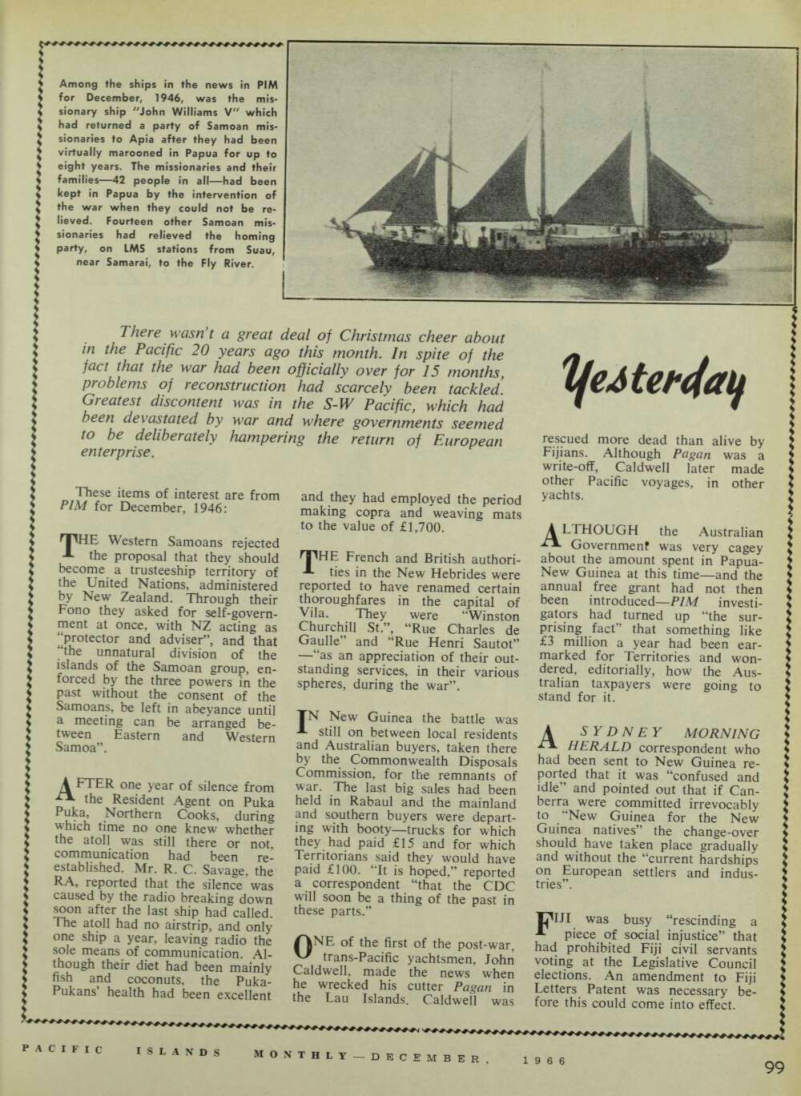
Among the ships in the news in PIM for December, 1946, was the mis sionary ship "John Williams V" which had returned a party of Samoan mis sionaries to Apia after they had been virtually marooned in Papua for up to eight years. The missionaries and their families—42 people in all—had been kept in Papua by the intervention of the war when they could not be re lieved. Fourteen other Samoan mis sionaries had relieved the homing party, on LMS stations from Suau, near Samarai, to the Fly River.