Discover"Sarka
pp. 95-99 · Read in the full issue
America's Art Lovers
Of The South Seas"
By Robert Langdon
Even if you pride yourself on your knowledge of South Seas history or South Seas art, you can fairly be excused if you have never heard of the artist Charles Sarka, sometimes known as “Sarka of the South Seas”.
WHEN Sarka died in the United States in 1960 at the age of 81, his attractive water colours of Tahiti and Moorea had not been publicly exhibited for something like 40 years, and only a few of his closest friends were aware that he had ever been to the Pacific.
Now, however, Sarka’s South Seas pictures have been rediscovered; and institutions and private collectors are showing an eagerness to acquire them, reminiscent of the “rush” for Paul Gauguin’s South Seas paintings of half a century ago.
The revival of interest in Sarka’s South Seas work—or in his work generally, for that matter—began in October, 1963, when the Bernard Black Gallery in Madison Avenue, New York, staged a three-week ex hibition of 30 of his watercolours, done in Tahiti and Moorea in 1903.
Art lovers were fascinated by their subject matter and their spontaneous, turn-of-the-century charm, and the ex hibits were quickly snapped up by art institutions and private collectors.
The institutions included the Whitney Museum of American Art in New York City, the Institute of Fine Arts in Chicago, the Honolulu Academy of Fine Arts, and New York City’s Metropolitan Museum of Art.
The Metropolitan Museum’s ac quisition—a study of a Tahitian woman having “A Morning Smoke” —is being displayed again this month in a retrospective exhibition at the museum of American watercolours to commemorate the 100th anni versary of the American Watercolour Society.
Another Exhibition
To coincide with this, the Bernard Black Gallery is presenting another exhibition of Sarka’s work—this one including other works of Tahiti, plus water colours done in Hawaii in 1904-05, North Africa in 1909, and the Adirondack mountains of the United States in 1915.
Sarka’s name may thus become a
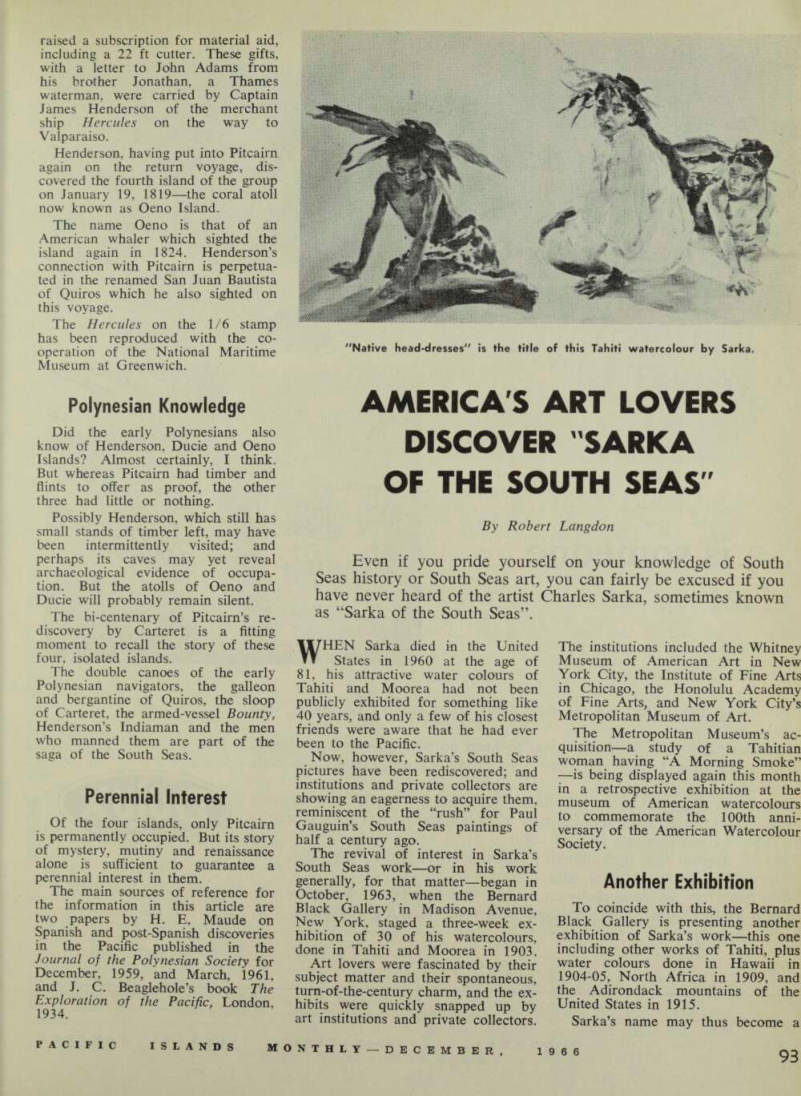
"Native head-dresses" is the title of this Tahiti watercolour by Sarka.
good deal better known in the next few years than it now is; and perhaps one of these days another Somerset Maugham will write another novel along the lines of The Moon and Sixpence that will really put him on the map.
Sarka’s life, though, does not seem to have been quite as colourful as Maugham’s model, Gauguin. But it was interesting enough.
According to an account of his career which he gave to the New Jersey newspaper Asbury Park Sun day Press in October, 1932, Sarka was born in Chicago on December 6, 1879. His parents, who came from Bohemia, had him baptised Charles Nicholas.
He began drawing in his earliest years, for his mother soon made the happy discovery that a pencil and a piece of paper had magical qualities for keeping him busy.
From pencils, the boy graduated to crayons (and the world of colour), and from there to watercolours.
His father, a gilder and maker of picture frames in a big store, en couraged his artistic leanings, allow ing him to copy the work of notable artists which he brought home to be framed.
Errand Boy
Sarka’s first job was as an errand boy in a Chicago engraving plant, where he worked without pay learning how the engraving work was done.
Eventually he was allowed to draw figures on blocks for the engravers at a salary of $1 a week.
He next worked on a spiritualist weekly for S 3 a week, and a comic weekly called The Cricket for SB.
However, The Cricket “chirped its last chirp” after three months; and Sarka moved to another weekly paper. He was then only 13 or 14.
At 16, he was a staff artist on the Chicago Record ; and when that paper’s cartoonist left on a trip round the world, Sarka was pushed into his place.
Sarka produced in pen and ink what photographers now do—pictures of murderers, fires, accidents and trials, including the trial of a sausage maker who boiled his wife to death in a vat.
At 19, Sarka moved on to papers and magazines in New York where he began to make what he called “real money”—sso to S9O a week. Before long he had more work than he could handle.
A magazine editor in New York, who had visited the South Seas, first put the idea into Sarka’s head of going there himself. But it was in Egypt, rather than the Pacific, that he had his first taste of life overseas.
With a fellow artist, George “Pop”
Hart, Sarka set out with a knapsack, travelling steerage to Naples and then steerage on another ship to Alexan dria. In Egypt, the pair travelled extensively, sometimes paying their way with paintings.
“It was a mighty fine winter we spent there in Egypt,” Sarka recalled 30 years later, “and we were sorry to return to New York and get back in the illustrating game.”
"Plenty Of Breadfruit"
Sarka’s Middle East adventure re sulted in his being given a number of Oriental stories to illustrate. But soon the wanderlust gripped him again, and he suggested to Pop Hart that they should go to Tahiti.
In the following year, 1903, Hart downed tools and headed for Tahiti via Cuba. Sarka remained behind to earn more money before leaving.
This was against the wishes of his friend, who wrote: “Am sorry that I leave here Thursday for Tahati (sic) without my old reliable side partner, but will await patiently your arrival in Tahati. But don’t see why you should want so much money as there is no chance to spend it over there, as we will get plenty of breadfruit just for the picking and plenty of fishing , , .
“I expect to do most of my stuff m oils this trip and don’t expect to come back for at least 2 years .
I am going to give all my stuff to
Steamship Co. to use for exhibition and adv. purposes and when I come back to the States 1 am to have all the originals back . . . and if you get to Tahati I will work you in on the same deal, but for god’s sake come alone as if more come it will queer the whole thing entirely . . .
“Next boat leaves about July 4th will expect you on it.”
Soon after Hart arrived in Tahiti, he sent Sarka another letter which said simply; “When are you coming down? Bring some fish hooks with you when you come.”
Sarka was about to set off for Tahiti when Hart’s note arrived. He found when he did reach that island, that Hart was not exactly living in elysium.
Sad, Solitary Figure
“The usual picturesque crowd of flower-crowned natives and whites dressed in white duck met my eyes at the dock,” Sarka told the Ashbury Park Sunday Press, “but I looked in vain for Pop.
“At last I spied him, a sad and solitary figure, pacing up and down the beach, head down and looking as though he had lost his last friend.
“He wore dirty flannel pants and a ragged blue flannel shirt. His hair looked as though sparrows had been nesting in it and he had not shaved for weeks.
“He didn’t see me coming. When I got near enough I yelled, ‘Hello,
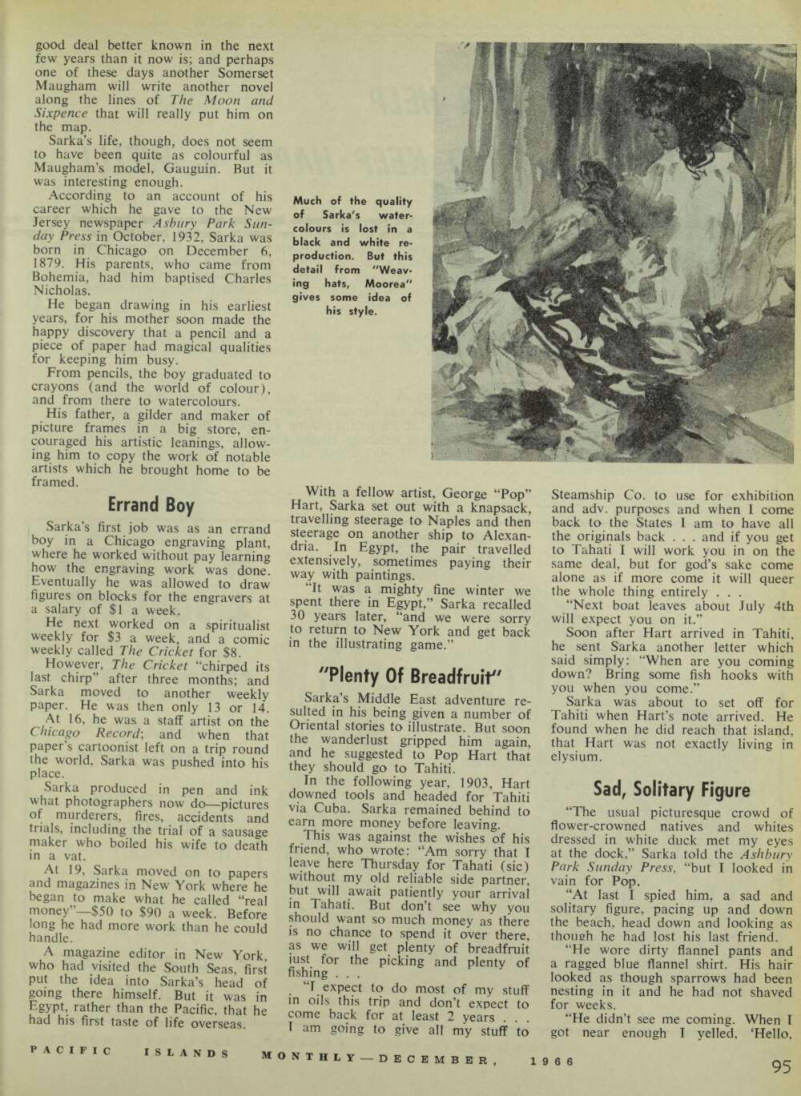
Much of the quality of Sarka's water colours is lost in a black and white re production. But this detail from "Weav ing hats, Moorea" gives some idea of his style.
Pop’. He turned in a flash, yelled ‘Sarka, by God’ and both of us threw our hats into the air and hugged each other.
“The authorities had been about to deport him, but everything was changed when I arrived.
“We rented a shack and then travelled around the island and other islands, including Moorea and Bora Bora, just as we had done in Egypt.
“We lived out in the country, but were always home on steamer day, once a month. Then we could come into Papeete and put up at the home of the American consul. He gave us one of the queerest rooms I ever slept in. It was piled not less than a foot deep with newspapers. It looked to me like an accumulation of years.
Here we’d sleep wrapped up in old American flags.
“It was a vagabond existence we
led there, roaming by day and putting up at the homes of natives at night, sleeping in brass beds which they used as ornaments while they slept on the floor. Every view was beautiful enough to sketch, every native was picturesque enough to draw. We were busy all the time.
Month On Moorea
“We spent a month on Moorea and got to be great friends with the natives, especially the youngsters.
Near where we lived was the “Pool of the Ghost”, a little lake in a woodland glade said to be inhabited by a spirit which pulled under the water anyone who ventured near the pool. I didn’t know its reputation until later, however.
“I was overjoyed one morning to discover the picturesque spot, but I was surprised that the children usually following me had turned back towards the village.
“I took a plunge and then painted the scene, putting on a stone over hanging the water the shadowy figure of a young girl reaching over for a floating leaf. The youngsters had given me up as a goner, and were surprised when I returned and told me the legend of the ghost.
“I showed them the picture and they yelled, ‘There it is’ when they saw the figure of the girl.” [Sarka’s “Pool of the Ghost” was apparently Lake Temae on the north eastern corner of Moorea. It was also described in somewhat ghostly terms by the US novelist Herman Melville in his novel Omoo, pub lished a century or so ago.] Sarka did not say in the 1932 newspaper article how long he stayed in Tahiti and Moorea, but it appears to have been only a couple of months.
On his return to New York, the pictures he had painted gained him the title of “Sarka of the South Seas”, but he did not pause long to revel in this new name, for in 1904-05, he visited Hawaii. Later trips took him to North Africa, Paris and the Carib bean.
Evocation Of Far Countries
Somewhere around this time, Sarka married Grace Jones, sister of Haydon Jones, an American news paperman, and they went off to “Wild” Wales for their honeymoon.
Other excursions followed, includ ing one to a guano island in the Caribbean, which is said to be the site of buried pirate treasure.
In his later years, Sarka became a frequent contributor to such well known American magazines as Collier’s, Scribner’s, Cosmopolitan, Everybody’s and Harper’s.
He is said to have been “a friend of, and respected by, some of the liveliest minds of the day—both artistic and literary—who admired the exhibitions of his watercolours and their evocation of the far countries he had visited”.
When his Tahiti and Moorea water colours were exhibited in October, 1963, they had not been shown in public since the late twenties.
“The present exhibition,” a cata logue published for that display pro claimed, “draws attention to a little known but delightful period of Charles Sarka’s work.
“In these fresh watercolours we are given not only an opportunity of recognising his ability as an artist, but also of enjoying his vision of a time and a place which will never be quite the same again.”
The titles of the 30 watercolours exhibited included Vahines making hats; Forest interior, Moorea; Where the surf thunders; Hymn-singers of Faaa; Dancers of Faaa; Weaving hats, Moorea; Tahiti dancers resting; Spearing fish on the reef; Tahiti, the golden; Sailing toy canoes, Moorea; and Pop Hart, sketching a vahine.
Charles Sarka as a young man. The picture, a self-portrait, in reproduced from a photographic reproduction of a news paper clipping. This reproduction is there fore three or four times removed from the original.