Fiji's Women Take A
pp. 77-80 · Read in the full issue

Hand In Politics
From Beryl Cates, in Suva In recent years women in Fiji have been demanding more of a voice in the running of the country. Now they are some what mollified because the newly-elected Legislative Council has three women take their places with the men. They are an Indian, a Fijian and a European.
MRS. Loloma Livingston and Mrs.
Irene Narayan were elected at the general polls and Adi Losalini Dovi was selected by the Great Council of Fiji’s Chiefs.
Mrs, Livingston, with 23,768 votes, won from her opponent, the Rev. P.
K. Davis, by 1,091 votes in the Western cross-voting constituency.
Mrs. Irene Narayan, with 5,676 votes, won her seat in the Suva Indian con stituency by 2,897 from Mr. A. I. N.
Deoki, A third woman candidate, Mrs.
Margaret Bain, missed a seat in the Suva general constituency by only 93 votes.
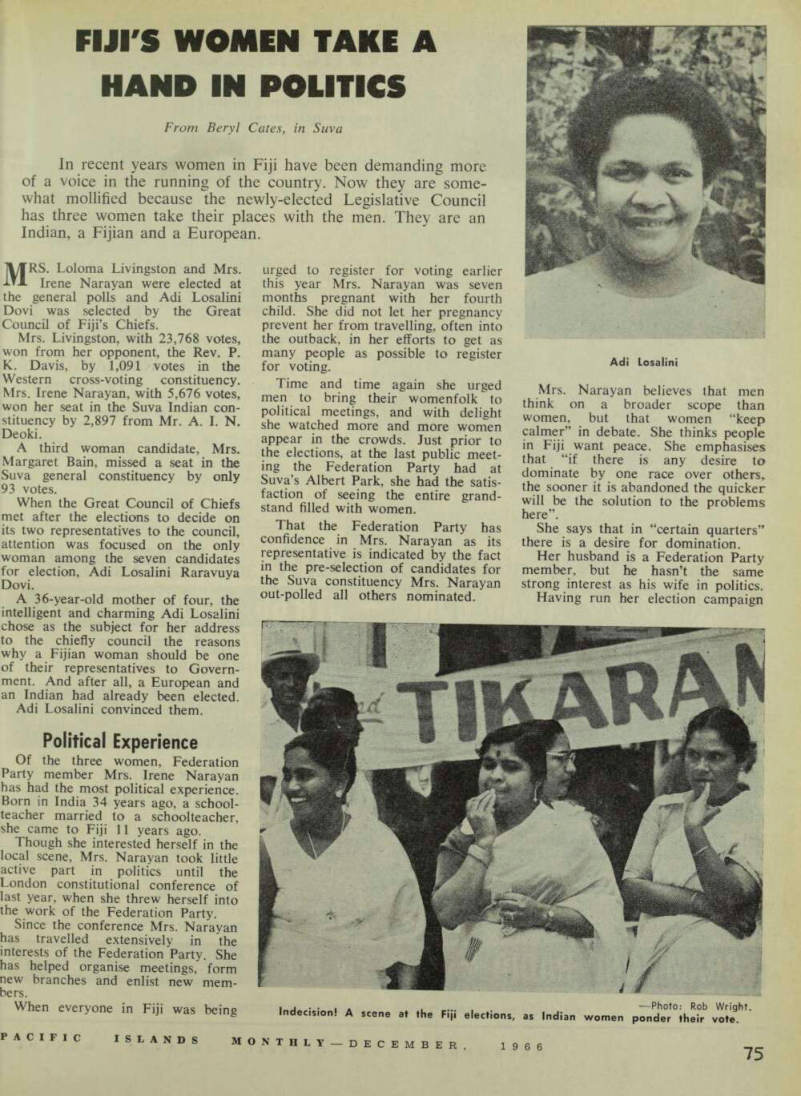
When the Great Council of Chiefs met after the elections to decide on its two representatives to the council, attention was focused on the only woman among the seven candidates for election, Adi Losalini Raravuya Dovi.
A 36-year-old mother of four, the intelligent and charming Adi Losalini chose as the subject for her address to the chiefly council the reasons why a Fijian woman should be one of their representatives to Govern ment. And after all, a European and an Indian had already been elected.
Adi Losalini convinced them.
Political Experience
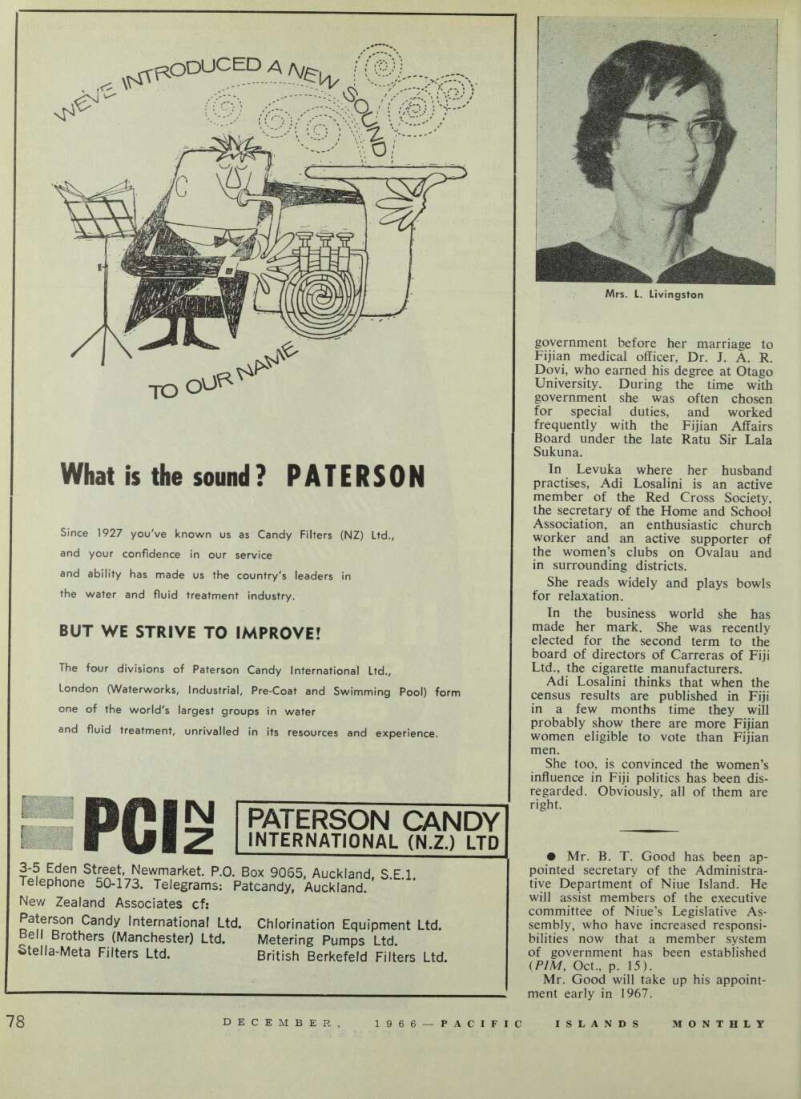
Of the three women, Federation Party member Mrs. Irene Narayan has had the most political experience.
Born in India 34 years ago, a school teacher married to a schoolteacher, she came to Fiji 11 years ago.
Though she interested herself in the local scene, Mrs. Narayan took little active part in politics until the London constitutional conference of last year, when she threw herself into the work of the Federation Party.
Since the conference Mrs. Narayan has travelled extensively in the interests of the Federation Party. She has helped organise meetings, form new branches and enlist new mem bers.
When everyone in Fiji was being
urged to register for voting earlier this year Mrs. Narayan was seven months pregnant with her fourth child. She did not let her pregnancy prevent her from travelling, often into the outback, in her efforts to get as many people as possible to register for voting.
Time and time again she urged men to bring their womenfolk to political meetings, and with delight she watched more and more women appear in the crowds. Just prior to the elections, at the last public meet ing the Federation Party had at Suva’s Albert Park, she had the satis faction of seeing the entire grand stand filled with women.
That the Federation Party has confidence in Mrs. Narayan as its representative is indicated by the fact in the pre-selection of candidates for the Suva constituency Mrs. Narayan out-polled all others nominated.
Mrs. Narayan believes that men think on a broader scope than women, but that women “keep calmer” in debate. She thinks people in Fiji want peace. She emphasises that “if there is any desire to dominate by one race over others* the sooner it is abandoned the quicker will be the solution to the problems here”.
She says that in “certain quarters” there is a desire for domination.
Her husband is a Federation Party member, but he hasn’t the same strong interest as his wife in politics.
Having run her election campaign
Adi Losalini
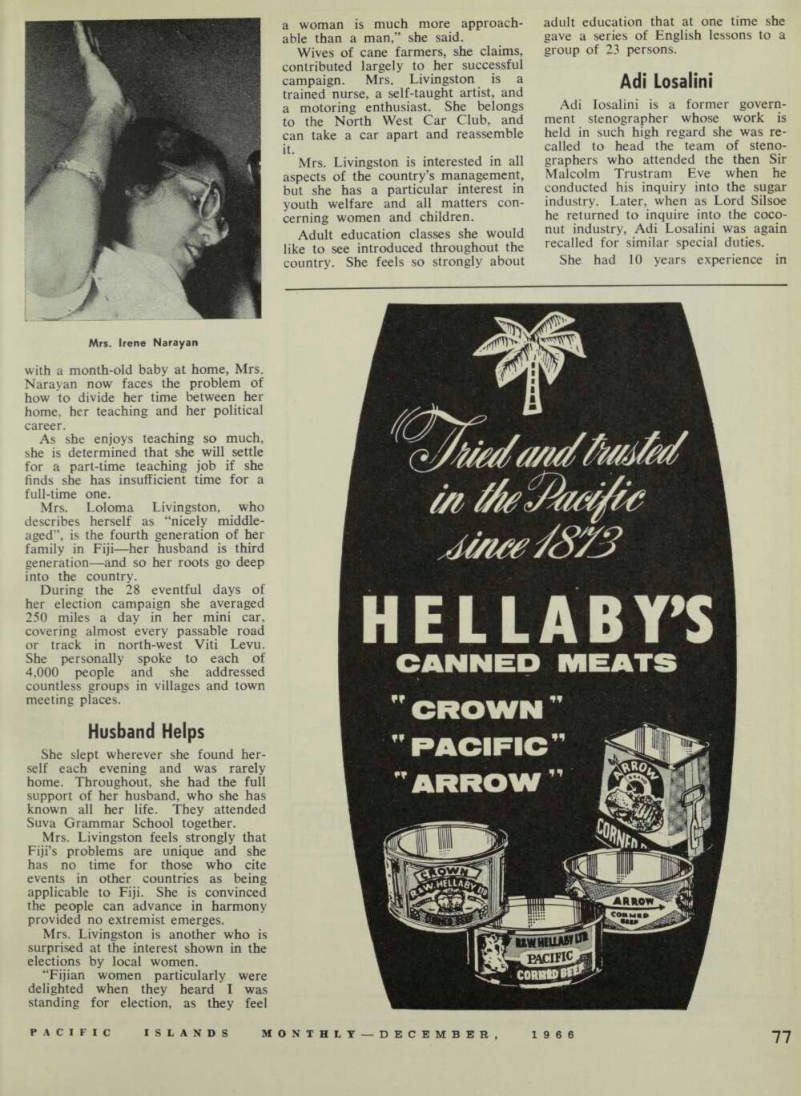
Photo: Rob Wright.
Indecision! A scene at the Fiji elections, as Indian women ponder their vote.
with a month-old baby at home, Mrs.
Narayan now faces the problem of how to divide her time between her home, her teaching and her political career.
As she enjoys teaching so much, she is determined that she will settle for a part-time teaching job if she finds she has insufficient time for a full-time one.
Mrs. Loloma Livingston, who describes herself as “nicely middle aged”, is the fourth generation of her family in Fiji—her husband is third generation—and so her roots go deep into the country.
During the 28 eventful days of her election campaign she averaged 250 miles a day in her mini car, covering almost every passable road or track in north-west Viti Levu.
She personally spoke to each of 4,000 people and she addressed countless groups in villages and town meeting places.
Husband Helps
She slept wherever she found her self each evening and was rarely home. Throughout, she had the full support of her husband, who she has known all her life. They attended Suva Grammar School together.
Mrs. Livingston feels strongly that Fiji’s problems are unique and she has no time for those who cite events in other countries as being applicable to Fiji. She is convinced the people can advance in harmony provided no extremist emerges.
Mrs. Livingston is another who is surprised at the interest shown in the elections by local women.
“Fijian women particularly were delighted when they heard I was standing for election, as they feel
a woman is much more approachable than a man,” she said.
Wives of cane farmers, she claims, contributed largely to her successful campaign. Mrs. Livingston is a trained nurse, a self-taught artist, and a motoring enthusiast. She belongs to the North West Car Club, and can take a car apart and reassemble it, Mrs. Livingston is interested in all aspects of the country’s management, but she has a particular interest in youth welfare and all matters concerning women and children.
Adult education classes she would like to see introduced throughout the country. She feels so strongly about
adult education that at one time she gave a series of English lessons to a group of 23 persons,
Adi Losalini
Adi losalini is a former govern ment stenographer whose work is held in such high regard she was re called to head the team of steno graphers who attended the then Sir Malcolm Trustram Eve when he conducted his inquiry into the sugar industry. Later, when as Lord Silsoe he returned to inquire into the coco nut industry, Adi Losalini was again recalled for slmllar s P eclal duties - She had 10 years experience in
Mrs. Irene Narayan
government before her marriage to Fijian medical officer, Dr. J. A, R.
Dovi, who earned his degree at Otago University. During the time with government she was often chosen for special duties, and worked frequently with the Fijian Affairs Board under the late Ratu Sir Lala Sukuna.
In Levuka where her husband practises, Adi Losalini is an active member of the Red Cross Society, the secretary of the Home and School Association, an enthusiastic church worker and an active supporter of the women’s clubs on Ovalau and in surrounding districts.
She reads widely and plays bowls for relaxation.
In the business world she has made her mark. She was recently elected for the second term to the board of directors of Carreras of Fiji Ltd., the cigarette manufacturers.
Adi Losalini thinks that when the census results are published in Fiji in a few months time they will probably show there are more Fijian women eligible to vote than Fijian men.
She too, is convinced the women’s influence in Fiji politics has been dis regarded. Obviously, all of them are right. • Mr. B. T. Good has been ap pointed secretary of the Administra tive Department of Niue Island. He will assist members of the executive committee of Niue’s Legislative As sembly, who have increased responsi bilities now that a member system of government has been established ( PIM, Oct., p. 15).
Mr. Good will take up his appoint ment early in 1967.
Mrs. L. Livingston