Papuans
pp. 68-69 · Read in the full issue
Poet Of The Papuans
By Stuart Inder
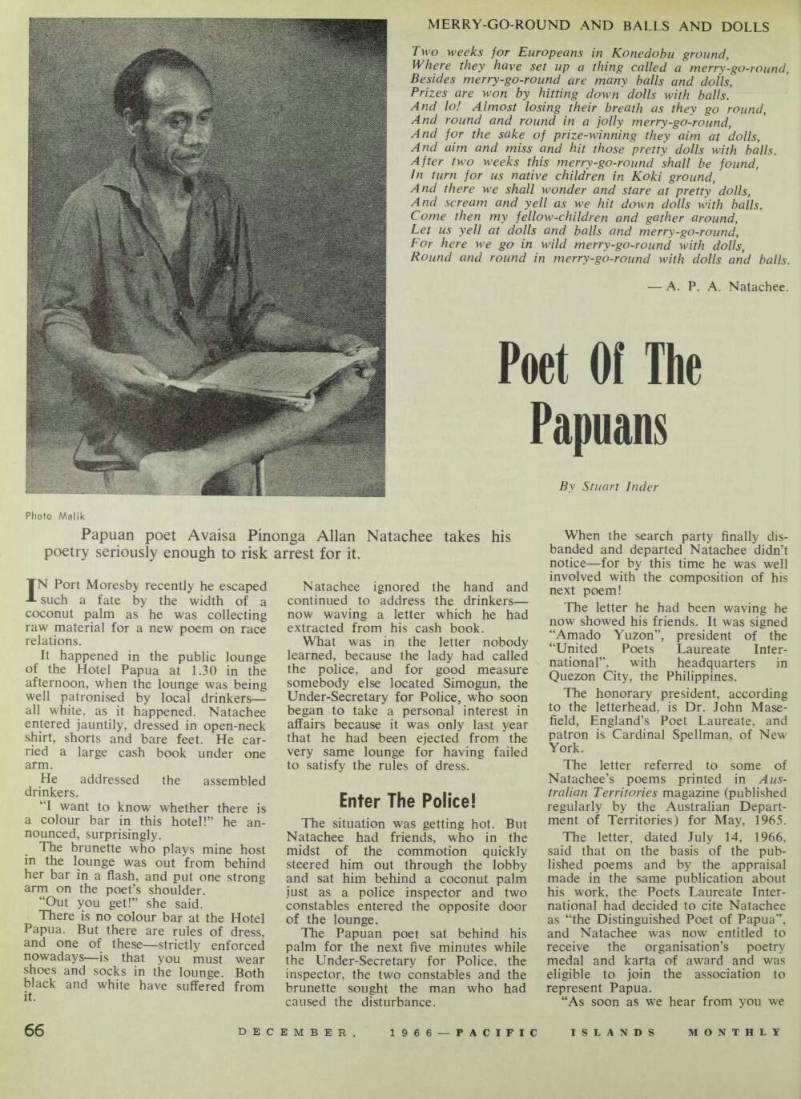
Photo Malik Papuan poet Avaisa Pinonga Allan Natachee takes his poetry seriously enough to risk arrest for it.
IN Port Moresby recently he escaped such a fate by the width of a coconut palm as he was collecting raw material for a new poem on race relations.
It happened in the public lounge of the Hotel Papua at 1.30 in the afternoon, when the lounge was being well patronised by local drinkers— all white, as it happened. Natachee entered jauntily, dressed in open-neck shirt, shorts and bare feet. He car ried a large cash book under one arm.
He addressed the assembled drinkers.
“I want to know whether there is a colour bar in this hotel!” he an nounced, surprisingly.
The brunette who plays mine host in the lounge was out from behind her bar in a flash, and put one strong arm on the poet’s shoulder.
“Out you get!” she said.
There is no colour bar at the Hotel Papua. But there are rules of dress, and one of these—strictly enforced nowadays—is that you must wear shoes and socks in the lounge. Both black and white have suffered from it.
Natachee ignored the hand and continued to address the drinkers— now waving a letter which he had extracted from his cash book.
What was in the letter nobody learned, because the lady had called the police, and for good measure somebody else located Simogun, the Under-Secretary for Police, who soon began to take a personal interest in affairs because it was only last year that he had been ejected from the very same lounge for having failed to satisfy the rules of dress.
Enter The Police!
The situation was getting hot. But Natachee had friends, who in the midst of the commotion quickly steered him out through the lobby and sat him behind a coconut palm just as a police inspector and two constables entered the opposite door of the lounge.
The Papuan poet sat behind his palm for the next five minutes while the Under-Secretary for Police, the inspector, the two constables and the brunette sought the man who had caused the disturbance.
When the search party finally dis banded and departed Natachee didn’t notice—for by this time he was well involved with the composition of his next poem!
The letter he had been waving he now showed his friends. It was signed “Amado Yuzon”, president of the “United Poets Laureate Inter national”. with headquarters in Quezon City, the Philippines.
The honorary president, according to the letterhead, is Dr. John Mase field, England’s Poet Laureate, and patron is Cardinal Spellman, of New York.
The letter referred to some of Natachee’s poems printed in Aus tralian Territories magazine (published regularly by the Australian Depart ment of Territories) for May, 1965.
The letter, dated July 14. 1966, said that on the basis of the pub lished poems and by the appraisal made in the same publication about his work, the Poets Laureate Inter national had decided to cite Natachee as “the Distinguished Poet of Papua”, and Natachee was now entitled to receive the organisation’s poetry medal and karta of award and was eligible to join the association to represent Papua.
“As soon as we hear from you we
Merry-Go-Round And Balls And Dolls
Two weeks for Europeans in Konedobu ground, Where they have set up a thing called a merry-go-round, Besides merry-go-round are many balls and dolls, Prizes are won by hitting down dolls with balls.
And lo! Almost losing their breath as they go round, And round and round in a jolly merry-go-round, And for the sake of prize-winning they aim at dolls, And aim and miss and hit those pretty dolls with balls.
After two weeks this merry-go-round shall be found, In turn for us native children in Koki ground, And there we shall wonder and stare at pretty dolls, And scream and yell as we hit down dolls with balls.
Come then my fellow-children and gather around, Let us yell at dolls and balls and merry-go-round, For here we go in wild merry-go-round with dolls, Round and round in merry-go-round with dolls and balls.
A. P. A. Natachee.
will have the medal and karta pre pared. More power to your muse,” added Amado Yuzon.
Natachee was very pleased with the honour.
Allan Natachee was born in the Mekeo district of Papua on July 16, 1925, one of two boys and two girls.
He had some early training with the Catholic nuns at Yule Island, nearby, and then went to boarding school at Inawaia, from 1935. From there he transferred to school at Bomana, near Port Moresby, until the Pacific War interrupted his studies in 1942.
His English, as a result of that schooling, is excellent, and it was in school that he fell in love with poetry.
He remembers that a poem by Tenny son which he saw in a newspaper about 1936 made the first impression on him, and he tried to write one himself, “I didn’t finish it,” he says, “but it went like this . .
I am a poor beggar, and roam around the world To find a shade to dwell.
The first completed poem of his own was “River of Knowledge”, done at school.
The war brought a break in his poetry writing, but when eventually he took it up again it was, he says, just too much for the bride he had acquired, and she left him.
Village Girl Left
“She was a village girl and she didn’t like my poems,” he explains, and leaves it at that.
For a time after the war Natachee was employed by the Administration as a clerk, and hopes to get another Administration job soon—perhaps one that will enable him to write—but for some years now he has worked as a wood machinist with a private building firm in Port Moresby.
He likes to write on Sundays. He uses the cash ledger as his notebook and fills its pages in a big round hand.
The day of the hotel disturbance was a Monday and he had come into town from work especially to put in an appearance in the lounge. He liad heard there was a colour bar at the hotel, and he had spent most of Sunday jotting down the theme for his new poem on the colour bar.
Lately, colour has been a con stantly recurring theme in his poems.
Explaining why he had found it necessary to address the throng in the lounge, Natachee said, “I don’t get cross with anybody. But they judge people according to our ap pearance and our colour, and they
do not look inside us to see us on the inside. They don’t chase me out of the Boroko Hotel. They know me there, and they say how are you?”
Natachee is not impressed with the argument that he broke the rules of dress at the Hotel Papua.
“They judge our people according
to our appearance and they don’t look inwards,” he repeated, and then broke off to recite his new poem, called “All Colours Come to Dust”.
He recited in a rich voice, with
genuine feeling:
If you be not true to yourself O white man And lest you be judged by your own lies Be wise and leave alone this brown man As sure as the stars in the skies For why do you waste upon the brown man Your false and pretentious time?
Leave him alone and take your rest O man This world is yours just for a time.
Tho you be white you cannot live forever You must leave this world and be gone And no colour can defy it ever But return to dust for anon.
For where are the great Emperors of long ago?
And where are the lords and the barons?
And where are the great writers of long ago?
And where are the great religious parsons?
O for the glory of your blood and state Can never save you from dying!
Wherefore let all colours be as one mate, One in living as in dying!
His sentiments are obviously better than his poetry above. But others of his poems have real poetry in them, as for instance this one called “Fear” and which, he says, refers to the cruelty of New Guinea tribal wars: From dark of darkest gloom were we born To live in fear from the cradle to the grave And never to see the light of day, To be filled with fear when thunders peal—and lightnings flash, When war drums beat and war trumpets blow.
When advancing yell of foes ring through dark and fearsome forests, When chiefs of peace call forth: “Flee ye women and children!
“Flee! Foes! Foes are advancing!”
When chiefs of war yell out their word of command! “To arms! To arms my men!
“To arms! For we are the defenders of our women, our homes and our land.”
Beat on our drums and blow on our trumpets of war In answer to drums and trumpets of our foes!
Yell out our war chants to let our foes know That we are going forward —forward to meet them.
Behold I sway my plant of war defeating To defeat and scatter the foes!
To kill and never to spare the life of any foes To kill! And kill alone!
Cut off the heads of every fallen foe!
Cut and take out their hearts also, That we may feast upon their brains and hearts To please our gods of war and our spirit fathers!