The Editavs' Mailbag
pp. 61-65 · Read in the full issue

That Samoan Article
Sir,-I am taking this opportunity to write you concerning your article on American Samoa (PIM, Sept.), Although I do not agree with everything yon have said, I feel it is the first honest effort in reporting on the situation. It seems that mist journahsts who come here are wined and dined by the Governor and his lackeys and they see, hear and report just what the Governor wants them to, and write accordingly.
If anyone working for the Covernor does not give the Government line his job is in danger, and I must ask that if you quote anything from my letter you withhold my* If you write another article on American Samoa I would be glad to help your reporter, and take him to as many people as he would like who also disagree with this Government’s policies. For it is dictatorship, and I believe that more of the truth, such as contained in PlM's article, is the only way to change the situation for the better.
Name Withheld.
Pago Pago, American Samoa. • Since this letter was received, the reader has written asking for 100 reprints of Robert Langdon’s article “for many friends in the United States Sir, —It was with a good deal of interest that I read Robert Langdon’s article, “All That Glitters Isn’t Gold in America’s South Seas ‘Showplace’ ” (PIM, Sept.).
While I have not been in sympathy with all Governor Lee’s concepts and programme and am not sure what the US can contribute toward Samoa or anv other distant place except money and drain off surplus people, I do feel that the article was unfairly biased, and carefully concentrated on the minus sides of the situation as much as the many articles by Governor Lee’s friends stress the other side of the coin.
Whether the Samoans or anyone else like it or not, the world is com ing their way. They can make an intelligent effort to affect the course of events if mentally and philosophi cally prepared to do so; or they can sit in the fates and ignore history (I don’t think). I understand some one official once proposed making the
whole place a national park—a sort of African game preserve for people.
The Samoans were properly insulted, as who would not be?
The fact that Governor Lee did not speak Samoan upon arrival was noted in a rather derogatory way.
Very few of the administrators, technicians and other trained people needed in Samoa are going to learn the language. Very few Statesiders expect to make a career there, and any that do are probably in for dis appointment. American Samoa is not New Guinea with its tremendous area and population.
If the Samoans do not become proficient in English (OK —French, German, Spanish, Russian, etc.) they have no access to the literature of the world, exception—the Bible— but mechanics, electricians, medical personnel or others will not be able to read their instruction manuals, and catalogues of parts and equip ment, nor will business be able to conduct any affairs ouside of Samoa.
So it would be back to the zoo concept. Of course, English will endanger the Samoan language and thereby the culture. It is up to the Samoans to preserve it if they want it.
All this consternation about some one losing their culture leaves me cold. We Americans have had ours completely changed every 50 years since the Clermont first steamed up the Hudson, and think little of it.
We have certainly lost the culture we had in 1910, and whether we groan or rejoice is of no moment.
I do not believe that most of the Samoan people want to live in a subsistence economy as the world approaches the 21st century. As attractive as the old Samoan system seemed (it did have drawbacks), and in the environment where it developed it was marvellously efficient, it was by design the deadly enemy of that spark plug of progress—individual initiative.
History has one case of an intelligent effort to maintain a parochial culture in the face of a changing environment—the Japanese severance of almost all contact with the outside world for 250 years. It was a good try, but collapsed more from internal dissatisfaction than any external pressure.
As to travel between American and Western Samoa, which received
adverse comment, a census of the Tutuila schools disclosed several hundreds of Western Samoan children attending school to avoid school fees paid in Western Samoa, or for other reasons. The funds, school space, and personnel were not by any means sufficient to keep them on.
Other large numbers of people came for free or cheap hospitilisa tion. And I have reason to know that the American Samoans resent Western Samoans (except the in dividual’s relatives) holding jobs, particularly the better jobs, in American Samoa.
As to the hotel, I felt it was a mistake from the beginning. A project and investment and operation of that magnitude would hardly pay in Fiji and would require the continual application of brains and management know-how of a high order, expensive promotion, and carefully maintained “tone” to have much chance of profit in the Hawaii market.
I know little of the brains and know-how provided by Inter continental but would make a sport ing wager on the promotion and “tone” of the Pago Pago operation.
I hope that none of my friends, either palagi or Samoan, find grounds for offence in the foregoing, as none is intended.
Geo. R. Jacobs
1224 Marion Drive, Glendale Calif. 91205.
Usa.
Sir, —Sincerest congratulations to Robert Langdon on his survey of American Samoa. As one who lived through the pre- and post-Lee eras, I think his report fantastically accurate, and his assessment of Lee himself, remarkable.
When will Americans learn that the world cannot all be judged by a “made in USA” yardstick? And that to put all the Polynesians into jeans and give them transistors and juke boxes (or TV!) is not progress, but tragedy.
Western Samoa may be broke, re-
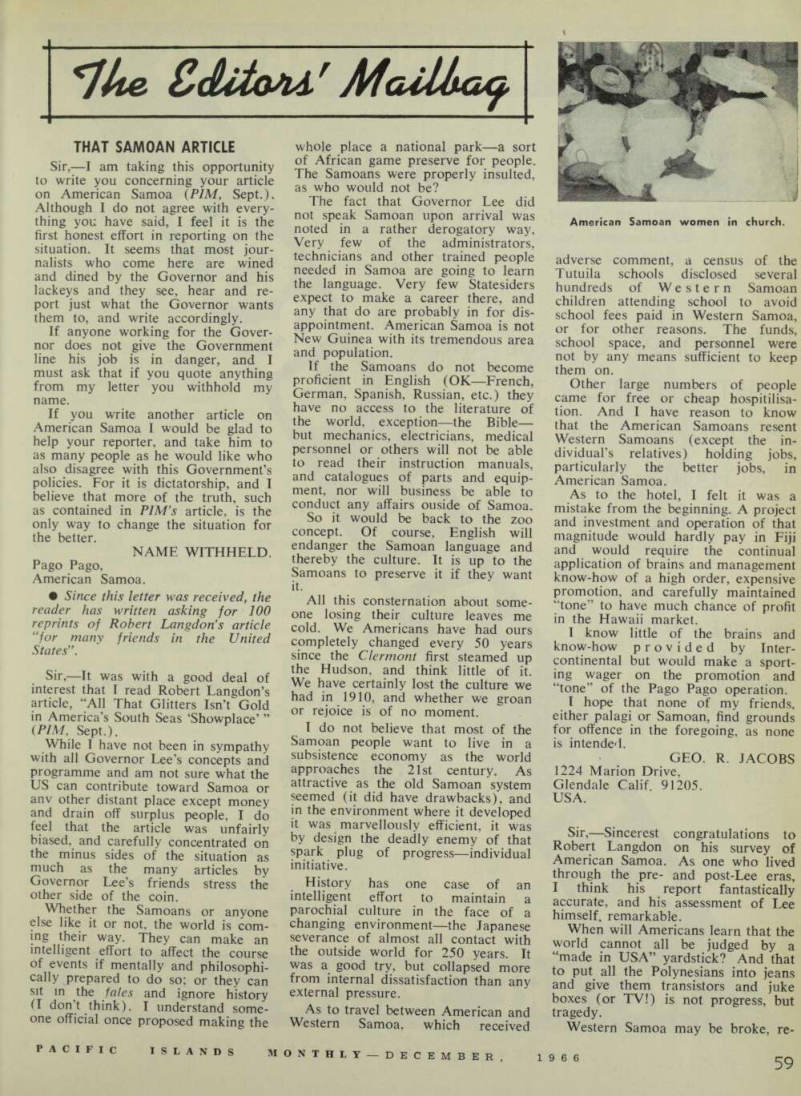
American Samoan women in church.
Letters
(Continued) actionary, and way behind the times, but at least it’s not yet a travesty of civilisation! I can well understand, however, that there will be many touchy American readers.
West Samoan.
Suva, Fiji.
The Fiji Elections
Sir, —The report on the Fiji national elections from your Suva correspondent ( PIM , Oct., p. 9) contains lies, distortions and con tradicting statements and reflects the immaturity of thought of your corres pondent.
Federation Party’s decision not to vote for general cross-voting con stituency candidates is based on the principle that the general voters are over represented. Is it not strange that a candidate gets elected with a mere 400 votes whereas another loses deposit with over 4,000 votes?
The Federation Party’s determina tion to boycott the use of The Fiji Times for election policy statements is caused by the attitude of the paper: Its aversion to a section of the people. Soon the voices of the people will rise above its propaganda.
Federation Party’s aims and objects, contained in its constitution, are well-known and honoured by honourable people. A few are trying to ignore them and some are trying to misrepresent. Recently Federation was alleged with malicious aims on land policy to create aversion and distrust in the minds of “Fijians” and to brainwash them against Federation. But it will not be long before they learn of the trick played upon them by their supposed leaders and turn them down, learning them to be handmaids of vested interests.
Many false allegations are made against Federation: “Venomous things are said at Federation meet ings”. They refer to the statements of truth on the tactics and activities of the vested interests and their hand maids at present and in the past, who tried, in one district recently, for example, to cell a Federation worker under false allegations with the hope of breaking the election campaign and hence the inevitable victory of Federation.
Did they succeed? Would not these statements be venomous when they dare not to face facts?
The propaganda organ of vested interests creates and encourages situa
tions which excite some people, in vites thoughtless people to write letters, publishes biased views being blind to the existing injustices and wants the continuence and even the enhancement of this tyranny. Now it reports Federation is anti-Euro pean, while Federation aims at equality in justice and status. Federa tion strongly disapproves the existence of projected status of minority.
The dirty tactics of Alliance can didates and “independents” are ignored, and Federation is alleged to have used those tactics. Federa tion Party is the party of masses, farmers, labourers, professional men and underprivileged. Its meetings are
attended by thousands who come on their own accord. Unlike others.
Federation does not coerce and cajole people to support it.
Is there any more proof needed to show the bias or incompetency of your reporter than this report of loss of deposit of Mr. Penaia Rokovuni, who would have won but for the foul play of a handful of anti- Federationists?
“With Federation forming a small opposition in the Legislative Council, what would the future bring?” To whom I should like to know, the masses? This reveals the fear of your correspondent or the ruling minority, who are behind the formation of
“Alliance”, that Federation is the largest and most well-organised party and had it formed the legislative majority as well, it would put an end to the existing oppression. It reveals the secret behind the forma tion of “Alliance”.
When did the plan for the fake majority originate? At a time when the election campaign had begun, the success and failure of various parties and of independents who had declared their candidature were dis cussed, and when Federation’s legisla tive majority was found inevitable under existing circumstances the “Alliance” was formed.
The chiefs, armed with their pro jected status and with false allega tions. brought about wholesale con version for “Alliance” from among timid section of the population. The masses were coerced and cajoled to support the “Alliance”, which seemed from all probable angles to have the approval of the present Government.
In spite of these handicaps Federa tion has secured more than double seats in the Legislative Council of what it had earlier.
While “Alliance” creates ill-will and distrust in the minds of people, especially “Fijians”, and follows a racist policy, it accuses Federation of malicious aims. Has Alliance any constructive policy, any constitution, any common binding among its can didates? Is the only binding among them that they are anti-Federation?
I agree wholeheartedly with Hon.
Mara’s statement in one respect: There should be no place in this peaceful land for trouble-makers and those who sow the seeds of distrust and violence. Unfortunately the speaker had, I strongly believe, been misguided and coerced to address these words at the wrong parties.
K. V. Ramani
PO Box 127.
Ba, Fiji.
New Guinea Shipping
Sir, —We notice with interest the reference in PIM, Oct., p. 109, to the shipping service to be opera ted by “South Pacific Lines, an amalgation of three Rabaul com panies”.
As a shareholder in the company owning the River Dagi, we would point out that the correct name of
the company is New Guinea South Pacific Line Pty. Ltd., and while two of the shareholder companies in New Guinea South Pacific Line Pty. Ltd. are companies registered in the terri tory, this company, also a share holder, is a wholly-owned Australian company registered in Sydney.
The foregoing is advised for the sake of correct reporting; at the same time we would like to express our appreciation of the many interesting articles which appear in your journal.
Keith N. Hole
Manager Hetherington Kingsbury Pty. Ltd., 4 Bridge St., Sydney.
Fiji's Place Names
Sir, —I have been very interested to read about the place names of Fiji ( PIM, June, p. 83), as all Fijian place names have meanings. The meaning of Suva is “Little mounds”.
The beach resort down the coast near Navua is now wrongly spelt.
Many years ago a great number of Tongans resided there, and the Fijians named it “Na Korotoga” (the Tongan village), and it should not be spelt as Nakorotogo, which has no meaning.
Glen Eden, Auckland, NZ.