Colony's Gold Medal Tally
p. 48 · Read in the full issue
Fiji's Women Athletes Boosted Colony's Gold Medal Tally
Fiji’s women were easily the most successful athletes at the Games. Their ability pushed Fiji ahead in its gold medal tally, and helped to mask the fact that Fiji’s men athletes, particu larly in the sprints, could barely hold their own.
FIJI women completely dominated the 100 and 200 metres (win ning all six places), took the 100 metres relay, the discus, high jump, javelin, long jump and shot put.
They were close on the heels of gold medallists in the 800 metres and 80 metres hurdles.
Among the outstanding Fijian women athletes were Merewai Turu kawa and Maca Vakalala, with Turukawa supreme in the field events.
She took the women’s discus, with a distance which was less than her Fiji record, but which still made her competitors look like amateurs.
In the women’s 100 metres, the three Fiji runners among the six competitors looked as if they were running a separate race.
French Polynesia put up the only real opposition to Fiji’s women, with young Helene Sarciaux, of Papeete, obviously a real threat at the next Games.
In the women’s broad jump, K. L.
Kuruvoli had a surprise win, putting up a new Fiji record of 18ft. |in., with team mates filling the other two places.
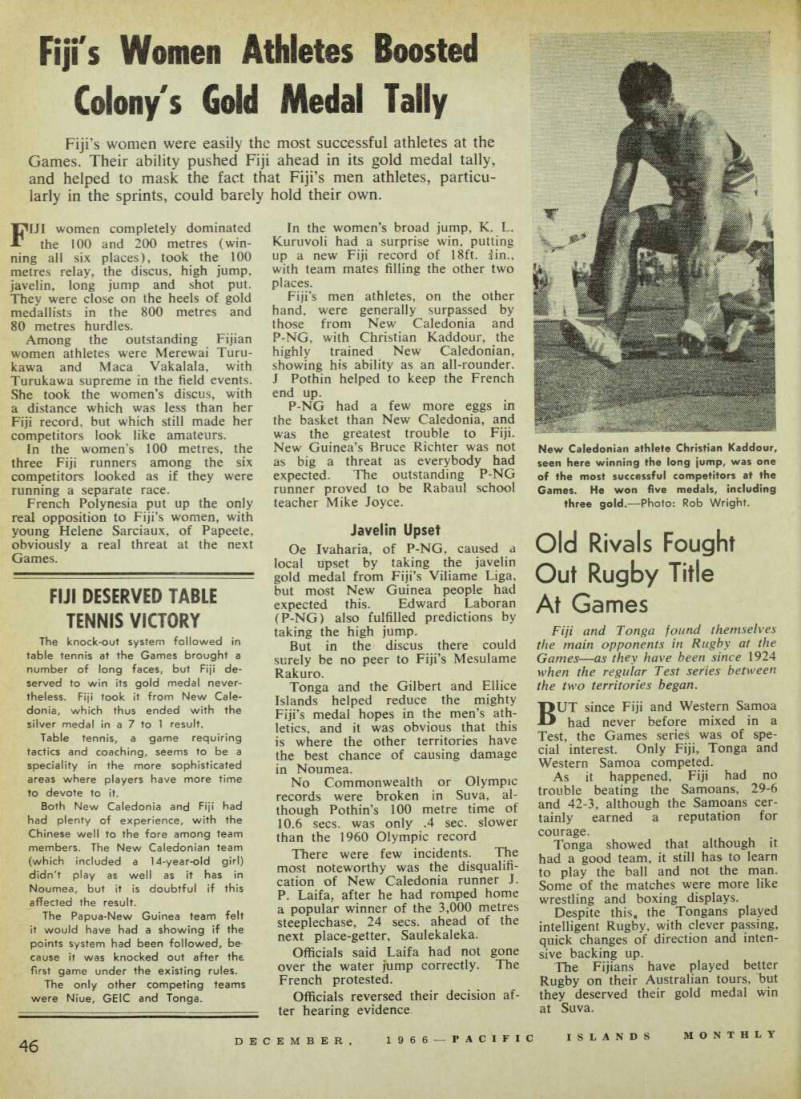
Fiji’s men athletes, on the other hand, were generally surpassed by those from New Caledonia and P-NG, with Christian Kaddour, the highly trained New Caledonian, showing his ability as an all-rounder.
J Pothin helped to keep the French end up.
P-NG had a few more eggs in the basket than New Caledonia, and was the greatest trouble to Fiji.
New Guinea’s Bruce Richter was not as big a threat as everybody had expected. The outstanding P-NG runner proved to be Rabaul school teacher Mike Joyce.
Javelin Upset
Oe Ivaharia, of P-NG, caused a local upset by taking the javelin gold medal from Fiji’s Viliame Liga, but most New Guinea people had expected this. Edward Laboran (P-NG) also fulfilled predictions by taking the high jump.
But in the discus there could surely be no peer to Fiji’s Mesulame Rakuro.
Tonga and the Gilbert and Ellice Islands helped reduce the mighty Fiji’s medal hopes in the men’s ath letics, and it was obvious that this is where the other territories have the best chance of causing damage in Noumea.
No Commonwealth or Olympic records were broken in Suva, al though Pothin’s 100 metre time of 10.6 secs, was only .4 sec. slower than the 1960 Olympic record There were few incidents. The most noteworthy was the disqualifi cation of New Caledonia runner J.
P. Laifa, after he had romped home a popular winner of the 3,000 metres steeplechase, 24 secs, ahead of the next place-getter, Saulekaleka.
Officials said Laifa had not gone over the water jump correctly. The French protested.
Officials reversed their decision af ter hearing evidence
Old Rivals Fought
Out Rugby Title
At Games
Fiji and Tonga found themselves the main opponents in Rugby at the Games —as they have been since 1924 when the regular Test series between the two territories began.
BUT since Fiji and Western Samoa had never before mixed in a Test, the Games series was of spe cial interest. Only Fiji, Tonga and Western Samoa competed.
As it happened, Fiji had no trouble beating the Samoans, 29-6 and 42-3, although the Samoans cer tainly earned a reputation for courage.
Tonga showed that although it had a good team, it still has to learn to play the ball and not the man.
Some of the matches were more like wrestling and boxing displays.
Despite this, the Tongans played intelligent Rugby, with clever passing, quick changes of direction and inten sive backing up.
The Fijians have played better Rugby on their Australian tours, but they deserved their gold medal win at Suva.
New Caledonian athlete Christian Kaddour, seen here winning the long jump, was one of the most successful competitors at the Games. He won five medals, including three gold. Photo: Rob Wright.