First South Pacific Games
p. 47 · Read in the full issue
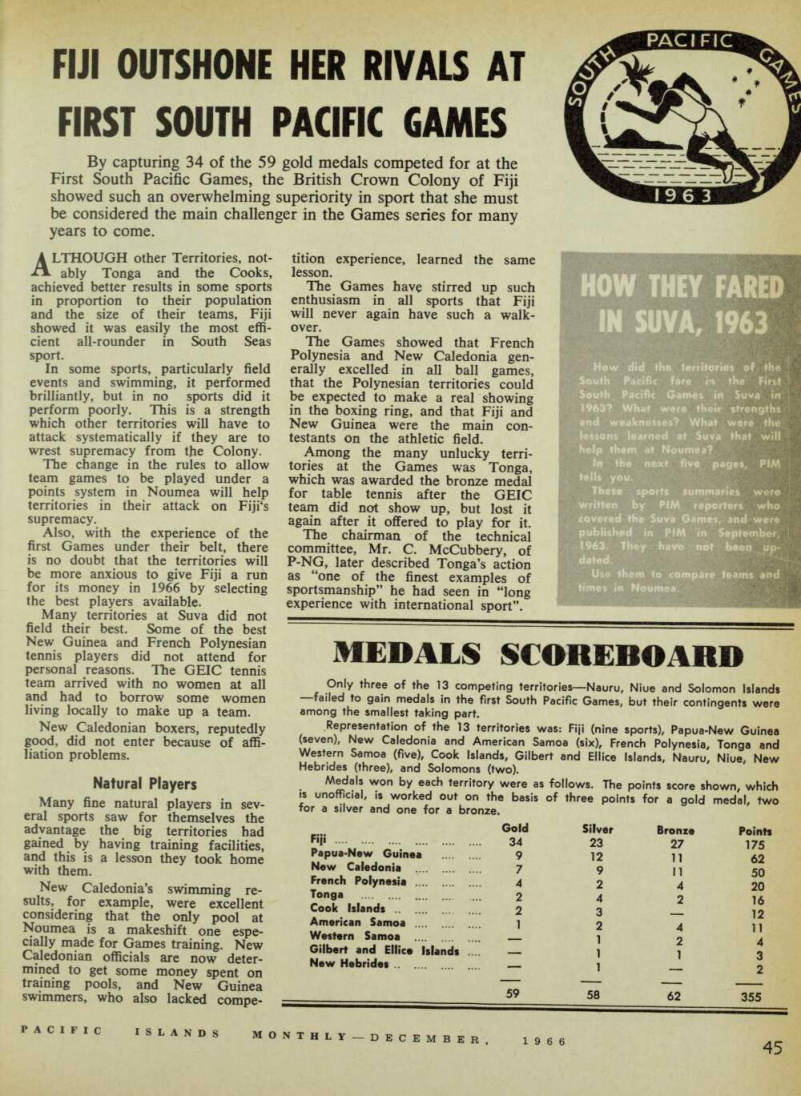
Fiji Outshone Her Rivals At
By capturing 34 of the 59 gold medals competed for at the First South Pacific Games, the British Crown Colony of Fiji showed such an overwhelming superiority in sport that she must be considered the main challenger in the Games series for many years to come.
ALTHOUGH other Territories, not ably Tonga and the Cooks, achieved better results in some sports in proportion to their population and the size of their teams, Fiji showed it was easily the most effi cient all-rounder in South Seas sport.
In some sports, particularly field events and swimming, it performed brilliantly, but in no sports did it perform poorly. This is a strength which other territories will have to attack systematically if they are to wrest supremacy from the Colony.
The change in the rules to allow team games to be played under a points system in Noumea will help territories in their attack on Fiji‘s supremacy.
Also, with the experience of the first Games under their belt, there is no doubt that the territories will be more anxious to give Fiji a run for its money in 1966 by selecting the best players available.
Many territories at Suva did not field their best. Some of the best New Guinea and French Polynesian tennis players did not attend for personal reasons. The GEIC tennis team arrived with no women at all and had to borrow some women living locally to make up a team.
New Caledonian boxers, reputedly good, did not enter because of affi liation problems.
Natural Players
Many fine natural players in sev eral sports saw for themselves the advantage the big territories had gained by having training facilities, and this is a lesson they took home with them.
New Caledonia’s swimming re sults, for example, were excellent considering that the only pool at Noumea is a makeshift one espe cially made for Games training. New Caledonian officials are now deter mined to get some money spent on training pools, and New Guinea swimmers, who also lacked compe
tition experience, learned the same lesson.
The Games have stirred up such enthusiasm in all sports that Fiji will never again have such a walk over.
The Games showed that French Polynesia and New Caledonia gen erally excelled in all ball games, that the Polynesian territories could he expected to make a real showing in the boxing ring, and that Fiji and New Guinea were the main con testants on the athletic field.
Among the many unlucky terri tories at the Games was Tonga, which was awarded the bronze medal for table tennis after the GEIC team did not show up, but lost it again after it offered to play for it.
The chairman of the technical committee, Mr. C. McCubbery, of P-NG, later described Tonga’s action as “one of the finest examples of sportsmanship” he had seen in “long experience with international sport”.