Fiji's New Opposition Gets
pp. 11-12 · Read in the full issue
Down To Business
From a Suva Correspondent
The formal opening of Fiji’s newly-elected Legislative Council on November 11 turned out to be a little more sticky than had been contemplated. The formal proceedings were meant to be a simple curtain-raiser to the Budget session, which followed a few days later, but Fiji’s new Government got quite a shock.
Government comprises 27 elected members and four official members, out of a chamber of 40 elected under Fiji’s new con stitution in November.
They are led by the newly-design ated Leader of Government Business, Fijian Ratu K. K. T. Mara, whose title is a euphemism for Premier.
He is the leader of the majority Alliance group.
The formal opening lasted only two hours.
But the nine members of the Fed eration Party, who form the Opposi tion with Mr. A. D. Patel as the Government-recognised Leader of the Opposition (salaried), went in boots and all, almost from the start.
With a planned cohesive move ment in which it brought its most practised pleaders into action— lawyers Mr. K. C. Ramrakha, Mr.
S. M. Koya and Mr. R. D. Patel (who is brother of Mr. A. D. Patel) —the Opposition attacked the Gov ernment on its proposals to create
several Parliamentary Secretary ships.
“Jobs for the boys,” accused Opposition members, and their cry found an echo in the hearts of many others in Fiji.
But at the start of the day it had all been billing and cooing. What with the oath-taking by all 39 mem bers (Mr. Abdul Lateef, still disabled from his stroke in September, was the only absentee) and the election of the Speaker and Deputy-Speaker, nobody opposed anybody for the first 45 minutes.
So keen had been everyone to see that all was sweet reason at the opening that the Government and the Opposition met before the meet ing to agree on the names of Speaker and Deputy-Speaker.
They decided that Mr. Ron Kermode, lawyer and General mem ber for West Viti Levu, who had been returned to the council without opposition, should be the Speaker in succession to Sir Maurice Scott.
Sir Maurice, under the old con stitution, was appointed Speaker by the Queen, and now severs a con nection with the legislature which, as member and later as Speaker, had lasted for 19 years.
It was reported that the Opposi tion wanted a Fijian appointed as Deputy-Speaker, and proposed that one be selected from the Govern ment side (since there is no Fijian in the Opposition; all are Indian).
Ratu Mara apparently wouldn’t agree to this, and eventually it was decided to appoint Mr. James Madhavan, Indian member for North East Vanua Levu, one of the oldest members of the Federation Party and a practised hand in the council.
In the chamber, Ratu Mara pro posed Mr. Kermode’s election and Mr. Patel seconded it. The nomin ation of Mr. Madhavan followed.
Tradition Followed
After the election of the Speaker, Ratu Mara and Mr. A. D. Patel, with the help of Mr. Kermode, acted out a traditional comedy which had its beginning in the days when to be elected Speaker of the House of Commons was to take a risk no in surance company would carry—the loss of one’s head at the hands of an irate monarch. The speaker was the Parliament’s spokesman and he conveyed decisions to the monarch.
Today in the House of Commons a newly-elected Speaker makes a show of being reluctant to take office.
Fiji’s Speaker and his proposer and seconder did their bit for tradition, and Mr. Kermode was almost dragged
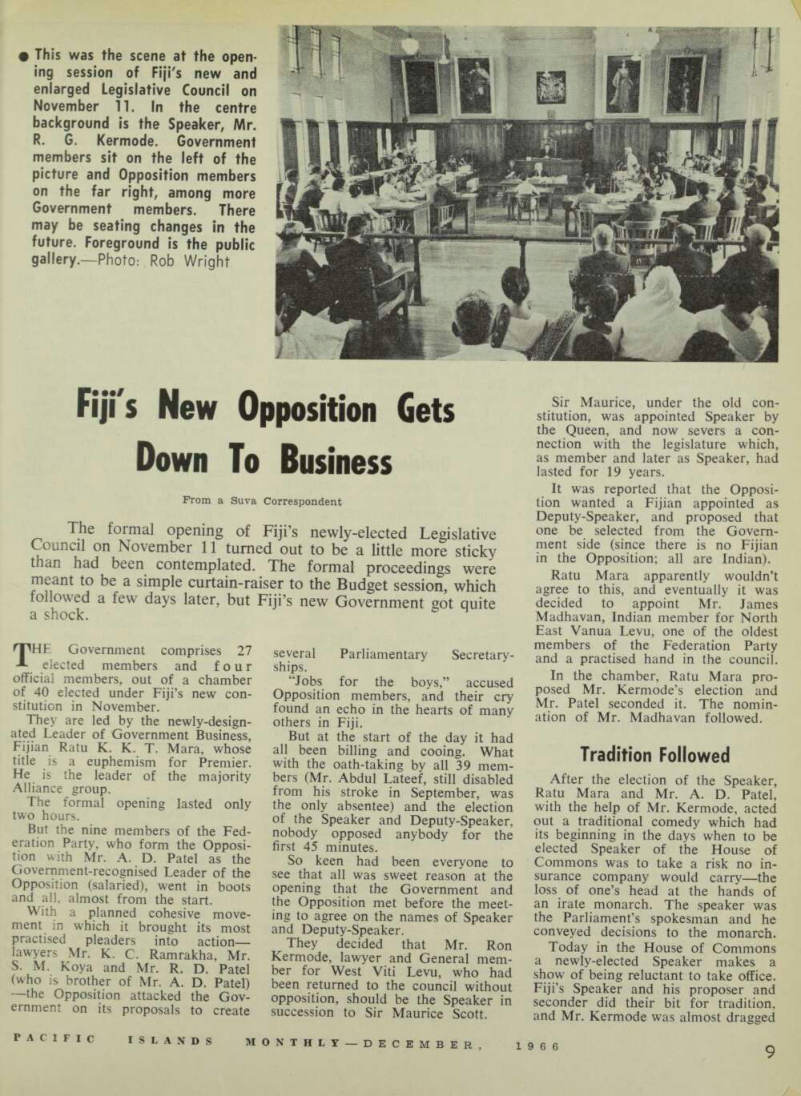
This was the scene at the open ing session of Fiji's new and enlarged Legislative Council on November 11. In the centre background is the Speaker, Mr.
R. G. Kermode. Government members sit on the left of the picture and Opposition members on the far right, among more Government members. There may be seating changes In the future. Foreground is the public gallery. Photo: Rob Wright
Attack On Secretaries' Salaries
(from previous page)
to the chair and thrust into it while the crowded public gallery tittered.
After a break for tea and cakes the fireworks began.
The Financial Secretary, Mr. Harry Ritchie, started it by submitting a schedule of supplementary expendi ture. This included sums to be paid to parliamentary secretaries who are to be attached to the offices of the Members for Natural Resources, Social Services, Communications and Works, Commerce and Tourism, and the Secretary for Fijian Affairs and Local Government.
The extra payments for these new posts represented only a sixth of the annual sum to be spent on positions which the London builders of the new Fiji think are a necessary part of internal self-government.
Members with portfolios get £3,000 a year plus a housing allowance of £9OO, and parliamentary secretaries will get £2,000 a year plus a housing allowance of £5OO.
There are various other perks, and the rank and file of the Legislative Council can collect a little over £6OO each if they attend every session of the council, and committee sittings.
All this in a country with a delicately-poised economy like Fiji’s isn’t peanuts.
The Opposition attacked almost every vote for the new posts, and the vote for additional payments to the office of the Fiji Government Representative in Sydney.
Political Patronage
None of them was really neces sary, argued the Opposition. It accused the Government of political patronage, of creating political sinecures.
Mr. Ramrakha spearheaded the attack in a way which points to him in the future being the most force ful speaker in the Opposition. He said only Ministers had parliamentary secretaries, and Ministers hadn’t been appointed yet.
Mr. R. D. Patel, using the same arguments, hinted at illegality. Other shots were fired by Mr. Madhavan and Mr. Koya, but the Leader of the Opposition was content to watch his lieutenants pepper the Government.
The Attorney-General, Mr. Justin Lewis, replied that nothing was
illegal. The constitution didn’t men tion parliamentary secretaries, and it didn’t mention many other Govern ment posts either. Money could be paid to anybody the Legislative Coun cil approved.
He also pointed out that the Gov ernment could, according to the con stitution, turn the Members into Min isters at once—his argument ap parently being that as they were Ministers in all but name they would need parliamentary secretaries.
But this didn’t meet the Opposi tion’s argument at all. The argument was that the posts weren’t necessary, and many people in Fiji agree with the Opposition.
Why is it necessary to follow slavishly the British Parliament?
Ministers there might need secretaries and under-secretaries, but what has that got to do with Fiji?
Divisions Forced
As the Opposition pointed out, some individuals who become parlia mentary secretaries don’t earn half that in private life, and wouldn’t be able to get it in commerce.
That’s the system, for better or worse, in the Mother of Parliaments, where a dockworker overnight can blossom into an alleged expert on education, trade, finance, or what ever. And that’s the system that Fiji has to have, says THE system.
Three times the Opposition forced a division, with its time-wasting name-recording (and now that Fiji has a Government and an official Opposition the vote is a foregone conclusion). Each time it was 29 votes for the Government (with Mr.
Lateef missing) and nine against.
The Opposition kept up its pressure (although its members were silent on one money vote which included pay ment to the Leader of the Opposi tion). They didn’t manage to save the colony one penny. But it did show clearly that in future Fiji would have an Opposition that could be expected to operate vigorously—and that is what oppositions are for.
The move to have a Fijian ap pointed Deputy Speaker was interest ing; if he had been appointed the Indians would have been on “the outer” in the more important public positions in the colony.
Only a week or so earlier, a Chinese, Mr, Eddie Wong, had been elected Mayor of Lautoka, Fiji’s
second biggest town; and two Euro peans, Mr. C. H. Hunt and Mr.
P. R. Allan, were elected Mayor and E)eputy Mayor of the city of Suva.
Oddly, the Lautoka post was filled with the active support of Federation members, and in Suva an Indian councillor, Mr. R. I. Kapadia, lost the opportunity of becoming Deputy Mayor because of non-support by Federation members.
The position is no doubt ripe for some Fiji Indians to complain to the UN that the Indian community of Fiji, despite its numerical superiority, can’t get a look in. And one is entitled to presume that Federation members are aware of it.