As A Minor Safari, Try Fiji’s
pp. 123-129 · Read in the full issue
Dusty, Round-Island Road
By Judy Tudor
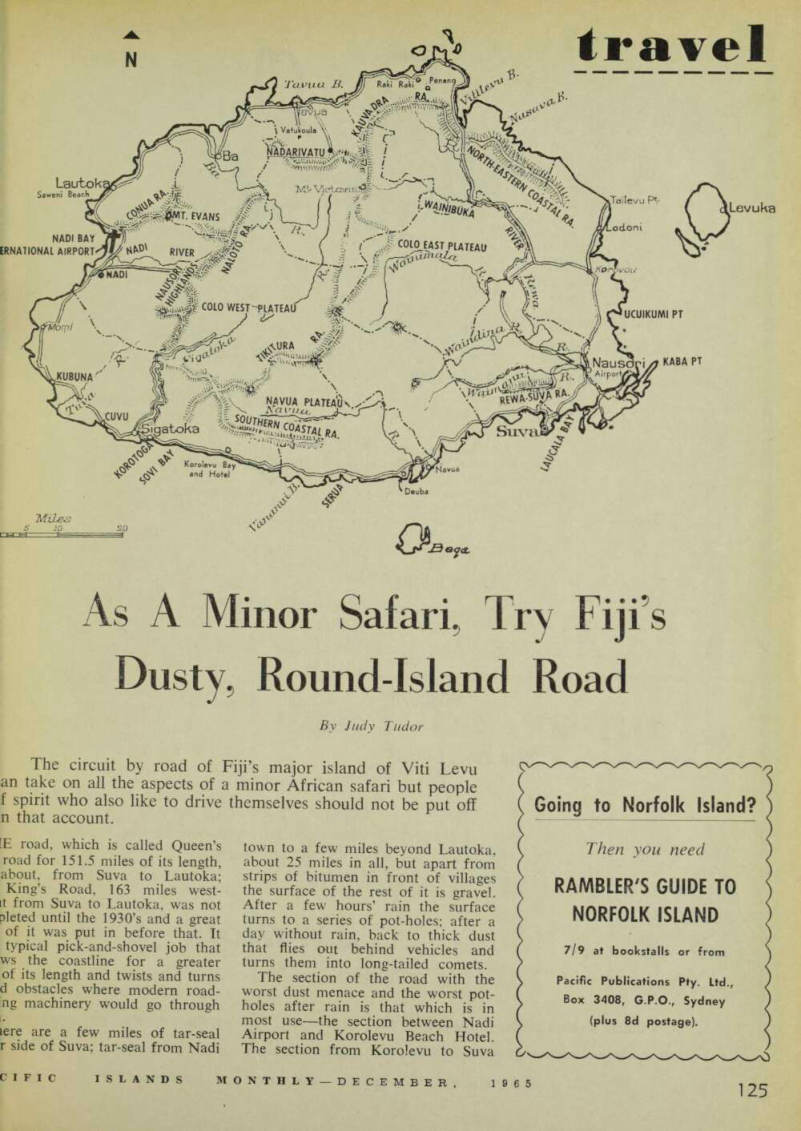
The circuit by road of Fiji’s major island of Viti Levu an take on all the aspects of a minor African safari but people f spirit who also like to drive themselves should not be put off n that account.
E road, which is called Queen’s road for 151.5 miles of its length, about, from Suva to Lautoka; King’s Road, 163 miles west ;t from Suva to Lautoka, was not Dieted until the 1930’s and a great of it was put in before that. It typical pick-and-shovel job that ws the coastline for a greater of its length and twists and turns d obstacles where modern road ng machinery would go through icre are a few miles of tar-seal r side of Suva; tar-seal from Nadi
town to a few miles beyond Lautoka, about 25 miles in all, but apart from strips of bitumen in front of villages the surface of the rest of it is gravel.
After a few hours’ rain the surface turns to a series of pot-holes; after a day without rain, back to thick dust that flies out behind vehicles and turns them into long-tailed comets.
The section of the road with the worst dust menace and the worst pot holes after rain is that which is in most use—the section between Nadi Airport and Korolevu Beach Hotel.
The section from Korolevu to Suva
not much better. The section of ig’s Road from Tavua right through Suva, although it, too, has its bad iods is, on the whole, in far better idition than the more popular een’s Road. fhe traffic on Fiji roads has in ased tremendously in recent years, art from tourist vehicles, the dom ting impression of travel along sen’s Road is the number of taxis, h enveloped in its own cloud of t and full of Indians, madly speed off somewhere. Road haulage of e (in the crushing season) has also reased —it was once hauled almost irely by locomotive. 7 iji also has its own brand of roadf —with drivers of cane trucks and kers at the top of the list. Traffic ice may sometimes patrol Viti m roads but if so they are rarely a.
Poor State Of Roads
'he state of the roads in Fiji, which v counts tourism amongst its top astries, causes endless comment at ae and abroad. But the Govern it has not yet been able to face to the enormous cost—enormous Fiji, that is—of sealing even :en’s Road, although the Govem it and its advisers are well aware : the longer it is left the more it cost.
Lbout five years ago the cost of ing the rest of Queen’s Road was mated to be about £F4 million. zst estimate is more than double lonetheless, in spite of the worst
that can be said about these condi tions, there is much that can be said in favour of a touring holiday around Viti Levu, driving a rental car your self and making your own pace, which should be as leisurely as possible.
Apart from the hurricane season, when there are flash floods and an occasional washaway, there are no natural hazards to driving around Viti Levu. No spectacular feats of derring-do are required; there are no 5,000 ft mountain passes to negotiate or rivers to ford.
If you are to get any pleasure and
benefit, the trip should be spaced over a minimum of four days. This will give time for a late start and ample time out for tea, a beer, or lunch at a wayside hotel, for a picnic, photography, a swim, or a few devia tions from the main road.
A suggested timetable is as fol lows: First day: Nadi airport to Rakiraki.
Second day: Rakiraki to Suva.
Third day: Suva to Korolevu- Siga toka coast.
Fourth day: Korolevu-Sigatoka to Nadi.
Nadi Airport-Rakiraki
The distance from Nadi airport to Rakiraki Hotel is a little over 82 miles. With all the breaks thrown in you can spend the best part of a day doing it—or rush it in three hours.
The first 21 miles is tar sealed and there then follows several miles under reconstruction that reduces speed to 2 mph. The rest of the road is gravel.
The first town after leaving the air port is Lautoka, 15 miles away. This is the second biggest town in Viti Levu, the biggest sugar producer and shipping port. It has two hotels but if you are too early for morning tea push on another 23 miles to Ba.
Ba is another sugar centre and probably the fastest growing town in Fiji. At present it is in the throes of a giant programme of reconstruc tion, roads are being re-routed and
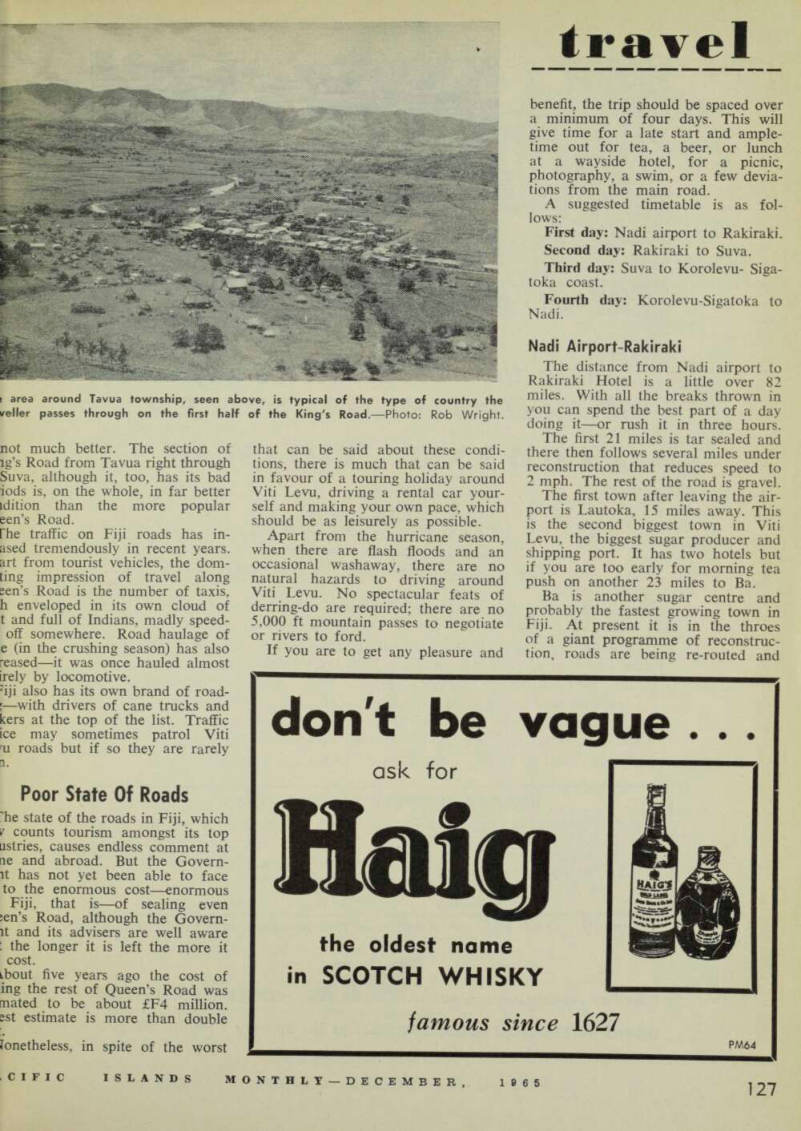
[?] area around Tavua township, seen above, is typical of the type of country the [?]eller passes through on the first half of the King's Road.— Photo: Rob Wright.
ic whole thing looks as though it is covering from a war.
The new hotel that Northern Hotels td. is building to replace the old pub lould be completed by Christmas, will have air-conditioned bedrooms id suites, lounge, dining room, coffee top and swimming pool. Nonetheless is difficult to see Ba as a tourist wn. It is located several miles up e Ba River, surrounded by a sea : sugar cane.
It is just under 17 miles further i to Tavua, at the junction of King’s oad and the Vatukoula Road. There a small country-style hotel at ivua with a view over the cane- Ids and out to the coast. Before nching here you can drive an extra miles which will take you up to e gold mines at Vatukoula and back, le Emperor Gold Mining Co. em- Dys about 1,500 people and over 0 million worth of gold has been tracted from deep and open cut ining.
Fiji's Highest Peak
Alternatively, if you have provided urself with a picnic lunch, con ine on, along King’s Road out of vua for 1.6 miles to the Nadarivatu :n off, on your right. Nadarivatu 14.5 miles along this secondary id at an elevation of 2,700 ft.
It was an important milling area, now a forestry area and has often sn spoken of as a potential hill lion for Fiji. There are a few week -1 houses there and it is a cool d pleasant place, only a few miles >m Fiji’s highest peak, Mt. Victoria 341 ft).
From the junction of the Nada atu Road with King’s Road it is urther 25i miles to Rakiraki Hotel, e hotel is on the main King’s Road, >ide Rakiraki village, but there is slight confusion in names around s point as the local township is led Vaileka and is about two miles >m the hotel on a branch road; and : Penang sugar mill, which is the ison for local prosperity, is a mile ther on from Vaileka.
The scenery from Tavua right ough to Rakiraki is pleasant, lleys of sugar cane alternate with ;ged and fantastically shaped •untains and you are never very from sight of the coast.
Rakiraki is one of the older hotels : friendly hospitality makes up for other short-comings. It is situated a very pleasant garden where, in evenings, you can sip your beer 1 get to know some of the local
residents, Fijian, Indian and Euro pean—which is rarely the case these days in most of the Colony’s plushier hotels.
The Rakiraki area, with its off shore islands and proximity to Viti Levu Bay, seems capable of consider able tourist development. It is sur prising that the new hotel is not being built here rather than at Ba.
Rakiraki To Suva The distance by road from Rakiraki to Suva is 97 miles. There is a hotel (Tailevu Hotel), at Korovou, 65 miles from Rakiraki, so eating arrange ments should be made accordingly.
The first 23 miles of the road skirts the coast, including the big indenta tion called Viti Levu Bay, which has the only inviting white sand beaches for 100 miles in either direction.
The road then leaves the coast, cuts right across the north-east shoulder of Viti Levu, and for the next 30 miles follows the Wainibuka River, one of the tributaries of the Rewa. Here and along all the other tributaries of the Rewa system there is a big Fijian population whose main cash income comes from the export of bananas.
Eight miles south of Nayavu the road junctions, the right-hand branch going seven miles to Vunidawa and passing close to where the Wainibuka and Wainimala Rivers join to form the main stream of the Rewa. King’s Road turns left, and east, from the junction to Korovou a dairying centre about eight miles further on; then turns due south 20 miles to Nausori and from there crosses the Rewa River and completes the journey into Suva with a further 12 miles of road which is tar-sealed.
For those who want deviations, there is one from Korovou 14i miles north of Natovi, from where launches run to the island of Ovalau. From Nausori it is also possible to drive to Bau, significant in early Fijian
history, by proceeding a mile past the airport then turning north for about seven miles.
Suva To Sigatoka On Queen's Road The distance from Suva to Koro togo village is 81 miles. Sigatoka is four miles further on. This is the [nost popular piece of coast in Fiji and the touring motorist will have no trouble filling in a day on this part of the journey. Deuba, and the Beachcomber Hotel, are 34i miles :rom Suva —just a good distance for norning tea or, if you have made a ate start from Suva, an early lunch.
Another 30 miles will bring you ;o Korolevu, and between Korolevu and the township of Sigatoka there are 20 miles of palm-fringed sandy reaches where you can pull off the -oad and be as secluded as though m your own Pacific island. (See article PIM, Oct. p. 117.) There is a good choice of accom nodation with Korolevu Beach Resort at one end, Sigatoka Hotel at the >ther, and Reef Lodge Hotel, Sandy Point Cottages and Palm Beach Cottages within a mile of Korotoga,
>igatoka To Nadi Airport
The distance from Sigatoka to Nadi airport is 50 miles and, except for and for Yanuca Island, eight niles out of Sigatoka, where a new aotel is to be built, this is the most minteresting part of the whole 315 niles of the circuit of Viti Levu.
It can be done comfortably in inder two hours, which leaves time J or a deviation up the Sigatoka /alley. The road follows the left jank of the river for 34 miles to a lord, which is best not attempted vith a conventional vehicle.
The valley is the most intensely :ultivated part of Fiji and produces obacco, passion fruit, tomatoes, pota oes, maize, native vegetables and aises livestock. For those with in efficient time to see the whole valley, here is a very good lookout over ome of the lower reaches from a >oint about three miles from Sigatoka Jridge. A very good native bure has >een built at this point and can be ised for a picnic.
Hire Several firms hire drive-yourself 'chicles. Costs are about the same is in Australia and vary with the ype of car hired. If comfort is jssential, go for a heavy vehicle; it rill ride the corrugations better.
Hire of a Morris 1100 is £F2 per lay or £FI3 per week plus 7d a nile; a Holden sedan or station vagon is £F2.10 per day or £FI6 )er week plus 9d a mile. Insurance n each case is 6/- a day extra.