Justice versus sorcery
pp. 93-94 · Read in the full issue
The Month's New Reading
Justice versus sorcery In New Guinea
For 40 years, until his retirement in 1963, Mr. Justice [homas Gore administered the law and dispensed justice in ie primitive territories of Papua and New Guinea. In many espects his is a record without equal in the South Pacific.
IS book, Justice Versus Sorcery, gives us the essence of those s (four as a Crown Law official 36 on the Bench), and students unborn will have reason to bless for leaving the record, is a valuable and entertaining ative, because Judge Gore has ied with him into his retirement indying sense of humour, and a lory from which he has given :ountless stories of incidents in jungle and on the Bench, most hem really funny and many of i incredibly bizarre, e needed a sense of humour to ire the conditions under which ived on his “jungle circuits”, tie real value of the book, how , lies in the way in which this wd, kindly observer of primitive has given us a picture of dtive men as he saw them first, of the way in which they were ht to abandon murder and libalism and sorcery, and accept white man’s law.
A Sociological Study
obably nothing was further from ;e Gore’s thoughts than the pilation of a sociological study, that is what we have here. r years from now historians and jrs will gain from his book the atmosphere of the changes that place in these vast islands in middle period of the twentieth jry, the period of “colonialism”, dge Gore joined Hubert Murray ’apua in 1924, when the scanty >pean settlements along the coasts barely brushed the fringes of the r e communities, now totalling two on people, who inhabited the territory. Most of the region was officially labelled “un rolled”. When he left 40 years all the people except a little lant in the western centre of the i island were under control— h means that the stranger today
can go almost anywhere in the Territory without fear or molestation.
Millions of words have been written in criticism of Australian administration, and in condemnation of native “exploitation”. The over riding fact is that a combination of Australian officialdom and Aus tralian private enterprise, within a
half-century, has changed this vast area from a land of primitive savagery to an orderly country that is close to self-government and to general acceptance of Western stan dards.
Within the pages of Justice and Sorcery it can be seen how it was done by kindliness, incredible patience, and a tolerant understanding of the mentality of Stone-Age men.
It was not, of course, all done by policemen and law courts, any more than by the recruiting of super stitious savages to work in planta tions and gold-mines, or the sacrificial work of bush missionaries. But it was done by a combination of all such factors; and at the back of it
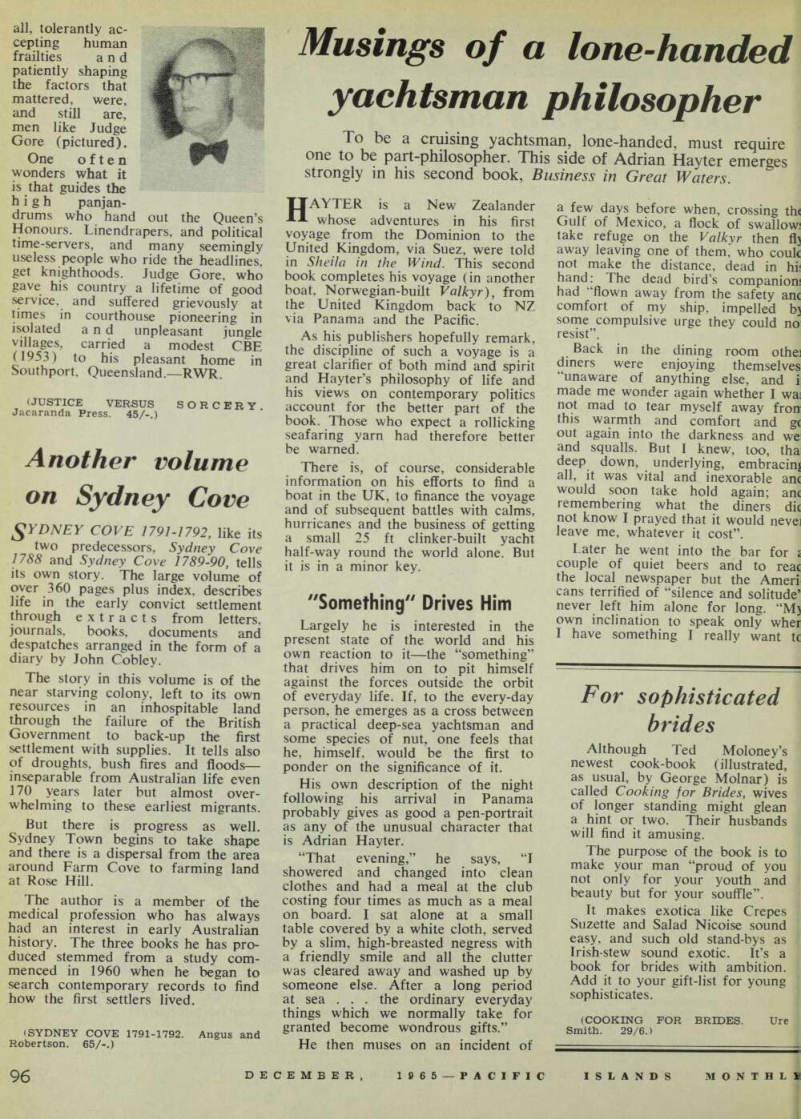
all, tolerantly ac cepting human frailties and patiently shaping the factors that mattered, were, and still are, men like Judge Gore (pictured).
One often wonders what it is that guides the high panjan-
drums who hand out the Queen’s Honours. Linendrapers, and political time-servers, and many seemingly useless people who ride the headlines, get knighthoods. Judge Gore, who gave his country a lifetime of good service, and suffered grievously at times in courthouse pioneering in isolated and unpleasant jungle villages, carried a modest CBE (1953) to his pleasant home in
Southport, Queensland.
Rwr.
( Justice Versus Sorcery
Jacaranda Press. 45/-.)