When 'Floggings'
pp. 83-90 · Read in the full issue

That More Gentle Age When 'Floggings' Were The Rule
G. A. V. Stanley, who died in Port Moresby on October 6, was a man of independent mind and spirit, who liked nothing better than a good controversy. He would have been delighted lad he known that only a month after his death a photograph :ound among his personal papers would touch off a burst of publicity that would fill the front pages of some of the Austra ian newspapers. The photograph was a censored picture of a >ublic caning of several Germans and a Belgian in Rabaul )n November 13, 1914, by order of the Australian Military Administrator, Col. William Holmes.
IE canings were ordered as “exemplary punishment” for an lult committed at Namatanai, v Ireland, on the Rev. William iry Cox a British national, who chairman of the Methodist sion in the Bismarck Archipelago. : was assaulted because of a »icion that he had been a spy for Australian forces, fatives were forbidden to be in vicinity of Proclamation Square n the canings took place; but nale German residents of Rabaul 5 ordered to attend, although they 5 not compelled to witness the ishments.
Ithough the Military Administra i orders were that no photographs ' to be taken, an American
ship’s fireman took one without being observed, and so apparently did at least two other people. Searches were made by the Australian Government for the photographs at the time, after a copy of one of them was sent to a Brisbane newspaper, which referred it to the censor, but no copies were found.
Nevertheless, one of the photo graphs reached the German Govern ment in Berlin where a note of protest was lodged about the canings.
This touched off a wartime con troversy about the whole affair.
The fact that, 50 years later, a copy of the photograph was found m GAV’s papers, was cabled in November to the Australian news papers by a Port Moresby journalist,
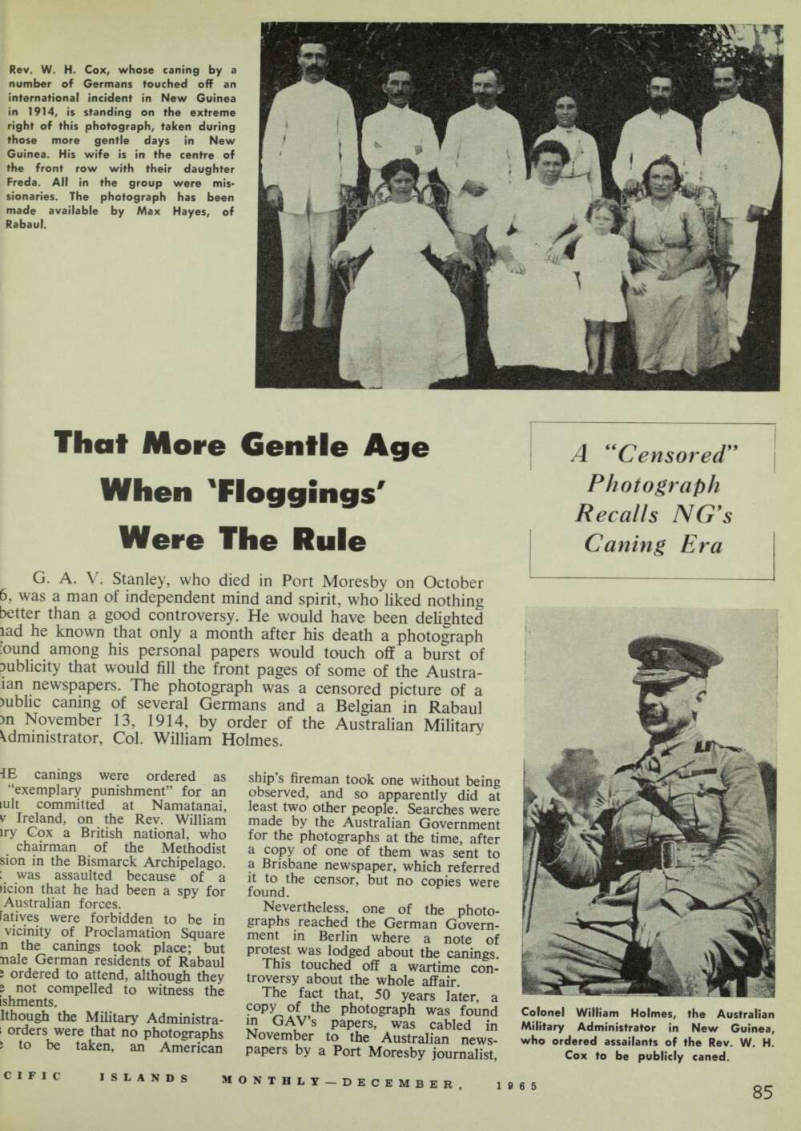
Rev. W. H. Cox, whose caning by a number of Germans touched off an international incident in New Guinea in 1914, is standing on the extreme right of this photograph, taken during those more gentle days in New Guinea. His wife is in the centre of the front row with their daughter Freda. All in the group were mis sionaries. The photograph has been made available by Max Hayes, of Rabaul.
A “Censored ”
Photograph Recalls NG’s Caning Era
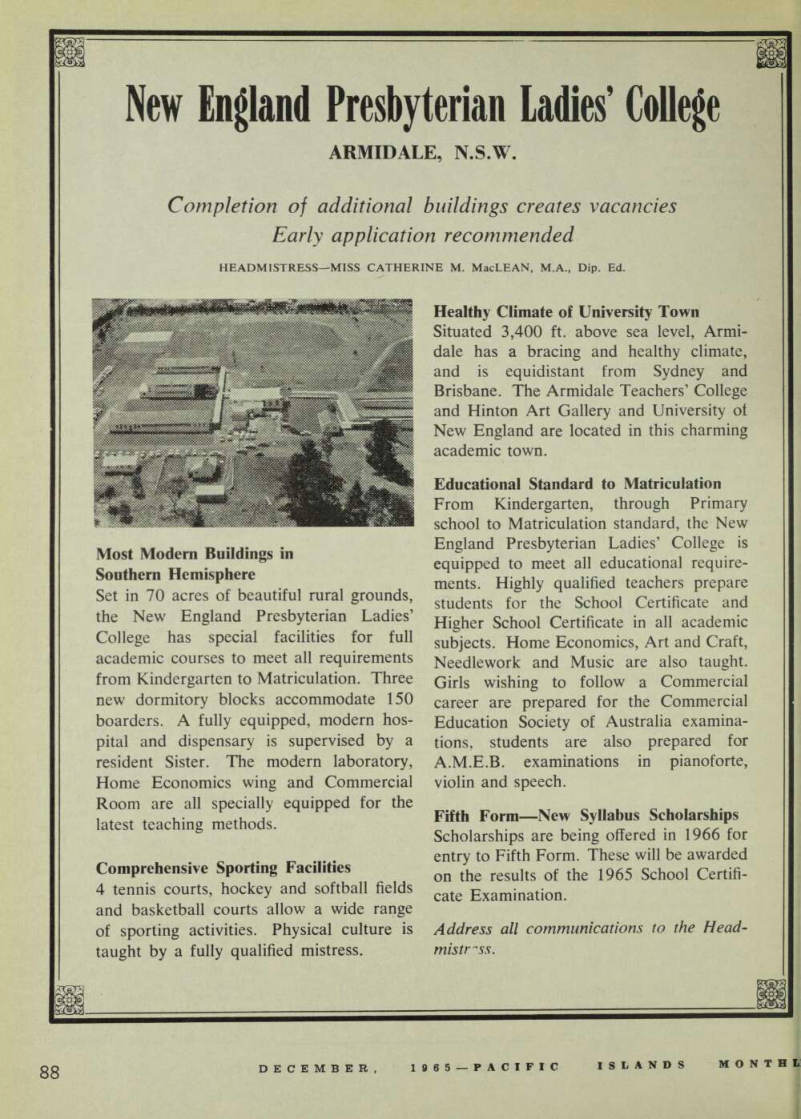
Colonel William Holmes, the Australian Military Administrator in New Guinea, who ordered assailants of the Rev. W. H.
Cox to be publicly caned.
gether with an account of the iginal caning, and the background • it.
There was a wild scramble by the ustralian newspapers to get hold of e censored photograph, and this rned out to be easier than the Press id imagined. With the publicity tout GAV’s copy, many people loned up the newspaper offices to y they had copies, too—kept all ese years from the censor’s hands, le copies had been offered for sale the time by one or other of the rreptitious photographers.
Also to hand came one or two d-timers former Australian )opers—who had witnessed the ning, and their accounts brightened i the news pages and the radio ws commentaries. Some of their jmories weren’t, unfortunately, very od.
"Convict Times"
“Do you remember how you men t when these people were being blicly flogged?” one interviewer ked of a former trooper.
“Yes I do. We felt it was terrible, e felt we must have been back in 5 convict times.”
But others, not quoted in the news pers, who also remember those ics, recall the caning of the :rmans as a not-very-special in lent at a time when caning was ' order of the day. Quite a number years were to pass, and much )re was to be said in Australia, be ■e caning was finally prohibited as method of punishment in New linea. Caning was generally re red to as “flogging”, although the m was incorrect.
The assault on the Rev. William nry Cox, which was in fact a ling, and the official caning of the rmans concerned in it, were
merely symptoms of a gentler day and age.
The assault of Mr. Cox occurred on October 26, 1914, after Aus tralian forces had occupied Kavieng, but before any of them had arrived at Namatanai.
There was much tension among German officials in the township and
there was also considerable unrest among local natives. German officials and planters believed that the native unrest had been caused through the influence of teachers belonging to the Methodist Mission, and they also be lieved—again incorrectly—that Mr.
Cox was a spy.
A number of Germans, including the German medical officer, and a Belgian planter, decided, after a drinking session, that Cox deserved a thrashing.
Three of the party rushed into the mission house where they found Cox talking to the missionary’s wife.
The medical officer pointed a pistol at Cox and exclaimed, “You are a prisoner”.
Cox was then seized by the neck, pushed or dragged out of the room on to the verandah and down the steps, held down over a wash-tub, and given 30 or 40 strokes with a cane. His assailants then ran away, and were seen by the German mis sionary as he was returning to the station.
The Official Story
When this affair was reported to Colonel Holmes, he had an inquiry made by a Captain Manning, and the Germans concerned admitted in writing what they had done. In Volume X of the Official History of Australia in the War of 1914-18, Seaforth Mackenzie reports: “To Holmes, this action against a prominent British subject—and a missionary—by Germans living under the authority and protection of a British government in newly-con quered territory naturally appeared to be one of outrageous insolence and defiance. ... In the highly charged state of a war atmosphere, the assault seemed, when first re ported, to have been purposely com mitted in order to insult the British character and cause. The indignation
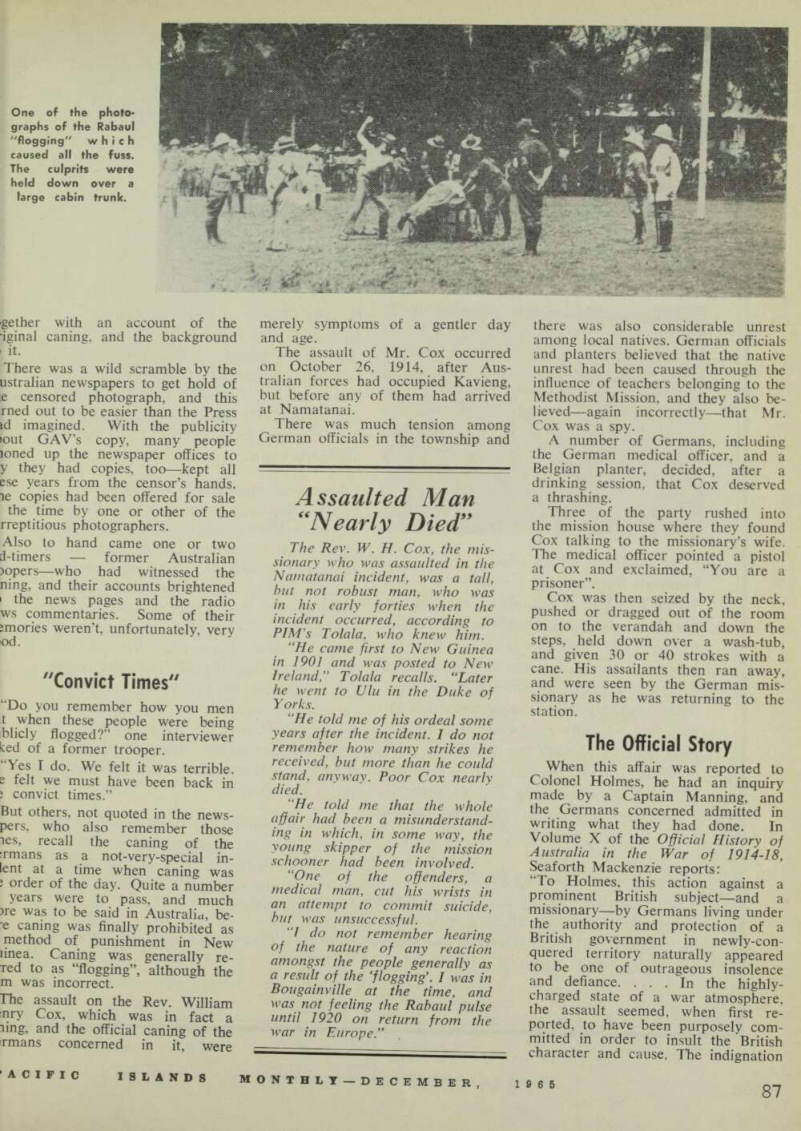
One of the photo graphs of the Rabaul "flogging" which caused all the fuss.
The culprits were held down over a large cabin trunk.
oused was intense, and the crime died for prompt punishment and ippression.
“Especially did Holmes conceive at the dignity and authority of the ilitary administration had been tentionally flouted. To persons parated from these events by a ide distance of time or space, it is :rhaps easy to judge that he wrongly signed to the occurrence a political dour which clouded his usually ear vision; yet the judgement must 5 passed.
“Here is no question as to whether 5 was morally justified in retaliating r a brutal act by inflicting similar mishment on the offender; the >ue is legal and political—not moral.
“In the face of a delicate inter itional situation, with the tide of cial feeling running full, he decided treat Manning’s report as a con usive judicial finding, and to dis use with a trial.”
30 Strokes For Ringleader
Holmes went ahead and issued an der that the Germans should be iblicly punished.
The order then prescribed that the igleader should receive 30 strokes th the cane, and the others 25 okes each, except for the German ictor’s young assistant who was to zeive 10.
Before the punishments were in cted, the Australian Administrator ade a speech in Proclamation
Square in which he explained the reasons for it and warned the German residents who had been compelled to attend that assaults on Bntish subjects would not be tolerated.
All the Germans, except Weber, the former German judge, and another German then left, and the arrested , were P l i nished witt ! a about as thick as a mans thumb .
Subsequently, as a protest against .proceedings, all the German officials resigned their posts as advisers to the Administration.
The question of whether Colonel Holmes’ action was legal was immediately raised in the Common wealth Parliament. When the Minister for Defence, Senator Pearce, looked into the dispatches, and found that the pumshments were not the result a vf court ’ he . assured insfrnrt?n!f f W ° U d issue an nstruction that this form of punishment should not again be employed.
Meanwhile, the Australian Government had sent a fuller statement of the case to England, based on an opinion from Pitt Cobbett, Emeritus Professsor of Law in the University 91 Sydney, who contended that Colonel Holmes action was justified.
He said that the offence constituted an infraction of the proclamation of martial law previously issnpH bv
Holmes, an* tEe
had ° been'°a S precaution miuary fU'c i A , • • * . .
With this legal opinion to back it
up, the Commonwealth Government refused to bring Holmes to trial, The Holmes’ affair wasn’t the end G f the cane in New Guinea. It was widely being used to keep the natives in c heck, and the publicity over the Holmes’ affair resulted in the Aus tralian Government making a review of the position.
Under the Germans, permits had always issued to employers of native labour to punish breaches of discipline and such things as neglect of duty> lazin re fr ac tory conduct and absenc e without cause could be dealt with by flogging or birching or by toiling with or without chains, * . r
Outcry From Planters
when the Australians took over, and unt il August, 1915, this system was maintained without alteration, and it caused no special interest. But then the Australian Government in structed the military administration that flogging of natives was not to be permitted in future. On August 15 that year the regulations were amended to forbid corporal punish ment by anybody other than a gov ernment official following a judge’s order.
T hk M ew Oninprf i“Ski a ? °. utcry *5 Guinea from the planters and '***’' ° f Wh ° m Were A “ter of protest from five leading German companies to the Administrator said the amendment had caused great consternation and
jciety among all settlers of the )lony.
The letter said: “As soon as the fives get aware of this change of s regulations, it will be impossible keep up the absolutely necessary jcipline amongst the labourers and 5 boys will neglect their work to ch an extent that the lucrativeness all plantations is questioned . . . ; natives of these islands are man beings of the very lowest mdard of life in the whole world, d their education is therefore like ught. Even the natives around ibaul, though being in continuous ich with white people for over 30 ars, are not yet more than children, d they have to get a licking just well as every naughty boy in ilised countries gets from his rents or schoolmasters”.
C. D. Rowley, in his Australians German New Guinea 1914-1921 :ords that at the end of 1915 the litary administrator reported to the istralian Government that total Dhibition of flogging for labour ences had been a mistake.
“It is also evident that natives are w taking advantage of the know ige that their masters, or even icials, are powerless to inflict the ly publishment that they dread, and ; becoming cheeky and more Ficult to manage,” the administra said.
Phe officer-in-charge of native airs reported that “matters are ting serious”. He added, “From areas the statement is made that ys are out of control. Gaol is ighed at, especially in Rabaul, as : boys get better food and very le work. I do not say that flogging mot be done without but I do nk that such a drastic change ght be introduced gradually by awing the court to order floggings >r labour offences)”.
"losing Control"
Phe harbour master reported that ropean officers on administration ps were losing control of their ;ive crews.
Fhe Australian officer at Kavieng •orted that the number of deser ts was assuming great proportions 1 “they simply laugh at any order return to work and welcome the a of calaboose, which is no shame a nigger”.
From many other areas, however, such complaints were coming in, the good reason that flogging s going on anyhow, illegally.
Linder this pressure the Australian •vernment relented, and in regula
tions gazetted in January, 1916, allowed canings to be ordered by officials after proper inquiries into each case. Canings could again be administered for desertion, or for gross insubordination.
Within three months the admini strator was reporting to the Aus tralian Government that “since restricted flogging has been permitted a marked improvement has been seen in the general behaviour of the natives and I think that difficulties
previously reported will gradually disappear”.
Meanwhile more and more canings were going on without the procedure of formal inquiry and even missionaries in one area in 1917 were arranging for the Government’s own native officials—the luluais—to inflict illegal floggings.
This state of affairs continued until the end of the war.
Probably the first post-war publicity in Australia came with a
Norman Lindsay cartoon in th Bulletin in 1919, showing a Germai Governor whipping a native labourer with an Australian soldier standin by at attention.
The Press again took took up th matter of “floggings”, and publi opinion was aroused.
So the Australian Cabinet mad( another about-turn. In March, 1919 it decided that flogging was not t< be permitted. The new possessioi was to be administered “in accor dance with British traditions”.
The then administrator, Brigadier General G. J, Johnston, proteste* to Australia that the advice of ex perienced officers had not been cor sidered before Cabinet made it decision. He said corporal punish ment was less severe in New Guinei than that inflicted to boys in Britisl public schools, and therefore it wa in the “British tradition”.
Official documents, recorded by C D. Rowley, show that Johnstoi pointed out that the inconvenience of bringing in a native for imprison ment could be avoided by flogginj him where he had committed th offence. Also, there was the in convenience to an officer whose “thieving boy” might be gaoled rather than flogged, and thus he would have to get along with anothe: one “freshly caught from the bush”
Johnston said German New Guinej had better control of the native than had “its neighbours” (meaninj Papua), and the opinion of respon sible officers should outweigl “irresponsible, sentimental gu s I indulged in by people with little o no practical experience”.
The Brigadier also reported at tha time, 1919, that he was now tryinj to arrange a new table of punish ments to take the place of the bannec canings, and that he would nee« more handcuffs and leg irons.
He soon ordered 300 pairs of hand! cuffs and 100 sets of leg irons (h was refused the leg irons) and sai« he was considering experimentinj with chain labour gangs, stone break ing, “the old fashioned” stocks am pillories and the cutting of hair foi minor offences.
Johnston’s attitude was an indicas tion of what was to continue. Caning; did not stop—they simply went under ground for many years, and were stil being inflicted after Australiai planters took ever expropriate* German properties.
For years stories of the flogginj of natives, some accompanied b; photographic evidence, got back t< Australia, where they continued U cause as much public interest as hat the caning of the Germans in 1914.