Pacific Planters’
pp. 73-75 · Read in the full issue

Digest
Replanting Coconuts
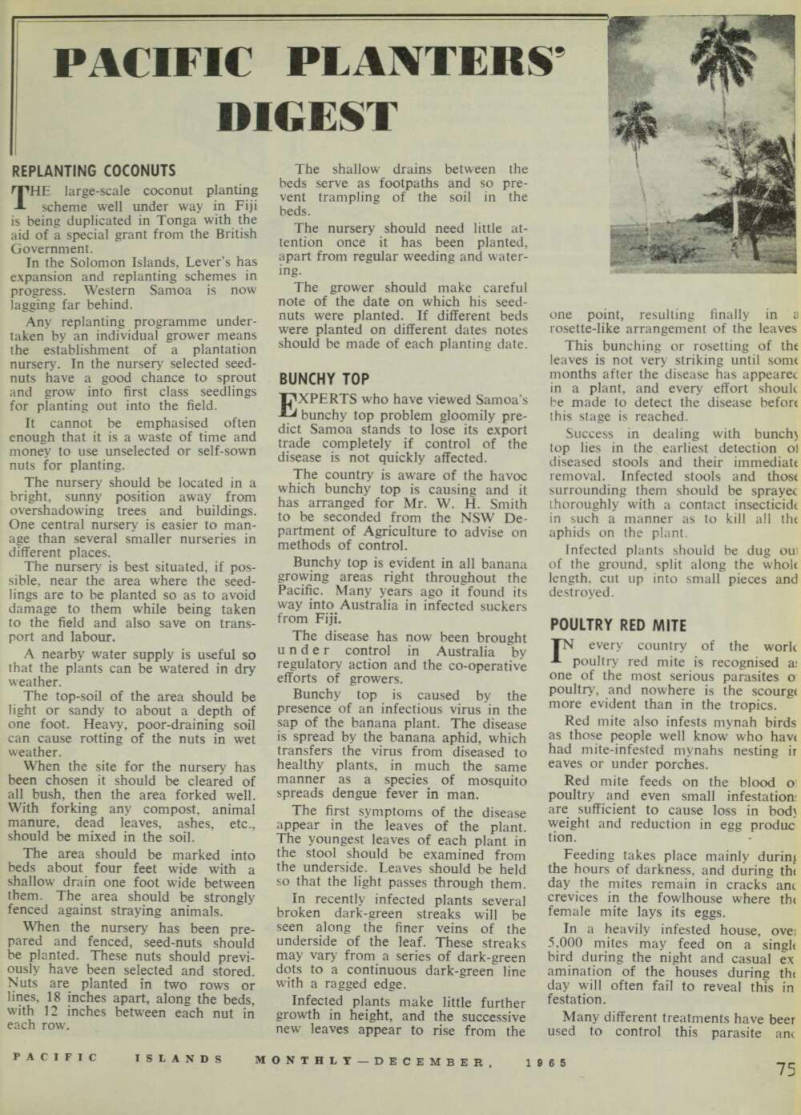
THE large-scale coconut planting scheme well under way in Fiji is being duplicated in Tonga with the aid of a special grant from the British Government.
In the Solomon Islands, Lever’s has expansion and replanting schemes in progress. Western Samoa is now lagging far behind.
Any replanting programme under taken by an individual grower means the establishment of a plantation nursery. In the nursery selected seed nuts have a good chance to sprout and grow into first class seedlings for planting out into the field.
It cannot be emphasised often enough that it is a waste of time and money to use unselected or self-sown nuts for planting.
The nursery should be located in a bright, sunny position away from overshadowing trees and buildings.
One central nursery is easier to man age than several smaller nurseries in different places.
The nursery is best situated, if pos sible, near the area where the seed lings are to be planted so as to avoid damage to them while being taken to the field and also save on trans port and labour.
A nearby water supply is useful so that the plants can be watered in dry weather.
The top-soil of the area should be light or sandy to about a depth of one foot. Heavy, poor-draining soil can cause rotting of the nuts in wet weather.
When the site for the nursery has been chosen it should be cleared of all bush, then the area forked well.
With forking any compost, animal manure, dead leaves, ashes, etc., should be mixed in the soil.
The area should be marked into beds about four feet wide with a shallow drain one foot wide between them. The area should be strongly fenced against straying animals.
When the nursery has been pre pared and fenced, seed-nuts should be planted. These nuts should previ ously have been selected and stored.
Nuts are planted in two rows or lines, 18 inches apart, along the beds, with 12 inches between each nut in each row.
The shallow drains between the beds serve as footpaths and so pre vent trampling of the soil in the beds.
The nursery should need little at tention once it has been planted, apart from regular weeding and water ing.
The grower should make careful note of the date on which his seed nuts were planted. If different beds were planted on different dates notes should be made of each planting date.
Bunchy Top
EXPERTS who have viewed Samoa's bunchy top problem gloomily pre dict Samoa stands to lose its export trade completely if control of the disease is not quickly affected.
The country is aware of the havoc which bunchy top is causing and it has arranged for Mr. W. H. Smith to be seconded from the NSW De partment of Agriculture to advise on methods of control.
Bunchy top is evident in all banana growing areas right throughout the Pacific. Many years ago it found its way into Australia in infected suckers from Fiji.
The disease has now been brought under control in Australia by regulatory action and the co-operative efforts of growers.
Bunchy top is caused by the presence of an infectious virus in the sap of the banana plant. The disease is spread by the banana aphid, which transfers the virus from diseased to healthy plants, in much the same manner as a species of mosquito spreads dengue fever in man.
The first symptoms of the disease appear in the leaves of the plant.
The youngest leaves of each plant in the stool should be examined from the underside. Leaves should be held so that the light passes through them.
In recently infected plants several broken dark-green streaks will be seen along the finer veins of the underside of the leaf. These streaks may vary from a series of dark-green dots to a continuous dark-green line with a ragged edge.
Infected plants make little further growth in height, and the successive new leaves appear to rise from the
one point, resulting finally in a rosette-like arrangement of the leaves This bunching or resetting of the leaves is not very striking until some months after the disease has appearec in a plant, and every effort shouk be made to detect the disease befon this stage is reached.
Success in dealing with bunch} top lies in the earliest detection ol diseased stools and their immediate removal. Infected stools and those surrounding them should be sprayec thoroughly with a contact insecticide in such a manner as to kill all the aphids on the plant.
Infected plants should be dug oui of the ground, split along the whole length, cut up into small pieces and destroyed.
Poultry Red Mite
TN every country of the work poultry red mite is recognised a; one of the most serious parasites o poultry, and nowhere is the scourge more evident than in the tropics.
Red mite also infests mynah birds as those people well know who have had mite-infested mynahs nesting ir eaves or under porches.
Red mite feeds on the blood o: poultry and even small infestation: are sufficient to cause loss in bod} weight and reduction in egg produc tion.
Feeding takes place mainly during the hours of darkness, and during th( day the mites remain in cracks anc crevices in the fowlhouse where th< female mite lays its eggs.
In a heavily infested house, ovei 5,000 mites may feed on a singh bird during the night and casual ex amination of the houses during th( day will often fail to reveal this in festation.
Many different treatments have beer used to control this parasite anc
frequently poultry keepers rely upon regular creosoting of fowlhouses to keep infestations at a low level.
Partially effective treatments, how ever, only reduce mite numbers for a short period because during the summer months the life cycle takes only 7-10 days to complete, and even small numbers of mites can affect the health of the birds.
For complete control of the mite the residual insecticide, Sevin, has proven its worth over the last two years in many tropical areas.
Spraying of Sevin 5 per cent, on poultry is not necessary, the applica tion being made to the structure of the poultry house. Mites which are not killed by the initial spraying will be killed when they move over the treated surfaces.
Sevin spray can be used even with birds left in the houses during treat ment. This is particularly useful in large, deep litter houses containing upwards of a thousand birds, where the labour involved in moving the birds would be considerable.
Since Sevin has a very low mammalian toxicity it is not neces sary for the operator to wear elaborate protecting clothing provided he takes reasonable care.
Sevin in dust form has been proven outstandingly effective against fleas in cats and dogs and it can be used on both with utmost safety.