Pitcairn Has
p. 57 · Read in the full issue
Had Many Ups
And Downs
Pitcairn has been formally self governing since Captain Eliot of HMS “Fly” gave it its first constitution, with adult suffrage, in 1838, and it has been a cardinal principle of Britain to interfere with it as little as possible.
IN the succeeding hundred years the community had its ups and downs, including the evacuation to Norfolk Island and partial return, but two events changed the pattern of life entirely.
The first was the opening of the Panama Canal in 1915, which brought ships on the London to New Zealand run within a few miles of Pitcairn, and the second was the re direction of those ships in 1960, under the force of competition with airlines for the trans-Pacific tourist trade.
By 1920, passenger ships were breaking the tedium of the long voyage for a few hours at Pitcairn and both the social and economic order of the island were transformed.
The self-sufficient structure of communal life gave way to a new individualism, and the souvenir trade, stimulated by Laeffler, an Austrian craftsman who came to Pitcairn in the 1920’5, diminished dependence on subsistence farming; and arable land steadily degenerated into bush and weed.
Not the least of the consequences of the shabby, new economy—for the line between honest trading and sponging was often crossed—was that
it masked a growing crisis in the system of land tenure.
Originally, the land had been divided among the mutineers and, probably, the patriarchal John Adams saw to it that their descendants each received an equitable, family portion.
But over the years families varied in size; fortunate marriages were made —indeed new settlers such as the American Warrens, Browns and Clarks had no other way of acquiring land; and some of the emigrants who went to Norfolk Island never returned to claim their shares.
In consequence the pattern of ownership became uneven and the practice grew of leaving the land un divided, often in the name of a dead ancestor. Further emigration during and since the last war added to the confusion as more and more land fell into the hands of “caretakers” who were quite unable to use it.
Criticism began to grow but it might well have remained muted if the passenger ships, upon which the souvenir trade largely depended, had not been re-routed to Tahiti.
Suddenly, the young and active men who had come of age in the post-war years found their earnings and social contacts with the outside world reduced and their inheritance tangled in a web of tradition and indecision. Having had a reasonably good primary education and relatives in New Zealand to go to, they left
Pitcairn.
Margaret Cowell.
Present-day Magistrate (elected leader of the council) is John Christian, a descendant of the mutineers.
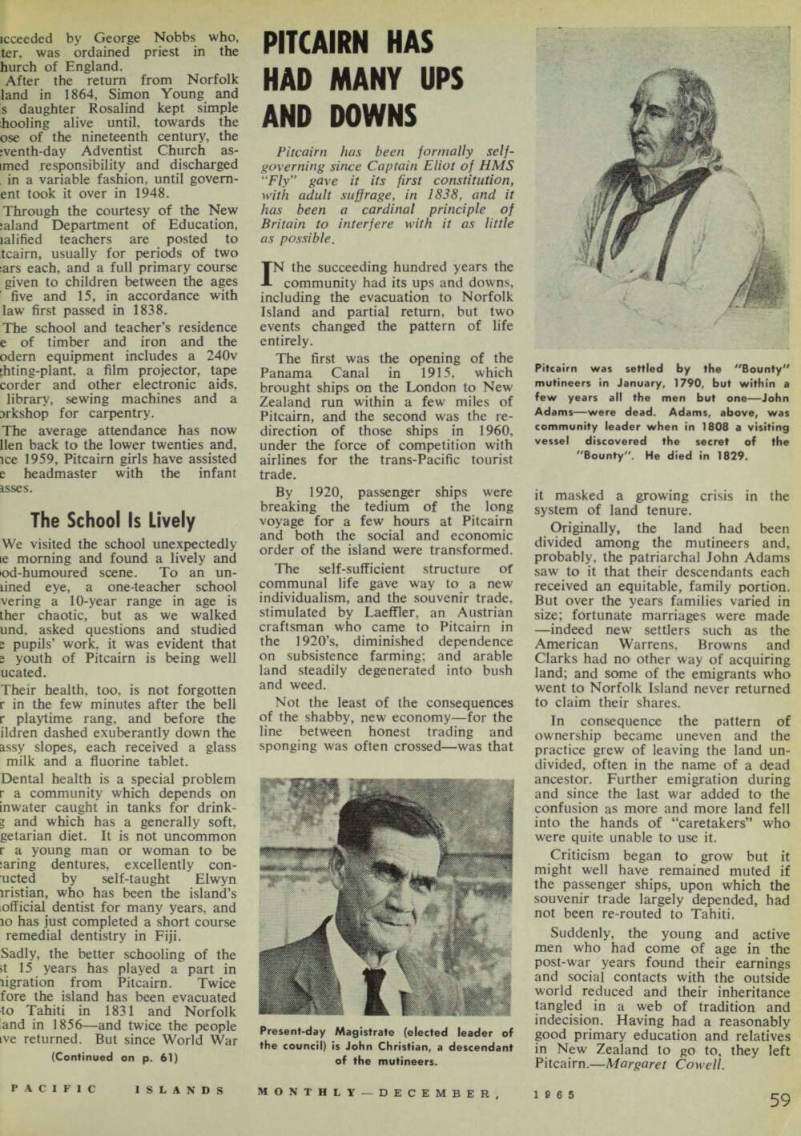
Pitcairn was settled by the "Bounty" mutineers in January, 1790, but within a few years all the men but one—John Adams—were dead. Adams, above, was community leader when in 1808 a visiting vessel discovered the secret of the "Bounty". He died in 1829.