Life On Todays Pitcairn
pp. 47-62 · Read in the full issue

From Margaret Cowell, in Suva
We left London on a bleak, wintry day earlier this year and three weeks later, having crossed the Atlantic and half the Pacific, sighted the familiar hump-back of Pitcairn rising from the blue sea. We had discovered how hard it can be to arrange a short visit to this lonely island three years before, when we had travelled the same long route. Then, our plan to drop off one ship and pick up another ten days later misfired.
three hours of our sight ing the island the launches and gboats were bobbing alongside 1 the Pitcairners, unkempt in their -clothes, were jumping for the ob’s ladder, scrambling up, each rying a leaf basket of stamps and ivenirs, fresh fruit and vegetables, trade with passengers and friends ong the crew.
garet Cowell is the wife of Mr. Reid ell, of the South Pacific Office, Suva, who Britain's administrative liaison officer for Pitcairn.
Pervis Young, the acting Magis trate, Ben Christian, the Secretary, and Jack Forster, the Education Officer, greeted us formally but quickly before calling on the Master and purser and going about their business.
In time nearly everyone else drifted by to welcome us also, and dart off again. They have only two hours on board and every minute is precious.
Trading comes first but cargo, too, has to be unloaded; wood-carvings are sold for almost any currency;
fruit and vegetables are bartered for flour, rice, meat and other stores; and, while the men take turn unload ing the cargo, the women, making most of the social opportunity, sell their woven baskets, fans, shells and grass skirts, and squander some of the proceeds on fripperies from the ship’s shop.
This is life to the Pitcairners, a crowded market day afloat: money, food, stores of all kinds from a few fathoms of rope, a few feet of dunnage, to the large, rain-storage tank for the school and the drums of
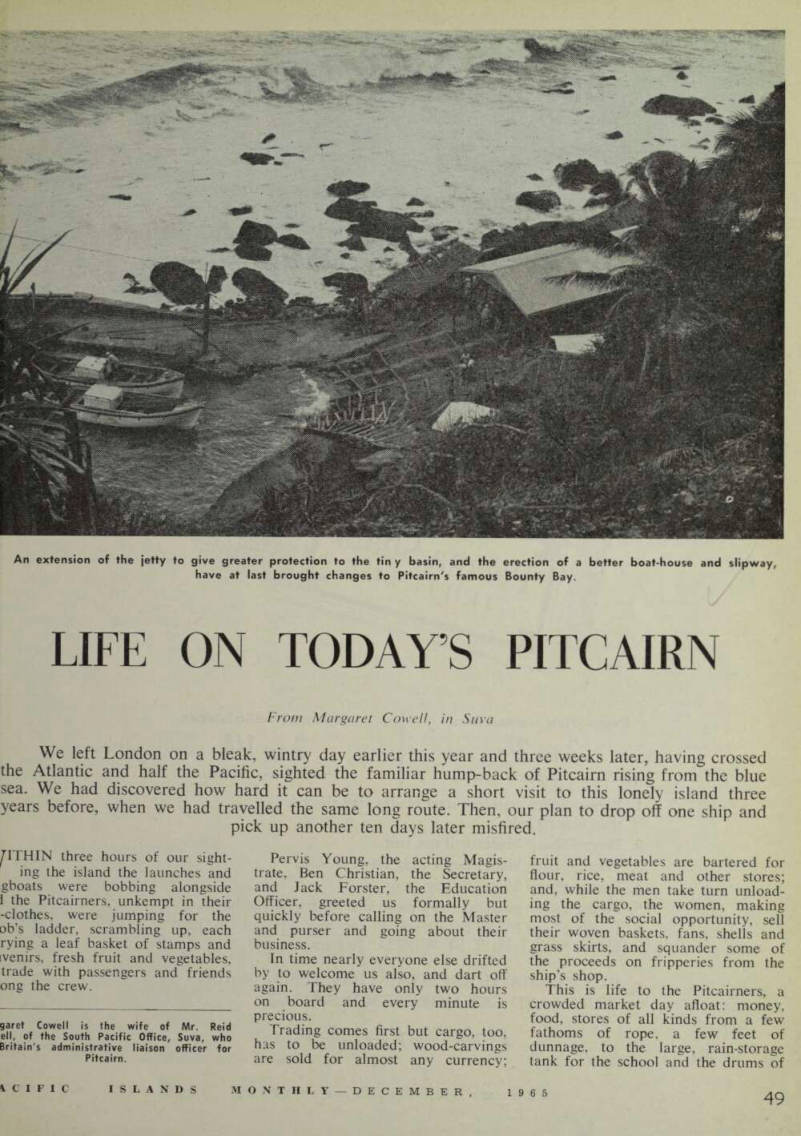
An extension of the jetty to give greater protection to the tin y basin, and the erection of a better boat-house and slipway, have at last brought changes to Pitcairn's famous Bounty Bay.
iesel fuel for their launches, genera >rs and recently-acquired tractors.
All this and the joy of company, >o, is every ship day at Pitcairn iland!
It was a good deal calmer than it ad been last time we went ashore ut, even so, we said goodbye to nr friends aboard a little reluctantly.
Most of the Pitcairners scuttled own; my husband went; and the late fastened a rope round my aist and wished me an encouraging oodbye.
I looked up with a fixed smile, aved, and stepped over the side id sea. A rope ladder is not [fficult to manage if you keep your ;ad, but crawling down the black all of a ship to a bobbing boat, ) feet or so below, is not my vourite pastime.
Headed For The Landing
But there were strong arms to pull e in across the last gap, lower me mtly on to the piled cargo and cast f the rope. The ship towered high >ove, and as the last legs tumbled >wn, and the engine of our launch, ie Reid Cowell, coughed into life, e Athenic moved slowly off.
The traditional song of farewell ed as the gap widened and in rnipany with the Dolphin, we turned Pitcairn and the landing at Bounty ay nearly three miles away.
Pitcairn is the top of an ancient )lcano, rising high from the South acific, mid-way between Panama id Auckland, just south of the opic of Capricorn. It looked red id rugged as the sun dipped behind and catching sight of Lookout aint a feeling for its loneliness came rer me.
It was from a hole in this rock-face at Fletcher Christian had stared r er the empty seas, beyond the mericas towards the homeland he id cast off with Bligh,
Desolate thoughts of the mutiny and its murders faded as the island drew nearer, and the village of Adamstown stood out among the trees. A new, red gash up the southern slopes persisted and I sought an explanation. Ah, it was the new road! Some of the men didn’t be lieve that the tractors, promised last year, would come. But they had come, the first of them early in December, and the road to the radio station was finished! Finished is an exaggeration, but the road is good enough for the tractors and trailers to use, and it is no longer necessary
to manhandle stores and equipment up backbreaking slopes.
As we drew nearer to Bounty Bay, the cove where Christian made his landing, we passed close to the bluff where the Bounty was burned on January 23, 1790. The channel is narrow and a left-hand sweep has to be made to the sand and pebble beach.
On a rough day, when the south east trades are blowing, the surf flies high over the jetty and it takes nerve, skill and experience to take the launches out and in. And even on a calm day such as this was, the right moment for entry has to be chosen.
We floated on the swell, engine idling, until a crest came; and, full speed ahead, we swept along, strained hard on the sweep-oar, cut the engine, and glided gently onto the beach.
In the last five years, the landing has been improved by blasting out the rocks that marred the approaches and, by extending the stub-jetty to “Mummy” and “Duddy”, two stable boulders further out in the bay, there is now turning-room in the tiny basin
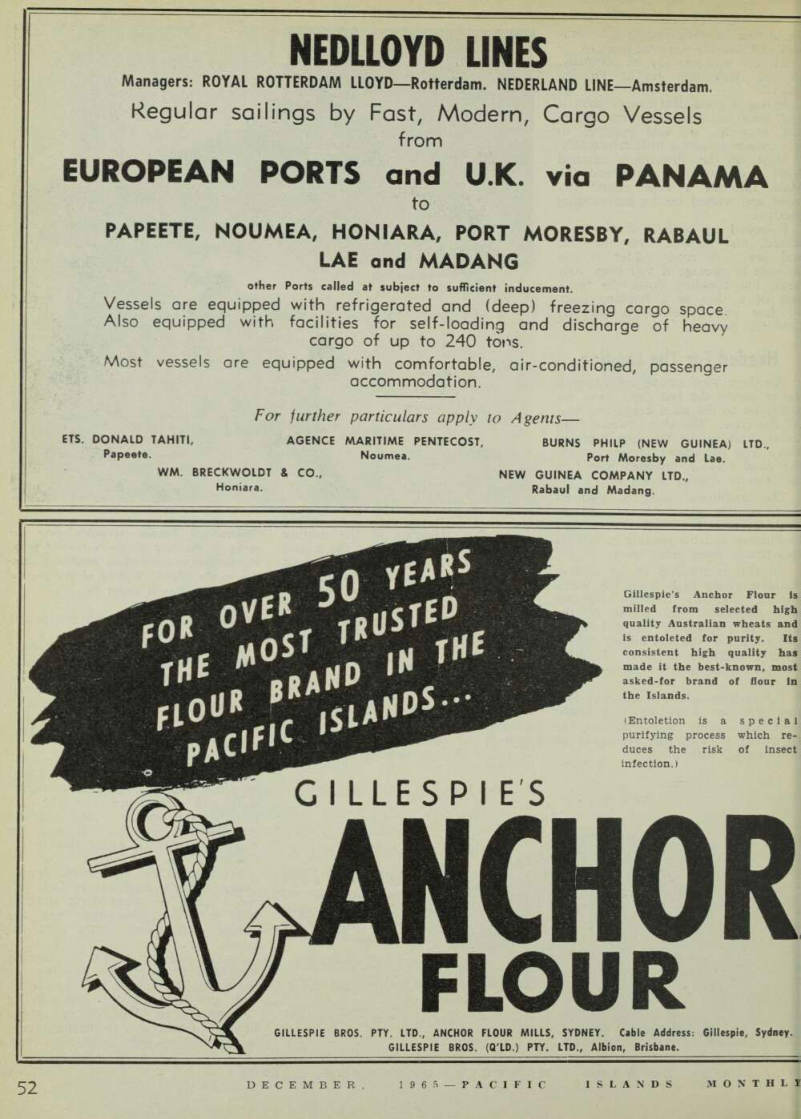
Pitcairn from a pass ing yacht - the "Okeanos". Cruising yachts are not in frequent callers.
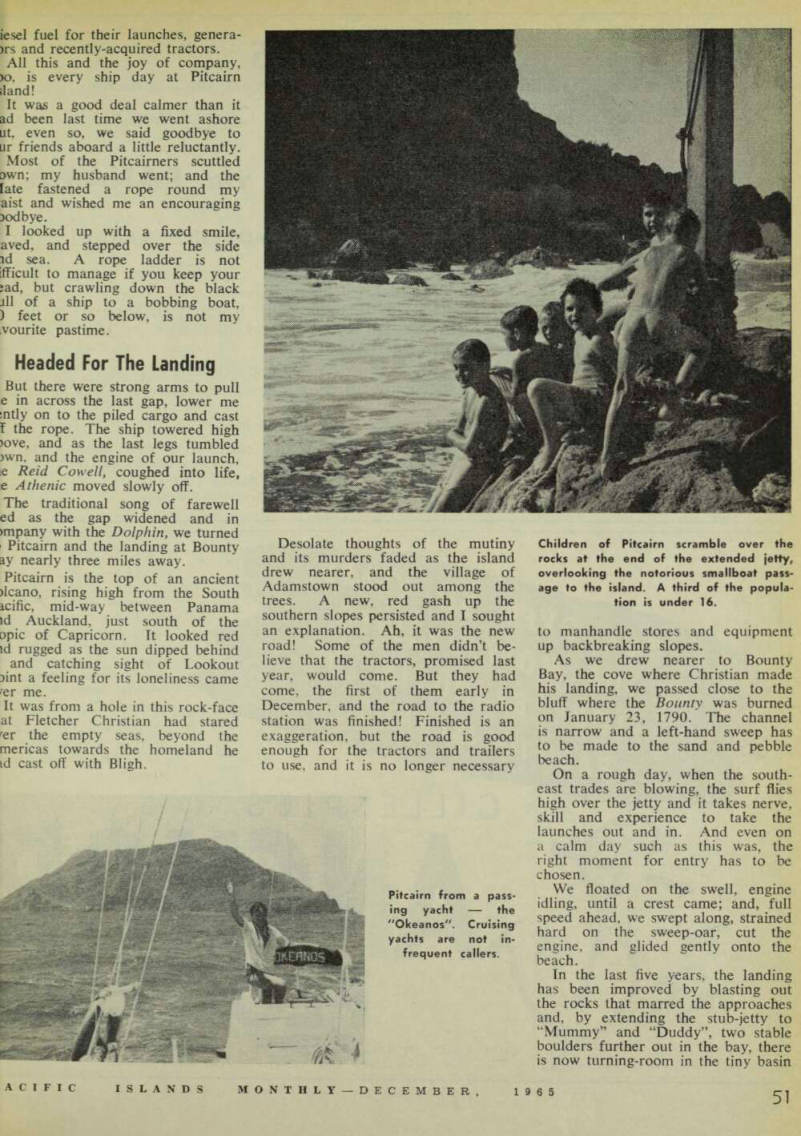
Children of Pitcairn scramble over the rocks at the end of the extended jetty, overlooking the notorious smallboat pass age to the island. A third of the popula tion is under 16.
or the two 37 ft launches and a ittle more shelter from the ocean well.
The patchwork slipway of rough >gs and the picturesque boat-houses nth thatched roofs, which served le island for 160 years, have gone.
I powerful winch now moves the lunches easily up and down rails lid in concrete beds, new boat-sheds ave been built and even the private anoes have been re-housed.
But Bounty Bay is still a landing -not a harbour; and much more will ave to be done if it is to be made ife for an ocean-going vessel capable F restoring Pitcairn’s ancient com mnications with Mangareva, 300 iles away. This is the plan: time ill tell whether it can be realised.
There was no royal welcome as e jumped ashore this time: we ere friends returning, not unknown ficial visitors. (We had gone to itcairn the previous year, from New ealand.) It was the Sabbath evening id although the boats were unloaded id winched up no other work was me till sundown.
How The Church Arrived
The Seventh-day Adventist faith as brought to Pitcairn in a box— box of literature—from the United ates and, 10 years later in 1887, ary McCoy wrote in her diary: "he forms and prayers of the tiurch of England laid aside. Dur g the past week meetings were Id to organise our church service i Sabbath”.
Since then Pitcairn has remained mnchly Adventist, though, from ne to time, a modern mutineer serts his independence by refusing attend services.
Last year, the track to the Edge, tiny, platform 200 ft up the cliff ze, was much as it was when the jtineers first tramped it. But the tted path, set with a few stone ps where it was steepest, slippery th mud in the rain and with pebbly rth in the sun, has given way to a >pectable, dirt road with a steady t still punishing gradient. The ictors had been at work!
At the Edge, under the dominating ak of Ship Landing Point, is a it under a gnarled miro tree, where j old folk sit, looking after the idlers, and wait for those return s' from the sea.
We were glad to rest and chat th friends until our luggage came inging precariously up and across unty Bay by flying-fox.
It was only a few yards along the ck to our home at “No. 1, Big nee Road”. We had rented it from in and Dobrie Christian last year
and, although they were absent in New Zealand this time, it was ready for us again, with brother Warren and his wife, Millie, in command, Millie had the copper alight and the water was ready for a hot, re freshing bath. Water was scarce in the first week of our stay, for the rains had recently been erratic, and the island was dry and dusty.
There are no rivers, except when the water gushes down ravines in the cliff face during a storm, and no surface springs of any significance.
Normally, the rains fall regularly enough throughout the year to water crops and fill the concrete cisterns which every household has, and which the Pitcairners call “wells”.
Drought is a nuisance more than a problem and, even in this dry period, the fruit and vegetables were abun dant and delicious, of a variety one might find in a sub-tropical cornu copia. The mangoes were in full season; we drank gallons of fresh orange juice, and ate incomparable tomatoes, crisp cabbage, apple cucum bers and numberless slices of fresh water-melon.
Our home, set back a hundred yards, rambled along the cliff face below the main road to the village square and commanded a majestic view of the Pacific. A hotch-potch of rooms in concrete and dunnage, radiating from a core of rough-hewn miro, lined with fibre-board and capped with iron, it petered out eventually in a workshop, bathroom and deep pit-latrine.
We were curious and amused to find our latrine in tandem, but soon discovered that all are twin-seated because, as the story goes, a lone child once dropped down the pit!
We used only part of the house, leaving severely alone the gloomy kitchen with its big stone oven and “bolt” or open fire-place, for it was not easy to run.
A Flow Of Callers
Home served as Reid’s office, too and, besides refreshing the steady flow of callers and consultants, the daily brooming had to be done to get rid of the dust, mud and little piles of frass which the white ants, reputedly introduced from the States in a pedal-organ many years ago, deposited ceaselessly.
Cockroaches abounded, and it surprised our “wisitors” when we brought them rapidly under control.
But we had less success with the vicious, but virtually harmless, mos quitoes which, fortunately, dis appeared at dusk so that sleeping nets were unnecessary.
We cooked by primus-stove and.
ther than repeat last-year’s chore stoking the copper for a bath, we ed up a bush-shower and filled by kettle.
There is no shop on Pitcairn so r food, generously supplemented by ts of fresh fruit and vegetables, d fish occasionally, came out of the is, bottles and packets we brought th us from London.
A. small, kerosene refrigerator and ctric-light in the evening, supplied the school generator, were our :uries and, all in all, although ing was time-consuming it was ighly comfortable.
ITe settlement of Adamstown, the ginal home of the mutineers, is ractively situated on a northerly pe 400 to 500 ft above sea-level 1 covers some 60 acres of park ; land. The main track from the ge runs for about half a mile ough the village, roughly parallel h the coast.
Many Houses Derelict
‘Upside” and “Downside” of the h. numerous little lanes wind /ards sprawling houses, like the ; we lived in but usually more cempt, which are scattered ir ularly among bushes and shrubs 1 are shaded by a canopy of ;s. dany seem to have accepted defeat encroaching nature and the enous termite for, of Adamstown’s houses, over half are derelict and pty. n the morning, while the children at school and the men are farm er cutting firewood on the hill js, fishing or working on their its in Bounty Bay, there is little astir in this sombre village. The men are cloistered in their hens and only a few old folk ter around outside or gather in ►s or threes to reminisce or carve weave.
Fred, Hale And Hearty
Roughly a third of the population 85 is under 16, and another third >ver 60; but the burden of caring them is not so heavy as it might for the Pitcairners are a robust e, many of whom are still active their eighties. -ast year, influenza came to the nd with us and, in turn, nearly ryone caught it, including Fred ristian who, at 81, left his bed to ird the U.S.S. Wyandot which un ectedly called. There was no soning with Fred, and he must e counted the succeeding days in I. drugged and nursed, a fair :e to pay for his outing!
U 65 anyone can apply for a
small pension from public funds and medical attention on the island is provided free—genuinely free, for there is no taxation—by government and the church in co-operation.
The nurse, usually the wife of the Pastor, is able to deal with the every day illnesses and, when the need arises, it is always possible to call in help from the surgeon of a passing ship or obtain emergency advice by radio.
It is a long time since anyone died on Pitcairn for the lack of medical attention and, in recent years, the risk has been further reduced by modern drugs and government’s
meeting two-thirds of the cost of hospital treatment in New Zealand.
The heart of Pitcairn is the Square, and even now, when so few people are about, it beats strongly. On three sides, in three modern buildings stand the church; the dispensary, library and post office; and the court house and magistrate’s office. Along the open fourth side, above the main road, runs a long, low bench shaded by trees broken only by the bell of HMS Pitcairn , a gift from the British Admiralty.
The bell, which is now cracked, is the public tocsin: a series of solemn strikes in ones and twos is the call
to prayer; peals of three summo the men to work; four is the rare signal for a share-out of food fror passing ships; and on a toll of five vigorously repeated and probabl responsible for the crack, everyon downs tools and hastens to Bount Bay to prepare for the visiting shif The church is very much part c the life of Pitcairn. We used to wal along to morning service on th Sabbath and wait in the square fo it to begin, often sitting down, wit groups of restless, inattentive childre who were being given Bible lesson: The Sabbath is a strict day of res thankfully observed, and nearl everyone attends church, the teenag girls, in particular, taking the oppoi tunity to dress smartly. We wer always welcomed and if we foun the service strange we also foun charm in its simplicity and the vigou of the singing.
The "Bounty" Bible
Standing in its sealed case in th church is the Bounty Bible, o: permanent loan from the Connecticu Historical Society, which we in spected with Pastor Ferris and Pervi Young in his dual capacity of Fide and acting Magistrate.
In it is a copy of the marriag lines of Captain Bligh, copied fron the register in the parish church o Onchan in the Isle of Man.
Recently a Pathfinder Club, ver similar in style to the Scouts an< Guides, had been formed and, on Sunday evening, we attended a dis play on the lawn outside the missioi house. Drill, first-aid and knot tying were demonstrated, the latte being remarkable for an argumenta live confusion in Pitcairnese betweei a sheepshank and a sheetbend.
Everyone contributed to the tej and after the display it was laid ou as a community picnic on lonj trestle-tables, and shared. We endec the evening with slides of Pitcain and Oeno Island, 60 miles away which the Pitcairners regularly visi for a holiday on coral beaches.
World Interest In Stamps
On three mornings a week, and of course on ship days as well, Oscai Clark is on duty at the post office: It is a bit trying to a visitor to be at the counter by seven o’clock bu by that hour the whole island is or the move and, with Mrs. Ferris in the dispensary and many friends there or at the stamp counter, it became a pleasant start to the day.
There is a world-wide interest in Pitcairn’s stamps which were intro* duced in 1940 and, although the public revenue depends on them, they
e sparingly issued and of good lality, so that collectors will con lue to regard them highly.
Far more genuine business is done stamps than one might expect on i small an island, for much of the uvenir trade is conducted through e post and outside interest in tcairn keeps the ordinary letter trrespondence remarkably high, ►me months had passed since the st new stamps were issued but even Mavis Warren, secretary of the •uvenir Agency, was often in the ist office attending to orders from any different countries.
Pitcairn's Souvenir Agency
The Souvenir Agency is one of tcairn’s responses to the recent re ction in the calls of passenger ips. It deals in mail orders for any ?e of souvenir, stamps and photo aphs and is ready to provide infor ition about Pitcairn to anyone who quires.
Outside the court house, on a nth, stands one of the anchors of dS Bounty, raised by Irving John i of the Yankee in 1957. The court use is rarely used for judicial pro :dings and far more often serves a committee room for the council d a village hall for movies, concerts J public meetings.
While we were on the island the mcillors, a majority of whom are cted, met frequently but, so as to erfere as little as possible with ;ryday life, always in the evenings.
Fhey had a heavy log of work to :omplish including the annual dget and development planning, a v civil and penal code, and a pre iinary debate on proposals for (demising the land law. 3ften, the sessions would continue til nearly midnight and it is small nder that soon after we left most
of the people set sail for the holiday atoll of Oeno, On other occasions we attended movies in the hall, including docu mentaries of Pitcairn itself, and, of course, a concert of sketches, songs and music in our honour, at which we were presented with gifts of an elegant walking-stick and a beauti fully-carved bird on the wing.
Last time, we arrived on New Year’s Eve and the annual Christmas Party had been postponed, partly be cause of rain and partly so that we could enjoy it. Ten Christmas trees transformed the Square and every one of them was laden with presents.
Father Christmas came down from the church roof with special gifts for the children who greeted him with “Jingle Bells”.
Then came the real distribution: the men started stripping the trees
and calling out the names and, for an hour or so, the Square rang with voices, movement and laughter. Even we received presents, although we had just landed!
Then, too, the Square had served as a dining-room for a public feast, an occasion which usually marks the departure of the pastor or school teacher. At least 80 of us must have sat down to eat at the long tables in an atmosphere of casual clatter arrested from time to time by not very formal speeches.
Strong Community Feeling
The feeling of community is strong and close on such occasions. There is no need for direction or orders, everyone instinctively comes together to participate in what is essentially an expression of the constancy of Pitcairn.
John Christian, the Magistrate, who on this visit was in New Zealand for an eye operation, was our principal host and he summed it up simply and adequately: ‘I love this yah Pitkern”.
Just beyond the last house in the village, the main road peters out in the open grounds of the public school lying in the shadow of Christian’s cave, at Pulau.
The story of education on Pitcairn began in the early years of the nineteenth century when John Adams taught the first generation of children to read from the Bounty Bible and Book of Common Prayer.
In 1823, John Buffet, a volunteer from a whaling-ship, remained behind as instructor and, in 1828, he was
a departure or a birthday party the feeling of community is strong as the Pitcairners gather at the long tables in the open.
icceeded by George Nobbs who, ter, was ordained priest in the hurch of England.
After the return from Norfolk land in 1864, Simon Young and s daughter Rosalind kept simple booling alive until, towards the ose of the nineteenth century, the ;venth-day Adventist Church as imed responsibility and discharged in a variable fashion, until govern ent took it over in 1948.
Through the courtesy of the New ;aland Department of Education, lalified teachers are posted to tcairn, usually for periods of two ;ars each, and a full primary course given to children between the ages five and 15, in accordance with law first passed in 1838, The school and teacher’s residence e of timber and iron and the odem equipment includes a 240 v ;hting-plant, a film projector, tape corder and other electronic aids, library, sewing machines and a 3rkshop for carpentry.
The average attendance has now lien back to the lower twenties and, ice 1959, Pitcairn girls have assisted e headmaster with the infant isses.
The School Is Lively
We visited the school unexpectedly ic morning and found a lively and od-humoured scene. To an un fitted eye, a one-teacher school vering a 10-year range in age is ther chaotic, but as we walked und, asked questions and studied 2 pupils’ work, it was evident that 2 youth of Pitcairn is being well ucated.
Their health, too, is not forgotten r in the few minutes after the bell r playtime rang, and before the ildren dashed exuberantly down the assy slopes, each received a glass milk and a fluorine tablet.
Dental health is a special problem r a community which depends on inwater caught in tanks for drink- I and which has a generally soft, getarian diet. It is not uncommon r a young man or woman to be taring dentures, excellently con victed by self-taught Elwyn iristian, who has been the island’s lofficial dentist for many years, and ao has just completed a short course remedial dentistry in Fiji.
Sadly, the better schooling of the >t 15 years has played a part in aigration from Pitcairn. Twice fore the island has been evacuated to Tahiti in 1831 and Norfolk and in 1856—and twice the people ive returned. But since World War
(Continued on p. 61)
, more and more young men and omen have settled in New Zealand ►r reasons ranging from the attrac ;>n of an urban life to dissatisfaction ith their own society and, more cently, reduced economic activity.
Walking around the island or, more jcurately scrambling up and down e steep tracks, the evidence of a jclining population is plain to see.
Broadly speaking, that part of itcairn which is used lies in an arc • about a thousand yards radius om the centre of Adamstown. Over ig Ridge to the north lies the slopes : Tedside where is the only other nding, Western Harbour, and the ild goats roam destructively.
In the west, the cliffs drop sharply om Taro Ground, capped by the idio station; to the south, Ship anding Point cuts off the rugged minsular of St. Paul. Within the c in the valleys and flatlands, deep ith rich, black soil are the garden itches, citrus groves and banana ands and the ever-encroaching jsh and weeds.
It is round the circumference of iis region that the new road is being jilt, with offshoots to St. Paul and, irough the upland plain of Hulianda, to McCoy’s Valley on the back ay to Taro Ground.
Farming Is Inefficient
The objective is to encourage co jeration in the use of land by im •oving access to the best of it and aking it worth while for groups : families to adopt the techniques : modern farming.
At present, farming is still con jcted in a casual, inefficient and in nsely individualistic way. Patches : “ground” are scattered all over the land and men and women stolidly od up and down the many “walley” acks from one patch to another, 'ten pushing their heavy wheel irrows which have stub runners in ace of the usual legs to suit the illy terrain.
When the soil is exhausted a new itch is cleared; the surface is xatched, the seed is sown and one ten waits on the pleasure of the eather for the crop to come.
It might be wondered why this isual method of farming must be janged if the crops are good. The imediate reason is that it consumes 10 much time which, by so small a needs to be carefully usbanded and, in the longer term, ic economy may have to exploit its itural resources to the full if the andard of living is to be maintained.
It is still too soon to mark much rogress but we saw signs of the
lesson being learned in the re afforestation of St. Paul where, new miro and the Fiji rain-tree are being planted out under a council scheme conducted by Jacob Warren.
Forestry on Pitcairn is an armed occupation, for one of the hazards of any agricultural activity on the perimeter of settlement is the in famous goat! Many years ago, no doubt, the herds were a valuable source of meat but there is no evidence they were ever truly domesticated, even though the old records contain descriptions and diagrams of family marks.
But the goats are a part of tradition and, although the stock has de generated and the meat is rarely
eaten, their effective control is a source of timeless controversy. For the present, because no owner is pre pared to tether or fence them, they have been banished to Tedside and any wanderer may be shot on sight, On the western side of the penin sular of St. Paul the land sweeps in to Rope, a shallow bay towered over by 800 ft cliffs. Down Rope, by a perilous path if one has a poor head for heights, are the caves containing the Polynesian rock-carvings, evidence of the occupation by Taratahi and his Mangarevans six centuries ago.
Along with Easter Island and Rapa, Pitcairn is of considerable interest to Polynesian archaeologists and in 1964 a team from Otago University
ipent two months on the island making an extensive survey of the evidence of occupation.
It seems to be fairly clear that Pitcairn was used by the early Polynesians at least as a temporary home and quarry site and the re mains of settlement suggest a selective yet extensive use of its re sources. With this expedition, Pit :airn began a liaison with the University of Otago which promises to benefit both the island and scientific research.
This year the council contributed to the costs of a social psychology and forest survey and next year the ioint-program includes experimental work in the construction of earth reservoirs, lined with plastic, to store rain for agricultural purposes.
Radio Broadcasts?
Straddling the path of the goats along the western ridge is the modern radio station at Taro Ground, the mlmination of a story which began when Andrew Young, the former island Secretary, experimented with signalling lamps to communicate with passing ships in 1921.
In the charge of Thomas Christian and Anderson Warren, today’s radio station, with its towering lattice-steel masts and specially-adapted equip ment, keeps Pitcairn in regular com munication with New Zealand and Fiji, both of which are 3,000 miles away.
There are plans afoot, too, to begin a broadcasting service, not only for the benefit of the Pitcairners but also for sailors on the many ships which cross the empty, South Pacific ocean.
On the outskirts of the village we paused to visit the grave of John Adams and, then, the abandoned louse of Thursday October Christian.
There is a curious story about the grave. We brought a letter ashore with us in which the writer claimed [hat the original gravestone, in wood, is in a churchyard in England and offered to negotiate its return to Pitcairn.
The claim may be a true one which should be followed up, for the present stone, repaired since our last visit, is a concrete slab of later con struction than 1829 when Adams died.
Thursday October, the son of Fletcher Christian, was the first child to be born on Pitcairn after the mutineers landed and his house, which was lived in until recent years by San Francisco-born Roy Clark and his wife May, still contains much of its original design and rough-hewn timber. We suggested to the council that it should be restored and turned
into a museum while there are still people alive who remember the old style of living.
To take tea in a Pitcairn home is to attend a feast, and we were not disappointed at the Christians, three or more families of whom co operated to entertain us.
The food was all laid out on a long table; soup made from lima beans or corn, chicken boiled or roasted, corned beef from a can which the Pitcairners love, fresh fish, Irish “taty”, sweet “taty” or kumara, pumpkin, boiled bananas, salads of cabbage, tomato and cucumber and, of course, pillhai, Pillhai is a local dish made of grated banana, pumpkin or sweet potato mixed with flour, wrapped in a banana leaf and baked in the oven.
The first course, if one has an appetite left, is followed by home made ice cream, wild strawberries, canned fruit, a delicious salad of fresh mangoes, banana and pawpaw sprinkled with lime, boiled puddings,
cake and biscuits and, according to one’s taste or beliefs, cocoa, tea or coffee.
Not even the Pitcairners, much less their guests from abroad, can finish this gargantuan repast and each family is assured of the next day’s meals as well.
A huge laundry-tub is brought in for the washing up, filled with buckets of steaming water from the copper, and the job is soon finished by willing hands, including our own, affably ac cepted, and with much chatter and laughter.
There was a slight confusion when the lights cut out through overloading but Warren Christian telephoned other houses on his circuit and soon had the generator going again. He was fortunate. There are two tele phone systems on Pitcairn, a private and a public one, both of which are party-lines of tangled wires, unreliably connected by earth return to anti quated receivers.
It happened that our house was
on the public line, though some are connected to both, but we established no communication at a distance throughout our stay—except by lean ing out of the window and shouting.
However, a new public system is on the way and should be installed this year.
After the washing up was done we sat in the cool of the evening on the front verandah over which the large banyan trees loom darkly.
In between slices of water-melon and cool fruit-drinks, Fred and Parkins Christian reminisced about a voyage to Tahiti in 1917 aboard the locally-built Messenger, an account of which, written by Fred, had re cently come to our notice. Towards midnight the party broke up.
Shadows and moonlight played on the dark road as we walked home contented and, as we turned indoors, Ship Landing Point rose clear ahead —a sharp and silent sentinel of a sleeping island.
When official duty at a plenary meeting of the council had been done, we invited the island to a farewell party and counted it a compliment when 69 out of 85 turned up.
The Last Night Arrives
The whole house was used for the first time, but the music and singing, chatter and laughter, could not defeat the toddlers, six of whom had to be sorted out from a large, string bed when the party ended.
We had saved several tins of sweet biscuits or cookies and supplemented our diminished supply of soft drinks with buckets of fresh orange-juice which some of the girls had helped to prepare.
But all knew perfectly well that what we could supply would not be enough and, in the generous Pitcairn style, each family brought a portion to make a common and sufficient pool. It was a simple and amiable evening which we shall never forget.
The last night came, our cases had gone down to the landing and we took a final slice of water-melon
next door with Pervis and Marona Young.
Since first light the craftsmen had been feverishly carving, the women weaving and preparing stamps, the children collecting fruit, and few of them went to bed early that night.
It is a curious thing that where time has little meaning there is never enough of it to permit one to be ready for the next event.
At two-thirty the lights were on, the steady tramp of feet told of men on their way to the boats, and by four o’clock, in squally weather, they were at sea waiting for the Wyandot, which, incredibly enough, was also due that day as well as our ship, the Corinthic.
Dawn had broken, murky and grey, when we said our first good byes under the miro tree at the Edge and trudged down the path to the landing.
At seven o’clock the men returned to unload cargo, launched the Reid Cowell on a falling tide which re quired some heaving and straining, and embarked us and their women folk.
We sailed out of Bounty Bay wav ing more farewells, called for the few men still aboard the Wyandot and turned into the weather towards the Corinthic, looming large out of a rain squall. The ascent to deck is nowhere near as difficult as the descent, provided one steps off on to the ladder when the launch is at the top of the swell. This we ac complished like veterans and if legs were a little wobbly as we reached the top who could really tell?
Aboard, for the next two hours it was market day again but finally the siren sounded for the last good byes and this time, we looked down on the bobbing boats.
There was a catch in our voices : as they turned home to Bounty Bay and the Pitcairn song of farewell floated up to us, to die on the air as our courses rapidly parted.
An anchor from the "Bounty" stands out side Pitcairn's court house—which more often serves as council chambers, public hall and cinema.