Behind Enemy
pp. 19-21 · Read in the full issue

Lines With The
Coastwatchers
By J. K. McCarthy
vlalcolm Wright was a patrol
cer in New Guinea before the r, joining the service as a let in 1937. I had the good tune to have him posted to asea in 1938, when I was >0 there, and my personal sfaction may be forgiven m I think that I sent him to lutu, in East Nakanai, New tain, to re-open the patrol t there.
RIGHT was essentially a “native man”—if one can dare use such old - fashioned term-—and the •ee to which he gained the hill 3le’s friendship and loyalty is vn in the pages of his book, Die, just published in Melbourne, is almost a too modest account Vright’s many months as a consi der, stationed in enemy-held itry during 1942-43. e was the first of “Feldt’s mob” >e put ashore behind the Japanese » by submarine—and he did this ic. The reader does not need h imagination to feel what ght felt when, in the dead of it, he left the submarine in a )er dinghy, to paddle through the mess and land on the dangerous it of Cape Orford—but this was r the beginning of his real mission, the initial solo attempt, Wright essfully contacted the villagers, ed with them a week, then re
turned to Australia by submarine, where he formed and led a party which included Peter Figgis, Les Williams (now District Commissioner at Popondetta), and my old friend Simogun, These men made a new landing and remained concealed at Wang— their observations post at Cape Orford—for almost a year, setting up an intelligence network which ex tended even to the Japanese strong hold at Rabaul, and making fre quent reports to Moresby and Aus tralia.
With the landing of new parties atj Cape Orford, Wright crossed New 1
Britain to his former mountain home in Central Makanai. He was wel comed by the villagers who remem bered his work there five years be fore.
By this time the Japanese had pretty accurate information of the coastwatchers’ position but their efforts to hunt and capture the Aus tralians were thwarted when Wright had arms dropped so the villagers could be trained to attack the Japanese. Wright finished up “com manding” several hundred Nakanai guerrillas, who inflicted heavy casualties on the Japanese.
' It is not possible to militarily assess,
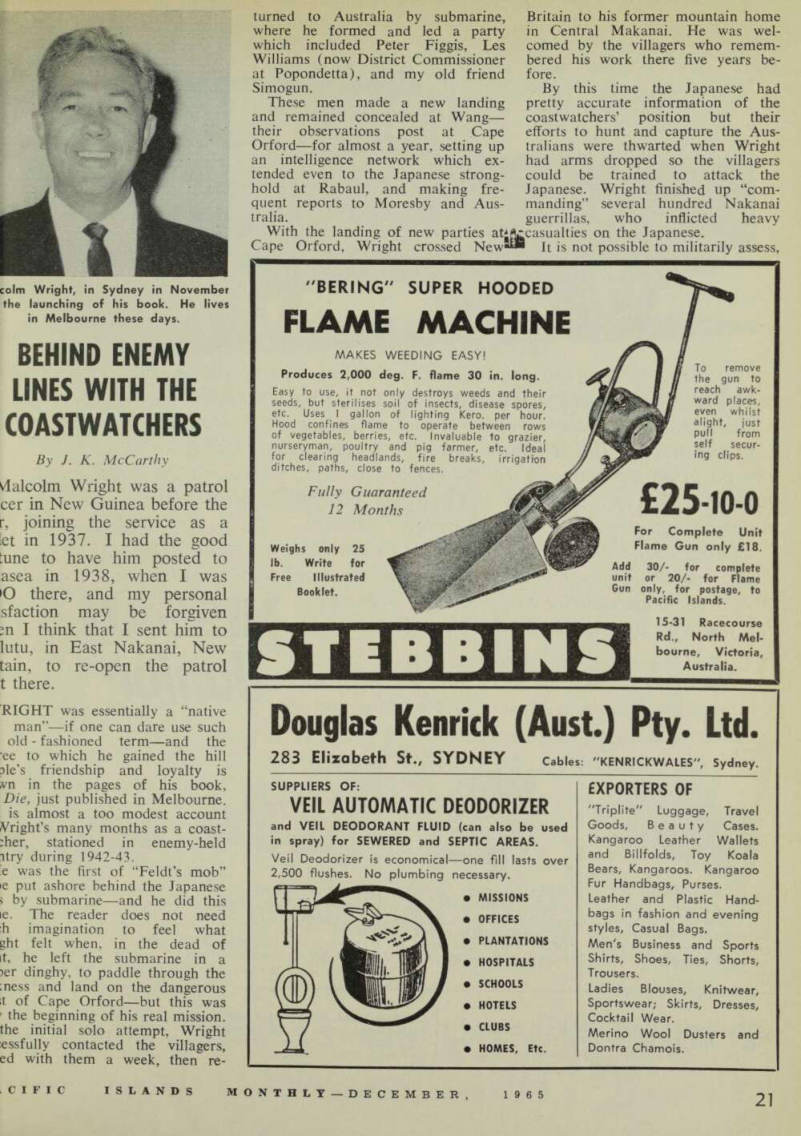
[?]colm Wright, in Sydney in November the launching of his book. He lives in Melbourne these days.
d-bloodedly, the work carried out men like Wright. On the other nd it is possible to count the ►re as it affected the political past New Guinea—bluntly put, this ans that Australia’s pre-war ad nistration of the country must have in sufficiently admired by the ;ive people otherwise coastwatching •ties would have been betrayed to i powerful Japanese as soon as they i landed.
Fhe book, self-effacing as it is, lunds with the names of heroes— magnificent Golpak, Alan berts, Chas Bates, Searle, of ilindi, Simogun, now a member the House of Assembly, lan nner and John Stokie. (Incident /, Stokie, a first-class bushman and repid climber of mountains, was :e refused enlistment into the AIF :ause his natural stride was not ig enough for him to keep in step!) Fhere are many other names in i excellent book that are known 3 fondly remembered by those who iw New Guinea. Some of them unknown—for instance, one uld like to know more of Johannes “Malay”, and his family, who re executed because they chose to lain loyal.
Fhere are many such heroes who 1 remain forever unknown—the iple villagers who met death be ise of their comradeship with the ite man. These, like the unmarked .ves in New Guinea’s war ceme ies, are “Known to God”.
The American airman Fred Har gesheimer, with Bill Townsend (who is now commanding the RAAF Base at Butterworth, Malaya) have since the war been instrumental in building a school in Nakanai that com memorates the coastwatchers’ effort to save escaped airmen—and this, like the Golpak memorial at Pomio —forms a fitting epilogue to the story of If I Die.
It is of course factual—perhaps coldly so—but even the least imagina tive cannot be but thrilled by it.
To me, and surely to many others, it brings a keen nostalgia. Some of the dialogue, correct at the time, seems curiously old-fashioned 22
years later, as for instance, the form of address used by the New Guinea people. “Master” is now dead in many places, and is dying out in others.
The world changes, of course, and this is as it should be. One hopes, however, that the same loyalty of the people will be shown in the years to come by the descendants of those who followed Malcolm Wright.
It has often been said that the written history of New Guinea is sparse. If I Die is therefore especially welcome and I highly recommend it to all who wish to learn something of New Guinea’s story. (IP I DIE. Lansdowne Press. 35/-.)
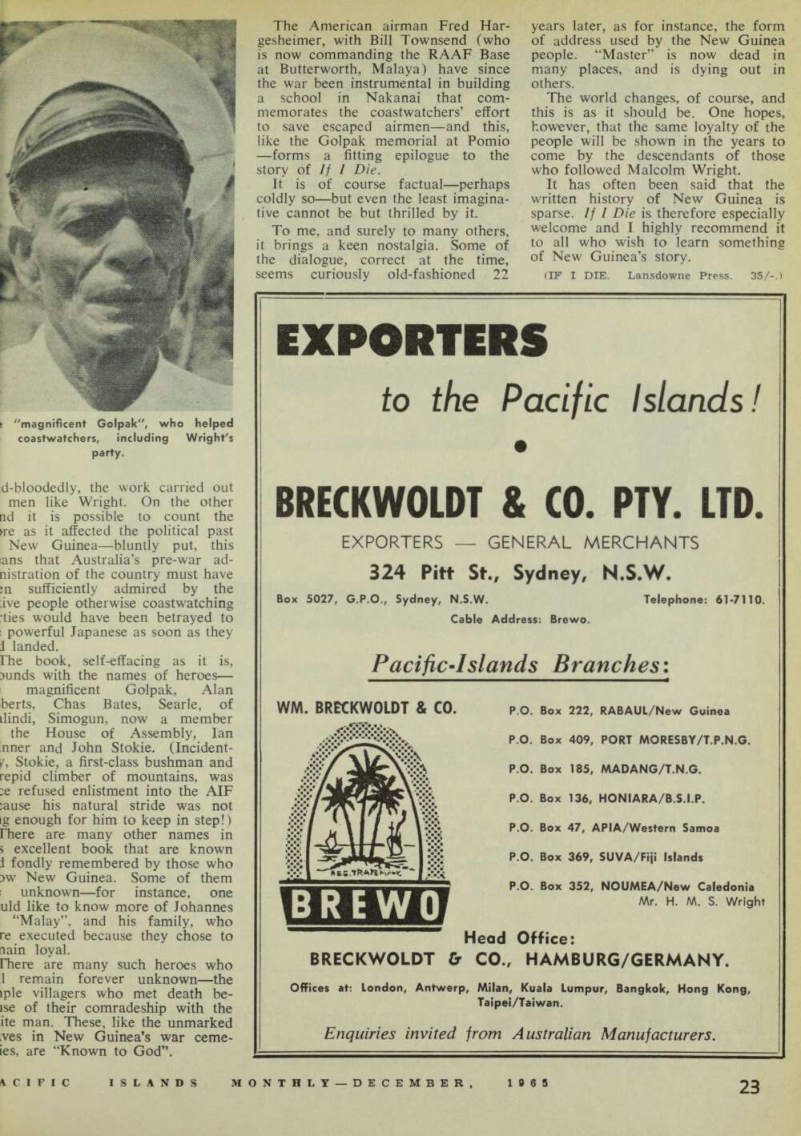
"magnificent Golpak", who helped coast watchers, including Wright's party.