Tropicalities
pp. 11-17 · Read in the full issue

lat hoary old perennial, a Federation of Oceania, has recently m brought out and dusted off for exhibition, this time the New Zealand Manufacturers’ Federation, which heard mper on it in November from Mr. K. G. Fraser, of ' Auckland Manufacturers’ Association.
IM sponsored something of the sort back in the 1930’5; there 5 a fresh flurry on the subject again : after World War 11. But even ther back in ancient history there e been official and unofficial efforts bring the nearer Pacific Islands ) closer union with either New land, Australia or both.
Jothing has come of any of these is, and, if this was so 20, 30 or years ago it is hard to see how thing can succeed now when every 11 island with a population of r ard of 2,000 or so is independ ;-happy. foreover, none of the contrived Tations of the post-war period ; succeeded. one of this isn’t to say that what NZ Manufacturers’ Federation t is not the plainest of plain monsense, especially for the ids partners in the scheme. They a federation embracing Australia, r Zealand, Samoa, Cook Islands, Papua-New Guinea and the mons —of which only Australia New Zealand have a really le economy. All the others man to exist through outside funds ped into them from the United ;dom, Australia, New Zealand elsewhere. addition to this present aid, the proposals would like to see Aus m and New Zealand contri >ns to the South Pacific Corn ion and the Colombo Plan sed out” and diverted instead to iding more educational, health other services to Islands neigh s. i a starter to the scheme for ation, they suggest a free trade embracing Australasia and the 3s mentioned; and for Australia NZ to lift its restrictions on ntry of people from the Islands, theory excellent; in practice full e screams of anguish of Queens sugar-farmers, NSW peanut ers, Auckland garment manu rers, and everyone who has a about allegedly cheap labour, exchange for their greater con
tribution to prosperity in the Islands, Australia and NZ would embrace a sphere of influence that reaches to the equator and stretches three quarters of the way across the South Pacific.
This is precisely what the great grandfathers of the present Aus tralasians had in mind when they got possession of Papua in 1884, the Cook Islands in 1901, New Guinea and Western Samoa in 1914.
Pursuing this to its logical con clusion, we can therefore only wonder why Islands territories are not only being allowed to quit the parental nest but are actually being helped out.
But along that line of reasoning, friends, lies not so much treason but, in this day, something much worse: Reactionary thought.
For our part, having shot our bolt in the matter many years ago, we are content to leave the solution of this thorny problem of a South Pacific Federation to the Manufacturers’
Federation of NZ and the NZ Prime Minister, who has promised to look into the matter. We certainly wish them luck, but we are prepared to wager that nothing short of a cataclysm will bring it about in our time.
Fiji-lndian Cookery
For Strine Tastes
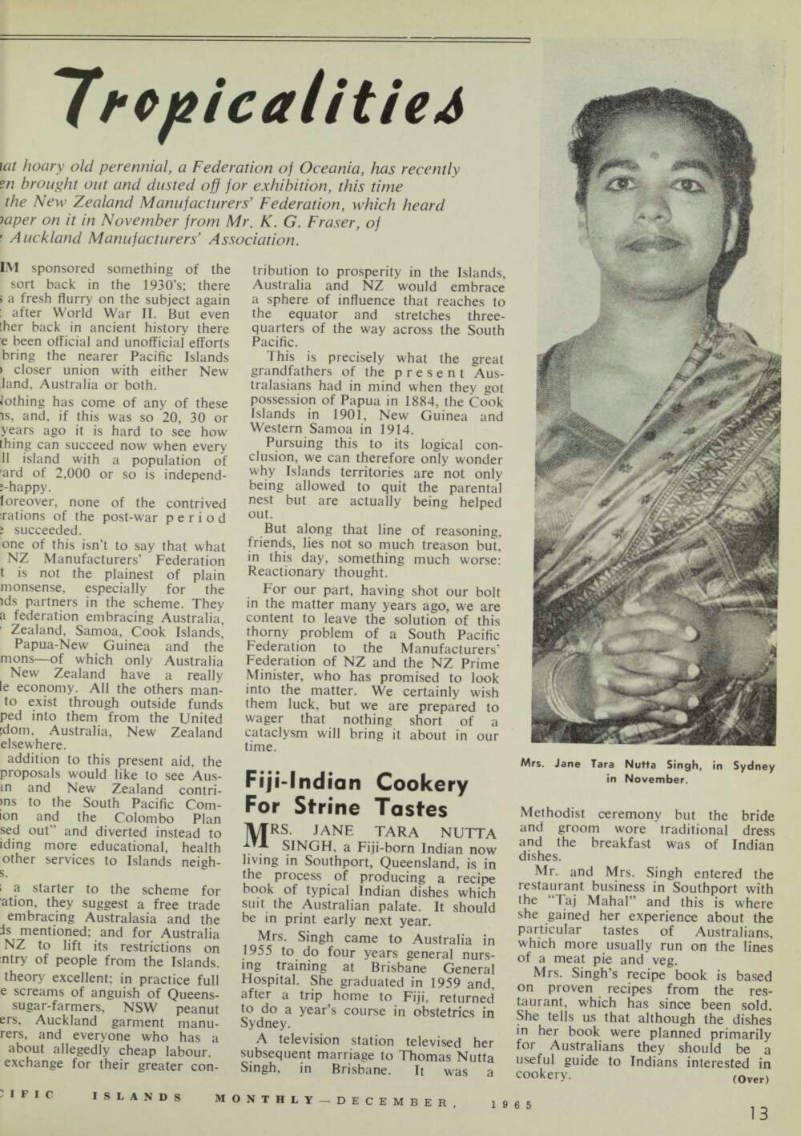
Mrs. Jane Tara Nutta
. r SINGH, a Fiji-born Indian now living in Southport, Queensland, is in the process of producing a recipe book of typical Indian dishes which suit the Australian palate. It should be in print early next year.
Mrs. Singh came to Australia in 1955 to do four years general nurs ing training at Brisbane General Hospital. She graduated in 1959 and, after a trip home to Fiji, returned to do a year’s course in obstetrics in Sydney.
A television station televised her subsequent marriage to Thomas Nutta Singh, in Brisbane. It was a
Methodist ceremony but the bride and groom wore traditional dress and the breakfast was of Indian dishes.
Mr. and Mrs. Singh entered the restaurant business in Southport with the “Taj Mahal” and this is where she gained her experience about the particular tastes of Australians, which more usually run on the lines of a meat pie and veg.
Mrs. Singh’s recipe book is based on proven recipes from the res taurant, which has since been sold.
She tells us that although the dishes in her book were planned primarily for Australians they should be a useful guide to Indians interested in cookery. (Qver)
Mrs. Jane Tara Nutta Singh, in Sydney in November.
24 Years As A
Judge In Samoa
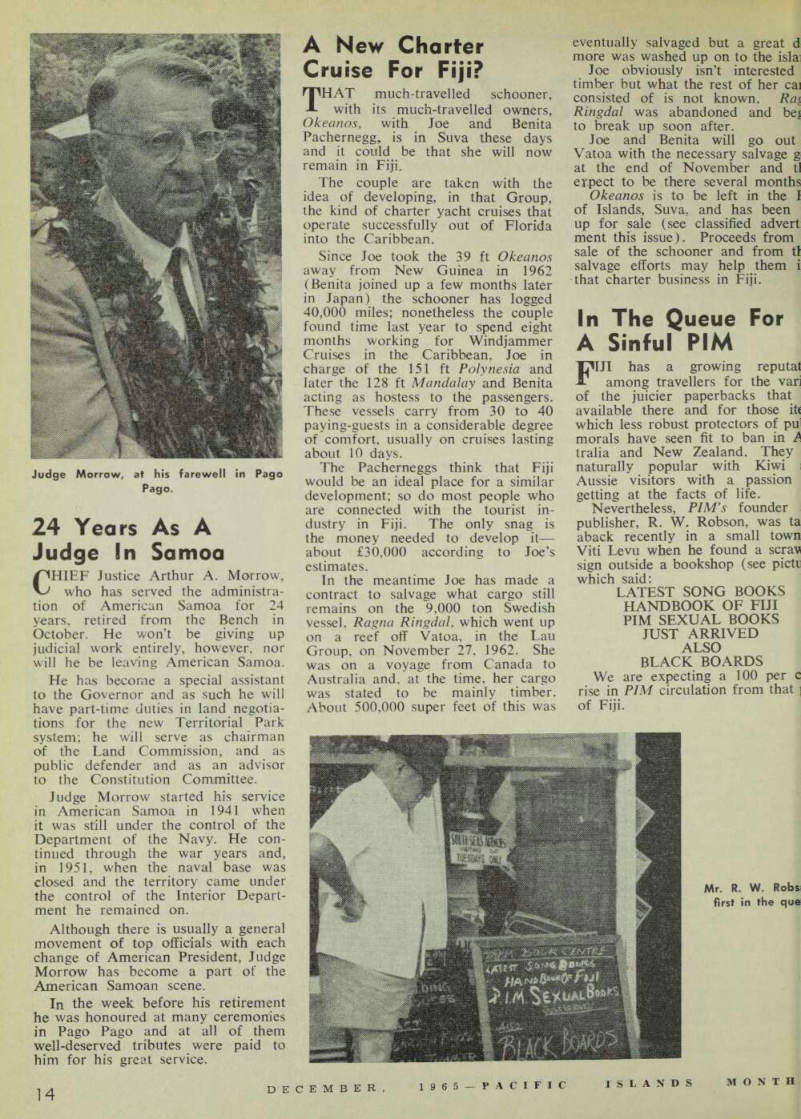
CHIEF Justice Arthur A. Morrow, who has served the administra tion of American Samoa for 24 years, retired from the Bench in October. He won’t be giving up judicial work entirely, however, nor will he be leaving American Samoa.
He has become a special assistant to the Governor and as such he will have part-time duties in land negotia tions for the new Territorial Park system; he Will serve as chairman of the Land Commission, and as public defender and as an advisor to the Constitution Committee.
Judge Morrow started his service in American Samoa in 1941 when it was still under the control of the Department of the Navy. He con tinued through the war years and, in 1951, when the naval base was closed and the territory came under the control of the Interior Depart ment he remained on.
Although there is usually a general movement of top officials with each change of American President, Judge Morrow has become a part of the American Samoan scene.
In the week before his retirement he was honoured at many ceremonies in Pago Pago and at all of them well-deserved tributes were paid to him for his great service.
A New Charter
Cruise For Fiji?
THAT much-travelled schooner, with its much-travelled owners, Okeanos, with Joe and Benita Pachernegg, is in Suva these days and it could be that she will now remain in Fiji.
The couple are taken with the idea of developing, in that Group, the kind of charter yacht cruises that operate successfully out of Florida into the Caribbean.
Since Joe took the 39 ft Okeanos away from New Guinea in 1962 (Benita joined up a few months later in Japan) the schooner has logged 40,000 miles; nonetheless the couple found time last year to spend eight months working for Windjammer Cruises in the Caribbean, Joe in charge of the 151 ft Polynesia and later the 128 ft Mandalay and Benita acting as hostess to the passengers.
These vessels carry from 30 to 40 paying-guests in a considerable degree of comfort, usually on cruises lasting about 10 days.
The Pacherneggs think that Fiji would be an ideal place for a similar development; so do most people who are connected with the tourist in dustry in Fiji. The only snag is the money needed to develop it— about £30,000 according to Joe’s estimates.
In the meantime Joe has made a contract to salvage what cargo still remains on the 9,000 ton Swedish vessel, Ragna Ringdal, which went up on a reef off Vatoa, in the Lau Group, on November 27, 1962. She was on a voyage from Canada to Australia and, at the time, her cargo was stated to be mainly timber.
About 500,000 super feet of this was
eventually salvaged but a great d more was washed up on to the islai Joe obviously isn’t interested timber but what the rest of her cai consisted of is not known. Rat Ringdal was abandoned and be* to break up soon after.
Joe and Benita will go out Vatoa with the necessary salvage g at the end of November and tl eypect to be there several months Okeanos is to be left in the I of Islands, Suva, and has been up for sale (see classified advert ment this issue). Proceeds from sale of the schooner and from tl salvage efforts may help them i that charter business in Fiji.
In The Queue For
A Sinful PIM
FJI has a growing reputat among travellers for the vari of the juicier paperbacks that available there and for those it( which less robust protectors of pu l morals have seen fit to ban in A tralia and New Zealand. They naturally popular with Kiwi Aussie visitors with a passion getting at the facts of life.
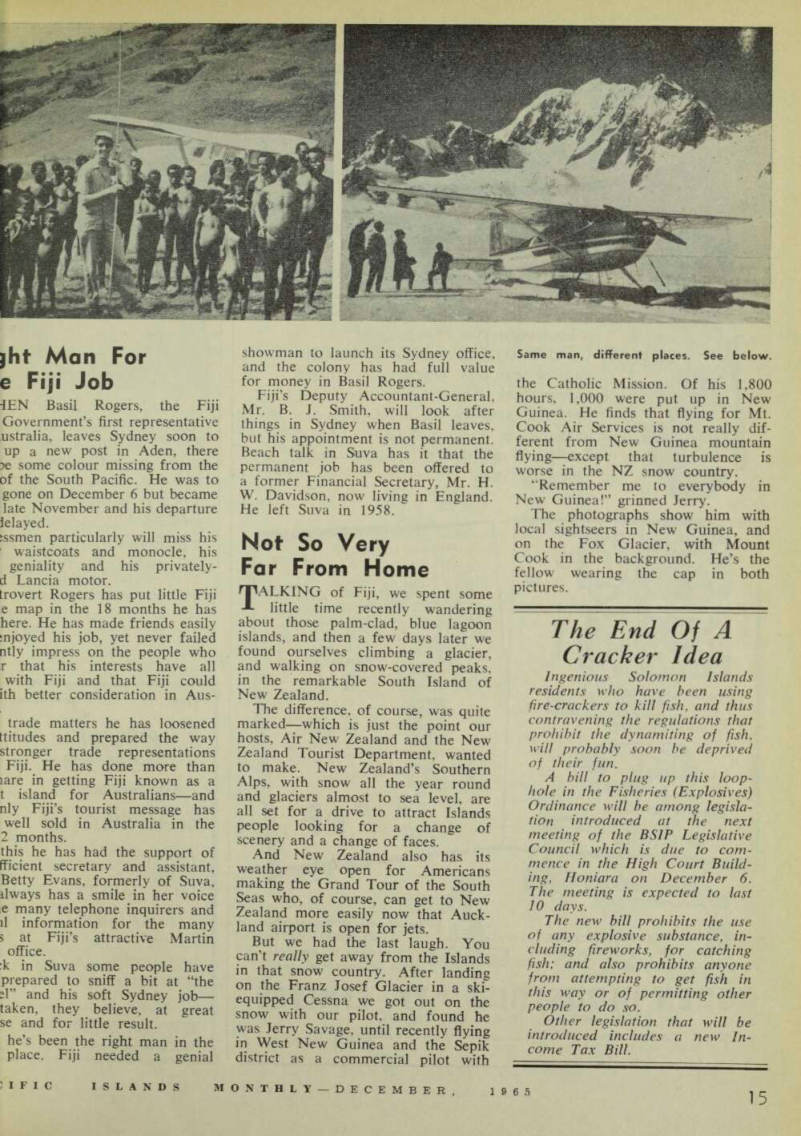
Nevertheless, PI M’s founder publisher, R. W. Robson, was ta aback recently in a small town Viti Levu when he found a scrav sign outside a bookshop (see pictr which said:
Latest Song Books
Handbook Of Fiji
Pim Sexual Books
Just Arrived
Also
Black Boards
We are expecting a 100 per c rise in PIM circulation from that ] of Fiji.
Judge Morrow, at his farewell in Pago Pago.
Mr. R. W. Robs[?] first in the que[?]
jht Man For
e Fiji Job
iEN Basil Rogers, the Fiji Government’s first representative ustralia, leaves Sydney soon to up a new post in Aden, there :>e some colour missing from the of the South Pacific. He was to gone on December 6 but became late November and his departure lelayed. jssmen particularly will miss his waistcoats and monocle, his geniality and his privately d Lancia motor, trovert Rogers has put little Fiji e map in the 18 months he has here. He has made friends easily mjoyed his job, yet never failed ntly impress on the people who r that his interests have all with Fiji and that Fiji could ith better consideration in Aus trade matters he has loosened ttitudes and prepared the way stronger trade representations Fiji. He has done more than tare in getting Fiji known as a t island for Australians—and nly Fiji’s tourist message has well sold in Australia in the 2 months. this he has had the support of fficient secretary and assistant, Betty Evans, formerly of Suva, ilways has a smile in her voice e many telephone inquirers and il information for the many 5 at Fiji’s attractive Martin office. :k in Suva some people have prepared to sniff a bit at “the si” and his soft Sydney job— taken, they believe, at great se and for little result, he’s been the right man in the place. Fiji needed a genial
showman to launch its Sydney office, and the colony has had full value for money in Basil Rogers.
Fiji’s Deputy Accountant-General, Mr. B. J. Smith, will look after things in Sydney when Basil leaves, but his appointment is not permanent.
Beach talk in Suva has it that the permanent job has been offered to a former Financial Secretary, Mr. H.
W. Davidson, now living in England.
He left Suva in 1958.
Not So Very
For From Home
rpALKING of Fiji, we spent some little time recently wandering about those palm-clad, blue lagoon islands, and then a few days later we found ourselves climbing a glacier, and walking on snow-covered peaks, in the remarkable South Island of New Zealand.
The difference, of course, was quite marked—which is just the point our hosts, Air New Zealand and the New Zealand Tourist Department, wanted to make. New Zealand’s Southern Alps, with snow all the year round and glaciers almost to sea level, are all set for a drive to attract Islands people looking for a change of scenery and a change of faces.
And New Zealand also has its weather eye open for Americans making the Grand Tour of the South Seas who, of course, can get to New Zealand more easily now that Auck land airport is open for jets.
But we had the last laugh. You can’t really get away from the Islands in that snow country. After landing on the Franz Josef Glacier in a ski equipped Cessna we got out on the snow with our pilot, and found he was Jerry Savage, until recently flying in West New Guinea and the Sepik district as a commercial pilot with
the Catholic Mission. Of his 1,800 hours, 1,000 were put up in New Guinea. He finds that flying for Mt.
Cook Air Services is not really dif ferent from New Guinea mountain flying—except that turbulence is worse in the NZ snow country.
“Remember me to everybody in New Guinea!” grinned Jerry.
The photographs show him with local sightseers in New Guinea, and on the Fox Glacier, with Mount Cook in the background. He’s the fellow wearing the cap in both pictures.
Same man, different places. See below.
iey Can't Do
There
IE crow of the cock will not be heard in the land. Not in imea, anyway. ime time ago the city municipal icil decreed that householders ild no longer keep roosters, geese, eys or ducks. A few hens only ; to be tolerated and the hen »es were to be concreted and d down at frequent intervals, is presumed that the poor rooster eliminated because of his early ling crowing but Noumeans not taken kindly to the council’s . Following a visit by the cil’s inspector, a couple of dozen eholders were up before the strates in November for keeping :ers. They got off with light fines a reprimand. ite householders see in the tion the subtle hand of Big less (which rules the local cipality) trying to prevent locals growing their own poultry, the dissenters to this opinion that the council could better I its money and efforts in con flg the packs of stray dogs which the Noumean night air hideous barking and wailing and, indeed, danger. ly a few weeks ago a suburbanite leld at bay by a pack of strays they killed his pet goat, useholders feel, moreover, that council still has any energy or y after controlling the dog ce then attention should be to the roaring of powered es in suburban streets at all of the night and morning.
J He Didn't
It Here
lT popular New Guinean MHA, imogun (who these days likes known as Petar Simogun) was to Sydney and Melbourne in nber to help publicise Malcolm t’s book on coastwatching, Die. The book is reviewed on of this issue. ogun accompanied Malcolm riiere (they are good friends) fith his wide grin helped the ity angle mightily. people who were especially J to see the two men were of the 2/22nd Battalion boys aging—who were put on the Rabaul and who were helped eople like Messrs. Wright, Lin, Les Williams, Peter Figgis, McCarthy, etc. The beer
flowed freely at times, especially as McCarthy was in town, too.
Malcolm Wright’s book shows more clearly than any other report just what Simogun did to earn that B.E.M. in New Britain and it im plants his reputation quite firmly in New Guinea’s history books.
But although Pidgin-speaking Simo gun is a mighty man with a rifle, he’s no shakes as a literary gent, and he probably couldn’t write a book to save his life. Many eyebrows, including Simogun’s, must have shot up at the front page story in Port Moresby’s South Pacific Post on November 10, announcing that If I Die was Simogun’s new book— “dictated in Pidgin to Malcolm Wright, who translated it into English”.
Poor Malcolm Wright had four novels rejected by various publishers before he finally hit the jackpot with his first attempt at real life narrative, If I Die. Now they’ve taken it away from him.
Look Out, Here
They Come!
A ®OUT 400 Australian university students are to descend on Papua-New Guinea and the Solomons in January, under a two-weeks work camp scheme to help the Administra tion and local governments.
The students will mainly work on construction jobs such as erecting local government buildings, helping with the water supplies for schools, installing sporting facilities, digging pits for water tanks.
Main organiser of the scheme is Kevin Martin, National Papua-New
Guinea officer for the National Union of Australian University Students, who tells us that the aim of the plan is to give university students the chance to see the Islands at first hand and to do something worthwhile at the same time.
The students are paying their own fares for travel and are being provided with free board and food. The Governments are behind them, and the student headquarters has had many letters of encouragement from the Islands.
The students will be divided into four main sections. Port Moresby receives two groups of 50, Madang one group of 20 and four groups of eight are distributed widely in the British Solomons. The remainder are assigned to various P-NG local governments who want a hand.
Many students will be living with New Guineans in villages, and later will be billeted with European settlers -to get a balanced view of Islands life. There will also be a week of touring to see areas apart from those in which the students are assigned.
It’s a worthwhile project, on the grand scale, and it’s taken 12 months of organising.
When Is A Fijian
A Native?
A PECULIAR little piece of *** legislation is coming before the Fiji Legislative Council, brought with the sole object—or so it seems on the surface—of avoiding stepping on the toes of the Fijian people.
The bill is a measure to amend the Agricultural Produce (Authorities by Natives) Ordinance, by replacing both “native” and “non-native” by the words “Fijian” and “non-Fijian”.
The expression “native” is disliked, according to the Government.
The Fijians, who are singularly free of any complexes regarding nomenclature, have never cared much whether they were called Fijians or natives. They’ve always got hot under the thatch, however, if anyone else has assumed the name Fijian, which so far as the Fijian is concerned is tied up with his ownership of the land. He doesn’t like Fiji-lndians being called Fijians.
The bill will do a few other things —such as control the payment of cane money to Fijians and cancel a measure whereby the approval of the Secretary or Deputy Secretary for Fijian Affairs, or of a District Officer, was needed before a “non native” could pay cane money into a Fijian’s bank account.
Approval will still be needed for the authorisation by a Fijian of
Simogun, and grin.
nent to a non-Fijian of any of proceeds of any agricultural luce payable to such Fijian, rwise the transaction will be . Obviously a case of protecting unbusinesslike Fijian from the legged sharks. he bill has prompted the thought the substitution of “Fijian” for ive” could have another motive nd it. the word “native” were to be undisturbed, future Governments a self-governing country could aps play ducks and drakes with legislation governing the Fijians’ ; to the land. might be that “native land” d come to mean land relating to rson born in Fiji who, of course, he generally accepted sense of word, would be “native” of Fiji, tere are those who hold that is only interpretation that can >erly be put on the word.
-ting Funeral
r An Old Salt
-W GUINEANS don’t usually live to a ripe old age. Their s have been against them. But ml Administration marine worker >tan was 83 when he died the r day, and furthermore he was :ing right up to the time of his i. oper tribute was paid to Subotan lis fellow marine workers, who led a guard of honour (right) as body was taken aboard the unistration trawler Theresa May
for burial in New Ireland, where Subotan came from “in the German times”.
He worked for the Germans, and for the Australians from 1915—a1l of it near the sea. Commander of the honour guard was Jerry Squires, a well-known Rabaul skipper.
Change Of Address
TERRITORIANS note. From November, Sydney office of the Department of Territories is not hard by the Coroner’s Court and the Morgue, but in livelier offices in the Commonwealth Bank, cnr. Market and George.
When Can There
Be Rule Of Law?
W hen can the Rule of Law be said to have taken root in New Guinea?
According to P-NG Administration senior official David Fenbury, when: A CLOSELY-CONTESTED election is fought without lawlessness; when a Hanuabadan magistrate can pass out a stiff sentence to a Kerema and that afternoon sit un molested among a crowd of Keremas at a football match; or when an unescorted surveyor can measure up a parcel of village land which is to be compulsorily acquired for a public purpose without interference from disgruntled land owners.
In “Kot Bilong Mipela”, in the fourth issue of the Council on New Guinea affairs quarterly magazine NEW GUINEA, shortly on sale, David Fenbury discusses the two systems of courts that exist in New Guinea—the ordinary Territory legal system and a native New Guinean system.
“It is a disquietening fact,” says Fenbury, “that the indigenous com munity of Papua-New Guinea has for many years been operating a widespread, completely unsupervised, and technically illicit system which has no contact with the Territory legal system.”
Other articles in the issue include: • Political scientist Paul van der Veur discusses the meaning of political asylum for West Irianese refugees and the meaning of “per missive residence”. • Economist Ric Shand continues his concise economic surveys with an article on the coffee industry, “Is coffee as good as it looks?”