Pacific Commerce and Produce
pp. 131-133 · Read in the full issue
Tongan Takes Full
Control Of Pago
Corporation
Pacific Commerce and Produce
m Dorothy Lavin, in Nukualofa After months of doubt and oulation over the future of the
conut Processing Corporation
Pago Pago, it has been re
lied that the Tonga Copra
ard has taken over most of the .res held by American inand now has virtually full itrol.
UGINALLY, the Tonga Copra Board owned 49 per cent, of the ■es and American interests, 51 cent. It was envisaged that the >oration’s factory in Pago Pago ild be processing 100,000 coco i a day by February, 1964.
M, Aug., 1963, p. 36). towever, because of finance diffi ies, the factory has not yet gone production, and recently one the American promoters, Mr. mond C. Turnbull, found it ossible to procure the cash they ; committed to, and withdrew i the corporation, onga then took over most of the shares, making its financial ■est to date about $735,600.
Production
allowing a recent visit by Tonga’s nier, Prince Tungi, to the US to Pago Pago, plans are now g ahead to complete the factory start production. heady the bulk of machinery, as driers, boilers and classifiers, arrived and is being installed, it is estimated production will in about 18 months, tie corporation has a new board nanagement. At present it con of Prince Tungi (chairman) the assistant manager of the ra Board, Tom Nakao (presi ). Three other members are ie appointed. tie manager will be a mechanical neer from the US, to be recom ded by the Food Machinery xiration of San Jose. This oration will undertake the con fer completing the Pago illation. ie Coconut Processing Corpora has been one of Tonga’s main iys in its efforts to rehabilitate
its finances, and it is hoped that things will begin to look up soon now that the murk of indecision over the corporation’s future has been lifted.
Meanwhile, the Tonga Copra Board is installing a pilot plant at its Havelu factory to process sugar cane. This is on similar lines to the plant installed by FAO in Apia, and it is expected that all local re quirements for raw sugar will be catered for.
Two other schemes, which were investigated, show promise for the future in local industries —the pro cessing of paper from banana trunks, and wallboard from coconut husks.
But money is not available at present to go ahead with these.
P-NG Move For Cocoa
Stabilisation Scheme
THE Australian Minister for Terri tories, Mr. C. E. Barnes, told Federal Parliament in mid-August that the Government would urgently consider any proposal for a stabilisa tion scheme from the Papua-New Guinea cocoa industry.
His statement coincided with a decision by the annual conference of the New Guinea Planters Associa tion in Rabaul to ask for the estab lishment of such a scheme.
The association decided to ask for an initial Government loan to set up a stabilisation fund, with growers contributing to the fund as world prices improved.
Contributions from growers would eventually pay off the Government loan and the industry would support the fund.
Delegates to the conference did not indicate the extent of contributions which growers should make to the fund. They said, however, that the contributions would be in the form of a levy per ton, based on a sliding scale governed by world cocoa prices.
The move for a stabilisation scheme follows a sharp fall in world cocoa prices this year, and marked instability in recent weeks—prices sometimes varying by as much as £5 a ton for beans overnight.
Prices for cocoa beans in store at Rabaul varied from about £l7O to £l9O a ton during most of 1964, and fell to £l5O in February, 1965, about £llO in March and April, £9B a ton in May, less than £BO in June, and less than £7O in July. However,
quotations in August were up to £lO5 a ton.
Devastation caused by the Army worm has also been worrying the 27 European and 60-odd New Guinean ex-servicemen cocoa growers at Popondetta, Papua.
The State president of the P-NG RSL, Mr. R. F. Bunting, told the annual Congress in Lae in August that the ex-servicemen growers faced disaster unless they received financial help urgently.
One of the growers said: “We are in a desperate plight”.
Mr. Bunting added that the RSL national president, Mr. A. J. Lee, had told the Prime Minister, Sir Robert Menzies, in a letter that the only hope for the settlers was for them to be given additional finance to enable them to hold on until the Army worm was eradicated, and in expectation that cocoa prices would improve.
It was later announced that, to assist the Popondetta cocoa growers in their fight to control the Army worm, the P-NG Department of Agriculture was buying bulk in secticides which would be resold to bona fide growers at cost price.
New Customs Rates
AMENDING legislation to the
Papua-New Guinea Customs tariff was passed by the Territory’s House of Assembly in August.
Under the amendments, there has been a general revision of rates, and although a few items will in future carry less duty, the overall result will be a net gain to general revenue of about half a million pounds in the next year, A Government plan to introduce a duty of 21 per cent, on imported tin meat, fish and rice, and 30/- a ton on sugar was withdrawn after criticism by elected members of the House. (The idea of this duty was to draw revenue from a section of the community that normally escapes direct taxation and to stimulate home industry).
The duty on the foodstuffs was withdrawn after the Government and elected members worked out a “deal” whereby the duty on imported beer, which had been increased on August 25 from 9/6 to 10/6 a gallon was further increased on August 30 to 11/6 a gallon, and the excise on local beer was similarly increased from 5/6 to 7/6 rather than 6/6.
More Trade With
N. Caledonia Likely
Australian exports of food stuffs to New Caledonia are expected to increase considerably this year as a result of a relaxation of import restrictions, according to Australia’s Minister for Trade and Industry, Mr. J. McEwen.
Mr. McEwen said recently that in recent years the importation of most foodstuffs into New Caledonia from Australia had been subject to import licensing restrictions, whereas imports from France and other western European countries, had been admitted freely.
Australia had made repeated re presentations to the French author ities, both in Paris and Noumea, about this discrimination, and the restrictions had now been relaxed.
Mr. McEwen said Australian ex ports of foodstuffs to New Caledonia last year had been worth about half a million pounds. This figure was expected to rise sharply as Australia’s proximity to the market would assist exporters to take full advantage of the relaxation.
Sugar sales, which had been negligible in recent years, could rise to over £lOO,OOO annually. Other commodities which could benefit were meat, cheese, eggs, honey, fresh vegetables and canned and dried fruits.
While welcoming the move to freer trade by New Caledonia, Mr.
McEwen said he was disappointed that some foodstuffs remained subject to licensing restrictions when im ported from Australia. These included flour, rice, butter, win© and fruit juices.
Coconut Pest Found
In The Yosawas
A BIG clean-up campaign to destroy likely breeding places began on the island of Naviti in the Yasawas Group of Fiji in mid- August following the discovery that the rhinocerous beetle had become established there.
The beetle, which attacks coconut palms and eventually kills them, was introduced accidentally into
Fiji’s main island of Viti Levu several years ago.
Many thousands of pounds have since been spent in trying to prevent its spread to other islands in the group.
The Yasawas are 25 to 40 miles off the north-west coast of Viti Levu and stretch for a distance of 50 miles. The coconut is the main crop in the group, although the produc tion of copra in the area makes up only a small proportion of that produced throughout Fiji.
The rhinoceros beetle may have reached the Yasawas via the islands of Vomo and Kadavulailai, two small islands between Viti Levu and the Yasawas, where the beetle was dis covered last July (PIM, Sept., 1964, p. 35).
New "Windfall" For
CSR Shareholders
Shareholders in the csr Co.
Ltd. will receive their third “windfall” since 1962 with a l-for-8 issue of £1 shares at a 10/- premium.
The company expects to maintain the 12i per cent, dividend on the new capital, which will be increased by about £3.3 million to £29,8 million.
The directors decided to make the issue after a review of the company’s capital requirements.
The last capital issue was in October, 1962, when shareholders were offered one share for every seven held, also at a 10/- premium.
Last year CSR borrowed £7 million on debentures, an issue which was quickly oversubscribed to the extent of about another £8 million.
The issue was announced on August 18, the day after the Aus tralian budget, when the £1 shares were selling for about 63/- on the Sydney market. That price gave a theoretical rights price of 29/4.
The new shares will not participate in the interim dividend, payable in December or January, but will rank fully for the final dividend for the year ending March 31.
The issue will be based on holdings on September 3, and the new shares will be payable in full on application by November 1.
New Interest In
Low-Grade Phospha
PHOSPHATE deposits in vari South Pacific islands, which w once considered of no commercial portance, may soon be studied ai by fertiliser organisations as som of raw material for the manufacl of superphosphate.
This follows the discovery that 1 grade phosphate can be used as fe liser after being subjected to a sin heat treatment.
Several long-known deposits of grade phosphate that have rece: attracted new interest as a result the heat-treatment discovery are the Lau Islands of Fiji.
The deposits are on the islands Vatoa, Ogea Driki, Vanua Vatu Tuvuca, The Vatoa and Ogea D deposits were found in 1909 by All F. Ellis, discoverer of the enorm Nauruan and Ocean Island depo Those on Vanua Vatu and Tuv were found in 1956-57.
The Fiji Mining Board report 1964, which was issued recently, s the Lauan deposits have been inv< gated at various times as poss sources of raw material for su] phosphate manufacture, but v found to be unsuitable because c high iron/alumina content.
“Recent technological advances other countries,” the report goes “have shown that similar mate can be used as fertiliser after sub tion to a simple heat treatment.
“Tests by the Department of A culture have shown that Lauan pi phates treated in this way give response in plant growth equivaj to imported superphosphate.
“Canadian organisations have pressed interest in exploiting the pi phates, but they have not been ] mitted to go ahead, as Governm wishes to complete the present se of pot and field trials before mall any decision on the exploitation! the phosprates.
“It is possible that the inter market for fertiliser will be suffic to support an industry to mine, t and market this material.”
New Guinea Find
Meanwhile, a team of Governm geologists has recently completei two-week investigation in Papua-F Guinea of an occurrence of pi phatic rock near the Nigo Nigo Rii Milne Bay District.
P-NG’s Senior Government Gee gist, Mr. A. Renwick, said in I Moresby in August that the pi phatic rock occurred as a bed atl
:t wide, and was exposed on the iks of the Nigo Nigo River. The ;ral and depth limits could not be srmined at present because of the •k soil and dense forest cover. specimen collected previously ai this bed contained approxi tely 6 per cent, of phosphate. This i considerably less than economic de, which was assessed at 15 per t. or more. lr. Renwick said the low grade narrow width of the phosphate t in the Nigo Nigo River area ild not permit economic mining, [e added: “The presence of phos te in the area indicates a favour ; environment which the geologists eve may extend along a narrow dull belt continuing north-westerly n Mullins Harbour through the t Moresby area, to Redscar Head.”
ist-War Record For
sntia Palm Seed
)Rd Howe Island Had Ex
ported more than 1,100 bushels Centia palm seed to July 21 this —the largest quantity since Id War 11, and collecting for season had not been completed, he Kentia palm, which is regarded the hardiest and most beautiful the world, is unique to Lord ye. Its seeds are collected and under the direction of the Lord ve Island Board of Control. >re the days of tourism they were lally the only source of income the island. he yield in 1913 was 5,000 ids but this decreased steadily 00 bushels in 1948 because rats royed the seeds before they could larvested. nee then the rats have been ight under control and exports : gradually built up again.
sw Nickel
>ntracts With Japan
iW Caledonian interests recently signed new contracts for the >ly of nickel ore to Japan. The new racts will be in force for three s, instead of 12 months as previ yie tonnages involved will be an iced each December during the ency of the contracts, eanwhile, directors of the Societe Nickel are optimistic about the re of the nickel industry in New donia. t the company’s annual meeting aris in July, it was revealed that
1,777,000 tons of nickel ore were ex tracted in the territory in 1964, com pared with 1,500,000 tons in 1963.
Overall deliveries to world markets in 1964 increased by 23 i per cent.
A programme of rebuilding and ex tending is hoped to lift figures for nickel production in New Caledonia much higher in the years to come.
PlM’s Noumea correspondent says an idea of the magnitude of the pro gramme can be gauged by the tonnage of material which has been landed from ships coming from France.
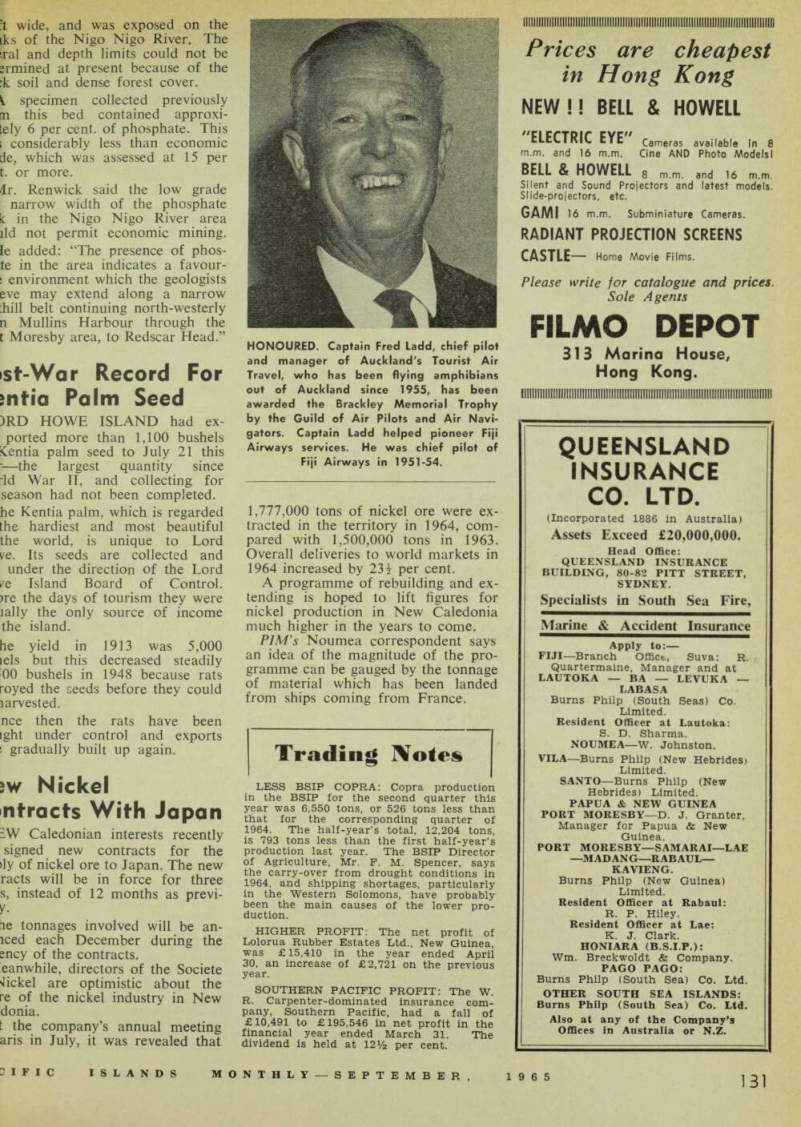
HONOURED. Captain Fred Ladd, chief pilot and manager of Auckland's Tourist Air Travel, who has been flying amphibians out of Auckland since 1955, has been awarded the Brackley Memorial Trophy by the Guild of Air Pilots and Air Navi gators. Captain Ladd helped pioneer Fiji Airways services. He was chief pilot of Fiji Airways in 1951-54.