[?]Ld Landmarks
p. 127 · Read in the full issue
Noumea Says
Goodbye To Its
From Fred Dunn, in Noumea I Woumea is losing the land rks of its colonial past, and rists who knew the town in old days would shed a tear
wme of the recent changes.
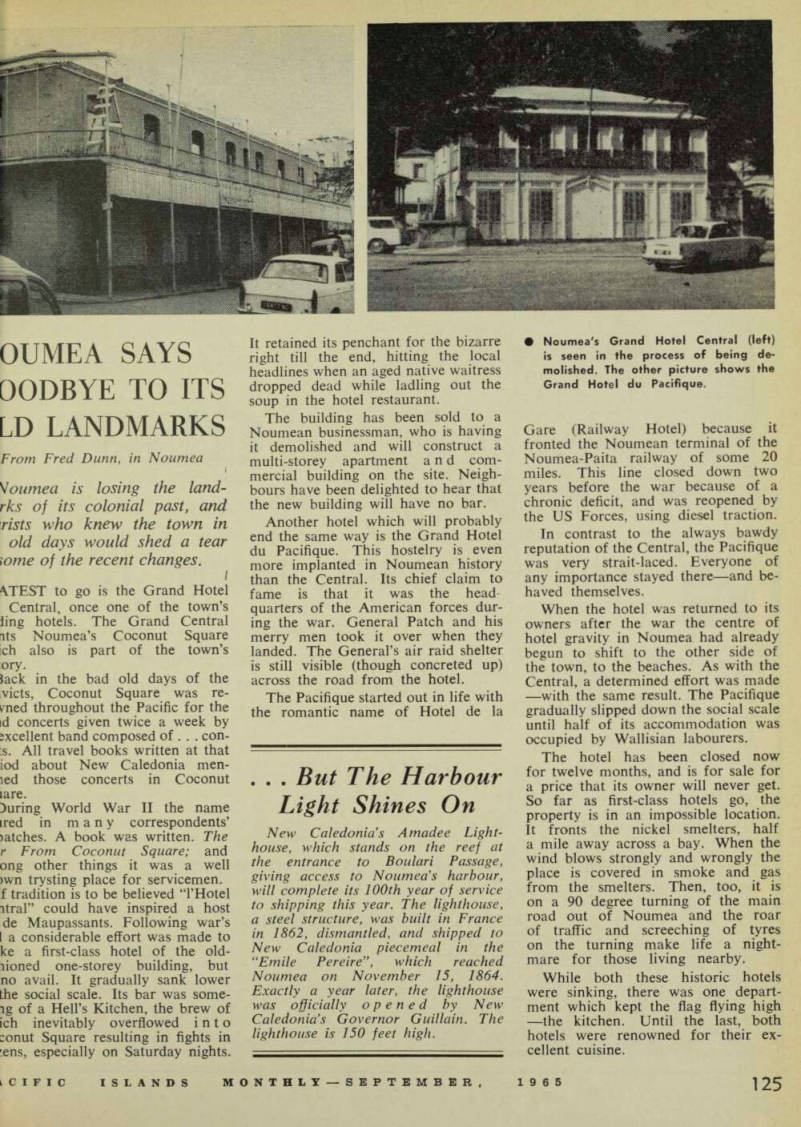
I \TEST to go is the Grand Hotel Central, once one of the town’s ling hotels. The Grand Central its Noumea’s Coconut Square ich also is part of the town’s ory. lack in the bad old days of the victs, Coconut Square was re ined throughout the Pacific for the id concerts given twice a week by excellent band composed of . . . con ;s. All travel books written at that iod about New Caledonia men icd those concerts in Coconut lare.
During World War II the name ired in many correspondents’ )atches. A book was written. The r From Coconut Square; and ong other things it was a well >wn trysting place for servicemen, f tradition is to be believed “I’Hotel itral” could have inspired a host de Maupassants. Following war’s 1 a considerable effort was made to ke a first-class hotel of the old lioned one-storey building, but no avail. It gradually sank lower the social scale. Its bar was some ig of a Hell’s Kitchen, the brew of ich inevitably overflowed into zonut Square resulting in fights in :ens, especially on Saturday nights.
It retained its penchant for the bizarre right till the end, hitting the local headlines when an aged native waitress dropped dead while ladling out the soup in the hotel restaurant.
The building has been sold to a Noumean businessman, who is having it demolished and will construct a multi-storey apartment and com mercial building on the site. Neigh bours have been delighted to hear that the new building will have no bar.
Another hotel which will probably end the same way is the Grand Hotel du Pacifique. This hostelry is even more implanted in Noumean history than the Central. Its chief claim to fame is that it was the head quarters of the American forces dur ing the war. General Patch and his merry men took it over when they landed. The General’s air raid shelter is still visible (though concreted up) across the road from the hotel.
The Pacifique started out in life with the romantic name of Hotel de la
Gare (Railway Hotel) because it fronted the Noumean terminal of the Noumea-Paita railway of some 20 miles. This line closed down two years before the war because of a chronic deficit, and was reopened by the US Forces, using diesel traction.
In contrast to the always bawdy reputation of the Central, the Pacifique was very strait-laced. Everyone of any importance stayed there—and be haved themselves.
When the hotel was returned to its owners after the war the centre of hotel gravity in Noumea had already begun to shift to the other side of the town, to the beaches. As with the Central, a determined effort was made —with the same result. The Pacifique gradually slipped down the social scale until half of its accommodation was occupied by Wallisian labourers.
The hotel has been closed now for twelve months, and is for sale for a price that its owner will never get.
So far as first-class hotels go, the property is in an impossible location.
It fronts the nickel smelters, half a mile away across a bay. When the wind blows strongly and wrongly the place is covered in smoke and gas from the smelters. Then, too, it is on a 90 degree turning of the main road out of Noumea and the roar of traffic and screeching of tyres on the turning make life a night mare for those living nearby.
While both these historic hotels were sinking, there was one depart ment which kept the flag flying high —the kitchen. Until the last, both hotels were renowned for their ex cellent cuisine.
• Noumea's Grand Hotel Central (left) is seen in the process of being de molished. The other picture shows the Grand Hotel du Pacifique.