travel
pp. 121-123 · Read in the full issue
Fiji Tourist Trade Hit
By Korolevu Hotel Fire
From a Suva Correspondent
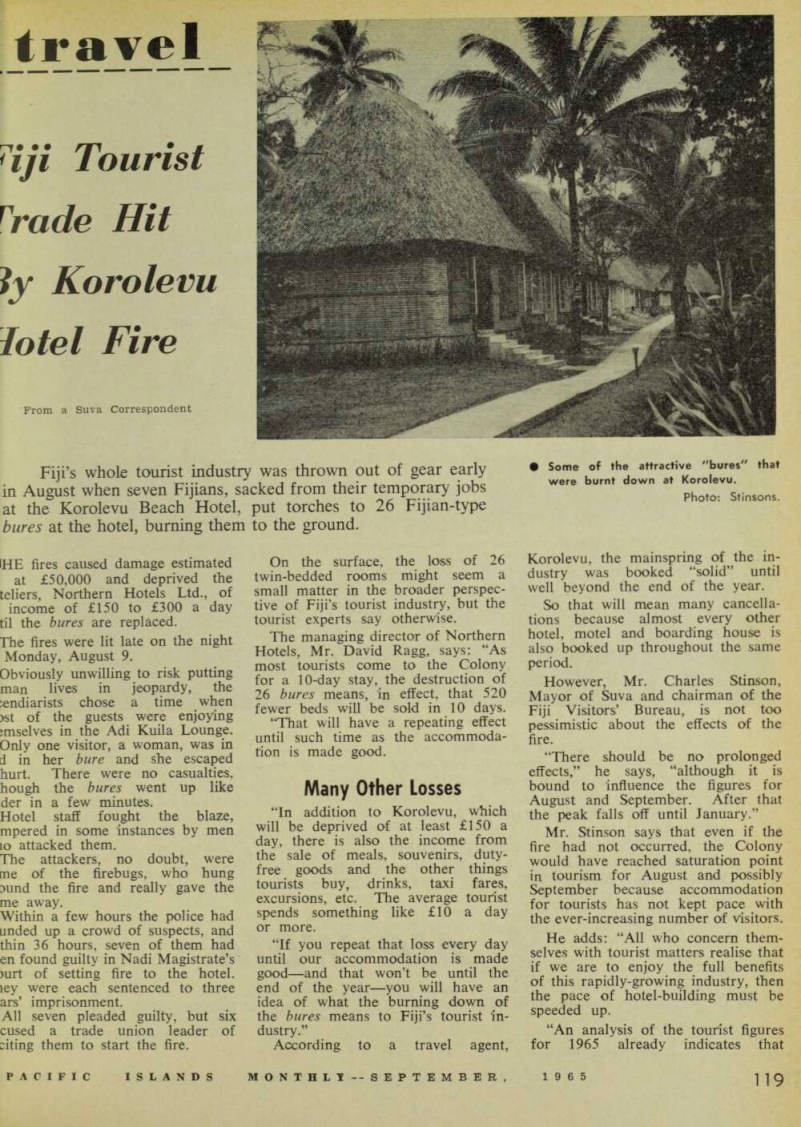
Fiji’s whole tourist industry was thrown out of gear early in August when seven Fijians, sacked from their temporary jobs at the Korolevu Beach Hotel, put torches to 26 Fijian-type bures at the hotel, burning them to the ground.
HE fires caused damage estimated at £50,000 and deprived the teliers, Northern Hotels Ltd., of income of £l5O to £3OO a day til the bures are replaced.
The fires were lit late on the night Monday, August 9.
Obviously unwilling to risk putting man lives in jeopardy, the chose a time when >st of the guests were enjoying smselves in the Adi Kuila Lounge.
Only one visitor, a woman, was in d in her bure and she escaped hurt. There were no casualties, hough the bures went up like der in a few minutes.
Hotel staff fought the blaze, mpered in some instances by men io attacked them.
The attackers, no doubt, were me of the firebugs, who hung 3und the fire and really gave the me away.
Within a few hours the police had unded up a crowd of suspects, and thin 36 hours, seven of them had en found guilty in Nadi Magistrate’s >urt of setting fire to the hotel, ley were each sentenced to three ars’ imprisonment.
All seven pleaded guilty, but six cused a trade union leader of riting them to start the fire.
On the surface, the loss of 26 twin-bedded rooms might seem a small matter in the broader perspec tive of Fiji’s tourist industry, but the tourist experts say otherwise.
The managing director of Northern Hotels, Mr. David Ragg, says: “As most tourists come to the Colony for a 10-day stay, the destruction of 26 bures means, in effect, that 520 fewer beds will be sold in 10 days.
“That will have a repeating effect until such time as the accommoda tion is made good.
Many Other Losses
“In addition to Korolevu, which will be deprived of at least £l5O a day, there is also the income from the sale of meals, souvenirs, duty free goods and the other things tourists buy, drinks, taxi fares, excursions, etc. The average tourist spends something like £lO a day or more.
“If you repeat that loss every day until our accommodation is made good—and that won’t be until the end of the year—you will have an idea of what the burning down of the bures means to Fiji’s tourist in dustry.”
According to a travel agent,
Korolevu, the mainspring of the in dustry was booked “solid” until well beyond the end of the year.
So that will mean many cancella tions because almost every other hotel, motel and boarding house is also booked up throughout the same period.
However, Mr. Charles Stinson, Mayor of Suva and chairman of the Fiji Visitors’ Bureau, is not too pessimistic about the effects of the fire.
“There should be no prolonged effects,” he says, “although it is bound to influence the figures for August and September. After that the peak falls off until January.”
Mr. Stinson says that even if the fire had not occurred, the Colony would have reached saturation point in tourism for August and possibly September because accommodation for tourists has not kept pace with the ever-increasing number of visitors.
He adds: “All who concern them selves with tourist matters realise that if we are to enjoy the full benefits of this rapidly-growing industry, then the pace of hotel-building must be speeded up.
“An analysis of the tourist figures for 1965 already indicates that
• Some of the attractive "bures" that were burnt down at Korolevu.
Photo: Stinsons.
>ple are wanting to stay here for ger periods and this really taxes accommodation.”
Commenting on adverse comments m overseas linking the Korolevu : with an alleged atmosphere of sion throughout the Colony, Mr. ison says: T do not hesitate to say that this quite untrue. It was an act of er irresponsibility on the part of : ew persons. This regrettable act ;ompletely out of character where people of Fiji are concerned, I will shock overseas visitors who re been to Fiji as much as it i the people of Fiji, and especially Fijians themselves.”
Meanwhile, Korolevu Hotel has arned to normal in its unburned tions. In fact, it was back to mal within a couple of days, work is under way on re c'ing the burned-out sections. The ditional Fijian-type bures are out the present, however. In their ce will be four two-storey, eight -1 units in concrete. fhey will not be concrete boxes. 2 exteriors will be decorated with -proof materials giving a rustic sh in keeping with the genuine nd atmosphere. fhe new units will add 64 beds the hotel, an increase of 12 on the -fire accommodation.
The reason for rebuilding in icrete is because it is speedier in ction and will restore public con mce in the safety of our ommodation,” Mr. Ragg says.
Provided there are no hitches, expect to start building about 1-September and the first unit will ready within 12 weeks of the *t of building.”
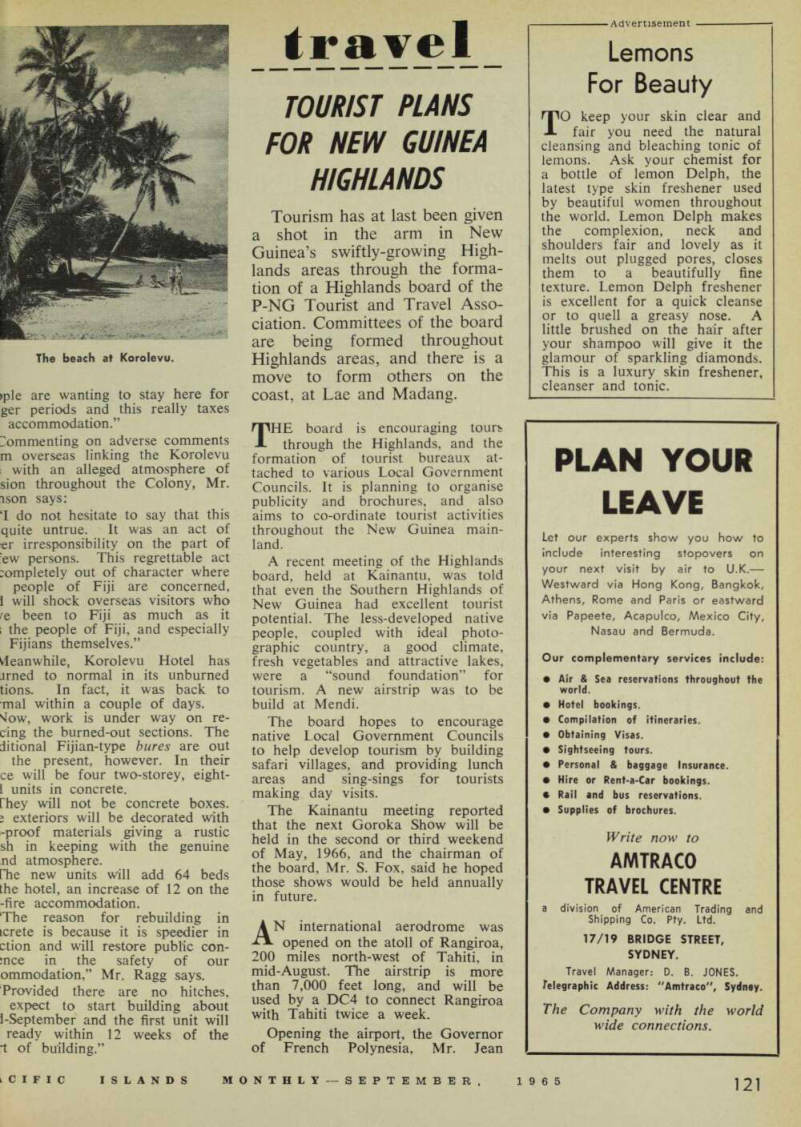
The beach at Korolevu,