Cruising Yachts
pp. 101-109 · Read in the full issue
Pacific Shipping And
Everybody's Doing It -Emulating The Epic Voyages Of The Past
Now that modem man has pretty well mastered the trick of flying to the moon in a rocket, more and more people, it seems, want to put back the clock and emulate some of the great sea voyages of the past.
[N the last few weeks no less than four voyages of this kind, which will take in the South Pacific, have segun.
The voyagers who are being emulated are Captain Joshua Slocum, ;he first man to sail solo around the world; the crewmen of the raft Kon-Tiki, who drifted from Peru to he Tuamotus in 1947; Captain Cook, who began his first voyage of dis :overy in the Pacific in 1768; and Ferdinand Magellan, the first Euro pean to cross the Pacific and leader 3f the first expedition to circum navigate the world.
"Pretty Easy"
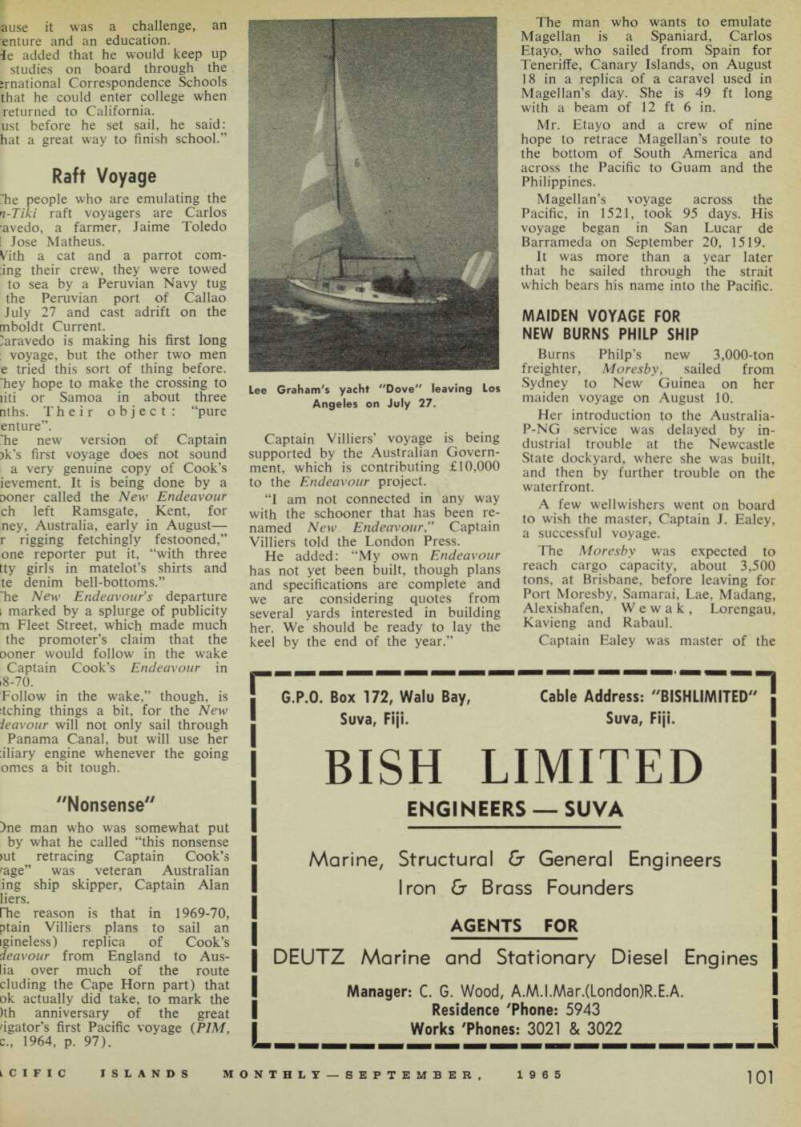
The latter-day Slocum is a 16year-old American schoolboy, Lee Graham, who completed the first 2,400-mile leg of a planned circum navigation on August 18 when he reached Honolulu from San Pedro, California, in his 24 ft sloop Dove.
Lee described the voyage, which took 25 days, as “pretty easy”, and said he would go on to Fiji via the
Phoenix Islands in two weeks to four weeks.
He expects to complete his circum navigation in about two years—and if he makes it, he will have the honour of being the youngest sailor to complete such a voyage.
Lee’s only companions are two kittens, Suzette and Jolliette, which were born on the day Dove was bought and which were two months old when he left California.
Despite his age, Lee is no novice as a sailor. He has been knocking around in sailboats since he was 10, and was a competent navigator at 13.
Before his latest cruise, he had covered more than 15,000 miles at sea, mostly in the South Pacific, and had made two crossings between Hawaii and California.
Most of his previous sailing has been done with his parents, whose ketch Golden Hind was mentioned several times in PIM in 1963 when the Grahams were in the South Pacific.
Dove is fitted with wind vane
steering which automatically cor rects the yacht if she gets off course.
She is also fitted with a 6 h.p. auxiliary engine and a radio receiver.
There is no radio transmitter.
Commenting on the lack of a transmitter, Lee’s father, Mr. Lyle Graham, told PIM : “This puzzles most power boat people, but most sail boat people understand that carrying a big, expensively adequate radio, with the necessary batteries and generator, is like taking along another boat in case one sinks.”
However, Lee does have safety equipment of another kind. On board, he wears a safety harness with a life line attached to the boat.
Lee told newsmen in California that he was making his voyage
New Freighter
Begins Service
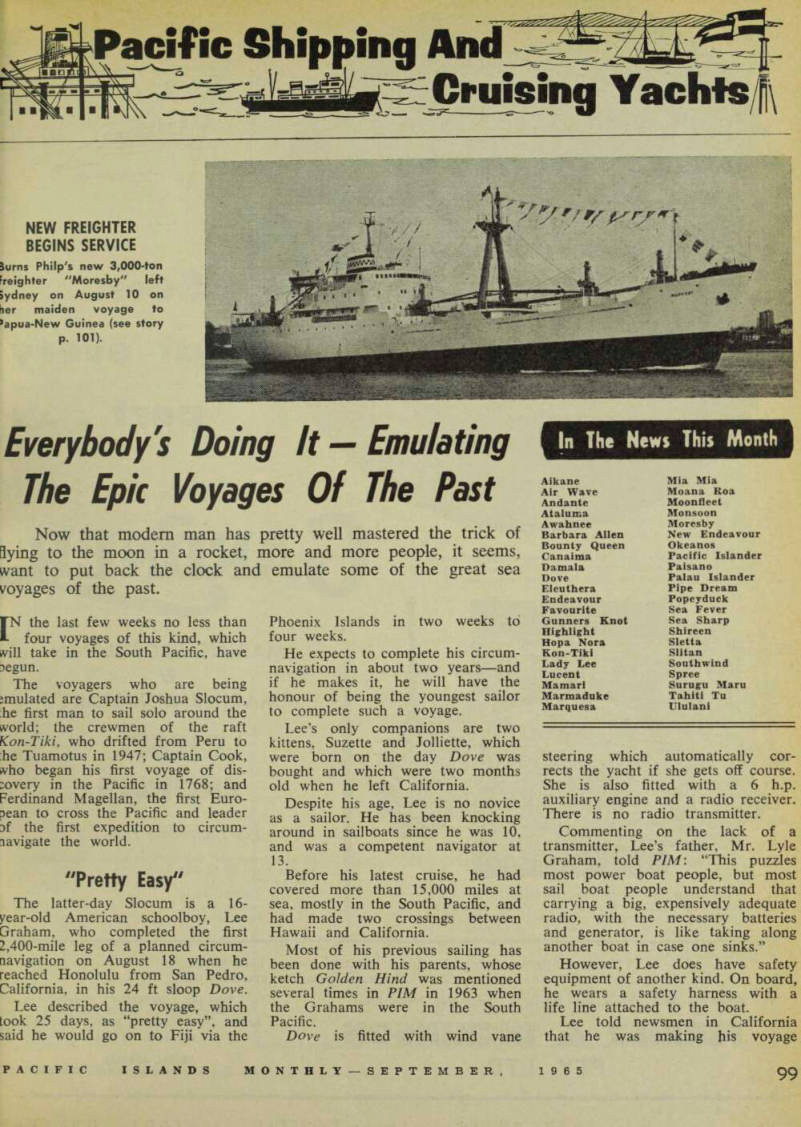
[?]Burns Philp's new 3,000-ton freighter "Moresby" left Sydney on August 10 on [?]er maiden voyage to [?]apua-New Guinea (see story p. 101).
ause it was a challenge, an •enture and an education.
Je added that he would keep up studies on board through the jrnational Correspondence Schools that he could enter college when returned to California, ust before he set sail, he said: hat a great way to finish school.”
Raft Voyage
Tie people who are emulating the n-Tiki raft voyagers are Carlos avedo, a farmer, Jaime Toledo 1 Jose Matheus.
Vith a cat and a parrot com ing their crew, they were towed to sea by a Peruvian Navy tug the Peruvian port of Callao July 27 and cast adrift on the tnboldt Current. )aravedo is making his first long ; voyage, but the other two men e tried this sort of thing before, 'hey hope to make the crossing to uti or Samoa in about three nths. Their object: “pure enture”.
Tie new version of Captain )k’s first voyage does not sound a very genuine copy of Cook’s ievement. It is being done by a ooner called the New Endeavour ch left Ramsgate, Kent, for ney, Australia, early in August— r rigging fetchingly festooned,” one reporter put it, “with three tty girls in matelot’s shirts and te denim bell-bottoms.”
Tie New Endeavour’s departure i marked by a splurge of publicity tl Fleet Street, which made much the promoter’s claim that the ooner would follow in the wake Captain Cook’s Endeavour in iB-70.
Follow in the wake,” though, is itching things a bit, for the New ieavour will not only sail through Panama Canal, but will use her iliary engine whenever the going omes a bit tough.
"Nonsense"
)ne man who was somewhat put by what he called “this nonsense >ut retracing Captain Cook’s rage” was veteran Australian ing ship skipper, Captain Alan Hers. fhe reason is that in 1969-70, ptain Villiers plans to sail an igineless) replica of Cook’s ieavour from England to Aus lia over much of the route eluding the Cape Horn part) that ok actually did take, to mark the )th anniversary of the great dgator’s first Pacific voyage ( PIM, c., 1964, p. 97).
Captain Villiers’ voyage is being supported by the Australian Govern ment, which is contributing £lO,OOO to the Endeavour project.
“I am not connected in any way with the schooner that has been re named New Endeavour,” Captain Villiers told the London Press.
He added: “My own Endeavour has not yet been built, though plans and specifications are complete and we are considering quotes from several yards interested in building her. We should be ready to lay the keel by the end of the year,”
The man who wants to emulate Magellan is a Spaniard, Carlos Etayo, who sailed from Spain for Teneriffe, Canary Islands, on August 18 in a replica of a caravel used in Magellan’s day. She is 49 ft long with a beam of 12 ft 6 in.
Mr. Etayo and a crew of nine hope to retrace Magellan’s route to the bottom of South America and across the Pacific to Guam and the Philippines.
Magellan’s voyage across the Pacific, in 1521, took 95 days. His voyage began in San Lucar de Barrameda on September 20, 1519.
It was more than a year later that he sailed through the strait which bears his name into the Pacific.
Maiden Voyage For
New Burns Philp Ship
Burns Philp’s new 3,000-ton freighter, Moresby, sailed from Sydney to New Guinea on her maiden voyage on August 10.
Her introduction to the Australia- P-NG service was delayed by in dustrial trouble at the Newcastle State dockyard, where she was built, and then by further trouble on the waterfront.
A few wellwishers went on board to wish the master, Captain J. Ealey, a successful voyage.
The Moresby was expected to reach cargo capacity, about 3,500 tons, at Brisbane, before leaving for Port Moresby, Samarai, Lae, Madang, Alexishafen, Wew a k , Lorengau, Kavieng and Rabaul.
Captain Ealey was master of the
Lee Graham's yacht "Dove" leaving Los Angeles on July 27.
r alaita , sold a few weeks previously, ffore assuming his present com and.
He has been in Burns Philp’s arine service for about 20 years, :cept for one break overseas.
The Moresby was the first ship lilt in Australia for Burns Philp.
The chairman, Mr. James Burns, caking at the launching ceremony the Newcastle State Dockyard on arch 6, said that if the Moresby as a success, Burns Philp hoped to iprove any additional tonnage they lilt by increasing the speed and :rhaps adding some passenger ac ►mmodation.
He reaffirmed the company’s >licy of gradually replacing its ips as they grew older with vessels ; suitable carrying capacity and eater speed.
P Chairman Hits At
Ng Wharf Facilities
Mr. James Burns, chairman of urns Philp and Co. Ltd., has added s voice to those of many other itics of wharf facilities in Papua ew Guinea.
In his address to stockholders at e annual meeting in Sydney in ugust, he said: “The trouble with e Papua-New Guinea trade at •esent is that there is not enough harfage accommodation for the rge number of vessels calling there, id frequent delays waiting for harfage space often occur.”
Mr. Burns repeated, in effect, what ; has been saying for a number of jars about the profitability of the impany’s shipping line.
He said the company’s business merally continued to be prosperous, ut the shipping service to Papua lew Guinea suffered heavy losses sspite a subsidy received from the ederal Government.
However, Burns Philp did not ant to discontinue the service, as icy had been running it to the Ter tory for more than 80 years.
“Notwithstanding heavy losses, r e hope, for the time being, to ontinue,” he said.
Mr. Burns said the new freighter ioresby had cost about £1 million.
The Moresby did not carry pas sngers, because there was enough assenger accommodation in other essels.
Concluding his remarks about the ompany’s shipping activities, he said iat with the slow turn around in ydney, it was hard to avoid losses i this field.
“However, with our world-wide aterests built up over 80 years, we re lucky in being able to stand up o our shipping losses, and still pay
our stockholders a reasonable dividend,” he said.
The parent company had a net profit of £1,113,888, and dividends from subsidiary companies amounted tC> Tha? figure, with the trading profit, gave a very satisfactory result.
Another Jap Ship For Moresby
A Japanese shipping line, Nippon Yusen Kaisha, is the latest to enter the Japan-Australia service, taking in a P-NG port.
The P-NG agents, Burns Philp, announced in July that the first ship on the new service, the Suruga Maru,
was expected at Port Moresby about August 26, en route from Kobe to Sydney, The Suruga Maru, a fast modern ship, carries cargo and passengers.
"Sletta" To Start New
Service To Bsip- P-Ng
™ n ew a service from Sydney and Brisbane to Honiara, Kieta and Rabaul. The Sletta will leave Sydney for the first time on this run on September 28.
The Sletta has a cargo capacity of 2,000 cubic tons, with refrigerated and cooler space. She is also fitted
carry explosives and special goes such as livestock.
Hie managing agents for the rlander New Guinea Line are H. Stephens Pty. Ltd., Sydney.
Hing Vessel
Andoned At Lord Howe
fhe insurance representative for 400-ton fishing vessel, Favourite, ich was badly holed when she was :pt on a reef off Lord Howe Island August 7, has decided to abandon vessel because pounding on the f has broken her back. Tenders [ now be called for the purchase the wreck. ■fie ship, valued at £50,000, was led by a food processing company, 1 operated from Eden, on the ith Coast of New South Wales, 'live Wilson, a resident of Lord we Island, was called out of bed >ut 3 a.m. on August 8 to take motor boat Pacific Chieftain out assist the Favourite. n a note to PIM, he said, that after went aground, the crew refloated under power, but the pumps Id not keep the water down, so was run on the reef at the rthern end of the island. .ater, when no world had been ;ived from the insurance company, as there were signs of the sea ig and the vessel breaking up, island superintendent, who is • the receiver of wreck, sought ;nt permission to begin salvage the valuable equipment. alvage work began on the 9th, ipment being ferried across the into the lagoon in a dinghy.
Ir. Wilson said that on August representatives of the insurance ipany and the owners of the ourite arrived at Lord Howe, t first they thought that it would possible to tow the Favourite off reef with the Jacques del Mar, a later inspection revealed that ship’s back was broken.
St Territory Contract
two-year contract has been rded to the United Tanker Cor ition of New York for the ation of the United States Trust itory’s three major vessels, fie Islander, Gunners Knot, and tu Islander.
It Russian Ship
he Russian oceanographic ship >a Nora, believed to be the first sian ship ever to visit the New rides, arrived in Vila on July 22 • a 10-day voyage from Fiji. tie call was made to enable the a operator to be treated for a at complaint.
Vila Trading Vessel
Wrecked At Tanna
The MV Air Wave, a Vila trading vessel, was wrecked in a storm off the north coast of Tanna, New Hebrides, recently. The Air Wave, of about 30 tons, was carrying a cargo of cocoa and sandalwood from Tanna to Vila.
The master tried to shelter in the bay at Back Beach, Tanna, but the wind was so strong that the Air Wave dragged her anchor and was blown on a reef. She sank in about 30 feet of water.
A Vila message says first reports
indicate that the Air Wave will be a total loss.
Higher Loss For
"Moana Roa"
The working loss of the New Zealand Government’s MV Moana Roa, which provides the only regular surface connection between NZ and the Cook Islands, was £41,369 for the year ended March 31, 1965.
This is stated in the latest annual report of the New Zealand Depart ment of Island Territories.
The report says that the loss for the year ended March 31, 1964, was
,200, and that the increased loss the succeeding 12 months was i to increased salaries and wages the crew, and increased stevedor and repair costs.
'o meet the increased costs, freight s were raised from October 1, 4.
Tie report adds that bad weather more calls to the outer islands ited the Moana Roa to only 10 ages between New Zealand and Cooks during the year compared i 11 the previous year.
Cairners Planning
■An-Going Launch
'itcairn Islanders are planning to d a twin-engine ocean-going ich to make regular trips to ngareva, in the Gambier Islands French Polynesia. An editorial in aim Miscellany suggests that the r launch could be called Bounty •en.
Tie 280-mile trip to Mangareva Id be made in about 35 hours in lunch of this type.
V Team Takes Over
F-Blasting In Tokelaus
lew Zealand Army sappers are blasting gaps in the reef at aofu atoll in the Tokelaus to ; free passage and a sheltered borage for small lighters used by islanders. l team of engineers, which started k on the project in May, was aced by a second team early in ;ust. /hen they finish their work, the iders will no longer have to >ot the reef’ in small lighters n they are loading copra boats.
Iporary Storage
! Lae Wharf
l new structure of steel trusses : ed with galvanised iron is to be t at the Lae wharf to increase covered area. ; will not be the main extension med for the wharf, but a tem iry expedient to ease overcrowd of the current storage space.
Will Reveal
Den Dangers
. closed circuit television unit is be installed in the hydrographic r ey ship, Ataluma, owned by tralian Hydrographic Services to give the helmsman a greater wledge of reefs and other gerous waters round the ship, he Ataluma is working in P-NG ;rs under charter to the Admini tion.