Fascinating Story Of The Pacific's “Queen Emma”
pp. 95-96 · Read in the full issue
Pacific's “Queen Emma”
In 50 years of travelling and working in the Pacific Islands, R. W. Robson has been fascinated by the history of scores of men and women of unusual character who made the South Seas their home. But none fascinated him more than the girl who was bom in Samoa in 1850 as Emma Eliza Coe. His book about her, Queen Emma, is the result of many years research in the Islands, Australia, New Zealand, the United States and Europe.
MMA COE’S life was one of paradox in that she was able take full advantage of the age of isting European acquisition in the ific; and at the same time achieve ilts that few women of the period 2d, or were permitted, to do. ler mother was Samoan, of royal lietoa blood; her father was Jonas Coe, son of a respectable erican family. He ran away to at 14 and at 16 was washed up the shores of Savaii, Samoa, ging to the broken spar of a eked American whaler, anas soon got his first taste of loan life and love, and although was finally “rescued” by the next
American ship to call at these islands, he never forgot Samoa. He returned there permanently in 1845 and set himself up as a trader.
Subsequently he was official United States representative—or Consul— in Samoa until he got himself embroiled in the native kingship wars and a fiery brand of local politics that displeased the people in Washington.
In all, Jonas had six acknowledged wives, all Samoan. Some of these were churched; other unions were simply fa'a Samoa; and some of the wives overlapped—that is, there was more than one in residence in the Coe establishment at the one time.
From these six marriages, Jonas recognised 18 children as Coes and meticulously listed them in his big family Bible. Emma was the second child of his first wife Le’utu, and his favourite. She was nearer to him in temperament and in her late teens and early twenties became his able lieutenant in trading and politics.
Coe saw to the education of all his acknowledged children but he was particularly careful with Emma.
He sent her to a convent school in Sydney when she was 11; and when she was in her mid-teens he persuaded his brother Edward, in San Francisco, to take her into his household so that she might finish her education.
Good-Looking
When Emma returned to Apia in 1869 she was 19. She was good looking in the sultry way of part- European girls but her Polynesian love of fun was leavened, to an extent, by Yankee shrewdness. For a while she engaged in the carefree life of the sprawling township of Apia but within months Jonas, who knew better than most the pitfalls of the prevaling social conditions, was urging marriage upon her.
Fortunately the means were at hand—22 years old James Forsayth, well-educated, English, second-mate on the vessel that had brought Emma home from California.
With Coe’s help, Forsayth became a trader and schooner owner in Apia and in these enterprises he was helped by Emma. Their first child, a daughter, was born in 1870 but did not long survive; their son was born in 1872 but Emma’s interest in Forsayth did not long survive the
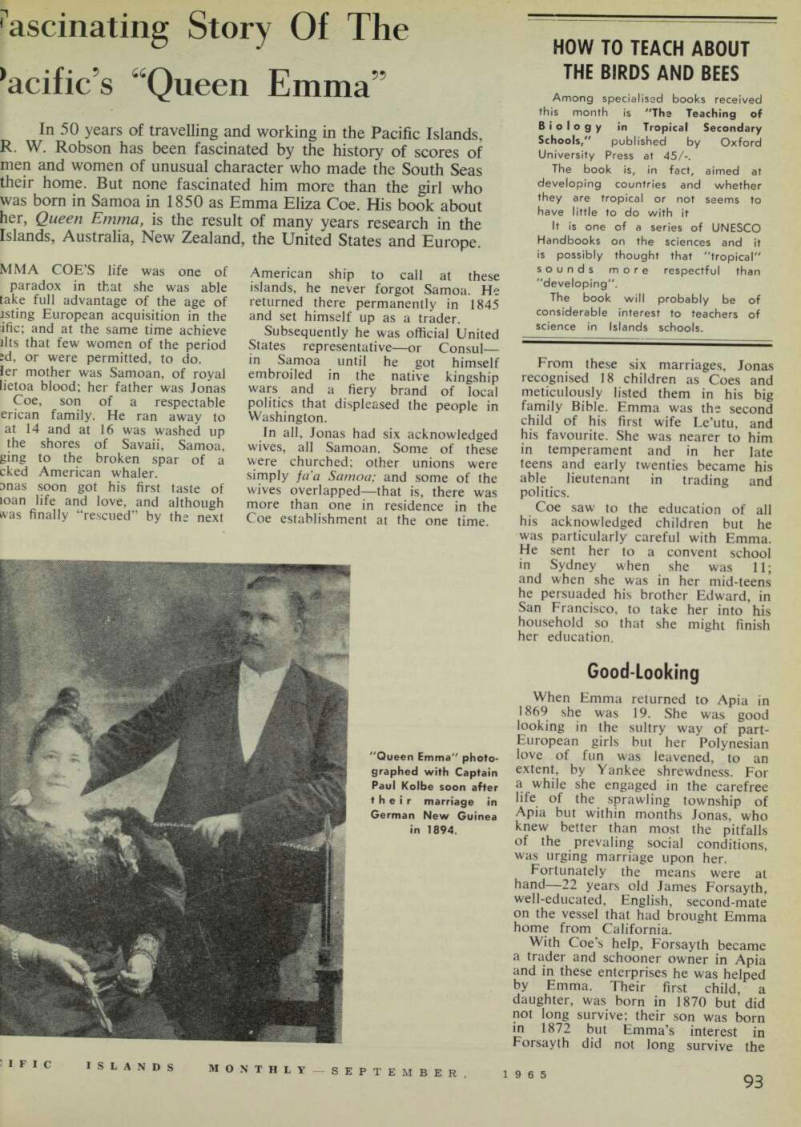
"Queen Emma" photo graphed with Captain Paul Kolbe soon after their marriage in German New Guinea in 1894.
Forsayth did not long survive the event. Increasingly Forsayth was away at sea and the suggestion is that he was finally lost with his ship off the China coast.
By 1873 Emma apparently re garded herself as free to again indulge in affairs of the heart; and at the same time she and her father both became entangled with notable events in South Pacific history and in the local Samoan kingship wars that involved the governments of Britain, Germany and the United States.
Emma became more personally involved with Colonel Albert Stein berger, whose manipulations of Samoan affairs severely embarrassed the US President, General Ulysses Grant; and when Steinberger was finally discredited in the eyes of the Samoans in 1876, and her father was temporarily deported, Emma entered a black period of her life.
Left Samoa
When Jonas Coe returned to Apia in 1877 he found Emma withdrawn from social life, living in a Samoan village. The story is that he then connived with a red-bearded Aus tralian labour-recruiter, Tom Farrell, to get her out of the village and back into circulation. It is a fact that they left Samoa together in a sailing ship in 1878 as Mrs.
Forsayth and Captain Tom Farrell; and that by mid-1879 they were established in Mioko, Duke of York Islands, in New Guinea, as Mr. and Mrs. Farrell. It was assumed that they had been married in Sydney but this was not the case—at this time Forsayth’s fate was still un certain.
It was in New Guinea that the Coe part of Emma’s nature began
to predominate. In this then savage no-man’s-land of deadly fevers and marauding cannibals she was the first to see the potential wealth in coconut planting. She got possession of rich areas of land on the main land of New Britain and in the off shore islands before German an nexation and then fought the Ger mans for her right to retain it.
She had a strange association with the scandalous enterprise of the Marquis de Rays to colonise New Ireland; Farrell faded from the scene and after her huge Dalmatian lover and her brother were killed by natives, she married Captain Kolbe, a German officer.
In the years between 1879 and 1900, the fun-loving part-Samoan girl, Emma Coe, changed into Queen Emma of New Guinea. In her planting enterprises she was assisted by her eminent botanist brother-in-law, Richard Parkinson; and she sur rounded herself with members of her
own family brought from Sam Through Emma and her fan: much of the foundations of N Guinea’s modern copra indus was laid.
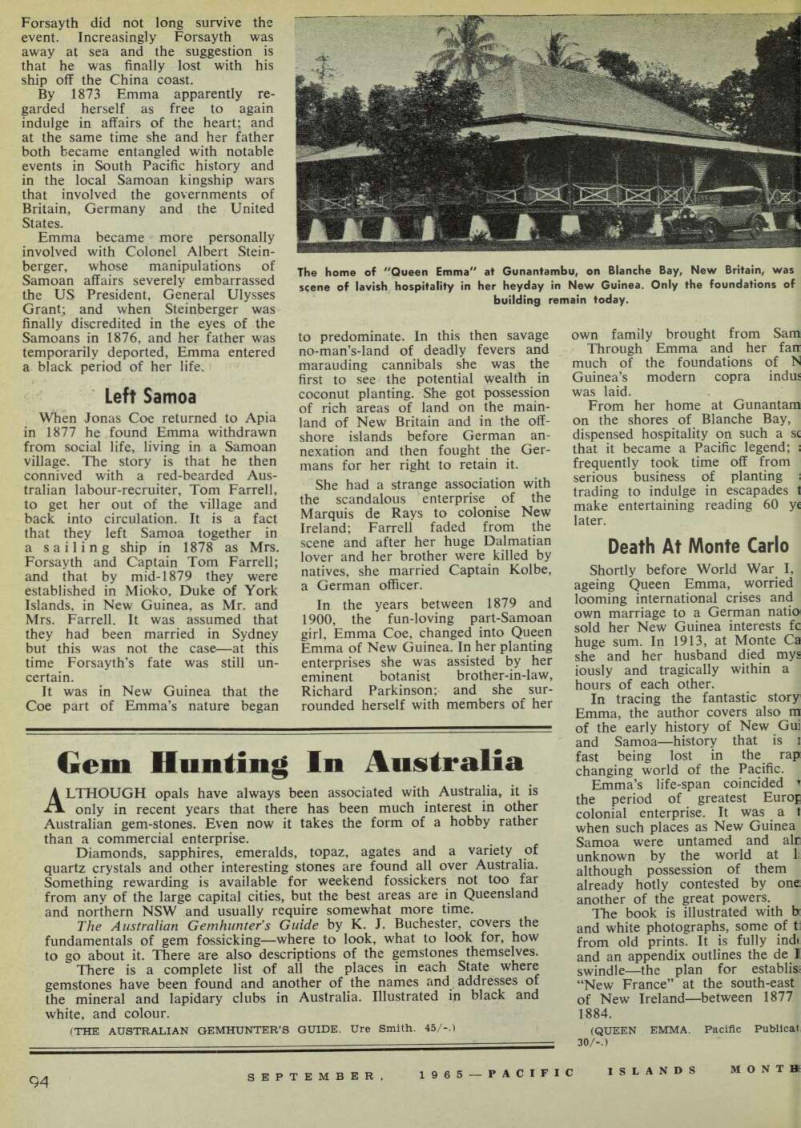
From her home at Gunantara on the shores of Blanche Bay, dispensed hospitality on such a sc that it became a Pacific legend; : frequently took time off from serious business of planting i trading to indulge in escapades t make entertaining reading 60 ye later.
Death At Monte Carlo
Shortly before World War I, ageing Queen Emma, worried looming international crises and own marriage to a German natioi sold her New Guinea interests fc huge sum. In 1913, at Monte Ca she and her husband died mys iously and tragically within a hours of each other.
In tracing the fantastic story Emma, the author covers also ra of the early history of New Gui and Samoa —history that is i fast being lost in the rap changing world of the Pacific.
Emma’s life-span coincided t the period of greatest Europ colonial enterprise. It was a t when such places as New Guinea Samoa were untamed and ale unknown by the world at I although possession of them already hotly contested by one another of the great powers.
The book is illustrated with b: and white photographs, some of tl from old prints. It is fully ind» and an appendix outlines the de I swindle —the plan for establis* “New France” at the south-east of New Ireland —between 1877 1884. (QUEEN EMMA. Pacific Publicat 30/-.)
The home of "Queen Emma" at Gunantambu, on Blanche Bay, New Britain, was scene of lavish hospitality in her heyday in New Guinea. Only the foundations of building remain today.