South Seas Pictures
pp. 83-86 · Read in the full issue
Forgotten Genius Put
New Colour Into
By Robert Langdon
Among the first things you notice when you walk into the room of Professor J. W. Davidson, head of the Australian National University’s Pacific history section in Canberra, are two coloured wall pictures of Islands scenes, which were ob viously done some time last century.
F you are familiar with early South Seas art and literature, u will immediately recognise them Baxter prints.
But unless you have ever made a tint of finding out who Mr. Baxter is, you will probably have no idea w he came to produce these South as pictures, or why they, and the any other pictures he published, j now much prized and sought ;er by collectors.
This, however, is nothing to be tiamed of, for neither the Ency ipaedia Britannica, Encyclopaedia nericana nor Collier’s Encyclo
paedia recognises the fact that Mr.
Baxter ever existed, while Britain’s massive Dictionary of National Biography dismisses the man in three or four lines. j t wou a p pe ar, though, that these great reference works have treated jvf r . Baxter with a contempt he did not deserve, for inquiry reveals that was one t^e g initiators in , he fie|d of p rinting .
He was (he inventor of an oil colour process which enabled colour ed pictures to be printed cheaply and in unlimited numbers for the first time.
This invention stimulated colour
printing in the same way that the invention of moveable types stimulat ed literature, and it enabled ordinary people to do what only the rich had previously been able to do—possess coloured pictures.
The London Morning Post of March 21, 1859, described Baxter’s process as “one of the most beauti ful and ingenious inventions of our time,” and it said it had “certainly done more than any other single modern discovery to make the great mass of people fond of good pic tures and familiar with them,”
Yet despite the recognition that Baxter achieved in his own day, no contemporary journalist ever thought that he was interesting enough to interview. And as Baxter, himself, left no diaries and few other papers, little is now known about his life or of the process he invented.
Such details as are known were not collected until nearly 40 years after his death by one, C. T.
Courtney Lewis, who wrote several books about him.
From these books one learns that Baxter—his Christian name was George—was born at Lewes, Sussex, on July 31, 1804, and that he was the second son of John Baxter, a printer. (John Baxter, by the way, was the first printer to use an inking roller, now an indispensable part of every printing establishment, and the first person to write and publish a book entirely devoted to cricket).
George Baxter went to school at Lewes and nearby Brigton, worked for a time in a Brigton bookshop, then apparently became apprenticed to a wood engraver. (over)
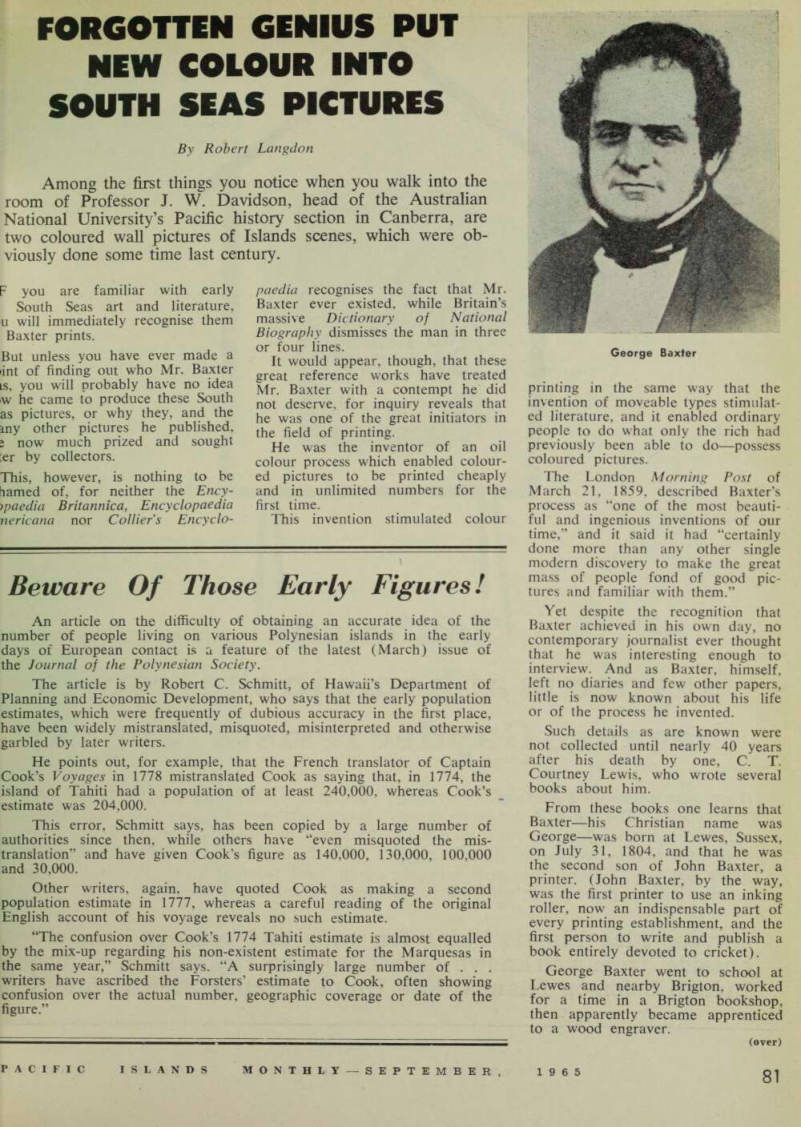
George Baxter
In 1827, he helped to produce the lustrations in two books on Sussex üblished by his father, and in the ime year he married and moved to ondon.
In London, he continued to work 5 an engraver, apparently spending inch of his time in experimenting n colour printing. The first colour rint that he is known to have pro uced depicted three butterflies, and ppeared in a book published in 829.
First Colour Print
Five years later, his first oil colour rint, produced by the process of is own invention, was published j a book illustration.
Baxter immediately took out a itent for his invention, and by the me of Queen Victoria’s accession [ 1837, his work had reached a igh standard.
It was in 1837 that Baxter began Elaborating with a man called low, who had just been appointed iblisher for the London Missionary xdety.
This was the beginning of Baxter’s isociation with the South Seas. was also the beginning of two jw phases in Baxter’s career—the •oduction of portraits in colours, id the production of prints of his mdiwork for sale separately, i.e. her than as book illustrations.
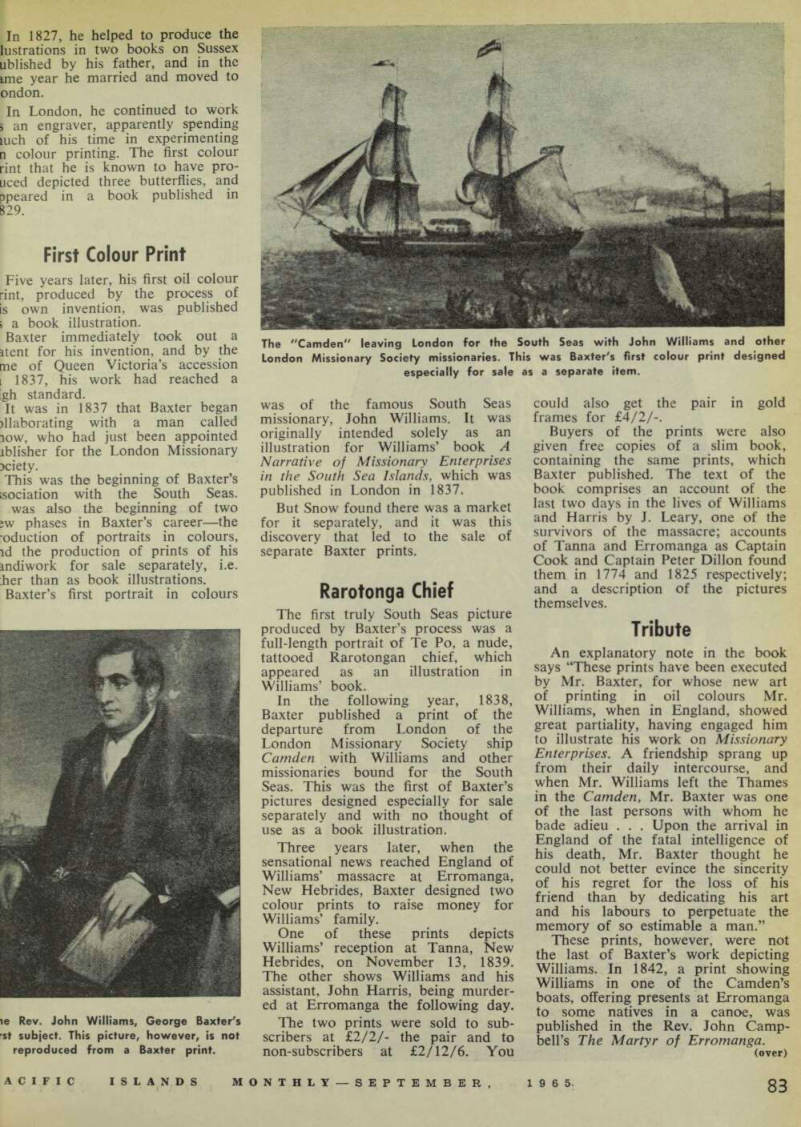
Baxter’s first portrait in colours
was of the famous South Seas missionary, John Williams. It was originally intended solely as an illustration for Williams’ book A Narrative of Missionary Enterprises in the South Sea Islands, which was published in London in 1837.
But Snow found there was a market for it separately, and it was this discovery that led to the sale of separate Baxter prints.
Rarotonga Chief
The first truly South Seas picture produced by Baxter’s process was a full-length portrait of Te Po, a nude, tattooed Rarotongan chief, which appeared as an illustration in Williams’ book.
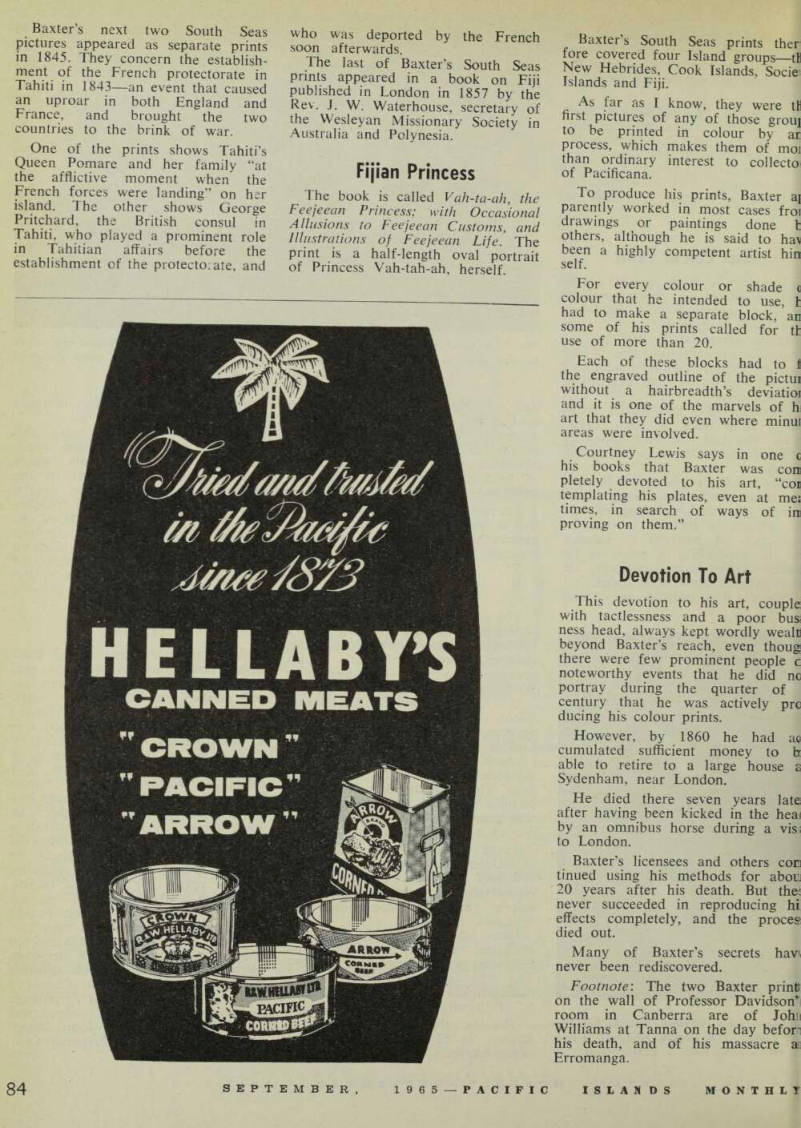
In the following year, 1838, Baxter published a print of the departure from London of the London Missionary Society ship Camden with Williams and other missionaries bound for the South Seas. This was the first of Baxter’s pictures designed especially for sale separately and with no thought of use as a book illustration.
Three years later, when the sensational news reached England of Williams’ massacre at Erromanga, New Hebrides, Baxter designed two colour prints to raise money for Williams’ family.
One of these prints depicts Williams’ reception at Tanna, New Hebrides, on November 13, 1839.
The other shows Williams and his assistant, John Harris, being murder ed at Erromanga the following day.
The two prints were sold to sub scribers at £2/2/- the pair and to non-subscribers at £2/12/6. You
could also get the pair in gold frames for £4/2/-.
Buyers of the prints were also given free copies of a slim book, containing the same prints, which Baxter published. The text of the book comprises an account of the last two days in the lives of Williams and Harris by J. Leary, one of the survivors of the massacre; accounts of Tanna and Erromanga as Captain Cook and Captain Peter Dillon found them in 1774 and 1825 respectively; and a description of the pictures themselves.
Tribute
An explanatory note in the book says “These prints have been executed by Mr. Baxter, for whose new art of printing in oil colours Mr.
Williams, when in England, showed great partiality, having engaged him to illustrate his work on Missionary Enterprises. A friendship sprang up from their daily intercourse, and when Mr. Williams left the Thames in the Camden, Mr. Baxter was one of the last persons with whom he bade adieu . . . Upon the arrival in England of the fatal intelligence of his death, Mr. Baxter thought he could not better evince the sincerity of his regret for the loss of his friend than by dedicating his art and his labours to perpetuate the memory of so estimable a man.”
These prints, however, were not the last of Baxter’s work depicting Williams. In 1842, a print showing Williams in one of the Camden’s boats, offering presents at Erromanga to some natives in a canoe, was published in the Rev. John Camp bell’s The Martyr of Erromanga. (over)
[?]e Rev. John Williams, George Baxter's [?]St subject. This picture, however, is not reproduced from a Baxter print.
The "Camden" leaving London for the South Seas with John Williams and other London Missionary Society missionaries. This was Baxter's first colour print designed especially for sale as a separate item.
Baxter’s next two South Seas pictures appeared as separate prints in 1845. They concern the establish ment of the French protectorate in Tahiti in 1843—an event that caused an uproar in both England and France, and brought the two countries to the brink of war.
One of the prints shows Tahiti’s Queen Pomare and her family “at the afflictive moment when the French forces were landing” on her island. The other shows George Pritchard, the British consul in Tahiti, who played a prominent role in Tahitian affairs before the establishment of the protecto:ate, and
who was deported by the French soon afterwards The last of Baxter’s South Seas prints appeared in a book on Fiji published in London in 1857 by the Rev - J - w - Waterhouse, secretary of the Wesle yan Missionary Society in Australia and Polynesia. c;;; ail
N|ian rnnCGSS
The book is called Vah-ta-ah, the Feejeean Princess; with Occasional Allusions to Feejeean Customs, and Illustrations of Feejeean Life. The print is a half-length oval portrait of Princess Vah-tah-ah, herself.
Baxter’s South Seas prints ther fore covered four Island groups—tß New Hebrides, Cook Islands, Socie Islands and Fiji.
As far as I know, they were tB first pictures of any of those grouj to be printed in colour by ar process, which makes them of moi than ordinary interest to collector of Pacificana.
To produce his prints, Baxter aj parently worked in most cases froi drawings or paintings done t others, although he is said to ha\ been a highly competent artist hin self.
For every colour or shade c colour that he intended to use, t had to make a separate block, an some of his prints called for th use of more than 20.
Each of these blocks had to I the engraved outline of the pictui without a hairbreadth’s deviatioi and it is one of the marvels of h art that they did even where minut areas were involved.
Courtney Lewis says in one c his books that Baxter was coo pletely devoted to his art, “coi templating his plates, even at mej times, in search of ways of io proving on them.”
Devotion To Art
This devotion to his art, couple with tactlessness and a poor busi ness head, always kept wordly wealt beyond Baxter’s reach, even thoug there were few prominent people c noteworthy events that he did nc portray during the quarter of century that he was actively pro ducing his colour prints.
However, by 1860 he had ao cumulated sufficient money to h able to retire to a large house a Sydenham, near London.
He died there seven years late after having been kicked in the heai by an omnibus horse during a vis:; to London.
Baxter’s licensees and others con tinued using his methods for abou 20 years after his death. But the; never succeeded in reproducing hi effects completely, and the proces died out.
Many of Baxter’s secrets hav\ never been rediscovered.
Footnote : The two Baxter print! on the wall of Professor Davidson* room in Canberra are of Joffii Williams at Tanna on the day befon his death, and of his massacre as Erromanga.