New Guinea’s
pp. 67-69 · Read in the full issue

Matthias Tollman
If you happen to be present at the Budget Session of the Papua-New Guinea House of Assembly in late August, you will probably be impressed by the parliamentary performance of Matthias Tutanava Tollman, the Deputy Leader of the Elected Members, who represents the Rabaul Open Electorate and is the Parliamentary Under-Secretary for the Administra tor's Department.
HHIS tall, good-looking Tolai has L been much in the news. He has sited Kenya, and on his return made e headlines when he eloquently had motion carried in the House, the Feet of which was to make it clear the Afro-Asian bloc in the United ations that the people of Papua and sw Guinea themselves were deter ined to work out their own destiny, irticularly in regard to the date and ning of independence.
He has recently returned from a o-month world tour, during which acted as a special adviser to e Australian Government at the usteeship Council meeting, and is honoured to have a private audi ce with the Pope.
Matthias (he prefers to use his ptismal name) comes from Papa ;ava, in the Toma region of the izelle Peninsula, some 15 miles nth of Rabaul. Toma is a hilly area, d the Tolai people who live around ;re are often quite distinguishable >m their better known brothers from ; coastal areas of Nodup, Matupit, luana and Vunamami.
Much Taller
Physically, they are much taller in the coastal Tolai, there are some nor variations in the way they ;ak the euphonious Kuana language, J they have remained much more ached to their farmer-type existence in have their commercially-minded )thers on the coast.
Very significantly also, they are lost exclusively Catholic, whereas ist other Tolai areas are equally ided adherents of either the tholic or the Methodist Missions.
Paparatava, Matthias’ birthplace, 5, for the past 60 years, been one the most important centres of tholic Mission activity, outside of napope itself. It has been noted for i excellence of its maternity and leral hospital, and the high quality its Primary school.
Matthias was born into a Catholic lily on August 25, 1925, so he is : yet 40. As a boy, he came under influence of the late Father G. irtens, MSC, a saintly man who ved at Paparatava for many years.
Matthias and his well-known brother Stanis (Torambilat) were two of Father Mertens’ star pupils. They began minor seminary studies at Vunapope before the war.
Matthias was not yet 17 when the Japanese occupied Rabaul, and the seminarians went into captivity with the missionaries. Later Bishop Scharmach often extolled the heroic manner in which the young semin arians held fast to their Christian faith, and how, by the most courage ous means, they helped to supplement the meagre food and medical supplies available to the missionaries.
In these activities, Matthias played a leading part until he was detected (or betrayed), and he suffered severe physical punishment at the hands of the Japanese.
Teacher
When the war was over, he returned to his seminary studies for two years, but about 1950 he quit to become a teacher in Catholic schools. He is reticent about what caused him to give up his studies for the priesthood, but there was nothing dishonourable about it. It was apparently a case of “many are called but few are chosen”.
He completed three years’ secondary general education and also a “C” course teachers’ training course in 1956. For the next seven years he was a teacher in Catholic schools in New Britain.
At the time of his election to the House of Assembly in 1964, he was the president of the Catholic Teachers’
Association of New Britain and New Ireland.
Personality Parade
With such a background, one might suspect Matthias to be a political “front man” for the Catholic Mission, but nothing could be more inaccurate. There is no doubt about Matthias’ fervent Catholicism, but he has never allowed his devotion to his faith to cloud his judgment or to deter him from speaking out frankly on matters in which sometimes the Church has proved to be reactionary and wrong.
An example of this was in the early days of the establishment of the Native Local Government Councils and the Tolai Cocoa Scheme when there was much bitter and unreasonable opposi tion from the Bishop and many of his priests to these Administration sponsored moves to advance the Tolais.
Matthias, and, indeed, almost all the people of the Toma area, were strong supporters of the councils and the cocoa scheme, and at meet ings of Catholic Action groups and other Church-sponsored movements, Matthias took a prominent part in urging on his pastors a more pro gressive attitude.
In the House, his attitude has been similarly broad-minded and pro gressive. He can be relied upon to speak on a variety of topics, but each contribution he makes is well thought out and logically presented. He is a fluent speaker of English and in recent months has perceptibly ridden himself of the pulpit manner he once had.
As Under-Secretary to the Admin
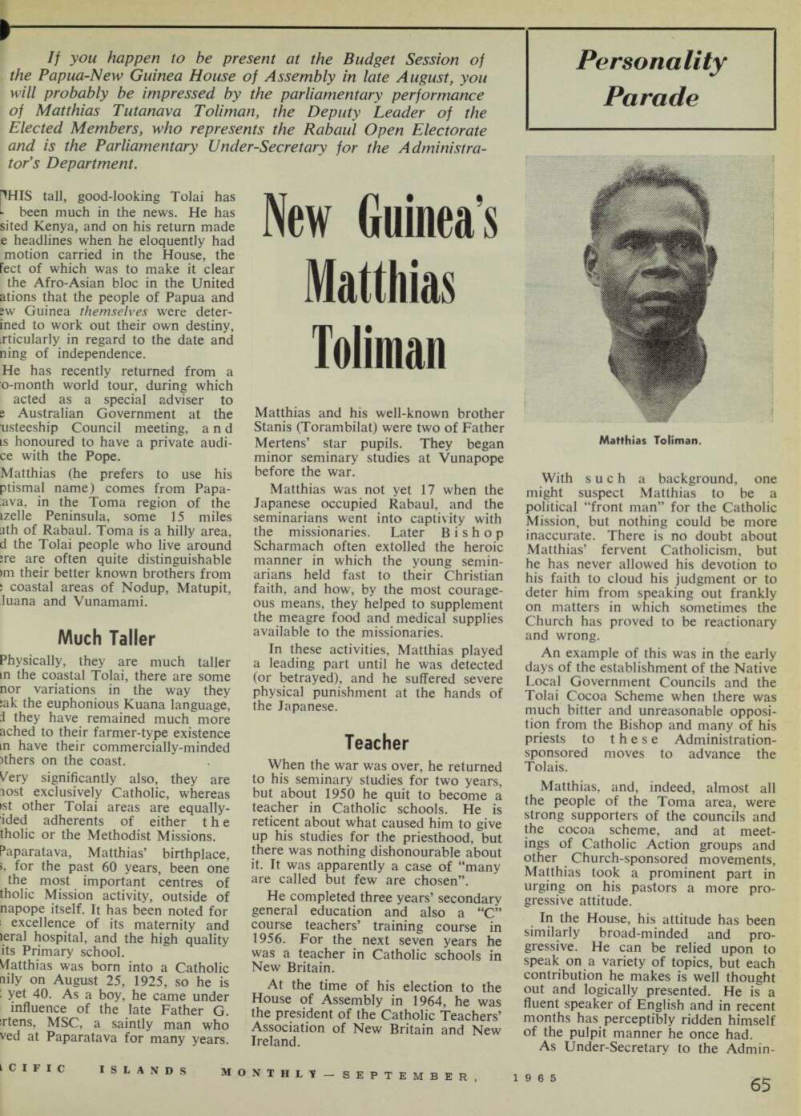
Matthias Tollman.
strator’s Department he is conscienti ous and eager to master the detail of idministration. It is of interest to lote that the permanent secretary to he Administrator’s Department is Mr. D. M. Fenbury (better known as David Fienberg), the man who intro kiced the council system and the Ihcoa Scheme into Rabaul.
Fenbury, a shrewd, hard-bitten, ardonically minded man, is a power >ehind the scenes in Port Moresby and le has a high opinion of Matthias.
There can be no doubt of Matthias’ nfluence among the Tolai. In the Sections of 1964, he defeated the riuch-respected and venerable Nason rokiala, of Nanga Nanga, by more han 4,000 votes in a poll of about 3,000. His achievements since his lection make it certain that his in luence and prestige have grown.
White Support
But how he stands with his fellow lected native members is a different latter. John Guise recognises him s a formidable rival, and at the loment, Guise has more influence nth most elected native members ian has Matthias. At the moment, do, the 14 native members from the iree Highlands districts are more rone to follow lan Downs than any ody else, but next to him, they would jpport John Guise in preference to latthias.
This will probably continue to be ic case during the lifetime of the resent House. But after the next lections, when a number of white lembers will not hold their seats, latthias might well emerge as the :ader of a centre or moderate group hose main appeal to the electorate ill be their reluctance to enter too seedily into independence.
In this role, they will undoubtedly ave the support of the whites, and icy almost certainly will have that of le Catholic Mission, and all the lission bodies in the Territory.
This support will make Matthias a )rmidable figure. Those who know im best are confident he will exercise hatever power comes to him with ►lerance and discretion.
Yet he will need something more ian his undoubted ability and talents, our of the areas, Rabaul, Kavieng, [anus and Bougainville, from which 5 normally could expect a lot of ipport, are areas where the onset of ilf-government and independence mid produce scenes of violence.
It is probably worth remembering lat Patrice Lumumba was also a minarian and schoolteacher.
Gorohauve