Territories TALK-TALK
pp. 49-53 · Read in the full issue

Wish Tolala
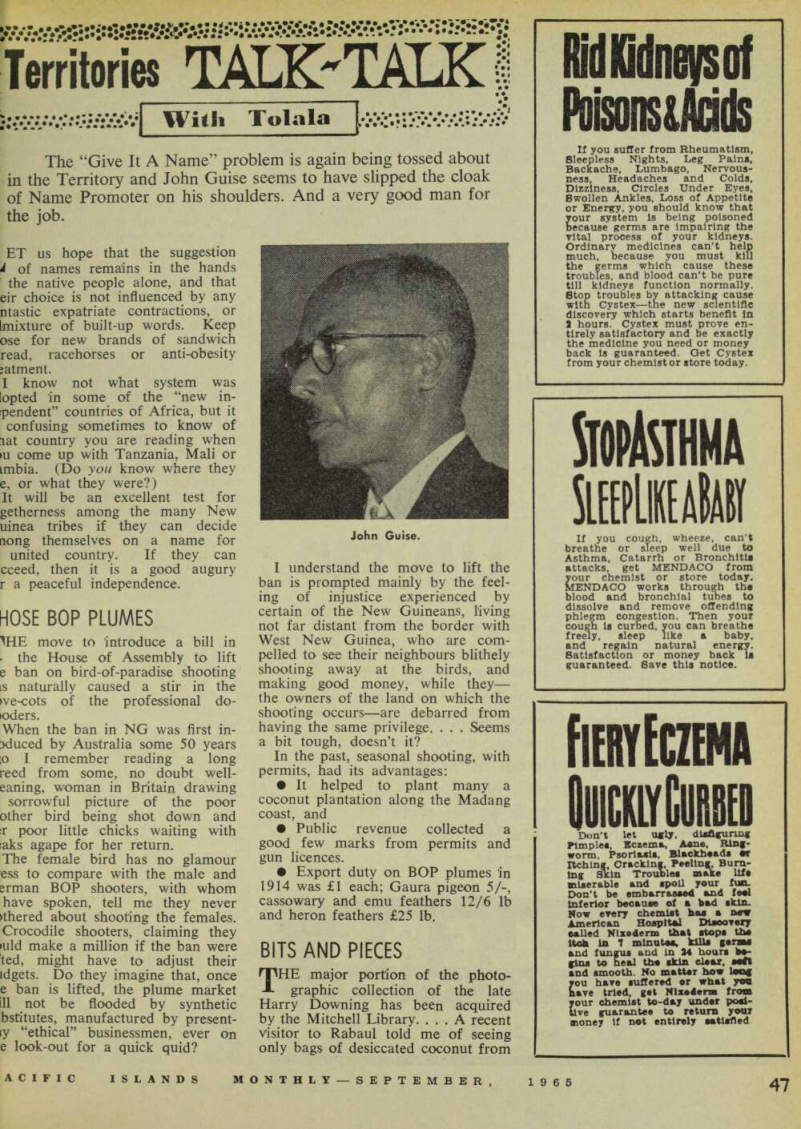
The “Give It A Name” problem is again being tossed about in the Territory and John Guise seems to have slipped the cloak of Name Promoter on his shoulders. And a very good man for the job.
ET us hope that the suggestion i of names remains in the hands the native people alone, and that eir choice is not influenced by any ntastic expatriate contractions, or [mixture of built-up words. Keep ose for new brands of sandwich read, racehorses or anti-obesity jatment.
I know not what system was lopted in some of the “new in pendent” countries of Africa, but it confusing sometimes to know of lat country you are reading when »u come up with Tanzania, Mali or imbia. (Do you know where they e, or what they were?) It will be an excellent test for getherness among the many New uinea tribes if they can decide long themselves on a name for united country. If they can cceed, then it is a good augury r a peaceful independence.
Hose Bop Plumes
THE move to introduce a bill in ■ the House of Assembly to lift e ban on bird-of-paradise shooting is naturally caused a stir in the we-cots of the professional de coders.
When the ban in NG was first in duced by Australia some 50 years ;o I remember reading a long reed from some, no doubt well eaning, woman in Britain drawing sorrowful picture of the poor other bird being shot down and t poor little chicks waiting with iaks agape for her return.
The female bird has no glamour ess to compare with the male and erman BOP shooters, with whom have spoken, tell me they never rthered about shooting the females.
Crocodile shooters, claiming they »uld make a million if the ban were ted, might have to adjust their idgets. Do they imagine that, once e ban is lifted, the plume market ill not be flooded by synthetic bstitutes, manufactured by present ly “ethical” businessmen, ever on e look-out for a quick quid?
I understand the move to lift the ban is prompted mainly by the feel ing of injustice experienced by certain of the New Guineans, living not far distant from the border with West New Guinea, who are com pelled to see their neighbours blithely shooting away at the birds, and making good money, while they— the owners of the land on which the shooting occurs—are debarred from having the same privilege. . . . Seems a bit tough, doesn’t it?
In the past, seasonal shooting, with permits, had its advantages: • It helped to plant many a coconut plantation along the Madang coast, and • Public revenue collected a good few marks from permits and gun licences. • Export duty on BOP plumes in 1914 was £1 each; Gaura pigeon 5/-, cassowary and emu feathers 12/6 lb and heron feathers £25 lb.
Bits And Pieces
THE major portion of the photo graphic collection of the late Harry Downing has been acquired by the Mitchell Library. ... A recent visitor to Rabaul told me of seeing only bags of desiccated coconut from
John Guise.
Ceylon on display in a large retail store. His inquiries for a dressed chicken brought forth the answer: “We have none in stock. . . . We must await the next steamer”. And I thought me of the good chooks I used to buy at the bung for a couple of bob—pre-war, of course, . . . P-NG had an adverse trade balance in 1963-64 of £19.2 m. . . .
Columnist in a Sydney paper: “. . .
Australian peanut crop has failed and we shall be importing peanuts from the US for the third time in 40 years”. No peanuts, either, in NG?
. . . Isn’t it time we started a de mistering campaign? A NG news paper referred to “Mr. Ratu Mara”, the leader of the Fijian delegation at the South Pacific conference at Lae.
And, of course, there is the constant redundant use of the title “Mister” before the Tolai To. However, it will be easier for sub-editors in a few years’ time, after the university at Port Moresby gets cracking. All politicians and VIPs, rating a men tion in the printed page, will no doubt have attained their doctorate of one thing or another.
Respect The
Tremors
“QUAKE Rocks NG Island,” sa, a 36 pt head-line in a Sydne afternoon paper in August ar followed with a message fro; Rabaul: “The sharpest earthqual for years shook a wide area of Ne Britain yesterday. People ran fro; buildings in fear. . . . However, litt damage was reported except to she stock which fell from shelves.”
The report went on to say that vulcanologist put the epi-centre Jacqueline (sic) Bay about 30 mil from Pomio. “One store at Kokop . . . reported several hundred poum damage to stock”. In Rabaul tl strength of the tremor was reports as six.
There certainly has been son seismic activity in parts of Ne Guinea recently, with eruptions ; some areas, but these are always good sign (up to a point) showir that nature’s safety valves are wor] ing, and not gpmmed up in prepar; tion for a major upheaval.
Some Australian newspapers ai inclined to over-play these shake creating earthquakes out of tremor and then, on the other hand, loc residents seem now to under-ph the potentialities of a quria, \ witness the shop stock falling froi the shelves.
This would never have happene in the early days.
Not Appreciated
Even just before the war in ar around Rabaul the fact that the are was located in one of the world greatest earthquake and volcaa regions was not appreciated by tl majority.
“Familiarity breeds contempt,” ca be held responsible for the blatai disregard by Rabaul people c nature’s warnings in May, 1937, pric to the Vulcan eruption.
When Vulcan Spewed. Well d I remember, on the day prior to tl upheaval, talking with Jimm Twycross, then manager of the AW, station at Rabaul, He was con cerned at the frequency of the earl) tremors over a long period. We botl agreed that “something unusual” ws afoot. We drove over to Matup Island. There the natives showe us substantial cracks in the roao way—feet long and inches deep.
We returned to Rabaul, over causeway which had sunk severs inches since we arrived. We didnt do a thing about it except to have drink at the club; have a whing about the dangers of earthquake:;
sk ourselves why nobody did any ling; then went our way.
I returned to my office and from lere rang Central Administration: Was everything under control?” I sked. To what was I referring, lease? , . . Twenty-four hours later le kite went up.
Twenty-six years earlier I had [rived in New Britain and on my rst night, when going to bed, my [>st said to me: “Don’t leave the mp on the dressing table; put it on ic floor”. And, in answer to my iquiry: “We have a lot of qurias, irth tremors, and the lamp could 11 to the ground and the kerosene ould be spilt. Don’t be alarmed; e wardrobe is hooked back against e wall; but don’t close the door, it ►uld jam in a ’quake. And if there a shake, don’t rush outside, it is st as safe inside—unless the house falling down. Good night, sleep ill!”
What sort of a country had I me to, thought I, diving under the election of my mosquito-net.
In those early days they took cessary precautions. All store elves had safety strips to prevent s goods from falling in the event a shake. All large furniture was chored to the walls by hooks: ardrobes, sideboards, book cases, mos.
I wonder if there is a single irdrobe hooked to the wall in ibaul now? I wonder, too, if ilders allow that required “give and :e” quantity when constructing uses in this seismic area.
Y The Rabaul
Hare
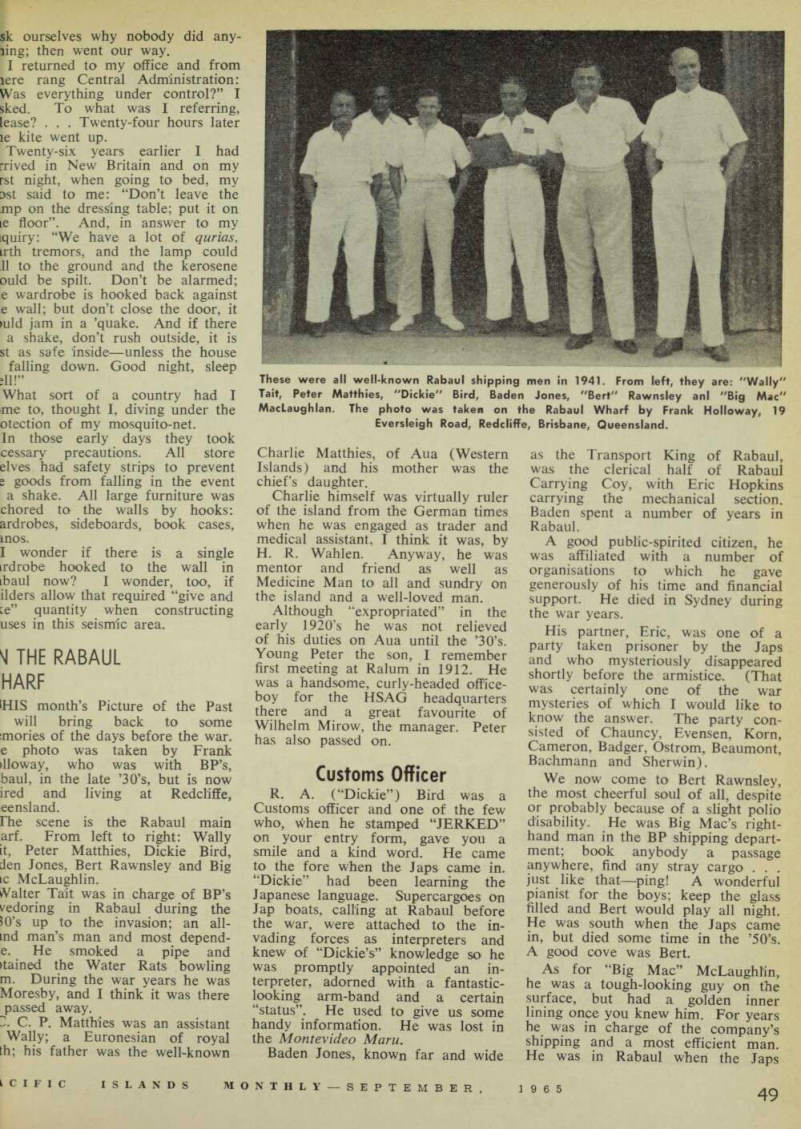
HIS month’s Picture of the Past will bring back to some mories of the days before the war. e photo was taken by Frank ►lloway, who was with BP’s, haul, in the late ’3o’s, but is now ired and living at Redcliffe, eensland.
Fhe scene is the Rabaul main arf. From left to right: Wally it, Peter Matthies, Dickie Bird, den Jones, Bert Rawnsley and Big ic McLaughlin.
Walter Tail was in charge of BP’s yedoring in Rabaul during the 10’s up to the invasion; an all ind man’s man and most depend e. He smoked a pipe and (tained the Water Rats bowling m. During the war years he was Moresby, and I think it was there passed away.
C. P. Matthies was an assistant Wally; a Euronesian of royal th; his father was the well-known
Charlie Matthias, of Aua (Western Islands) and his mother was the chiefs daughter.
Charlie himself was virtually ruler of the island from the German times when he was engaged as trader and medical assistant, I think it was, by H. R. Wahlen. Anyway, he was mentor and friend as well as Medicine Man to all and sundry on the island and a well-loved man.
Although “expropriated” in the early 1920’s he was not relieved of his duties on Aua until the ’3o’s.
Young Peter the son, I remember first meeting at Ralum in 1912. He was a handsome, curly-headed office boy for the HSAG headquarters there and a great favourite of Wilhelm Mirow, the manager. Peter has also passed on.
Customs Officer
R. A. (“Dickie”) Bird was a Customs officer and one of the few who, when he stamped “JERKED” on your entry form, gave you a smile and a kind word. He came to the fore when the Japs came in.
“Dickie” had been learning the Japanese language. Supercargoes on Jap boats, calling at Rabaul before the war, were attached to the in vading forces as interpreters and knew of “Dickie’s” knowledge so he was promptly appointed an in terpreter, adorned with a fantastic looking arm-band and a certain “status”. He used to give us some handy information. He was lost in the Montevideo Maru.
Baden Jones, known far and wide
as the Transport King of Rabaul, was the clerical half of Rabaul Carrying Coy, with Eric Hopkins carrying the mechanical section, Baden spent a number of years in Rabaul.
A good public-spirited citizen, he was affiliated with a number of organisations to which he gave generously of his time and financial support. He died in Sydney during the war years, H is partner, Eric, was one of a party taken prisoner by the Japs and who mysteriously disappeared shortly before the armistice. (That was certainly one of the war mysteries of which I would like to know the answer. The party con- Sted ° f Chauncy ’ Evensen, Korn, Cameron, Badger, Ostrom, Beaumont, Bachmann and Sherwin).
We now come to Bert Rawnsley, the m <>st cheerful soul of all, despite or probably because of a slight polio disability. He was Big Mac’s right hand man in the BP shipping depart ment; book anybody a passage anywhere, find any stray cargo . . . just .Bke that—ping! A wonderful pianist for the boys; keep the glass filled and Bert would play all night, He was south when the Japs came * n ’ but died some time in the ’so’s, A good cove was Bert, As for “Big Mac” McLaughlin, he was a tough-looking guy on the surface, but had a golden inner lining once you knew him. For years he was in charge of the company’s shipping and a most efficient man.
He was in Rabaul when the Japs
These were ail well-known Rabaul shipping men in 1941. From left, they are: “Wally"
Tait, Peter Matthies, "Dickie" Bird, Baden Jones, "Bert" Rawnsley anl "Big Mac"
MacLaughlan. The photo was taken on the Rabaul Wharf by Frank Holloway, 19 Eversleigh Road, Redcliffe, Brisbane, Queensland.
ame in, but before the general sxodus by Montevideo Maru, he fell II and was put into the hospital at Cokopo, where he died.
And so, we have this little group m the Rabaul wharf in the late 30’s, important cogs in the move nent of shipping and now ... all ►f them passed on.
[Hey Still Pass On
A ND there are others of the old time crowd who have passed way more recently.
On July 28, Harry Woolcott, one ime of Kabanga plantation in the Cokopo district, and latterly of 'urramurra (NSW) died. He would lave been in his 70’s. I knew him in he ’2o’s as an Exproboard planta ion man. He bought Kabanga, /eathered the bad years, retired to lydney and lived peacefully at 'urramurra.
On August 7, Jessie Jamieson bouton died at her residence in lellevue Hill (NSW) at the good ge of 91. Jessie Mouton was the econd wife of the Territory’s only urvivor of the Marquis de Rays ex pedition back in the ’Bo’s, Jean taptiste Octave Mouton, who died n the late ’4o’s.
Mouton was a quiet, unassuming haracter, but gifted with great tamina. He got away from the •outh New Ireland settler camp
where, as a cabin boy, he had landed with other members of the expedition and eventually contacted Emma Forsayth, who at that time was as sociated with Farrell at Mioko.
She gave him a job and eventually he took up the land at Kiniqunan, near Kokopo, and made himself a plantation and a home. Later he sold the property to the Catholic Mission at Vunapope. He retired to Sydney, but maintained his interests in New Guinea, among them being the ownership of The Rabaul Times newspaper, which he maintained until the invasion. Jessie did not spend much time in New Guinea after the plantation was sold.
She was the mother of Leopold; the other son, Max, was by the first wife, On the following day in Brisbane Margherita (Margot) Symington passed on. She was a popular woman with everyone. The wife of J. S. (“Don”) Symington, WRC’s manager in Rabaul during the ’3o’s and who was manager for Levers Pacific Plantations Ltd. at Gavutu in 1918. Her home in Rabaul was a favourite social centre and she was ever a keen worker for the various welfare organisations in the town.
Margot came from an artistic family; her sister was the noted Australian sculptor, Theo Cowan, who died in 1949.