TV Scriptwriter Couldn’t
pp. 43-47 · Read in the full issue

Have Done Better!
From R. F. Rankin, in Apia.
Apia is still not quite the same after its recent encounter yith a true life adventure series—better than anything an maginative script writer could produce—involving threats of issassination and murder, armed police guards and orders of leportation. The only trouble is that Apia still doesn’t know whether to laugh or cry.
AIN actors in the play were the Moors brothers—Captain Harry Oliver—and the forces of law order. PIM reported the basic 5 in August (p, 16), but what basic facts in a story like this? aptain Harry Moors is used to hes with authority. Early in July unhappy association with the ernment came to an end when services as Harbourmaster were dnated on direction from Cabinet. followed the findings of a imission of Inquiry into the ine Department earlier in the mong those who felt Harry ild have got a better deal is his her Oliver, a professional enter ;r, who returned with his wife i the States several months ago, the intention of starting a night in Apia. airy and Oliver are sons of ninent politician Afoafouvale
Misimoa. They were born in West ern Samoa but both hold United States citizenship.
On the morning of Thursday July 8, after attending their sister’s birthday party the night before, the brothers sojourned to the RSA Club.
Some witnesses claim that while drinking in the club Harry and Oliver threatened to kill the Head of State and the Prime Minister and certain Europeans, including Auditor General J. Campagnolo and Acting Harbourmaster Captain J. Jones (who has since died, see below).
The RSA reported this to the police and by Saturday there were armed guards around the home of Head of State Malietoa at Vailima, and Prime Minister Mataafa at Lepea.
Later guards were also placed on the homes of Captain Jones and Mr, Campagnolo.
The same day Harry and Oliver
received notices from the Prime Minister, as Minister of Immigration, ordering them out of the country within a week.
Mataafa claimed they were “dis affected, disloyal or likely to be a source of danger to the peace, order and good government of Western Samoa”.
On Tuesday the matter came up in Parliament. The Prime Minister dismissed the view put forward by Pilia’e that this was properly a matter for the aiga (families) to settle.
After three hours’ discussion, a motion by Tofilau amended by Asiata to put aside the deportation order and reconsider the matter was defeated by 25 votes to 13.
Deadline
The Saturday deadline came and went. The Moors stayed put, and the police waited in vain for orders to lay charges against them for dis obeying the deportation order.
On Tuesday Mataafa called Harry and Oliver to his office where a dis cussion was held, and, according to an aide, it was in a “very cordial atmosphere”.
On Friday Mataafa revoked the deportation order. He was satisfied that the Moors brothers were not a threat to peace and good order, he said.
To most people, the incident should never have got further than the walls of the RSA Club. (over)
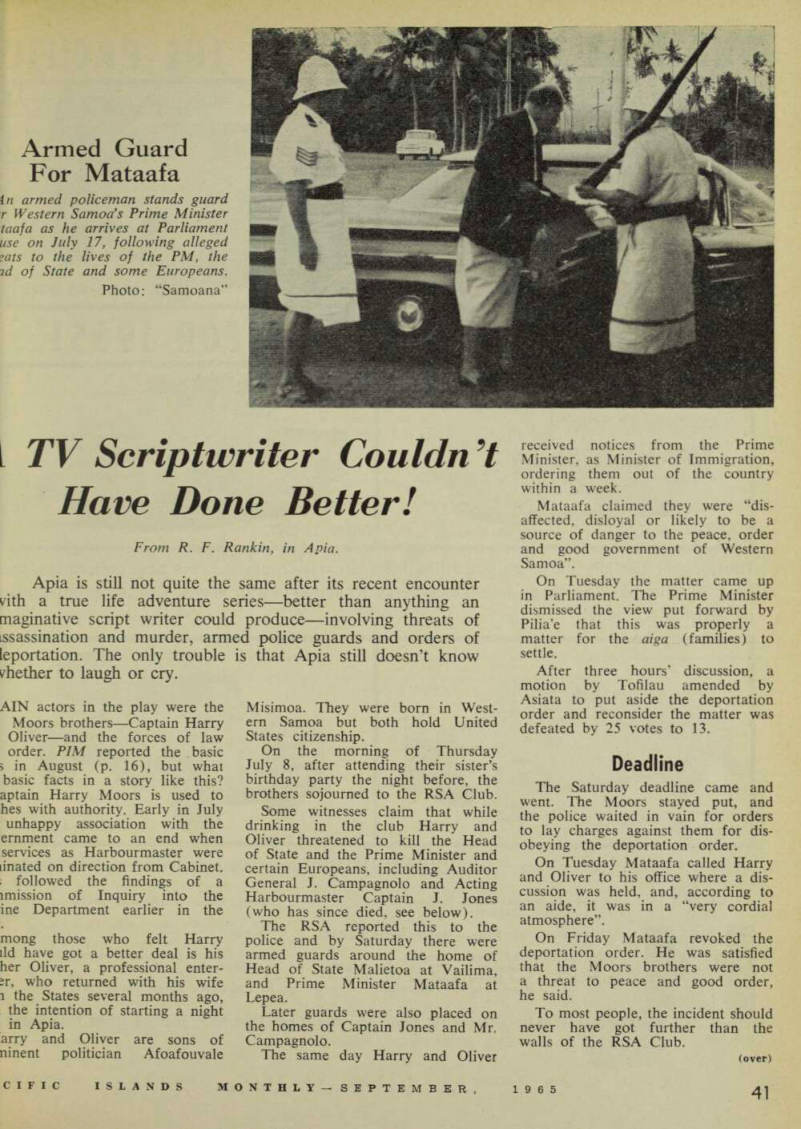
Armed Guard
For Mataafa
in armed policeman stands guard r Western Samoa’s Prime Minister taafa as he arrives at Parliament use on July 17, following alleged ?ats to the lives of the PM, the id of State and some Europeans.
Photo; “Samoana”
APTAIN J. W. Jones, who had been acting as Harbourmaster Apia since the dismissal of ptain Harry Moors earlier this r, died after an accident in Apia rbour on August 5. aptain Jones fell into the sea m the pilot boat as he was about board the Thorsisle to bring her ) harbour. He collapsed soon after ng helped back on board and was nd to be dead on being taken to pital, Captain Jones, who was in his I-sixties, held a master’s ticket both sail and steam vessels. He /ed under sail in World War I I was later an officer in the Maui nare, which linked Western noa with New Zealand, n the early thirties, he became a citation manager for New Zealand jaration Estates in Samoa; from 7 to 1940, he represented Burns Ip at their plantations at Hull and Iney Islands in the Phoenix iup; and from 1940 until 1942, ;n he was appointed Harbour ster in Apia, he was back with jaration Estates.
'aptain Jones remained as rbourmaster until his retirement 1959, when he took up coffee and ana-growing in Samoa. it the time of his death, he was sident of the Returned Services ociation, for which he was an ent worker. A large crowd at led his funeral.
'aptain Jones left a widow and daughters. ☆ ☆ ☆ ET another expert has had a long hard look at Western Samoan iculture and has come up with a liliar answer—the social and nomic inequalities inherent in the tai system make agricultural de- Dpment pretty well impossible, bearing the end of a two-year term Western Samoa, FAO agriculture msion services adviser, Mr. F. C. iganiban, a Filipino, recently ex ssed grave doubts about Samoan icultural development in an article Miifasi Ola, an information bulletin dished intermittently by the De tment of Agriculture.
In the midst of almost world-wide ancements, Samoan agriculture has ged behind, even in comparison h other Pacific Islands,” said Mr. iganiban. le said the Government had tried improve the social and economic idition of villagers by providing )r e schools, hospitals, fertiliser ms and forestry seedlings and by
organising rhinoceros beetle gangs and so on.
“The facts of the actual situation show the existence of a great disparity between objectives and facts,” he said.
“Most of the village people are still pitiful in their lack of enthusiasm and their seemingly indifferent attitude to life, “Is is apparent that there is something wrong,” he went on, calling for a reappraisal of existing programmes and policies to determine the cause of failure.
He said that the basic problems in the development of Samoan agri-
culture lay in land tenure, capital, education, social justice and public service, He placed most blame for failure on the lack of security for farmers using customary land, and on in adequate capital available for de velopment.
“Until the farmer can be assured of his right to use land as long as his family lives on it, the primary and basic incentive for a village farmer to dedicate himself to agricultural in dustry is lacking, and success is hardly attainable,” Mr. Panganiban said, Referring to capital, he said that
illage farmers had hardly any credit s they had no acceptable collateral ? offer; and that improved methods f farming were impossible with the ery limited amounts of capital avail ble to them.
He advocated supervised credit to ffset the absence of collateral and to nsure the sound use of capital and ) guarantee repayment of the loan.
To overcome the basic problem of lequitable distribution and insecurity f tenure, he advocated a re-orienta on of values and attitudes.
“If the land tenure system per etuates insecurity of ownership, rural rogress can never be achieved,” he ud.
Meanwhile, a Bill providing for the sasing of customary land is to come efore Parliament soon. It provides jcurity of tenure—as Mr. Panganiban —but limits leases to latai only!
ACCORDING to figures released by the Economic Development Secretariat and obtained from the Bank of Western Samoa, remittances overseas of earnings of overseas firms in Samoa for the first six months of this year were greater than similar remittances for the whole of 1964.
Earnings remitted to the end of June were about £l39,ooo—more than three times higher than for the same period last year.
Despite this apparent buoyancy, the Minister of Finance, Mr. G. F. D.
Betham, painted a gloomy financial
picture when he presented his Second Supplementary Estimates to Parlia ment in mid-July.
He predicted that because of falling export income, the Government would this year face a deficit of £219,015, or nearly twice the deficit he predicted earlier in the year.
Reserves were expected to fall from £438,191 at the end of 1964 to £157,273 by the end of 1965, he said, Mr. Betham blamed the unwilling ness of the House to impose extra taxation for the “critical position” of the reserves.