P-NG Security Men
pp. 33-35 · Read in the full issue

At The RSL Congress P-NG Security Men Will "Watch For Discontentment "
From a Lae Correspondent A strong warning on the angers of subversion in Papua few Guinea was one of the jatures of deliberations at the nnual congress of the P-NG ranch of the Returned Service ten’s League, held in Lae in oigust. The warning was made
y P-NG’s Police Commissioner,
It. R. R. Cole, who is a former district Commissioner. lIS statement follows a recent an nouncement in Port Moresby on le formation of a Special Branch of ic Constabulary, which will check i possible security risks in the Terri iry.
Mr. Cole, in opening the congress, tid that the Special Branch would so keep in touch with public opinion, mrticularly on matters which could tuse discontentment with the Gov nment and its policies.”
Mr. Cole said criticism was damag g to Papua--New Guinea’s security iless it was “well considered, well esented, and indeed warranted.
Unreasoned Criticism
“Not only do we have a large un lucated Territory population ripe for ly unreasoned form of criticism of ir Australian Government, but there e many countries looking on and aiting for any such expressions of ternal dissatisfaction,” he said.
“I am satisfied there is much being me in the field of security, and there much the RSL can do to foster ese efforts by avoiding damaging iticism and educating the public, )th European and native, to realise at it is in their interests to avoid bversive elements which encourage ob rule.”
He added: “We must expect an in ease in subversive activity by those terests who are critical of the Aus ilian Administration. Our immedi e and greatest danger is not from iy armed onslaught, from any atant unwarned invasion by military ight or saturation bombing.
“This type of warfare is something in which we have experience and know the answers. Rather we must be pre pared and watch for a much more insidious approach a softening-up process with subtle propaganda.
“We must watch for creation of discontent and dissatisfaction towards employers and Government,” Mr.
Cole said.
“We must be on our guard against subversive political approaches to weaken loyalties, fostering discontent among frustrated semi-educated politicians.
“We must watch for the formation of ‘front’ organisations with lofty ideals but overt political control, and for penetration of unions and in dustrial organisations to distort their aims.”
Mr. Cole, a World War II Military Cross winner, warned against what he called “the quiet men who never appear in the forefront but lead from behind in the shadows.”
He added: “This is the cold war approach and I suggest it is possibly being practised in the Territory today.
Much of it is cleverly engineered and developed to well-organised plans and there is no hesitation in using the ill informed ‘do-gooder’ to spread such discontent.”
Coastwatchers
Speakers at the congress also called for a reorganised and improved Coast watching system in the Territory.
The congress recommended the establishment of a school for Coast watchers at Rabaul and the urgent appointment of an experienced officer to head the organisation.
Delegates said the present Coast watching organisation would not work efficiently in wartime.
The State president, Mr. R. F.
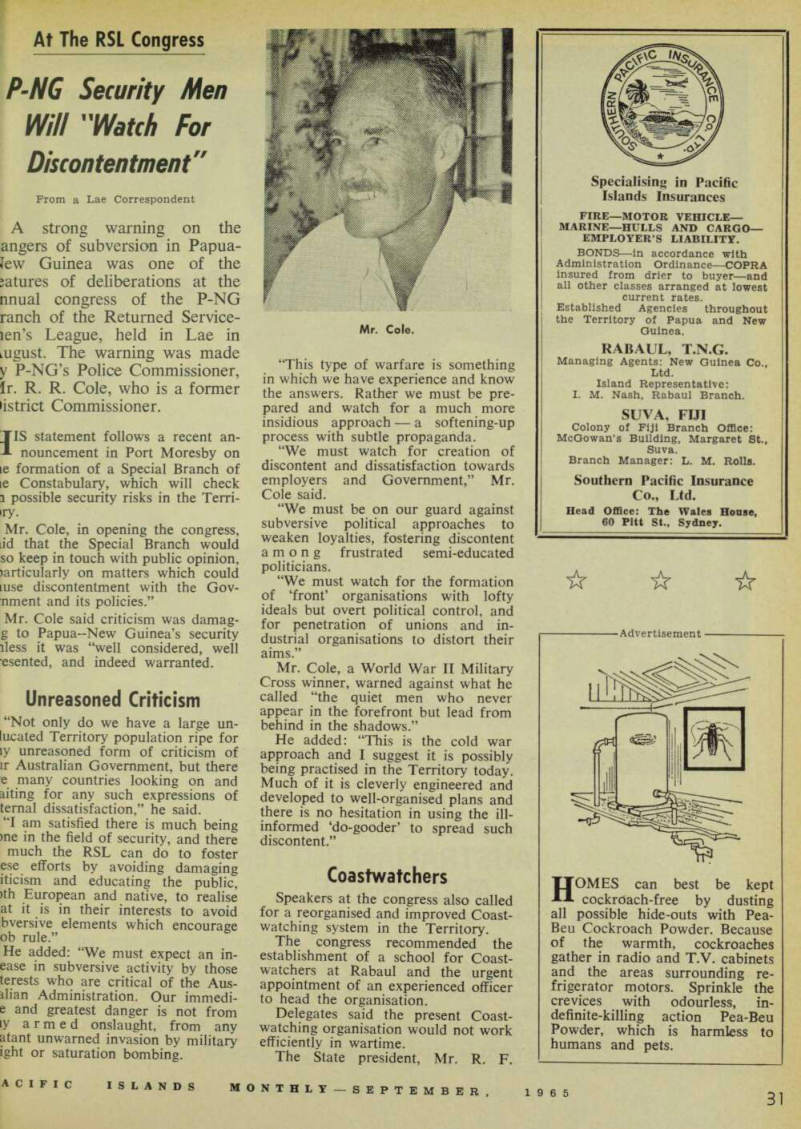
Mr. Cole.
hunting, said some Coachwatchers lad complained that their present adio equipment was “quite unsatis actory.”
Mr. L. E. Ashton, a Coastwatcher i New Guinea during World War 11, aid it was essential tha t Coast ratchers had the best equipment avail ble.
Mr. P. Dennis, of Rabaul, said that 0 time should be lost in the training f volunteers as Coastwatchers.
“It is not just a matter of having wireless set on a plantation,” he ud. “You have got to have men ho know how to make good re orters.
“Lots of reports from Coastwatchers 1 World War II were misinterpreted scause the men who made them had ot been properly trained.”
Army Pay Disparity
Another delegate to the congress tiled for the removal of pay differ ices between native and European embers of the Territory’s CMF lits.
The delegate, Mr. R. Kerruish, of Dugainville, said this difference in ty rates in the Papua-New Guinea olunteer Rifles had created a rtentially dangerous situation.
“We feel it’s bad to have two men a fighting force doing identical bs and getting different rates of y,” he said.
“We feel the non-indigenous CMF ;mber is a dedicated man, other se he wouldn’t be in it, and he mid be quite prepared to accept the Be rate of pay as an indigenous ;mber.
“Eventually these men may go into don together and the indigenous dier could say, ‘You get more pay in I do, you fire the shots.’ ”
Mr. Kerruish was speaking during discussion on a resolution calling the expansion of the CMF to engthen the Territory’s defences.
Phe question of pay rates was not r olved in the motion.
Phe congress decided to ask the ivemment not to send the Papua w Guinea Volunteer Rifles to fight ;rseas as a unit. \ resolution adopted said the troops uld be needed in the Territory be ise of their specialised local train er. P. Dennis, of Rabaul, said his •-branch was concerned at reports t members of the unit might serve Vietnam. ‘We don’t want them bunged over Vietnam or Malaysia or anywhere We want them here,” he said, tfr. L. Shoppee, of Wau, said that
if individual members of the unit wanted to volunteer to serve overseas they should be free to do so, Congress urged the Australian Government to stop training Indonesian officers and NCO’s.
A resolution said Australian troops were actively engaged against Indonesian insurgents who could be led or have been trained by Indonesian officers trained in modem warfare at Australian Army establishments, The resolution was carried unanimously without discussion.
The congress also called on the Government to warn Indonesia that it would not tolerate any infringement of Papua-New Guinea’s borders,
Mr. F. Turner, a Port Moresby delegate, said Indonesia was likely to start border incidents unless the Aus tralian Government took a firm stand, The congress decided to ask the Australian Government to do every thing in its power to ensure that the people of (Indonesian) West New Guinea were given the opportunity to vote on their future, Mr. F. Sagar, of Madang, said New Guineans were very concerned about the fate of the people of the former Dutch territory.
“They have the feeling that the Indonesian action there is the thin edge of the wedge for Papua-New Guinea,” he said.