Tropicalities
pp. 23-27 · Read in the full issue
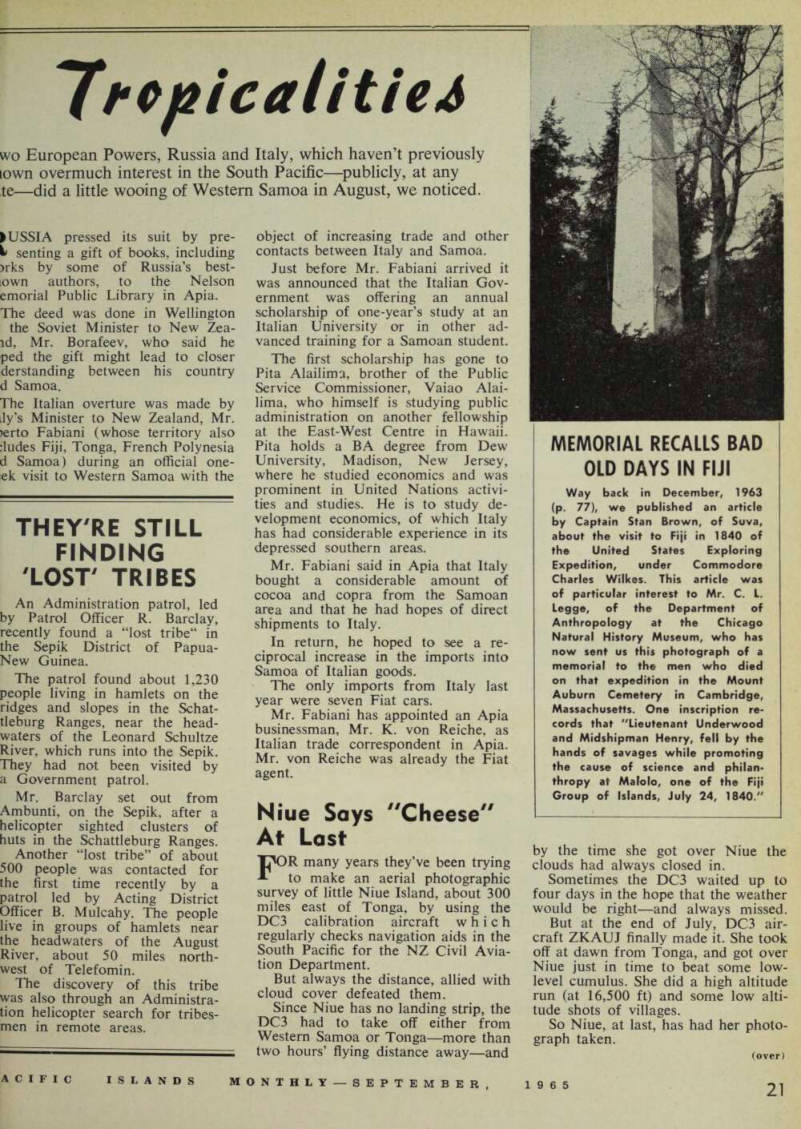

wo European Powers, Russia and Italy, which haven’t previously lown overmuch interest in the South Pacific—publicly, at any te—did a little wooing of Western Samoa in August, we noticed.
RUSSIA pressed its suit by pre senting a gift of books, including >rks by some of Russia’s best lown authors, to the Nelson emorial Public Library in Apia.
The deed was done in Wellington the Soviet Minister to New Zea id, Mr. Borafeev, who said he ped the gift might lead to closer derstanding between his country d Samoa.
The Italian overture was made by ily’s Minister to New Zealand, Mr. >erto Fabiani (whose territory also dudes Fiji, Tonga, French Polynesia d Samoa) during an official one ek visit to Western Samoa with the
object of increasing trade and other contacts between Italy and Samoa.
Just before Mr. Fabiani arrived it was announced that the Italian Gov ernment was offering an annual scholarship of one-year’s study at an Italian University or in other ad vanced training for a Samoan student.
The first scholarship has gone to Pita Alailima, brother of the Public Service Commissioner, Vaiao Alai lima, who himself is studying public administration on another fellowship at the East-West Centre in Hawaii.
Pita holds a BA degree from Dew University, Madison, New Jersey, where he studied economics and was prominent in United Nations activi ties and studies. He is to study de velopment economics, of which Italy has had considerable experience in its depressed southern areas.
Mr. Fabiani said in Apia that Italy bought a considerable amount of cocoa and copra from the Samoan area and that he had hopes of direct shipments to Italy.
In return, he hoped to see a re ciprocal increase in the imports into Samoa of Italian goods.
Hie only imports from Italy last year were seven Fiat cars.
Mr. Fabiani has appointed an Apia businessman, Mr. K. von Reiche, as Italian trade correspondent in Apia.
Mr. von Reiche was already the Fiat agent.
Niue Says "Cheese"
At Last
rR many years they’ve been trying to make an aerial photographic survey of little Niue Island, about 300 miles east of Tonga, by using the DC3 calibration aircraft which regularly checks navigation aids in the South Pacific for the NZ Civil Avia tion Department.
But always the distance, allied with cloud cover defeated them.
Since Niue has no landing strip, the DC3 had to take off either from Western Samoa or Tonga—more than two hours’ flying distance away—and
by the time she got over Niue the clouds had always closed in.
Sometimes the DC3 waited up to four days in the hope that the weather would be right—and always missed.
But at the end of July, DC3 air craft ZKAUJ finally made it. She took off at dawn from Tonga, and got over Niue just in time to beat some low level cumulus. She did a high altitude run (at 16,500 ft) and some low alti tude shots of villages.
So Niue, at last, has had her photo graph taken. (over)
'Jew Loom From
Old Idea
A NEW loom developed by a Port Moresby building research fficer could revolutionise traditional and-weaving by New Guineans, ccording to local experts.
Operated by two men, the loom an produce six 8 ft x 5 ft woven tieets in about eight hours. One ieet of this size would take a man dth average speed about one day > hand-weave.
The new loom, designed by Mr.
B. Brealey of the Department of /orks Research Station, Port foresby, is a wooden structure 0 ft by 5 ft. Mr. Brealey based his esign on old-type looms previously sed in some parts of the Territory, [is can be built for about £10 and eeds little skill to operate.
Sago Stalks
Mr. Brealey says each loom-made teet would cost about 2id a sq. ft. ► produce in rural areas. In one ly three men can cut enough sago alks to supply material for six leets.
Another three men can strip the irk from the stalks and maintain ic flow of material to the two >erators working the loom.
Costs in urban areas, based on the •ban cash wage, would be double ose in rural areas.
With the existing system, an operator feeds single bark strips into the loom.
“We are experimenting now with a new type of shuttle to take 24 strips instead of one,” Mr. Brealey says.
He says loom-woven bush material sheets can supply villagers in agri culturally poor areas with an ad ditional source of cash income. The wall linings can be sold.
Although the sheets cannot com pete in durability with permanent materials, experience with sago bark and pit-pit (wild sugar cane) has proved them to be very satisfactory wall-lining, resistant to white ant and termite attack. They can be ex-
pected to last more than six years before renewal.
Extensive stands of sago palm are found in many areas of the Ter ritory. For many years sago bark has been the traditional material for wall and wall-lining construction.
Pit-pit, found in abundance in the Highlands, is used for the same purpose.
Officers of the Research Station are currently conducting a survey to assess the variety of bush materials available in the Territory suitable for loom-woven wall linings.
The loom has meanwhile been introduced into the Western District of Papua by Mr. Brealey and Mr.
Robert Tabua, member for Fly River in the P-NG House of Assembly.
67 Into 25 Leaves
A Lot Over
A RATHER sobering statistic was released in Noumea, New Cale donia, recently when it was stated that 67 applications had been re ceived for an examination to engage 25 typists for the local Administra tion, Commenting on this, the local Press emphasised the already well known fact that there is a very narrow choice of positions open to young women in Noumea. They can become either typists, secretaries or shop assistants—and that is about all.
At present, more than 300 young
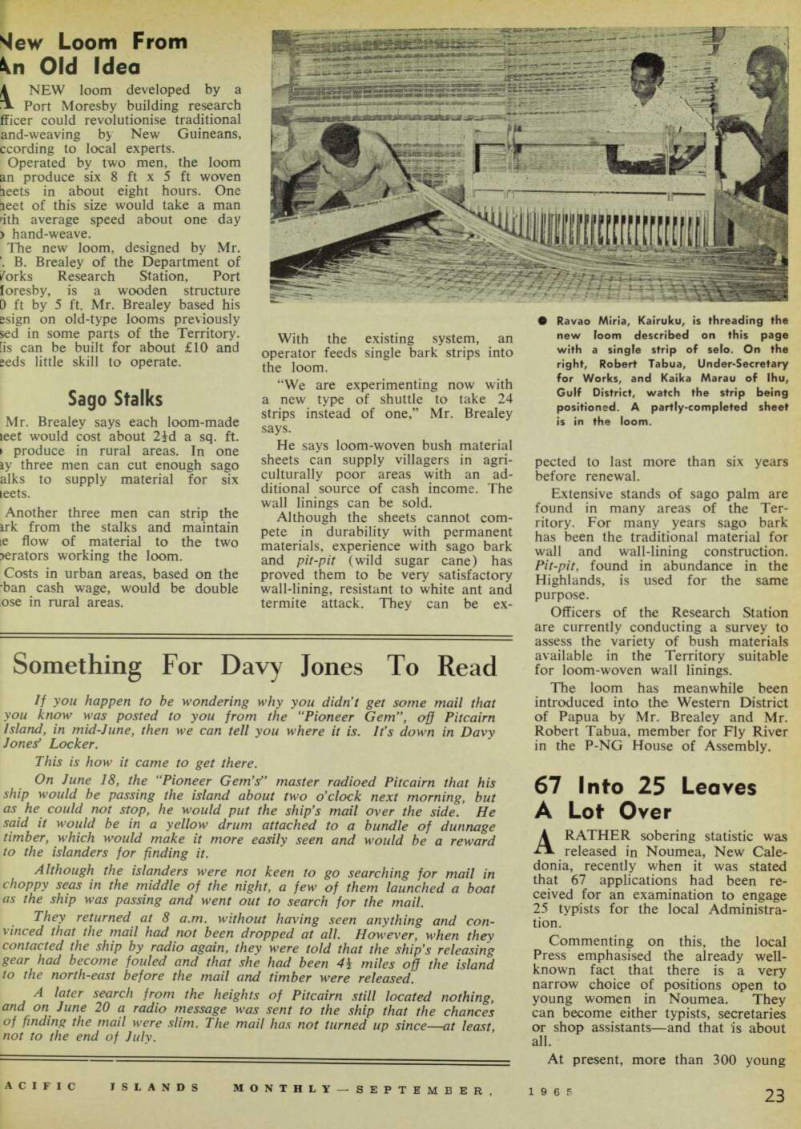
Ravao Miria, Kairuku, is threading the new loom described on this page with a single strip of selo. On the right, Robert Tabua, Under-Secretary for Works, and Kaika Marau of Ihu, Gulf District, watch the strip being positioned. A partly-completed sheet is in the loom.
women are studying to equip them selves for jobs of this kind. But as the Press says: “Unfortunately neither the Admini stration, local commerce nor industry can ever progress enough to absorb all these young women and those coming after.”
The Loom Of
Language
PAPUA-NEW GUINEA has never been attacked so persistently by so many linguists as it has in recent years. Their work is beginning to open new language horizons.
For instance, that especially per
sistent linguist from the Australian National University, Dr. S. A. Wurm, whose work in the New Guinea Highlands has been mentioned here before, reports in a recent paper that 50 of the languages found in the three Highlands Districts of the Terri tory can now be grouped into five language families—and that the five families are inter-related.
They can be combined into a larger group, or stock, which has been named the East New Guinea High lands Stock. This stock has a total of 735,000 speakers (out of a total P-NG native population of about two million).
Dr. Wurm is currently working on a detailed description of the individual
language families. He points out th the borderline between language a; dialect is a very difficult matter New Guinea, and if the languag of these five families are looked from a different view it is possible regard a few of them as dialects one language, rather than as sepan languages.
And if you are wondering what a the reasons for the interest by lingui; in New Guinea languages, Dr. Wui has the answer.
He says there are two main reaso —the first being that the study languages naturally gives a greater i sight into the people. The second more important from the scienti view. ”In spite of the simplification of t New Guinea linguistic picture in ] cent years,” he says, “the fact remai that there are still very numero highly complex and diverse languaj in New Guinea to provide lingui with a wonderful opportunity for t study of the still not fully understo phenomenon of language as such.
“The study of these [New Guim languages may well have a consid( able influence upon general linguis theory, and help us in our effo towards achieving the final full und< standing of the mystery of languaj in its multiple and varied manifesi tions.”
Where Has All
That Silver Gone?
WITH the changeover next ye to decimal currency in Ai tralia and many of the Pacific tt titories, there has been renewed i terest in the “millions of poun worth of silver coins” that are sr posed to be buried in New Guinez The owners are allegedly natrv who don’t trust banks, and all so* of publicity is being directed to t locals in an effort to get the sil\ out of the ground and back ir circulation.
A New Guinea friend of on has a theory on all this. He sa these hidden caches don’t exi That is, the amounts buried are r nearly as large as officialdom thin!
His view is that all this silver fc long since gone to the Far Ea where it has been made into jew lery. It has been smuggled out the country by Chinese seamen the ships that regularly service Ni Guinea and the Far East.
Our friend says that Australii courts frequently prosecute Chino seamen caught attempting to smug): Australian silver out of the count: usually in special “smuggle jackets” with the money sewn in
e lining. Blackmarket price in rdney has been 22/- for £1 worth : silver coins, which are sold for f/- in Hong Kong.
The reason for the blackmarket terest in Australian coins is that ey have a high silver content.
FOOTNOTE ; After an absence years, those New Guinea coins th holes in the centres have come ck in circulation again. They, at ist, must have escaped the at ition of the Chinese—probably cause they would be regarded as Drt measure! At the South Pacific inference at Lae in July, the official iteen did a brisk business offering ;m to the South Seas delegates for dr curio value. Official exchange e was one coin with a hole for 5 coin without a hole—which was r value, we thought.
Cheap Harbour
Jr Norfolk Island?
'ORFOLK ISLAND’S historic Ball Bay now has an access id again—the first since World it 11, when the Americans Idozed one in so they could ve cargo from ships anchored in bay. But maintenance lapsed and road disappeared. ►ome Norfolk Islanders think the sibilities of Ball Bay as a much ded harbour have been over ked. The island has no harbour— )s stand off on either one side of island or the other, depending on weather, and the islanders rcise their not insignificant skill small boat handling by removing go in surf boats. tow that the tourist industry has lly got under way on Norfolk, er port facilities would be a great m. Cheaper freight would help ig down building costs for one g l few of the islanders would like ;ee authority sink a couple of old cs across part of the Ball Bay ance which, they claim, should a long way towards giving folk a reasonably good harbour he right price. ► A smart new definitive issue tow Hebrides postage stamps was 2d on August 16, and further ips to mark International Co ■ation Year will be issued on )ber 24. A feature of the issues he extremely attractive first day ;rs in English and in French pre id to go with them.