New Fiji Constitution
pp. 10-149 · Read in the full issue
Planned-But Patel
Group Doesn't Like It[?]
By R. W. Robson
After intense discussion in London from July 26 to August 8, the Fiji constitutional conference accepted a plan for con stitutional and administrative changes in Fiji (see panel), although four of the six Indian delegates, led by Mr. A. D.
Patel (Indian Minority Group) would not agree. The latter de mand a common, all-Fiji electoral roll instead of communal rolls.
THE plan probably will come into operation in 1966. It represents a definite step towards complete self government, but no break in the ties between the British Crown and Fiji is contemplated.
At the end of August, all sections in Fiji were waiting to see whether the Patel-led Indian minority would respond to the Colonial Office’s appeal for unity among the Indian, Fijian and European communities to make the new constitution work har moniously, or whether it would launch a campaign against the Lon don plan.
Hopes of harmony were not too bright after the London Daily Telegraph published an apparently inspired article on August 20 saying that Fiji-Indian sources in London had affirmed the previous day an Indian intention to wreck the con stitution. The article claimed that:
• Indian influences were tht busy in London trying to brii pressure to bear on the Coloni Secretary, Mr. Anthony Greenwoc by threatening “grave racial d; harmony” if he attempted to activa the new constitution. • Fiji’s Indian population wou be urged to refuse to register on t] proposed voters’ rolls. • The four Indian elected mei bers of the Legislative Council wou resign. • There would be an appeal the United Nations through “friendly” foreign power. • The Indians might launch series of strikes and a civil d obedience campaign in Fiji.
Two days after the Daily Telegra\ article appeared, Mr. Patel, who w still in London, denied that tl Indian community planned “wreck” the new constitutio although his group still “disapprove* the conference report.
Mr. Patel added that his groi would take no action until he r turned to Fiji and discussed tl situation with the Indian communit
General Satisfaction
Apart from hostility expressed 1 Patel followers, the announcement the new constitutional plan gave wit general satisfaction in Fiji. Noi expressed their pleasure mo forcibly than the younger brigade Fiji-born, Fiji-educated Indians.
Messages from the European ai Fiji delegations in London gave war praise to Ratu K. K, T. Mara, wl led the Fijians at the conference.
These tributes added to the reput tion he made in July at the Son Pacific conference in Lae (PH Aug., p. 23) and suggest that Ra Mara will have an important plat in the future government of Fiji.
The Fijian and European deleg
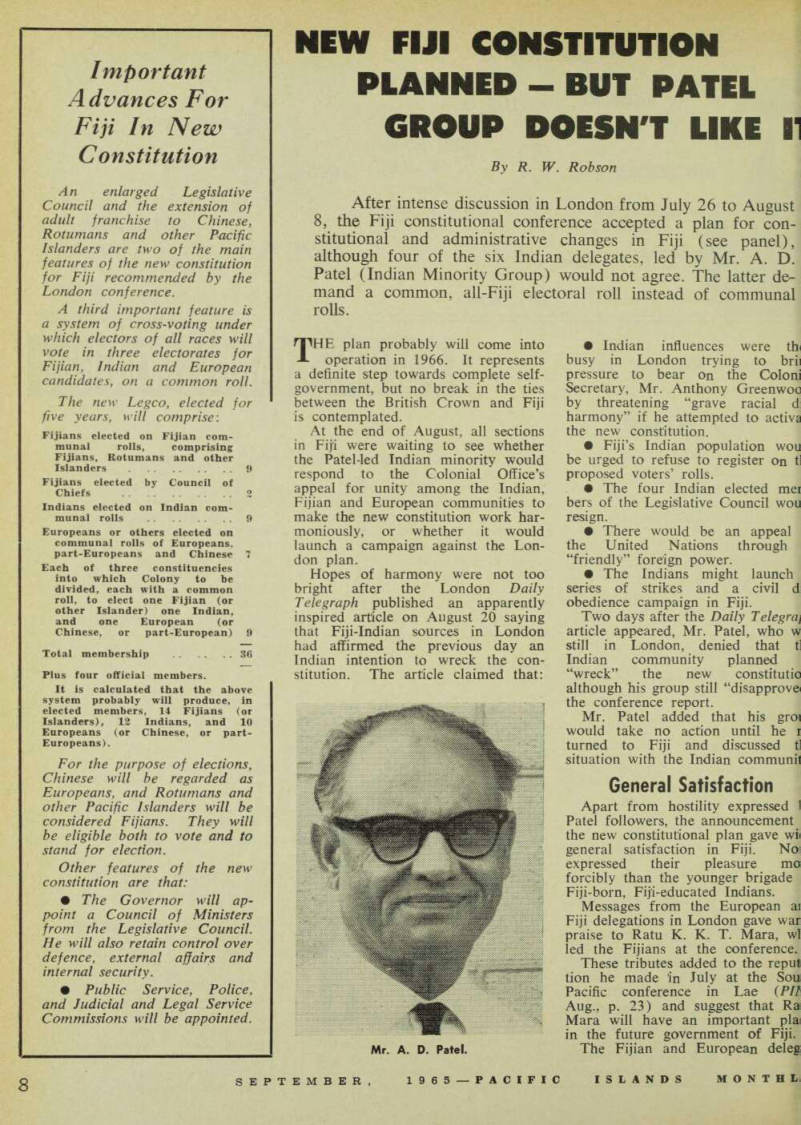
Mr. A. D. Patel.
Responsible Indians Must Be Encouraged To Repudiate Patel
ions worked together impressively, nd there is no doubt that the Colony at last getting some constructive sadership from those communities.
Now, it is hoped, the two com mnities will be able to encourage le non-Patel Indians to provide the jadership that is needed to enable 11 races in Fiji to go forward armoniously to build up the rchipelago’s economic strength to ike care of the rapidly-growing opulation.
If the Patel group is going to fight, ad seek the interference in Fiji of le wild-eyed visionaries of the fnited Nations (we have seen lore than enough of them in New ruinea!) it will be necessary to show le world that the majority of Fiji idians are quiet and dependable sople, who can play their proper art in the future development of le country.
Great Harm
Great harm was done to Fiji by ie quibblings and posturings of the del group in London, especially hen they insisted that they spoke ir the majority of Fiji’s Indians. The olonial Office finally was convinced at the group represented only a inority.
It is important, therefore, that the ore sober and responsible sections Fiji-Indians be encouraged to ake their voices heard, in repudia >n of Mr. Patel and all his political orkers.
Unless that is done, and with the jians in their present temper, a sastrous situation could develop in e Colony.
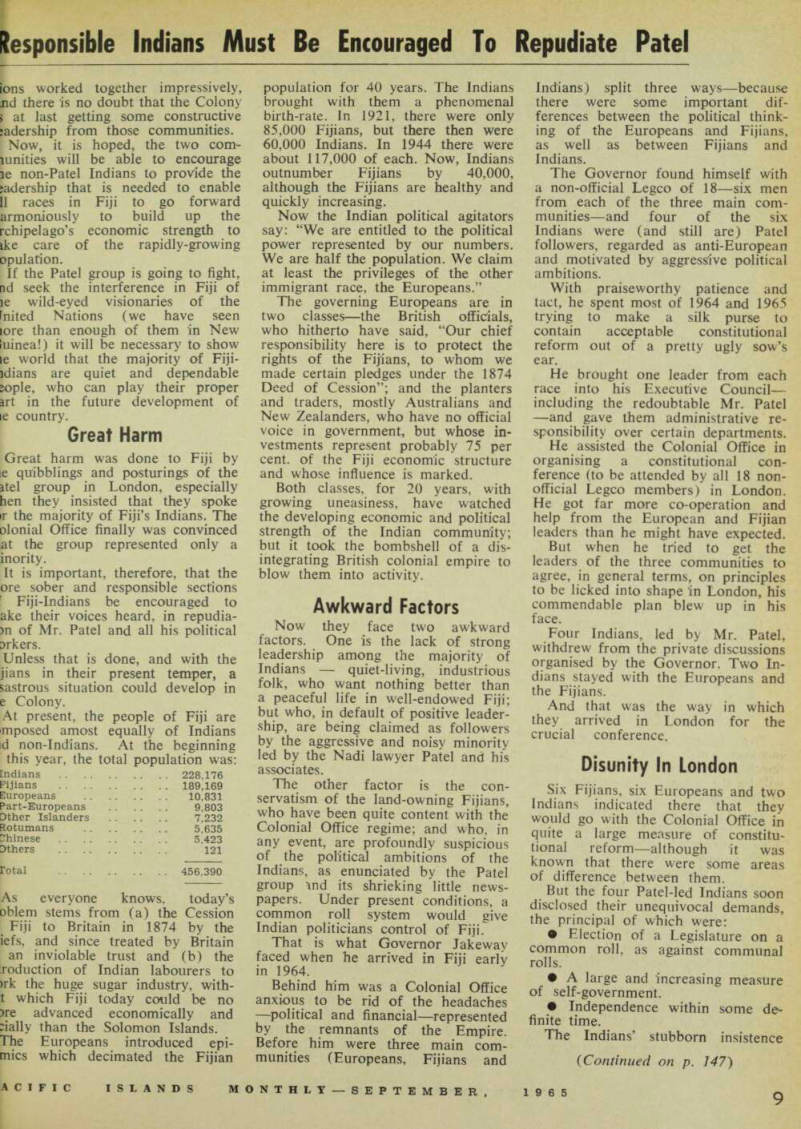
At present, the people of Fiji are mposed amost equally of Indians id non-Indians. At the beginning this year, the total population was: Indians 228,176 Fijians 189,169 Europeans 10,831 Part-Europeans 9,803 Other Islanders 7,232 Rotumans 5,635 Chinese 5,423 Others 121 Fotal 456,390 As everyone knows, today’s oblem stems from (a) the Cession Fiji to Britain in 1874 by the iefs, and since treated by Britain an inviolable trust and (b) the reduction of Indian labourers to >rk the huge sugar industry, with t which Fiji today could be no >re advanced economically and :ially than the Solomon Islands.
The Europeans introduced epi mics which decimated the Fijian
population for 40 years. The Indians brought with them a phenomenal birth-rate. In 1921, there were only 85.000 Fijians, but there then were 60.000 Indians. In 1944 there were about 117,000 of each. Now, Indians outnumber Fijians by 40,000, although the Fijians are healthy and quickly increasing.
Now the Indian political agitators say: “We are entitled to the political power represented by our numbers.
We are half the population. We claim at least the privileges of the other immigrant race, the Europeans.”
The governing Europeans are in two classes—the British officials, who hitherto have said, “Our chief responsibility here is to protect the rights of the Fijians, to whom we made certain pledges under the 1874 Deed of Cession”; and the planters and traders, mostly Australians and New Zealanders, who have no official voice in government, but whose in vestments represent probably 75 per cent, of the Fiji economic structure and whose influence is marked.
Both classes, for 20 years, with growing uneasiness, have watched the developing economic and political strength of the Indian community; but it took the bombshell of a dis integrating British colonial empire to blow them into activity.
Awkward Factors
Now they face two awkward factors. One is the lack of strong leadership among the majority of Indians quiet-living, industrious folk, who want nothing better than a peaceful life in well-endowed Fiji; but who, in default of positive leader ship, are being claimed as followers by the aggressive and noisy minority led by the Nadi lawyer Patel and his associates.
The other factor is the con servatism of the land-owning Fijians, who have been quite content with the Colonial Office regime; and who, in any event, are profoundly suspicious of the political ambitions of the Indians, as enunciated by the Patel group ind its shrieking little news papers. Under present conditions, a common roll system would give Indian politicians control of Fiji.
That is what Governor Jakeway faced when he arrived in Fiji early in 1964.
Behind him was a Colonial Office anxious to be rid of the headaches —political and financial —represented by the remnants of the Empire.
Before him were three main com munities (Europeans, Fijians and
Indians) split three ways—because there were some important dif ferences between the political think ing of the Europeans and Fijians, as well as between Fijians and Indians.
The Governor found himself with a non-official Legco of 18—six men from each of the three main com munities—and four of the six Indians were (and still are) Patel followers, regarded as anti-European and motivated by aggressive political ambitions.
With praiseworthy patience and tact, he spent most of 1964 and 1965 trying to make a silk purse to contain acceptable constitutional reform out of a pretty ugly sow’s ear.
He brought one leader from each race into his Executive Council— including the redoubtable Mr. Patel —and gave them administrative re sponsibility over certain departments.
He assisted the Colonial Office in organising a constitutional con ference (to be attended by all 18 non official Legco members) in London.
He got far more co-operation and help from the European and Fijian leaders than he might have expected.
But when he tried to get the leaders of the three communities to agree, in general terms, on principles to be licked into shape in London, his commendable plan blew up in his face.
Four Indians, led by Mr. Patel, withdrew from the private discussions organised by the Governor. Two In dians stayed with the Europeans and the Fijians.
And that was the way in which they arrived in London for the crucial conference.
Disunity In London
Six Fijians, six Europeans and two Indians indicated there that they would go with the Colonial Office in quite a large measure of constitu tional reform—although it was known that there were some areas of difference between them.
But the four Patel-led Indians soon disclosed their unequivocal demands, the principal of which were: • Election of a Legislature on a common roll, as against communal rolls. • A large and increasing measure of self-government. • Independence within some de finite time.
The Indians’ stubborn insistence
(Continued on p. 147)
; these things be written into itever agreement was reached— high-up Colonial Office officials ked literally day and night in an eavour to persuade them that i demands would get them no ire—drove the Fijians and Euro as into a solid camp, he Europeans made it clear that r would not at this stage dream of ing into the hands of Indian poli l agitators the kind of power rep nted by the common roll, hey quoted the record of Mr.
J’s Indian group (especially in 3 and 1960-1) in Fiji’s affairs. They tioned the history of Mauritius British Guiana—sugar-growing itries which acquired a large an population, and suffered end political and economic trouble n the Indians gained political rol. he general tenor of the Patel-In speeches was anti-British, he Fijians made it clear that they ed to maintain close administra and commercial ties with the sh. he sessions were all in private; it soon became known that the gations were deadlocked on the mon roll demand, and on matters ing to Fiji’s future “indepen ;e”, le Colonial Office people went to t lengths in seeking a “compro but the Fijians and Euro is would not accept anything h would give political power to Indians, or break the tie with tin. nally, a majority report was an iced and signed, with the Patel ndians withdrawn and protesting, le report will now be the sub of a British Government White t, which will be presented to the Legislative Council. It is not ex xl to be acted on until about 1 next year. eanwhile, it remains to be seen her the three racial groups can together to make the proposed titution work.
Mr. C. G. Cox, Director of ic Works in the Solomons, has appointed Deputy Director of hiblic Works Department in Fiji.
Cox who comes from Britain, ;d in Nyasaland from 1948 until when he went to the Solmons.