Cruising Yachts
pp. 101-109 · Read in the full issue
Pacific Shipping And
Quick Action Needed On
Moresby's Port Problems
From a Port Moresby Correspondent A marked increase in the number of overseas ships and the amount of cargo coming into Port Moresby in recent months is putting a heavy strain on the port’s wharf space and cargo storage facilities.
HIPPING men are already com plaining about congestion on : wharf and wharf approaches, and i difficulty of handling cargoes hout damaging them.
Until more facilities are built— i there are no definite plans for m at present—the position will >bably get worse. fhe result is likely to be a slower n-around of ships, with pilfering cargo left in the open, and nage to perishable and unprotected goes when the rainy season begins >ut December. [he main reason for the present iculties is the vast amount of istruction work going on in and
around Port Moresby, for which continual consignments of building materials, trucks, tractors, earth moving equipment, etc., are needed.
The construction work includes the building of an underground hydro electric power station at Rouna Falls, about 20 miles from Port Moresby; the Administrative Staff College, with staff accommodation, at June Valley; various defence projects, costing several million pounds; and a 12storey building for the Australia-New Guinea Corporation.
All this work has begun since a
World Bank mission visited New Guinea in the second half of 1963 and reported that the territory ports needing the most urgent attention were Rabaul, Lae and Madang.
Now, the World Bank would probably give Port Moresby’s harbour needs an equally high priority.
Port Moresby’s overseas wharf, which is T-shaped and just over 700 ft long, was built in 1953-54 when the total amount of overseas cargo handled in the port was 72,192 tons.
This figure compares with 137,550 tons in 1962-63 (the year quoted in the World Bank report), and 170,039 tons in 1963-64 (10 years after the wharf was built).
The latest figures available—for the nine months to March 31, 1965 —show that 140,063 tons of overseas cargo were handled in Port Moresby.
So the total figure for the year ended June 30, 1965, will undoubtedly be at least 190,000 tons, and probably a good deal more.
In other words, Port Moresby’s 700 ft wharf is now handling nearly three times as much cargo as when
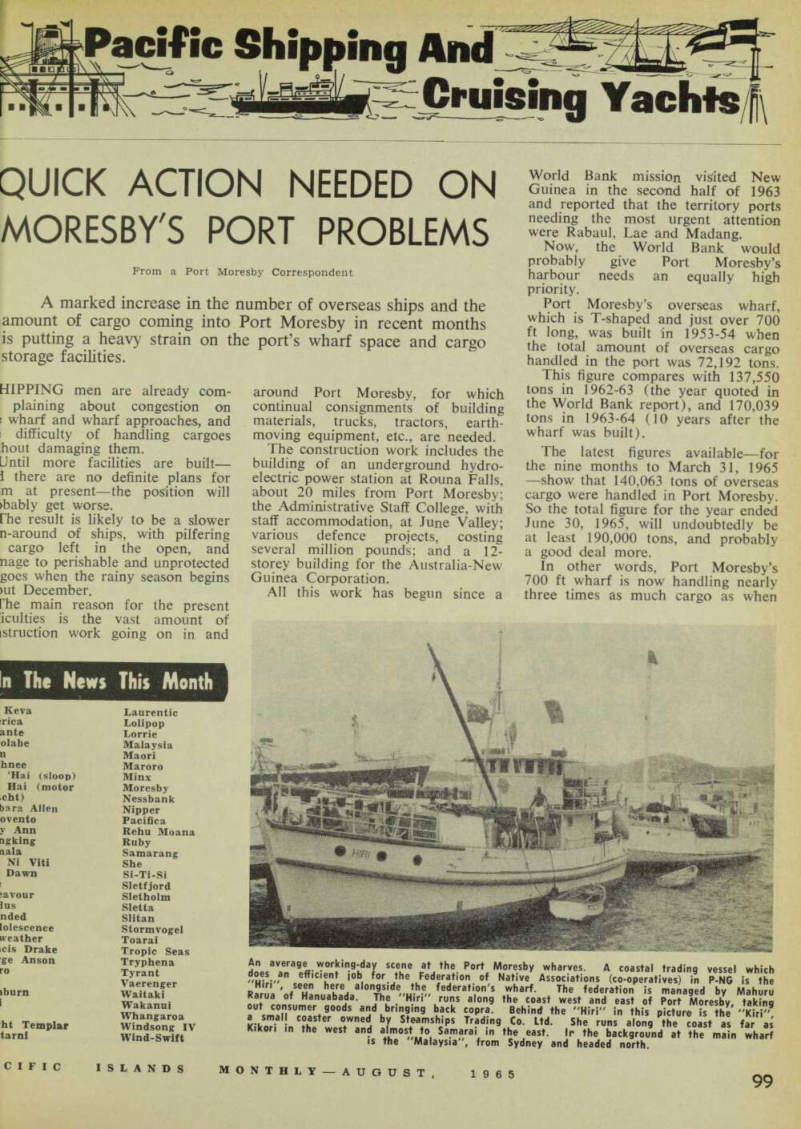
An average working-day scene at the Port Moresby wharves. A coastal trading vessel which does anef ficient job for the Federation of Native Associations (co-operatives) in P-NG is the "Hiri", seen here a longs ide the federatio n' s wharf. The federation is managed by Mahuru Rarua of Ha nuabad a. The "Hi ri" ru ns along the the coast west and east of Port Moresby, taking ourt consumer goo ds an d bringing back co pra. Behind the "Hiri" in this picture is the "Kiri" a small coas ter o wned by St ea mships Tradi ng Co. Ltd. She runs along the coast as far as Kikori in the west and almost to Samara, in the east. Ir the background at the main wharf is the "Malaysia", from Sydney and headed north.
Swas built, and about 35 per cent, ore than two years ago.
Two years ago, according to the odd Bank mission’s figures, there »re 83 days of the year when no ips were in Port Moresby and 166 ys when only one ship was in port.
Now, a ship-less day in Port oresby is a red-letter day, and days th two or more ships in port are out three times as common as ase with only one.
If two large cargo ships are in rt at the same time—for example, ; Chungking and Ness bank— ither can be unloaded or loaded iciently as the wharf is not long ough to accommodate the full igth of both. In one case, the •’ard hatches extend unworkably yond the wharf; and in the other, ' after hatches.
If more than two big freighters 5 in, those in excess of two must it their turn for wharf space at i anchorage. However, an ad ional freighter of up to about 00 tons gross can be accommoda . on the inner side of the wharf. [n June, 19 overseas freighters ited Port Moresby; the number icduled for July was 22; and with town’s building work being pped up continually, the number ild go even higher before long.
Phis means that the number of jrseas freighters visiting the port mally will probably soon be in the inity of 300 —an alarming figure en compared with the 132 of only 1 years ago (1959-1960).
I Needs More
Larf Space Too
7 iji, too, is under pressure for irf space.
Jew wharves have been built at ’s main ports of Suva and Lautoka he last four years, but even at the b they were officially opened, it apparent that they could do no re than cater for current needs.
Wth more overseas and local ship l making demands on the facilities oon became apparent that further elopment was necessary. The Fiji /eminent has now set up an expert imittee to assess the position and Dare plans for the future.
Tie terms of reference include such ters as evaluating the need for •e wharf space and shed accommo on, and the speeding up of cargo dling (as this will ultimately give iter wharf capacity).
Tie committee will also consider need to expand ship repairing and i building facilities in Suva, and additional facilities which may be jssary. he northern end of Walu Bay,
to where the Port of Suva must eventually expand, will come under the committee’s scrutiny. This area at present is industrial and com mercial, and wharf development in that direction must be co-ordinated with those needs; and also with a reclamation programme.
The committee comprises Messrs.
R. N. Atkinson (chairman), who is Secretary for Communications and Works; D. T. Lloyd, Director of Lands; J. P. Barron, Director of Public Works; E. J. T. Mabbs, Comp troller of Customs; Captain E. L.
James, Harbour Master; Messrs. G. S.
Barrack, W. R. Carpenter and Co. (Fiji) Ltd.; and E. R. Horne, USS Co. manager at Lautoka.
A conspicuous omission is a repre sentative of the Fijian Stevedoring Union, who would be competent to advise on methods of speeding up the handling of cargo.
Additional Service
For P-Ng
The latest addition to the Kar lander-New Guinea Line fleet is the Sletfjord, which was scheduled to ar rive in Sydney on July 16 from Hong
ng to enter the Australia-New inea service. ler ports of call will be Sydney sbane, Port Moresby, Lae, and wak.
Tie Sletfjord is sister ship of the holm, which toured Pacific ports ing the recent Australian trade sion. he has a cargo capacity of 3,300 ic tons, with refrigerated cargo ze. She will be specially fitted to •y inflammable and explosives »o, and will carry a limited num of passengers. fie other ships in the fleet are the in and Sletta, which are also exact ;r ships. fie Sletta in July carried 239 head Hereford cattle from Sydney to uara for a new BSIP beef cattle :rprise. She had engine trouble route. here were no stock losses on the age; in fact the number increased everal head because several calves j born en route.
On Steam Ship
New Guinea
he Union Steam Ship Co. of NZ is to compete in New Guinea :rs. The company will service a between New Zealand ports and Moresby in place of the »ader Line, which has withdrawn, tie USS Co. expects to place the taki and the Whangaroa on the with four to five loadings a year, tie Waitaki was scheduled to load 4ew Zealand ports in July and ust for the first run. le Crusader Line ship, Knight plar, had been serving Port esby from NZ at intervals, but has now been switched to the NZ n run.
>S Will Still
L At Rabaul
ie Francis Drake and the George m will continue to call at Rabaul he Sydney-Japan service for the being. was reported early in June that would no longer call at Rabaul, lat the service between Australia Japan, and vice versa, could be ded up. spokesman for H. C. Sleigh Ltd. tydney, agents for the owners, Dominion Navigation Co. Ltd. .), said the decision to eliminate ml had been revoked, ie people of New Britain had not happy about the original de n, for the two ships had been
providing a regular service for the last two years.
The ships are air-conditioned and many Territory people use them when travelling to Australia for leave.
The voyage between Rabaul and Sydney usually takes about five days.
Nz-New Caledonia
Norfolk Service
The Holm Shipping Co., New Zealand, has inaugurated a monthly service embracing New Zealand, Norfolk Island and New Caledonia with the Holmburn, 1,800 tons.
On the inaugural voyage the Holm burn’s cargo included potatoes, onions, garlic, ice cream, frozen meat, and butter for New Caledonia, and also a number of cattle for New Caledonia graziers.
The Holmburn, which was built in 1958, can carry 12 passengers.
The service was warmly welcomed in the islands, for New Zealand was able to supply many foodstuffs at prices much below those of compar able Australian items.
Experienced Master
In "Adi Keva"
One of Fiji’s most experienced mariners, Captain Steven Smith, has been appointed master of Morris Hed strom’s new ship, the 351 ton Adi Keva, which was formerly the Morag.
The Adi Keva on her first trading voyage, called at copra ports in Lomaiviti and Cakaudrove, and on her next voyage was scheduled to take in Northern Lau ports.
Captain Smith has sailed as master in the cutter Ruby (now the Calm
sea), the auxiliary cutter Adi Maca, the auxiliary schooner, Resolution, the Tui Labasa, the Ono-i-Lau, the Tui Walievu, LCT fishing craft, the old Komaiwai (since broken up), the Tovata (left to rot in Walu Bay), the Tuvalu and the Altair.
He also served as chief officer in the Yanawai, the Kurimarau, Oliver Mac and Ai Sokula.
Adi Keva is believed to be the big gest ship to berth at Morris Hcd strom’s wharf at Nasea, Labasa.
But she was unaole to sail up the Labasa River to her berth till she dis charged much of her cargo at the mouth of the river.
Tenders Called For
Kieta Wharf
Tenders for the new overseas wharf at Kieta, Bougainville, are now being called. The wharf will be 200 ft long and 40 ft wide.
The P-NG Administration has ac cepted a tender for £56,000 for the supply of sheet metal and bearing piles, which will be used to build a 500 ft retaining wall for a reclaimed site for the proposed wharf.
The PWD has excavated and placed about 10,000 cubic yards of earth on the site.
Portrait
..Man At Work!
M. R. Hayes took these aloft and below pictures of the skipper of the "Day Dawn" at Rabaul, and his method of avoiding the heat of a stuffy wheelhouse.
'0 Ships Wrecked
leefs in the Western Pacific imed two more victims early in f n the New Hebrides, a Japanese ing boat ran aground on the west st of Santo, in the Wonisuli area, 1 tenders were later called to r age it. n New Caledonia, the catamaran xius, which takes tourists on itseeing tours of the reefs, was >wn on a reef near Noumea after motor broke down. The six pie on board, including owner per Paul Berger, were rescued r keepers at the Amedee light se noticed them clinging to the :ked vessel.
Urentic's" Maiden
R Age
haw Savill’s newest cargo ship, the rentic, called at Fiji and Tonga une and July, while on her way New Zealand on her maiden ige. he Laurentic was built at the :ers - Armstrong naval yard, r castle-on-Tyne. he Shaw Savill Line is following olicy of steady replacement of tonnage, and has placed orders two more cargo ships for de y in 1966 and 1967. le Laurentic has a cargo capacity 64,120 cubic feet.
R Medical
' In Papua
46 ft ship, the Toarai (“to bring ’), was expected at the Gulf •ict headquarters of the P-NG th Department at the end of e was built at Maryborough in :nsland and arrived at Port ssby on June 10 for final modifi ns at the Napa Napa slipway, le Toarai, the first permanent cal ship for the Gulf District, be stationed at Kerema.
Resby's" First
*GE rns Philp’s new cargo ship, the ’sby, launched in February, was luled to leave Newcastle on July >r Sydney to load for her maiden ?e to Papua-New Guinea, e replaces Malaita, which has sold ( PIM, July, p. 97).
Lel To Sinking
Betty Ann"
ipowners and masters in the a coast trade will be advised of eed to ensure adequate stability heir ships, for employing ex
perienced helmsmen, and to stow life-jackets.
This action follows an inquiry by the Marine Board of Papua into the sinking of the Betty Ann, 37 tons gross, in Milne Bay on April 13, with the loss of one life.
The board in its findings was critical of the master, Leonard John Hansen, who has since had his local master’s licence cancelled.
The Betty Ann left Samarai early in April for Gabagabuna with a
small amount of cargo, mainly timber, and eight deck passengers.
About 6.20 a.m. she heeled to star board, went over on her beam end, and subsequently foundered.
A woman passenger died in a life boat, and the survivors reached the northern shore of Milne Bay.
The board found that the Betty Ann was improperly loaded at Samarai before departure as a cargo of timber was loaded on deck to the detriment of stability.
/Iar0R0" To Provide
[Ansport For Scientists
Captain Stan Brown, of Suva, and ; well-known cruise ketch Mar or o ived in Honiara on June 16 to wide inter-island transport for the yal Society expedition to the lomons. The last members of the man expedition reached Honiara the end of June. fhe expedition is divided into two ►ups—one for the study of flora 1 fauna and the other to investigate sea and reefs. )n July 1, the land party, under leadership of Mr. E. J. H. Corner, for their base camp at Tambolao lage, Guadalcanal, from where f will climb Mount Gallego, col ing specimens of plants, insects other wild life, he marine party, under Professor E. Morton and his assistant Mr.
A. Challis, made preliminary in flations along the reefs west of liara in late June and on July 1 for the Nggela coast in the ■oro. They were later to cruise to tern Guadalcanal, he expedition’s programme in es visits to Florida, the Eastern •mons, Ysabel, and the Western rict. The expedition will stay in Solomons until December.
Rine Superintendent
aptain John Hozack has been )inted Marine Superintendent and if Harbourmaster in Tonga. He id as Acting Marine Super ident and Chief Harbourmaster 963-64, and was later Assistant me Superintendent. For 18 ths he was master of the Tonga •a Board’s Aoniu.
[Ship's Scientific
ie New Zealand warship, a\our, late in June finished a 54scientific expedition in the South ic, during which she cruised t 10,000 miles. e primary purpose was to take im of New Zealand, Australian British scientists and their equip to Manuae Island to observe the £ of the sun. ter landing the scientists, the avour cruised through the Cooks, >ther groups, carrying out seismic lings. out 6,300 lb of explosives were ated in small charges during Programme.
Censed Papua
•Ing Canoes
2 P-NG Superintendent of ie, Captain G. A. Hawley, plans
to make a drive against unlicensed canoe owners operating in cut-throat competition in the Papuan coastal cargo and passenger trade.
First, he must secure the services of a ship inspector to police the law.
Licensed canoes engaging in the trade are required to carry life-jackets for passengers and crew, extra life buoys, two fire extinguishers, adequate covering for passengers, clean water barrels, and sufficient fuel for pas sengers to cook their food.
At present only three canoes are licensed, but the number of canoes operating could be more than 60, although all would not be engaged
in regular trade. The licence fee is £l/10/-.
Fiji's Geological
Survey Ship
The Fiji PWD has built a 30 ft launch, the Dan Ni Viti, for the Geological Survey Department, for mapping and economic investigations.
The launch cost £1,500 of which the Fiji Government paid £l5O. The remainder came from a Colonial De partment and Welfare grant.
Miss Xandra Williams, the only woman scientist in the Geological Survey Department, launched the Deni Ni Viti.