The Editors' Maillag
pp. 51-55 · Read in the full issue

Fiji's Council Of Chiefs
Sir, —I have been asked by the Secretary for Fijian Affiairs, Ratu Ganilau, to pass to you the allowing; There appeared on p. 11 of the 'une issue of Pacific Islands Monthly in article under the heading “Ap >rehension Over London Talks On 7 iji’s Future”. This was below the >y-line of “A Suva Correspondent”.
It stated. “At the time of writing, he Great Council of Chiefs is meet tig at Suva and from it has come me piece of information which in icates the present temper of some f the Fijians.
“A motion was placed before the 'ouncil calling for the exclusion of ndians from the constitutional talks i London. It was defeated by a arrow majority.”
The Secretary for Fijian Offairs :ates: “No such formal motion was laced before the Council, although ie matter was raised and briefly dis used. Consequently, there can be d basis for the statement that it was efeated by a narrow majority.”
E. J. F. Hackett,
Public Relations Officer, iji Government Offices, iva.
"Cry, Beloved Islands"!
Sir, —From a visitor’s viewpoint ie New Hebrides group appear at active, happy-go-lucky, palm inged. Indigenous Melanesians are ire-free and always ready with a rule. Their worries, if any, are nited, as fertile soil and regular infall are kind to yams, taros and /eet potatoes. Whatever problems be faced are left entirely in the mds of Europeans.
The Europeans are divided in veral groups, here described: (a) It may or may not be un rtunate that some of the tropical thargy has been passed on to the iw generation of white settlers hose forebears only 60 years ago -re tough, diligent pioneers. How er, there remain a number of ucated New Hebridean-born whites ho feel deeply for the Group. This their home and they are here to iy, be they French, British or half stes. (b) To manage the political side the Group (even though the
Protocol forbids “politics”) British and French governing bodies have been given full sway by their respec tive home governments. These good people are replaced every few years.
Their short sojourn is not conducive to administrative continuity. In some cases, their presence does more harm than good. (c) British and French com mercial firms, who were here at an early stage of development, were instrumental in assisting European settlers, but since appear to have changed their policy. (d) Other members of the com munity are business people who hail from various points of the globe. A businessman is generally endowed with a sharp brain. To further his end he must practice social graces on local political parties with suitable gifts. Most are here for a short time, but long enough to shower viewpoints which, at times, could be detrimental to these islands. Their aim seems to be to exploit speedily. (e) Mission bodies cover a large mixture of Christian denominations, all vying with one another to “bring light into darkness”. There are more kinds of Christian sects in the Group than in any other part of the Pacific.
However well-meaning, their varied numbers confuse the inhabitants. (f) Last but not least, the third Administrative body comprises a motley crowd with varying degrees of capabilities. Some are not-so-capable.
It used to be the standard joke that if a person could not find employ ment elsewhere the Condominium always had room for him. Thus, this organisation has swelled its numbers over the years.
It was suggested that qualified men should be imported from overseas.
Good men are, unfortunately, ex pensive, and those with “European systems” are generally known to be too frail to stand up to tropical con ditions.
Regardless of origin or whether recruited “on the spot”, Con dominium employees and families are granted up to nine months Euro pean-leave every six years, not counting annual leave. An indepen dent, wage-earning youth, outside of Condominium services, is per mitted to share this joy-ride with a Condominium parent. The local Budget must feel the strain in no mean measure.
In conclusion, the agriculturist who forms the back-bone of the islands wonders at the outcome of all this.
Regardless of colour, he is here to stay.
Evolution will take its course and the Melanesian standard will be raised, given time. To force the issue with a slap-dash move towards self determination hurriedly mapped out, can only result in unhappiness and confusion.
Whatever unrest may ensue will not be by choice of the people but because of the governing powers.
Their task is mainly concerned with a steady flow of reports. Visiting Ministers from abroad are only shown what they wish to see.
And so, the contented Melanesian with his ever-ready smile must con form, and be jerked out of a sweet, care-free existence to become part of a chaotic world simply to suit the whims of a handful.
Madam X
Santo, New Hebrides
Why At Samarai?
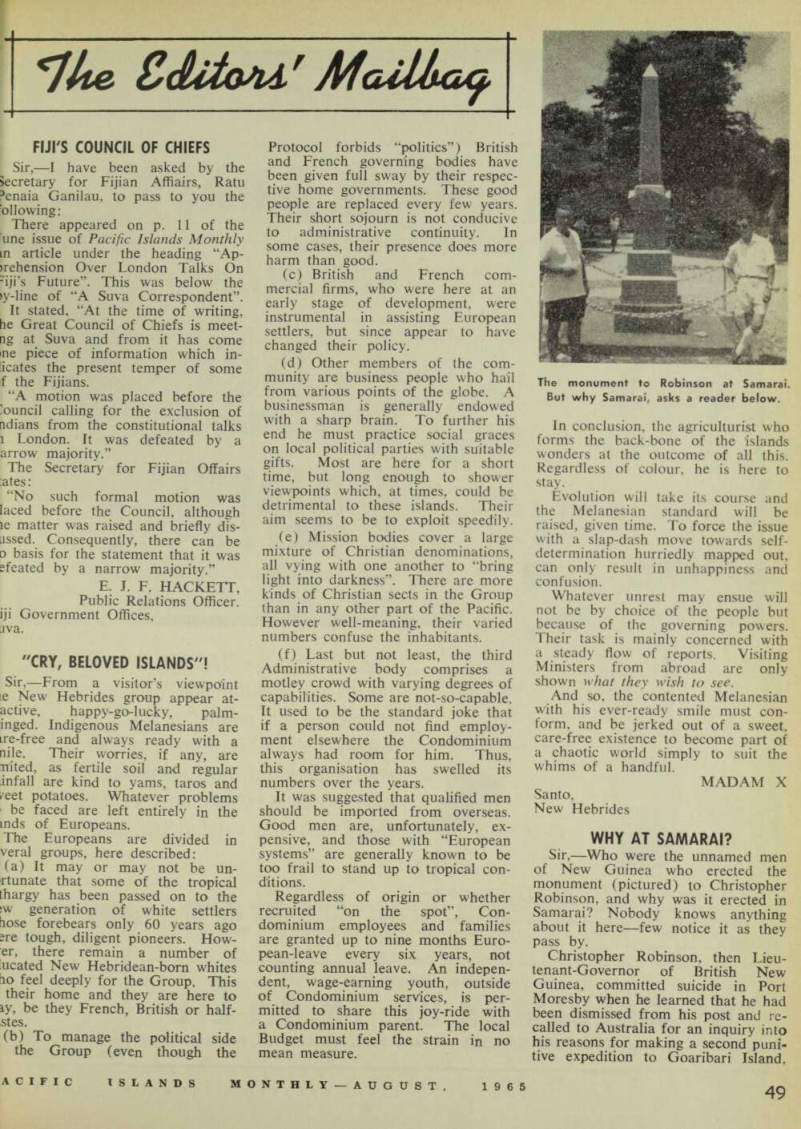
Sir, —Who were the unnamed men of New Guinea who erected the monument (pictured) to Christopher Robinson, and why was it erected in Samarai? Nobody knows anything about it here—few notice it as they pass by.
Christopher Robinson, then Lieu tenant-Governor of British New Guinea, committed suicide in Port Moresby when he learned that he had been dismissed from his post and re called to Australia for an inquiry into his reasons for making a second puni tive expedition to Goaribari Island,
The monument to Robinson at Samarai.
But why Samarai, asks a reader below.
tear Kikori, to punish the murderers >f the LMS missionaries Chalmers md Tomkins. A punitive expedition tad already been sent by his pre lecessor, Sir George Le Hunt.
The memorial cenotaph has the in cription: In Memoriam : Christopher Robin on. Able Governor —Upright Judge -And Honest Man. Died 20th June 904. Aged 32 years. His aim was 7 make New Guinea a good country or white men!
This stone was here set up by the len of New Guinea in recognition f the services of a man who was as ell meaning as he was unfortunate, s kindly as he was courageous!
Life is mostly froth and bubble two things stand like stone.
Comfort in another's troubles courage in your own.
D. S. Askew
imarai, Papua.
Bougainville Pygmies
Sir, —I found the article “The [ysterious Little Men of Buka and ougainville,” by R. J. Giddings, *IM, April), very interesting.
I had heard also from Europeans ithin P-NG talk of the possibility ! primitive pygmies living in the ountainous, jungle-covered interior ' Bougainville, in the vicinity of >th active volcanoes, Mt. Balbi and f. Bagana.
However, like Mr. R. J. Giddings, am rather inclined to believe that e report of pygmies on Bougainville Buka are rumours, and completely Ise.
Likewise I have done extensive trolling as a Medical Assistant trth, south, east and west in the mgainville District and if there are d pygmies running around then my me isn’t J. Stewart.
Eric. J. Stewart.
iblic Health Department, •mio, New Britain.
Aviation Problem
Sir, —For a number of years I ve been collecting First Flight vers of P-NG, and thanks to a mber of your readers, I have thered much interesting data. Now have a problem that nobody to te has been able to answer, but I i sure that one of your readers i help.
It deals with a cover (envelope) sted from Bulolo on March 15, 32, and addressed to Mr. B. G. allis, Salamaua, and annotated
Irst Flight And Opening
Lte Of Bulolo Post
•Fice”.
Can your readers tell me who the stmaster was, lend me photos of
the opening of the post office, tell me what company, pilot, and aircraft flew the first mail from Bulolo to Salamaua?
I would not be surprised to learn that the pilot was Capt. Orme Denny, in Junkers VH-UKW.
Can any of your readers lend me photos and negatives of aviation in P-NG prior to World War II? Due care will be taken of any item lent me and postage will be paid both ways. I also want to get freight and baggage labels, stickers, timetables of old airline companies.
John Watson
27 Menvale Street, South Brisbane
Tonga's "Assassination"
Sir, —Sir Basil Thomson, who was quoted in your June issue (p. 91) on the attempted assassination of the Rev.
Shirley Baker, made a strange mistake in The Diversions of a Prime Minister, his account of his Tongan experience.
He refers to the execution of four Tongans, but there were in fact six killed by the firing party; the four who were alleged to be present at the “assassination attempt” and Tobui, a minor chief with lands at Mu’a and Holonga, and his son Motuhi. In the process of getting material for a book A Harpoon in my Hand, to be published later by
Angus and Robertson, I visited the tiny uninhabited island of Malinoa with its six graves. They are still kept in good order, regularly weeded and covered with fresh sand, though they are remote from habitations.
It was a strange mistake for Sir Basil, who, by virtue of his task, was /ery close to the surviving victims of Shirley Baker’s persecutions.
Olaf Ruhen.
Mosman, NSW.
Boat Harbour For Norfolk
Sir, —May I suggest that the powers-that-be on Norfolk Island give jarliest consideration to providing a safe anchorage for yachtsmen to shelter their craft. Many yachtsmen vould be glad to visit the island, and heir visits could help publicise its aeauty. New Zealand yacht clubs vould be interested in organising a •ace to Norfolk Island, besides races o Noumea and Fiji, and I feel this ;ould be of value to the island.
H. Dimock.
-I. I. Dimock Ltd., kelson, NZ.
Bulls In A Ng China Shop
Sir, —There is still time to attempt i somewhat different approach to New 3uinea than the conventional one of i colonial power—an approach with magination.
Our fragmented society I think )bscures the fundamental issue that <ew Guinea life still proceeds as a mity—all its expressions merely be ng integrated parts of a whole. We nust be prepared to learn from New juinea civilisation as well as allow ng them to partake of ours. But we lave behaved like bulls in a china hop and we have not respected the nherent dignity of the native life. We lave thus retarded, sometimes de frayed, their imagination.
There is a kind of discipline in lative life, different to ours, which :ould well provide the basis of a >etter understanding and it is for us o show the way.
But this requires time and patience, or it is necessary for us to try to ixplain to New Guinea that the basis if our own life is still discipline, irderly living and responsibility.
We have to create a New Guinea ociety, through education, where our vays are intelligently intertwined with heirs. An educational programme vhich does not include their own visdom and learning will create mis its and second-raters, instead of men tanding on their own feet, in their >wn society.
H. L. (Bob) Schultze.
osman, NSW.