Life's Faster Tempo Is Getting
pp. 43-45 · Read in the full issue
On Papeete's Nerves
The increasingly rapid tempo of life in Tahiti’s capital, Papeete, is threatening the “nervous equilibrium” of the town’s inhabitants and is causing serious social problems.
CHIS is stated in a paper presented by the French Polynesian delega on at the Sixth South Pacific Con ;rence in Lae, New Guinea, in July.
The paper speaks of the hap azard proliferation of “unauthorised avels” in Papeete, the problems of restitution, liquor and tuberculosis, ic filthiness of the municipal rubbish amp, and an alarming increase in le number of road accidents.
Papeete’s social problems are more r less attributed to two great changes tat have befallen French Polynesia, id Papeete especially, during the ast five years.
These are the opening of the in rnational airport at Faaa, Tahiti, in ?60, and the inauguration of the jelear testing project in the territory 1962.
The opening of Faaa airport has itirely transformed the traditional immunications connecting Polynesia, id especially Papeete, with the world large, the paper says.
Transformed
In 1964, more than 21,000 move ents of aircraft of all nationalities ere recorded at the airport—l,6o3 immercial aircraft, 987 official (civil • military) aircraft, and 18,535 pri de aircraft.
The last census (1962) revealed tat the population of Papeete was },903. Today the municipal author ies estimate that 24,000 people in abit the city.
The population comprises persons nmigrating from the districts of ahiti and the islands, tourists on lort visits, or those who came to ay before 1962.
Since 1962 there has also been a eat deal of coming and going in mnection with the nuclear testing roject.
Some big private companies have :t up offices locally—Dumez-Citra, Tagages, Grands Travaux de I’Est -while soldiers, sailors, airmen and vilian engineers have been pouring The paper says that the labour )rce in Papeete increased from 5,700 i 1959 to 9,500 in 1964.
“Fortunately not all of these
workers have abandoned the rural areas of Tahiti,” the paper goes on.
“All that happens is that to get to and from work, they have to adapt their timetables to those of persons inhabiting the suburbs of some huge metropolitan conurbation.
“Some of them, from the island of Moorea or from the remoter rural areas of Tahiti, 40 or 50 miles from Papeete, go home only on week ends.”
The paper says that the number of tourists visiting Papeete increased from 1,472 in 1959 to 14,135 in 1963 and 13,085 in 1964, and that the figures for 1965 are expected to be much higher than those for 1964.
In addition to the 13,085 tourists in 1964, 33,926 people visited Tahiti in cruise ships and liners on regular runs.
Before 1962, the paper says, the chief reason people left their own islands to settle in Papeete was that they wanted to give their children a better education than they could get at home.
Other reasons were that poor com munications deprived them of such
things as flour, sugar and canned foods; and that a native, who, for any reason, spent some time in Papeete, found it hard to go home again and preferred instead to summon his family to join him.
Before 1962, no more than a few hundred people a year migrated to
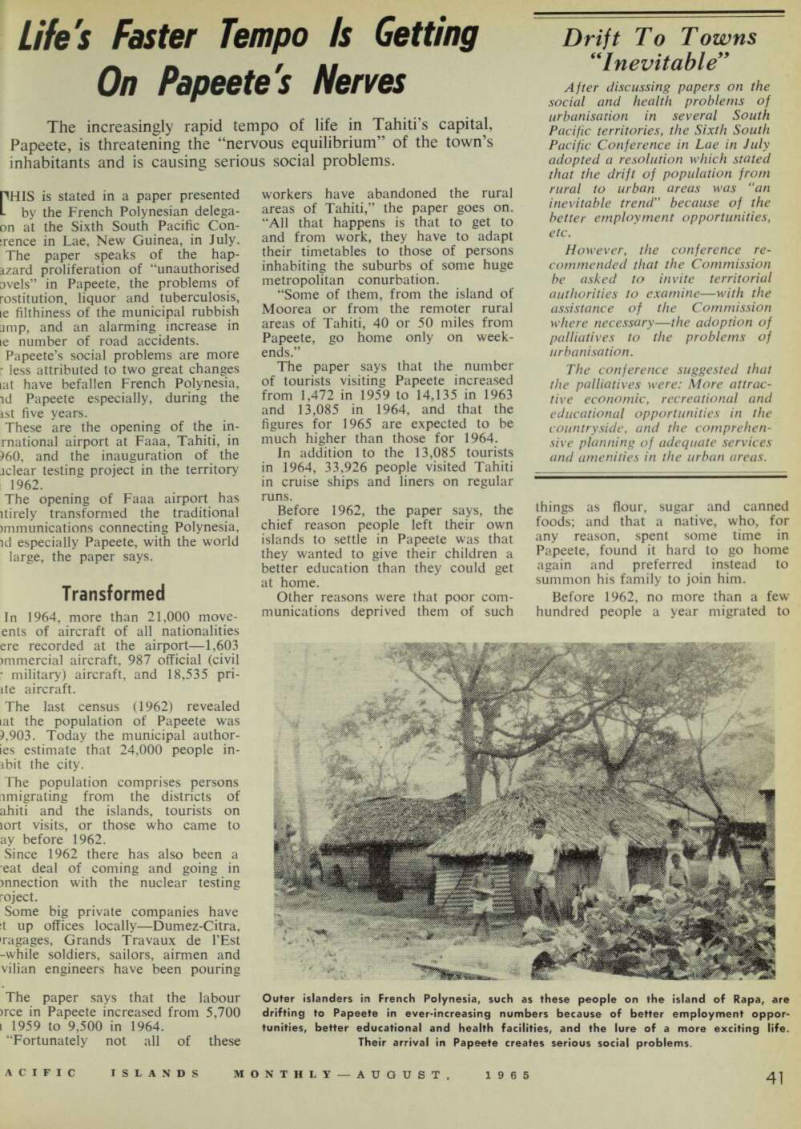
Outer islanders in French Polynesia, such as these people on the island of Rapa, are drifting to Papeete in ever-increasing numbers because of better employment oppor tunities, better educational and health facilities, and the lure of a more exciting life.
Their arrival in Papeete creates serious social problems.
apeete in this way. But since then icre has been a very considerable crease because of the demand for hour.
The influx of people from the lands in Papeete has created a dif ;ult housing problem because the unigrants put up shacks, unbeknown i the authorities, on unused land.
These shacks, of one 15 ft by 15 room apiece, may shelter from 15 i 20 people each night.
The proliferation of the shacks, ith their primitive sanitary conveni ices, is a source of grave concern i the health authorities.
But the problem is likely to grow orse during the next two years hen workers return from the con ruction of aerodromes and military stallations at Mururoa, Hao and angiroa atolls.
The authorities will then be faced ith the dilemma of either overlook g the unauthorised shacks, which e an obstacle to future drainage id sewage disposal plans, or to in st on building permits and observ ice of the regulations.
“If we choose the latter course,” ie paper says, “there is bound to be i increase in over-crowding a •oblem already grave enough—and is will inevitably lead to such things i prostitution, a risk of serious )idemics, and the spread of tuber ilosis, and so on.”
Drains
The paper says the laying of new ains has not kept pace with the stward and westward expansion of ipeete.
This lack, particularly in the areas habited by indigent islanders, en mrages the breeding of flies and metimes creates a source of phoid.
The municipal rubbish tip also aves “a very great deal to be de -ed.”
It is situated at the end of the paerui valley next to a pigsty, “the habitants of which, with the com icity of their owner, roam freely 'er the rubbish.”
The paper says: “This area (the paerui industrial zone) is steadily reading, and the municipal rubbish >, where rats and flies abound, is source of serious annoyance.
“The new brewery, for example, mplains about the risk of contam ation of its vats by flies.”
The paper says it is difficult to keep ireast of the incidence of venereal sease in Papeete, but “a garrison wn with a floating cosmopolitan ipulation is likely to suffer from ostitution and all it entails.
“Among the newly-arrived families, malnutrition is not infrequently observed,” the paper goes on. “Often enough the earnings of a single breadwinner do not suffice to feed all his numerous dependents, and even when everybody has a job, the children are left too much to their own devices and, as a result, are not properly fed.
“It may well be, too, that in certain families too much money is set aside for such things as drink and leisure instead of being devoted to necessities. . .
“In some respects, the transition from rural to urban living has been
too sudden. The noise and strain of modern urban life, combined with easier access to alcohol for those un accustomed to it, have led to a suc cession of grave, sometimes fatal, in dustrial accidents which would have been unthinkable even a few months ago, as well as to road accidents in even greater numbers,”
Records kept by Papeete Hospital, the paper says, show that the number of people injured in road accidents increased from 165 in 1960 to 715 in 1964, and that blood tests showed an even steeper increase in the num ber of accident victims severely affected by alcohol.