"The things they said...
pp. 32-33 · Read in the full issue
Among the hundreds of thousands of words spoken at the Sixth South Pacific Conference in Lae in July were these two or three dozen pithy remarks that perfectly sum up current situations, trends and attitudes in the South Seas.
IN the New Hebrides, we do not think about independence or things like that.— The Rev. Titus Path, English-speaking New Hebridean delegate.
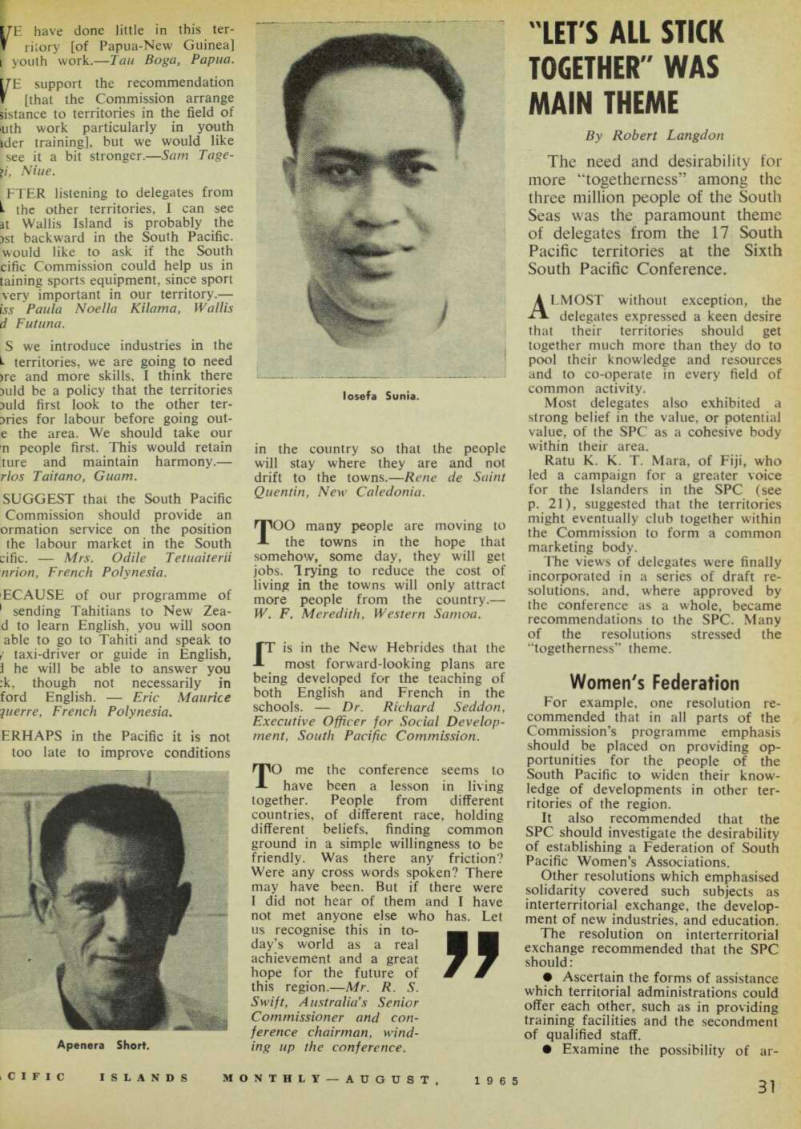
IN our territory, we have been brought up with the idea that we are independent even though someone else is paying the greater part of our expenses. This system has worked very well for us.— losefa Sunia, American Samoa.
I THINK it is understood that Nauru is not aided at all by the administering authorities. The little island of ours finances itself.
Laurance Stephen, Nauru.
FOLKLORE is a wealth we must safeguard even if modern life is causing us to discontinue some of our practices.— Mrs. Odile Tetuaiterii Henrion, French Polynesia.
IN the Gilbert and Ellice Islands we lose expatriate officers just when they are beginning to under stand local conditions. Buren Ratieta, Gilbert and Ellice Islands Colony.
THE territories should legislate so that they have a share in any new industry established with out side capital. They should buy shares for the people.— Apenera Short, Cook Islands.
IT is necessary to bring in new capital from outside, but we must be careful not to over-legislate to protect ourselves and so scare away those who would be willing to help us.— losefa Sunia, American Samoa.
I READ somewhere that the rate of population growth between Fiji and the Tuamotus is the highest in the world, perhaps the highest in history. That is why we need new industries. — Ratu K. K. T. Mara, Fiji.
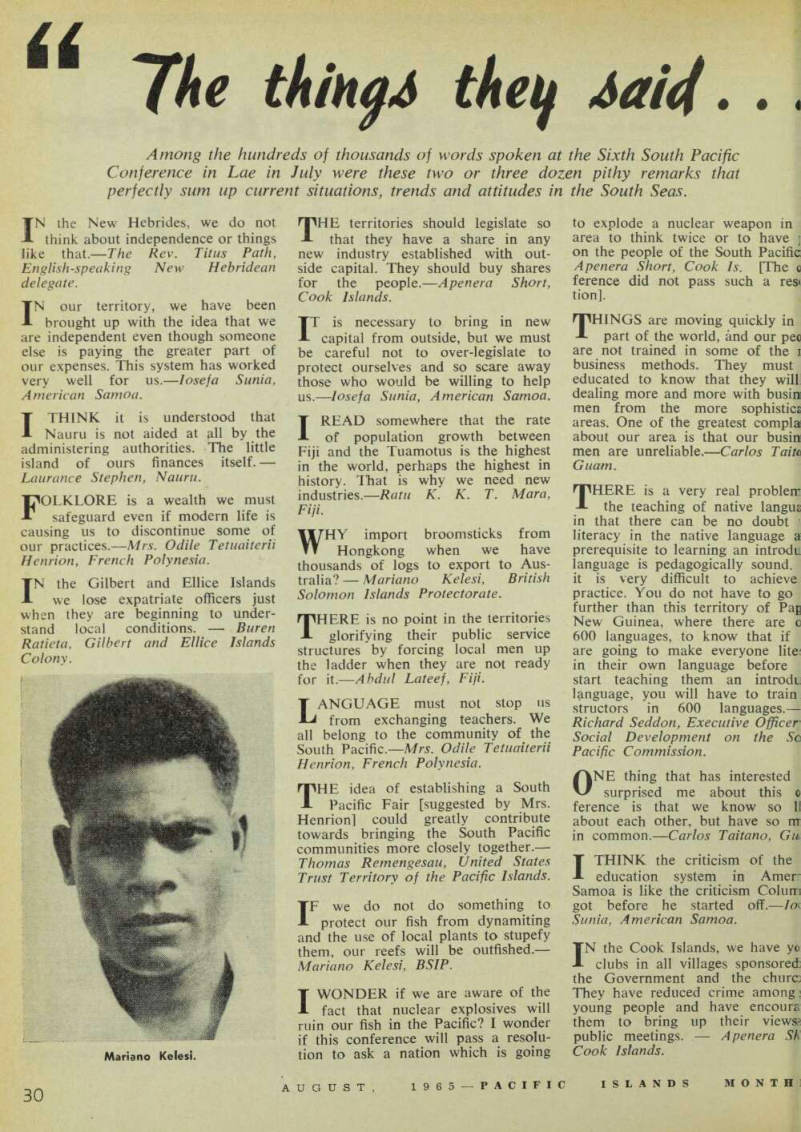
WHY import broomsticks from Hongkong when we have thousands of logs to export to Aus tralia? Mariano Kelesi, British Solomon Islands Protectorate.
THERE is no point in the territories glorifying their public service structures by forcing local men up the ladder when they are not ready for it.— Abdul Lateef, Fiji.
Language must not stop us from exchanging teachers. We all belong to the community of the South Pacific.— Mrs. Odile Tetuaiterii Henrion, French Polynesia.
THE idea of establishing a South Pacific Fair [suggested by Mrs.
Henrion] could greatly contribute towards bringing the South Pacific communities more closely together.— Thomas Remengesau, United States Trust Territory of the Pacific Islands.
IF we do not do something to protect our fish from dynamiting and the use of local plants to stupefy them, our reefs will be outfished.— Mariano Kelesi, BSIP.
I WONDER if we are aware of the fact that nuclear explosives will ruin our fish in the Pacific? I wonder if this conference will pass a resolu tion to ask a nation which is going
to explode a nuclear weapon in area to think twice or to have ] on the people of the South Pacific Apenera Short, Cook Is. [The o ference did not pass such a res< tion].
THINGS are moving quickly in part of the world, and our peo are not trained in some of the i business methods. They must educated to know that they will; dealing more and more with busim men from the more sophistics areas. One of the greatest complai about our area is that our busim men are unreliable.— Carlos Taitc Guam.
THERE is a very real problem the teaching of native langus in that there can be no doubt literacy in the native language a prerequisite to learning an introdu language is pedagogically sound, it is very difficult to achieve practice. You do not have to go further than this territory of Pag New Guinea, where there are o 600 languages, to know that if are going to make everyone lite; in their own language before start teaching them an introdu language, you will have to train sitructors in 600 languages.— Richard Seddon, Executive Officer Social Development on the So Pacific Commission.
ONE thing that has interested surprised me about this o ference is that we know so II about each other, but have so ru in common.— Carlos Taitano, Gw I THINK the criticism of the education system in Amer Samoa is like the criticism Colum got before he started off.—/oc Sunia, American Samoa.
IN the Cook Islands, we have yo clubs in all villages sponsored; the Government and the churc They have reduced crime among; young people and have encours them to bring up their views? public meetings. Apenera SK Cook Islands.
Mariano Kelesi.
ITT have done little in this ter f ritory [of Papua-New Guinea] I youth work.— Tau Boga, Papua.
UE support the recommendation f [that the Commission arrange sistance to territories in the field of uth work particularly in youth ider training], but we would like see it a bit stronger.— Sam Tage >/, Niue.
FTER listening to delegates from i the other territories, I can see at Wallis Island is probably the ast backward in the South Pacific, would like to ask if the South cific Commission could help us in taining sports equipment, since sport very important in our territory.— iss Paula Noella Kilama, Wallis d Futuna.
S we introduce industries in the L territories, we are going to need >re and more skills. I think there auld be a policy that the territories auld first look to the other ter aries for labour before going out e the area. We should take our n people first. This would retain ture and maintain harmony.— rlos Taitano, Guam.
SUGGEST that the South Pacific Commission should provide an ormation service on the position the labour market in the South cific. Mrs. Odile Tetuaiterii nrion, French Polynesia.
ECAUSE of our programme of 1 sending Tahitians to New Zea d to learn English, you will soon able to go to Tahiti and speak to / taxi-driver or guide in English, 1 he will be able to answer you :k, though not necessarily in ford English. Eric Maurice querre, French Polynesia.
ERHAPS in the Pacific it is not too late to improve conditions
in the country so that the people will stay where they are and not drift to the towns. — Rene de Saint Quentin, New Caledonia.
TOO many people are moving to the towns in the hope that somehow, some day, they will get jobs. Trying to reduce the cost of living in the towns will only attract more people from the country.— W. F. Meredith, Western Samoa.
JT is in the New Hebrides that the most forward-looking plans are being developed for the teaching of both English and French in the schools. Dr. Richard Seddon, Executive Officer for Social Develop ment, South Pacific Commission.
TO me the conference seems to have been a lesson in living together. People from different countries, of different race, holding different beliefs, finding common ground in a simple willingness to be friendly. Was there any friction?
Were any cross words spoken? There may have been. But if there were I did not hear of them and I have not met anyone else who has. Let us recognise this in to day’s world as a real achievement and a great hope for the future of mm this region.— Mr. R. S.
Swift, Australia’s Senior Commissioner and con ference chairman, wind ing up the conference.
Apenera Short.
losefa Sunia.