South Seas Regional
pp. 23-31 · Read in the full issue
Council May Grow
Out Of Lae Talks
By Robert Langdon
A regional council of the South Pacific, which would give the Islanders a greater say in the political, economic and social affairs of the region, will probably be the outcome of a con ference in Lae, New Guinea, in July.
HE conference, the sixth to be sponsored by the South Pacific mmission since it was set up in 17, was attended by delegates from of the 19 Pacific territories within scope. (Delegates from Pitcairn md and the Tokelaus could not at d because of transport difficulties), fhe conference, which may well ive to be a milestone in Pacific tory, was dominated by Fiji’s giant mber for Natural Resources, Ratu K. T. Mara. latu Mara, who holds a Master’s ;ree from Oxford University and lomas from the London School of momics, succeeded in getting the iference to pass a resolution ex ssing the desire of the Islanders greater participation in the South ‘ific Commission’s activities, fhis resolution, if acted upon by present member governments of Commission, could turn the Com mon itself into a regional council addition to being the research anisation it now is.
"he present member governments the SPC are the five metropolitan vers with interests in the South :ific —Australia, the United States, ited Kingdom, New Zealand and nee—plus the independent State of stern Samoa, which became a Tiber last year.
18 Years Old
"he SPC’s purpose is to promote health, and economic and social elopment of the Pacific territories means of research and technical rk.
"he SPC’s budget for 1965 was g. 345,000, of which £267,000 was tributed by the member govern ats in the proportions of: Aus ia, 32 per cent.; United States, 20; ited Kingdom, 17; New Zealand, France, 14, and Western Samoa, 1. n the 18 years of its existence, the nmission has done much valuable rk for the people of the South :ific, but its usefulness has been
limited by its charter, which prohibits politics from entering into SPC affairs.
Another limiting factor has been that the SPC itself has always decided what it would do for the Islanders, rather than the Islanders telling the SPC what they would like it to do for them.
However, at the Fifth South Pacific Conference in Pago Pago in 1962, the idea was put forward privately that delegates to future conferences should be allowed to discuss the
Commission’s work for the next couple of years.
This idea was agreed to at the 26th session of the Commission in Noumea last October.
But it now seems that the idea is already behind the times, for dele gates to the Lae conference soon com plained they were being presented with a proposed work programme that was largely unalterable.
This was because the Commission’s expected budget is only large enough to pay for continuing projects and new projects of high priority import ance, leaving little scope for new proposals.
The first delegate to point this out was Ratu Mara, who had come to the conference with the backing of Fiji’s Governor, Sir Derek Jakeway, to seek a new deal for the Islanders in the Commission’s affairs. (Sir Derek Jakeway is also Britain’s Senior Com missioner on the SPC).
Tart Reply
Ratu Mara’s first opportunity to speak out came within the first hour or so of the conference’s discussions on the work programme on July 9.
Delegates had been coming up with so many suggestions for the Com mission to tackle that the conference chairman, Australia’s Senior Com missioner, Mr. R. S. Swift, felt obliged to intervene.
“I think that at anything like the present level of expenditure, it would not be possible to carry out all the activities that have been suggested,” he said.
Ratu Mara retorted tartly that con ference delegates would be wasting their time if they were to be limited to “some sort of criticism of the programme already worked out by the secretariat.
“If the intention is not to have us participate in the work programme,”
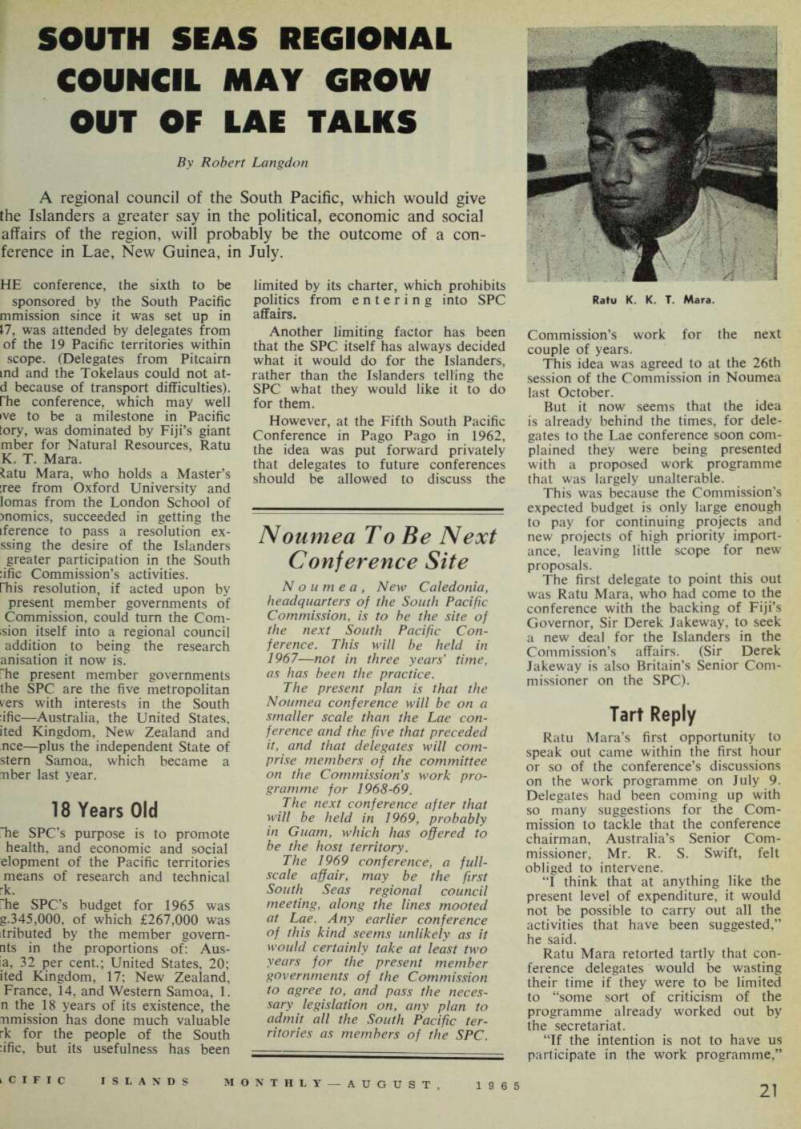
Ratu K. K. I. Mara.
i went on, “then let us know now id we can wind up the conference ' recommending the recommenda ms that have already been pre red.”
This unexpected commentary was untered by Mr. Swift, who pointed it that the metropolitan govern mts determined the amount of the idget, and that he was merely trying say that discussions had to be lated to it.
He was unable to give a specific swer to Mr. Carlos Taitano, of jam, Speaker of Guam’s legislature, 10 wanted to know whether the jeting could be given a clear under inding about the size of the budget that delegates could make realistic Dposals.
A day or two later Ratu Mara was ck on the attack.
This time he took the line that the immission would never be able to everything that the Island people inted until the Islanders’ territorial ministrations were paying for the ggestions. But he said the consti ;ion of the Commission seemed to ike this impossible.
The chairman, Mr. Swift, denied it there was anything to debar the ritories from making contribu ns. In fact, he said, they were eady doing this.
Mr. Swift then asked whether the nference wished to formulate ;cific work proposals for the Com ssion.
This prompted Mr. Taitano to ask lether delegates would be able to home to their governments with y assurances that any of their re mmendations would be carried out.
When Mr. Swift said, in effect, o”, Ratu Mara hopped into the iy again.
He said the idea of having delegates rticipate in discussions on the Com ssion’s work programme had proved failure, and that all the good in itions of the Territories would be
to no avail unless the Commission’s budget was increased.
Ratu Mara added that he would be most reluctant to ask the member governments to increase their contri butions unless the territories were asked to contribute also.
“Unless they are asked to contri bute,” he went on, “I feel that re sponsibility will be denied them, and they will never act with responsibility until they, themselves, are paying for what they want.
“To deny them this responsibility is not in keeping with the trend that has been taking place in the terri tories.
“We are being trained to take more responsibility in our own countries, so why should we be denied responsibility here?”
Mr. W. F. Meredith, of Western Samoa, “whole-heartedly supported” and seconded the idea of contributions by the territories.
Then Mr. Buren Ratieta, of the Gilbert and Ellice Islands, came straight out with what most delegates had shown they believed during earlier discussions.
“I think the feeling we should have about this Commission is that it is ours,” he said. “The metropolitan Powers are here to run it now, but the time will come when they will go, “We should therefore contribute to the Commission, because it is ours, however small the amount may be. I am sure that we from the GEIC will contribute.”
Money Proposals
Mariano Kelesi, from the Solomon Islands, went a step further. “If we agree to contributions to the Com mission’s funds, we will have more say in this conference,” he said. “If we refuse to contribute, we will not have the right to say anything.”
At this point, France’s Senior Com missioner, Mr. Henri Nettre, asked to speak for the first time.
“It is not for us to declare what the status of the conference is. The status of the conference is clearly defined in the constitution,” he said.
At Mr. Nettre’s request, Mr. Swift then made it clear that delegates to the conference were not empowered to make specific commitments on be half of their governments to contri bute to particular projects.
But he said the conference could, if it wished, pass a general resolution that contributions now made by the territories to the commission’s work should be expanded.
At a Press conference during the ensuing luncheon break, Ratu Mara described the Commission, as it stood, as “an exclusive club” for the metro
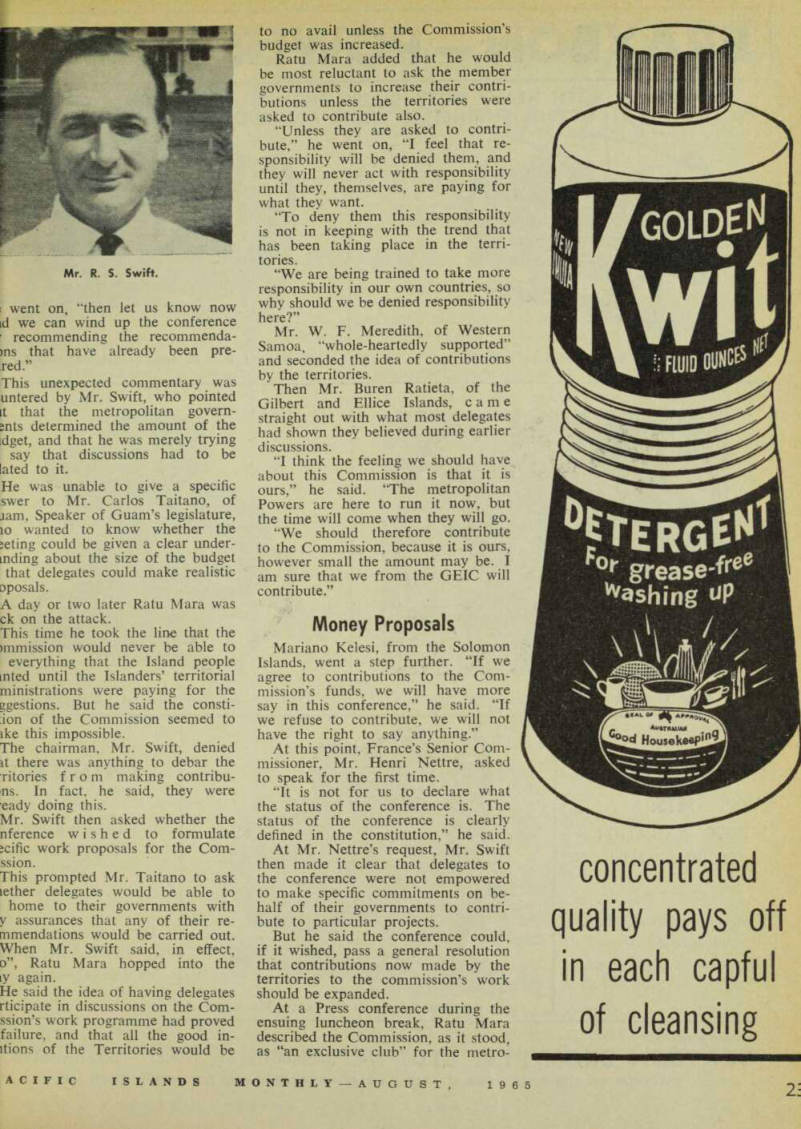
Mr. R. S. Swift.
litan governments which was out date.
“The other delegations have not sed any objections to what I have sn proposing,” he went on, “so when i have paid our entry fee to the club, lope the member governments will dte us to sit with them as equals.
“Each government in its own ter- Dry is trying to inculcate the idea self-government, but the Com ssion should do this also.”
Ratu Mara added: “From the trend events in my territory and other itish territories, I think the British ivernment will be behind the idea lave put forward.
T intend to take the matter up h the British Government when I to London at the end of the month constitutional talks on Fiji.” (See 11).
Vlr. Taitano, who was also at the jss conference, said he felt sure t the US Government would sup t an equal voice for the Islanders the Commission.
During the next 24 hours or so, tish and American officials at the iference seemed to think that their vernments would, in fact, support tu Mara’s campaign. Meanwhile, officials from New Zealand and mce did not appear to be at all turbed by the turn events had en.
Australia Surprised
Mistralia’s officials, however, med completely surprised and en aback by what had happened, I quite a few pounds must have n spent in cabling to Canberra for ructions on the stand they should e. t was on Wednesday, July 14 — 176th anniversary of the fall of Bastille and the symbolic attain nt by Frenchmen of liberty, lality and fraternity—that Ratu ra submitted a draft resolution to conference that could bring lality and fraternity for the inders within the Commission, fhe gist of the resolution was that, the opinion of the conference, un i the territorial governments were >wed to contribute directly to the mmission’s budget, they could not iect to have any responsible influ e in the Commission’s affairs. The iference therefore asked the Com ision to take up the matter of con ditions with the member govern nts.
Ninety minutes of the most in sive debate of the whole conference k place before the resolution, with ie amendments, was voted through.
Delegates from Guam, the GEIC, ited States Trust Territory, Cook
mds, Solomons and Tonga said y fully supported the resolution.
Jut several others —from Western noa, French Polynesia, Nauru, le and the New Hebrides—had notion that they would be corn ting their governments to a de te course of action if they voted favour of the resolution.
Phey therefore declared that they •e not prepared to vote on the re jtion either way, although in some es they said they supported it. ’apua-New Guinea’s sole University duate, Mr. John Natera, speaking behalf of the Papuan and New inean delegations, had a third view, ich seemed to reflect the attitude the Australian Government.
"his was that as the member gov ments of the Commission paid the f for all the territorial adminis ions, anyway, any greater contri ions by them to the Commission’s Iget would only reduce the amounts t they now contributed to the ter ries directly.
Jr, Natera therefore proposed t part of Ratu Mara’s resolution uld be amended to read: “The con mce requests the Commission to ite member governments to ex re all possible ways of increasing financial resources available to the nmission, including the expansion :ontributions in cash or kind from itorial governments to specific pro s’’.
To clarify what I mean by ‘specific jects,’ ” Mr. Natera said, “I will i research on the rhinoceros beetle. :el the plantation owners are mak enough money to help finance re rch on cococnuts.”
Jr. Natera’s amendment received e support from the other delega is; and a motion moved by Western ioa to refer Ratu Mara’s resolu i to the territorial governments
without the conference voting on it was defeated by nine votes to six.
This left the coast clear for Ratu Mara’s resolution to be voted through —with amendments and additions proposed by delegates from New Caledonia and Guam.
Speaking in support of his resolu tion, Ratu Mara appealed for an equal voice on the Commission for the Islanders because of the equality of mankind. He said that the great egalitarian philosophers—Jean Jacques Rousseau, John Stuart Mill, Hume, Locke, John Adams and the authors of the United States Constitution— all came from countries represented on the Commission.
Ratu Mara also made these points: • In this time and age, the mem ber governments of the SPC should teach the Islanders politics. • If independence was the quali fication for becoming a member (as Western Samoa had), then it should be explained why the independent Kingdom of Tonga had not been in vited to beome a member. • Also, if independence was the qualification, then Fiji was doomed never to become a member as its people had stated that independence was not their goal.
Eti Luamanuvae, of Western Samoa, who moved that Ratu Mara’s resolu tion be referred to the territorial gov ernments, said he was of the opinion that most of the governments would fully support it.
Buren Ratieta, of the GEIC, said: “I think you will agree with me that this is the age of equality, and if you are prepared to sit with other people in other world organisations, you should be prepared to treat us like wise.”
"Move Towards Unity"
Thomas Remengesau, of the United States Trust Territory of the Pacific Islands, said; “This resolution is in line with the objectives of the South Pacific Commission . . . and will be regarded as a second step towards the Islanders acquiring more respon sibility within the framework of the
Spc.”
In an effort to sway delegates who said they would abstain from voting on the resolution, Ratu Mara re iterated that the resolution would not commit the territorial governments to any line of action.
He added: “I think the greatest change that will be involved if the principle of territorial contributions is accepted is that politics will come into the Commission, and is bound to come into it. Politics is a fact of life and we cannot hide it or ignore it, “Many of the territories will prob ably share the feeling of Fiji that one
Mr. Carlos Taitano.
i the South Pacific territories [West ew Guinea] was removed from Utch control and given to Indonesia ithout any of our members whimper g one word of protest. This is a atter which interests many of our rritories, particularly Papua-New uinea and the Solomons.
“These matters should be discussed, d we can only do this if we are ad itted to the Commission,”
In its final form, the main points Ratu Mara’s resolution were that ; conference requested the Com ission: • To ask the member govern ;nts to invite territorial administra ns to increase their contributions the Commission’s budget in cash kind. • To recommend to member gov iments that they consider appoint ; as one of their commissioners a ident of the territories within the >pe of the Commission.
Phis last point, which was an icndment moved by Dr. Antonio mashita, of Guam, is open to more n one interpretation.
But Dr, Yamashita said outside the iference that he meant his amend nt to convey the idea that each ritory should have an indigenous, ally-born or permanent resident on Commission. f this idea proves acceptable to member governments of the Com ision—and there seems to be no )d reason why it should not—then tart will have been made towards rning the Commission into a ional council for the South Pacific, iowever, as the metropolitan gov ments would probably continue to r the lion’s share of the Com ison’s budget, they would no doubt st on a power of veto over the ex diture of money.
'his, on the face of things, would car to be a wise provision anyway, it would prevent the formation of /er blocs within the Commission,
'he English-speaking territories, for
mple, would be unable to steam er any proposal through that was ely of interest to them, as the nch Commissioner could quash it ply by voting against it.
'hus, if the two main points of Lae conference resolution are ;d upon, future conferences nsored by the South Pacific Com sion will no longer be the glorified imer schools they have been until i.
Certainly, the SPC must be changed t is to continue its existence. The v at Lae was that the era of onising paternalism in the Pacific the part of the metropolitan gov nents cannot go on, for the people he South Seas have come of age.