With Willey
pp. 16-17 · Read in the full issue
New Guinea Romp With Willey
WHEN young Michael Rockefell went missing without trace West New Guinea in 1961, and t subsequent expensive search by 1 father focused world attention on t scene, we remember predicting these columns that for the next years or so Rockefeller would “ seen” in one part of the world another (as Fletcher Christian us to be “seen”) or else various insi stories would give the “tru explanation of his death.
Well, Australian writer Kei Willey has added one for the p in his bright new book, Assignme
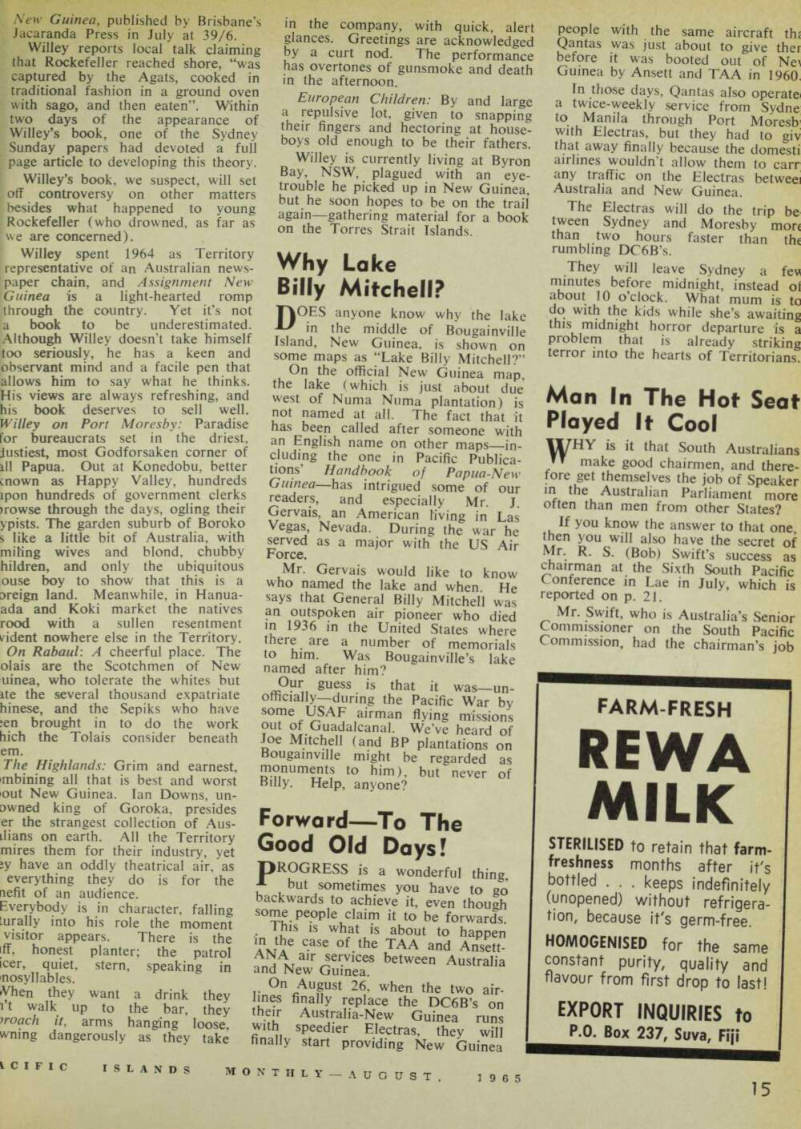
Keith Willey
New Guinea, published by Brisbane’s Jacaranda Press in July at 39/6.
Willey reports local talk claiming that Rockefeller reached shore, “was captured by the Agats, cooked in traditional fashion in a ground oven with sago, and then eaten”. Within two days of the appearance of Willey’s book, one of the Sydney Sunday papers had devoted a full page article to developing this theory.
Willey’s book, we suspect, will set off controversy on other matters besides what happened to young Rockefeller (who drowned, as far as [we are concerned).
Willey spent 1964 as Territory representative of an Australian news paper chain, and Assignment New Guinea is a light-hearted romp through the country. Yet it’s not a book to be underestimated.
Although Willey doesn’t take himself too seriously, he has a keen and observant mind and a facile pen that allows him to say what he thinks.
His views are always refreshing, and his book deserves to sell well.
Willey on Port Moresby: Paradise For bureaucrats set in the driest, dustiest, most Godforsaken corner of ill Papua. Out at Konedobu, better mown as Happy Valley, hundreds ipon hundreds of government clerks >rowse through the days, ogling their ypists. The garden suburb of Boroko s like a little bit of Australia, with miling wives and blond, chubby hildren, and only the übiquitous ouse hoy to show that this is a oreign land. Meanwhile, in Hanua ada and Koki market the natives rood with a sullen resentment rident nowhere else in the Territory.
On Rabaul: A cheerful place. The olais are the Scotchmen of New uinea, who tolerate the whites but ite the several thousand expatriate hinese, and the Sepiks who have ;en brought in to do the work hich the Tolais consider beneath em.
The Highlands: Grim and earnest, rnbining all that is best and worst out New Guinea. lan Downs, un owned king of Goroka, presides er the strangest collection of Aus dians on earth. AH the Territory mires them for their industry, yet ly have an oddly theatrical air, as everything they do is for the nefit of an audience.
Everybody is in character, falling turally into his role the moment visitor appears. There is the iff, honest planter; the patrol icer, quiet, stern, speaking in nosyllables.
Vhen they want a drink they i’t walk up to the bar, they noach it, arms hanging loose, wmng dangerously as they take
in the company, with quick, alert glances. Greetings are acknowledged by a curt nod. The performance has overtones of gunsmoke and death in the afternoon.
European Children: By and large a repulsive lot, given to snapping their fingers and hectoring at house boys old enough to be their fathers.
Willey is currently living at Byron Bay, NSW, plagued with an eye trouble he picked up in New Guinea, but he soon hopes to be on the trail again—gathering material for a book on the Torres Strait Islands.