Easy Passage For Fiji
p. 13 · Read in the full issue
London Talks Begin: No Easy Passage For Fiji Constitutional Reforms
Prom a Suva Correspondent
August 1.
Members of Fiji’s Legislative Council, currently meeting in London at a vital conference with the UK Government in an effort to work out a political future for the Colony, ended their first week of talks by finally facing up to the first of the really controversial matters —the common roll versus the communal roll.
[>UT by week’s end the matter had not been resolved and the nxious public back home —serviced y thousands of words of com lentary in special wire and radio averages from London—was re gned to a waiting game.
Unless the conference adjourns, hat the future holds on the really ital matters will be better known by le time this issue of PIM is distri iited.
The UK Government seems to ave set its sights on establishing,
through the talks, a ministerial system of government for Fiji, with all but three of the ministerial posts in the hands of elected members.
The elected members would pro bably hold six portfolios, equally distributed among the Indian, Fijian and European members.
The title of Colonial Secretary would be changed to that of Chief Secretary, and the communal rolls would be retained, probably with the addition of one seat for the Chinese and one seat for the other Islands minorities.
But it does not look at this stage that Britain’s views will have an easy passage.
Mr. Patel's Surprise
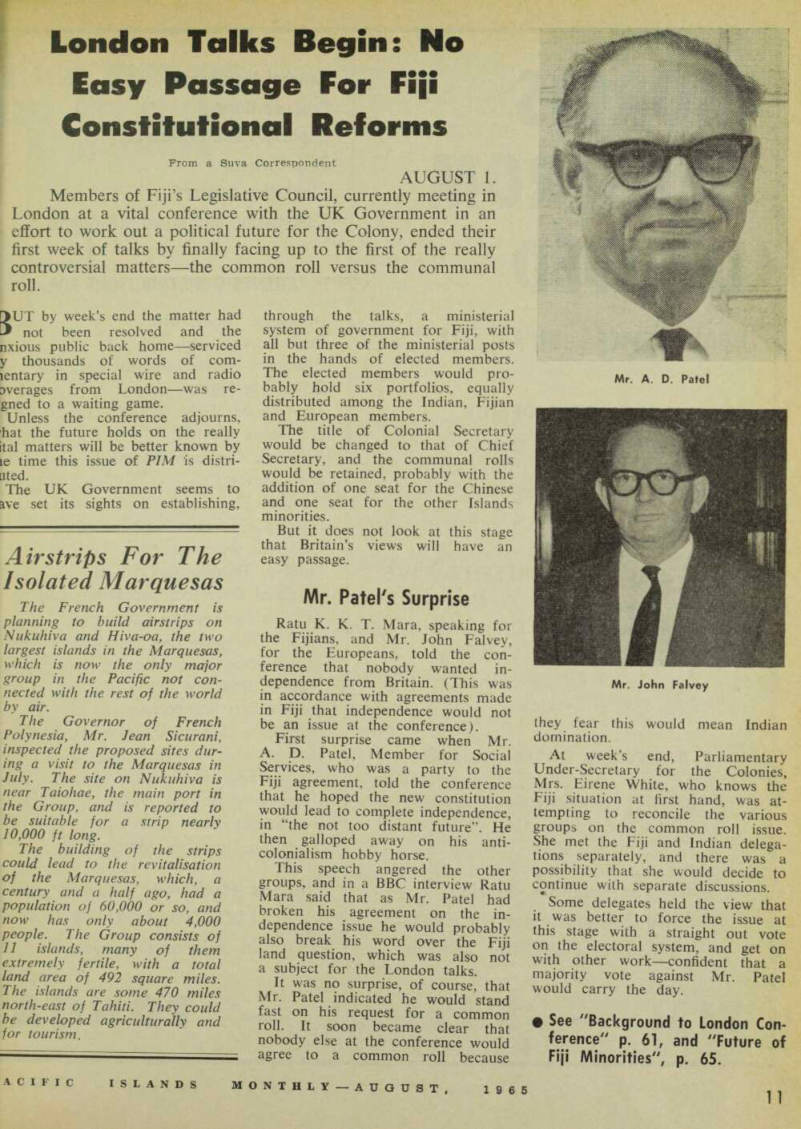
Ratu K. K. T. Mara, speaking for the Fijians, and Mr. John Falvey, for the Europeans, told the con ference that nobody wanted in dependence from Britain. (This was in accordance with agreements made in Fiji that independence would not be an issue at the conference).
First surprise came when Mr.
A. D. Patel, Member for Social Services, who was a party to the Fiji agreement, told the conference that he hoped the new constitution would lead to complete independence, in “the not too distant future”. He then galloped away on his anti colonialism hobby horse.
This speech angered the other groups, and in a BBC interview Ratu Mara said that as Mr. Patel had broken his agreement on the in dependence issue he would probably also break his word over the Fiji land question, which was also not a subject for the London talks.
It was no surprise, of course, that Mr. Patel indicated he would stand fast on his request for a common roll. It soon became clear that nobody else at the conference would agree to a common roll because
they fear this would mean Indian domination.
At week’s end, Parliamentary Under-Secretary for the Colonies, Mrs. Eirene White, who knows the Fiji situation at first hand, was at tempting to reconcile the various groups on the common roll issue.
She met the Fiji and Indian delega tions separately, and there was a possibility that she would decide to continue with separate discussions.
Some delegates held the view that it was better to force the issue at this stage with a straight out vote on the electoral system, and get on with other work—confident that a majority vote against Mr. Patel would carry the day.
• See "Background to London Con ference" p. 61, and "Future of Fiji Minorities", p. 65.
Mr. A. D. Patel
Mr. John Falvey