travel
pp. 117-121 · Read in the full issue
New Guinea's Travel
Business Is Hardly
An Industry Yet
travel
A Regular Pim Department
Reporting News Of South
Seas Tourism And Travel
From The Inside
From a Port Moresby Correspondent It is a remarkable thing but the travel business in Papua lew Guinea is rather similar to the political state of the country -disjointed and disorganised, with pockets here and there that re on the move, but with no overall unity or even conscience, "he travel business here is just not an industry yet.
JT, as with the political state of the country, it is emerging, i though nobody can predict when > likely to be a going concern. In meantime it is a matter of just ng your luck and hoping for the Wiile it is possible for travel nts overseas to arrange, from a ance, for a grand New Guinea r for their clients, neither the tit nor the client can expect the i of smooth service in New Guinea ; they will get, say, along the l-trodden tourist trails of Tahiti, and New Caledonia. ti the east the traveller can have itinerary planned to the hour, i all his connections, his hotels, cars, his shopping. So well will it ow the time-tested patterns that can just about guarantee meeting the people he met everywhere else his tour, so they can all compare
the prices they paid for the same transistors at the same shops.
In New Guinea there are no well defined trails, although the Austra lian domestic airlines are doing their best to develop some. But the Ter ritory is so big, and so expensive to move about in, and the hotels are so small and so little tourist-con scious, that development is not a quick process.
Hotels Needed
New and better hotels are pro mised—they have been promised for years—but meanwhile tourists will find themselves jammed two or three to a room with the commercial travellers and touring Government officers who keep the hotels in busi ness—together, of course, with the bar trade.
For this privilege they will pro
bably pay tariffs higher than they did in Fiji and get none of the little services that matter. In a leading Moresby hotel for instance, the traveller is required to individually mark each piece of his own laundry before he puts it out, well before breakfast, for attention.
A little matter, perhaps,—but an irksome little matter—and similar irksome little matters give most of the Territory’s hotels an air of the second-rate boarding house.
Everybody is agreed that some thing has to be done about the hotels before there can be a real tourist industry. But also something has to be done about getting some overall organisation that will develop and smooth the Territory’s tourist trails.
There is an organisation called the Papua-New Guinea Tourist and Travel Association, but it is not really functioning and certainly doesn’t have the unanimous support of the Territory’s many travel agencies. (If you might wonder how the agencies make a living out of an under-
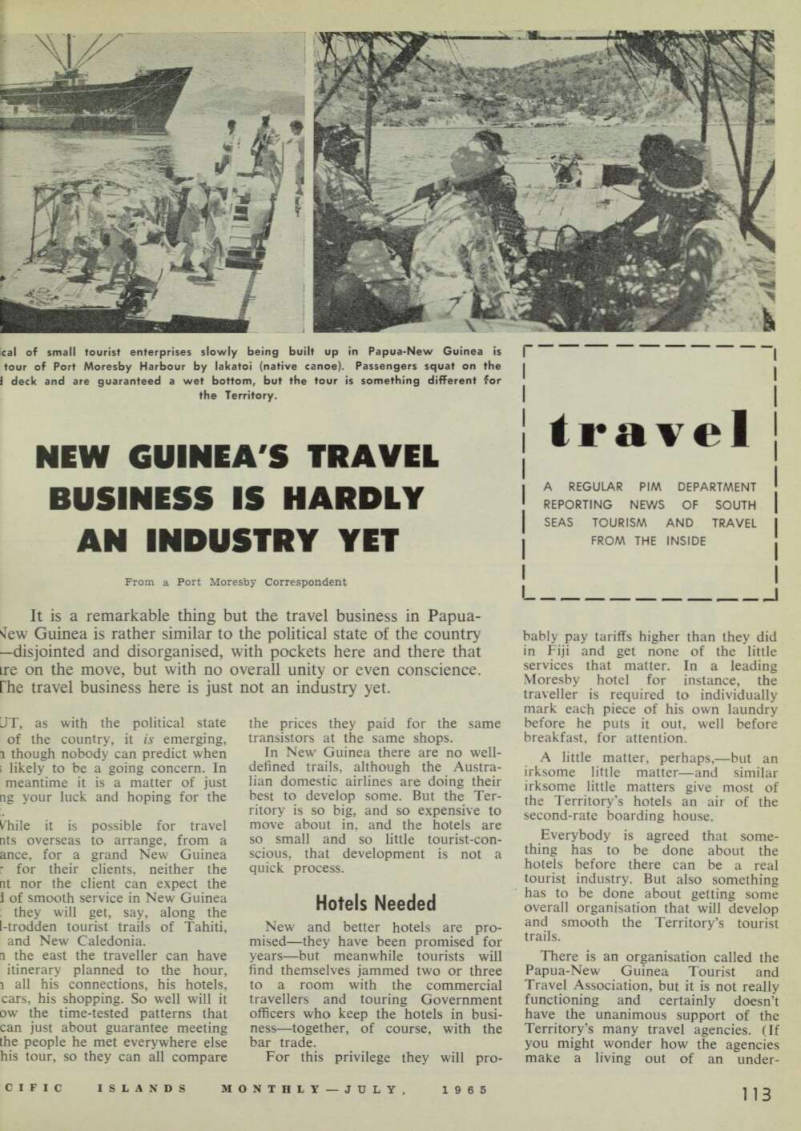
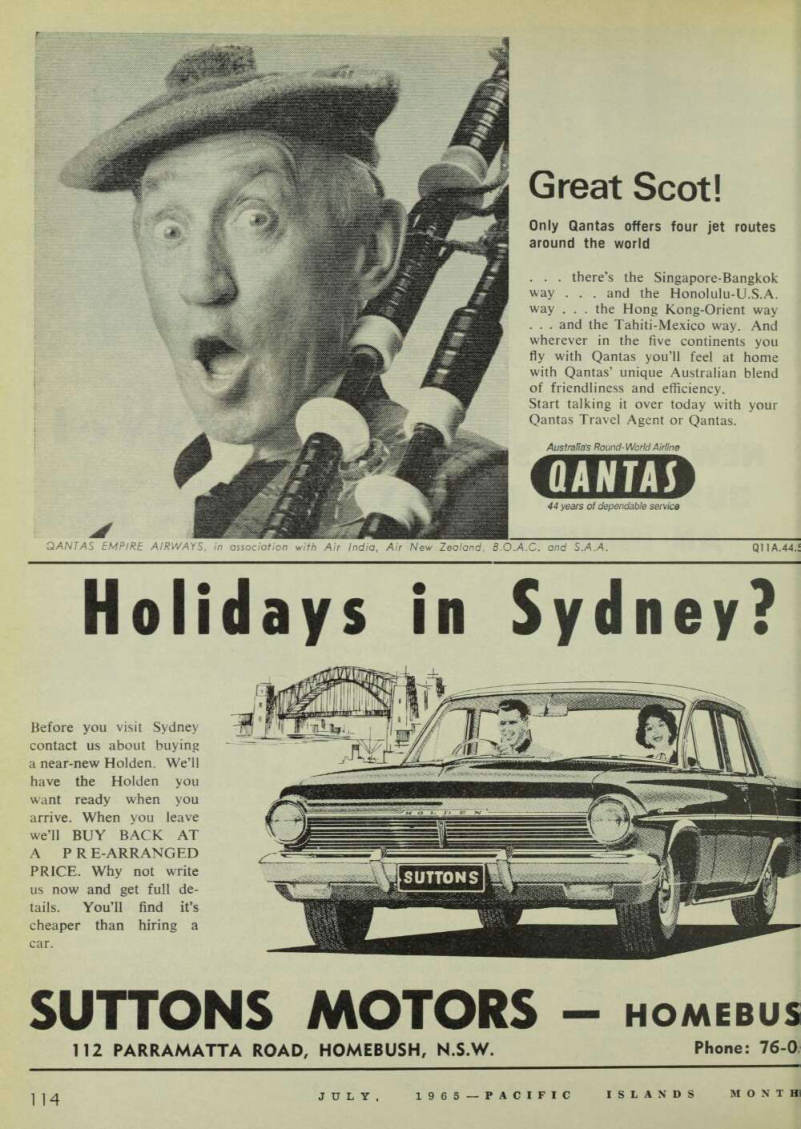
leal of small tourist enterprises slowly being built up in Papua-New Guinea is tour of Port Moresby Harbour by lakatoi (native canoe). Passengers squat on the I deck and are guaranteed a wet bottom, but the tour is something different for the Territory.
veloped local industry, it’s because »w Guinea residents do a very sat deal of travelling overseas).
Nearly every Territory town has own local sight-seeing arrange rs—buses, boats, planes, organised ig-sings—but mostly they aren’t blicised outside the town and there no overall tour pattern which >uld allow a tourist to tour the ;hts cheaply and smoothly.
It's Trial And Error
Agencies build up their own in rmation, usually the hard way, by al and error. Sometimes what ap ars to be a simple query by an ending visitor turns out to involve ich work and original planning, Mrs. A. J. Chandler, managing •ector of Port Moresby’s New linea Travel Service, recently dealt th a request from an American d his wife who wanted to climb ;w Guinea’s Mt. Wilhelm during a -day vacation. Could they do it, d if so, when, and where else in 5 territory could they get some jgh walking?
Mrs. Chandler wrote to the ADC Kundiawa, who suggested the )0 at Gembogl patrol post might able to help. The ADO, W. H. scoe, obliged with a long and Ipful letter explaining just how ; visitors should start on the ex dition, what they might expect in ; way of weather and native rest uses, what their carriers would st, what they should carry in the ly of food and bedding.
He added: “If they want long ilks in rough country I would :ommend the Koroba-Kopiago
travel
Laiagam area in the Western High lands.”
“Co-operation like this from all sorts of people makes New Guinea unique and the more fascinating for real travellers,” says Mrs. Chandler.
“New Guinea is really an experience, but examples like this illustrate the present situation of the tourist busi ness here. It’s not organised, although lots of little people in lots of little places try to do what they can.”
Two examples of small enterprises in Port Moresby are typical of the kind of thing which is slowly developing, independently, in various areas of the Territory. People like Mrs. Chandler would like to see more of them.
Lakatoi Enterprises is a co operative venture between native lakatoi skippers and native women’s clubs. The skippers are all retired Administration servants who run their own lakatois (with the aid of outboards). The big canoes take tourists on a two-and-half hour trip of Port Moresby Harbour for 25/per head (children half price). The canoes leave a small jetty near the main wharf and take passengers to the native villages of Hanuabada, Elevala and Tatana—and the cause way built by the Americans in World War ll—and give a close-up look at the bombed Macdhui wreck.
Wet Bottom Guaranteed
At Gabi the canoes beach so that the local village women can display their skills at grass skirt making, weaving and pottery. Curios are for sale.
Another trip, in the afternoon, takes the visitors to a local coral reef where Hanuabadan fishermen demonstrate native fishing methods.
Says an unpretentious typewritten sheet which advertises the tour: “You
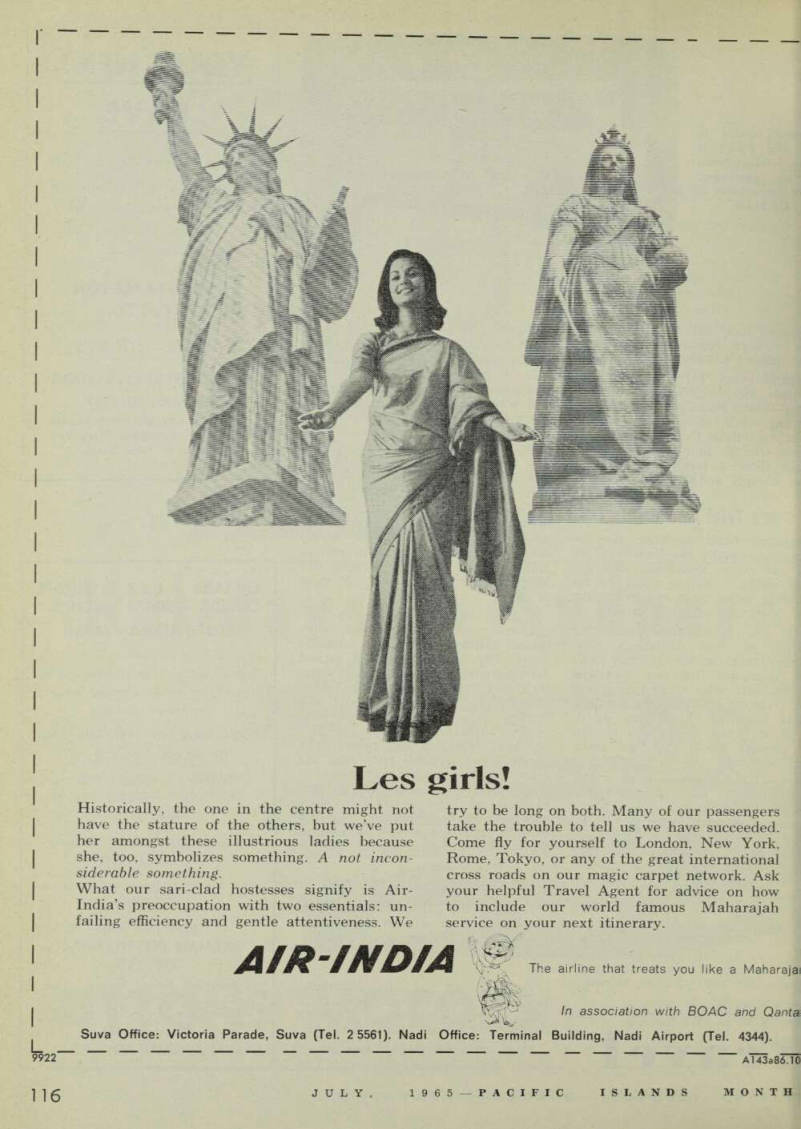
new venture in [?] Moresby is ner's Tropic Tours. ere passengers [?]ht for a swim at Ela Beach.
travel
! guaranteed a thrilling morning, possible wet bottom and a chance meet the native people. Please nember this trip involves primitive :ive type (but safe) transport, mitive village conditions and your operation to sit on the deck :hout chairs, native style, is es itial. Swimming may be permitted your native crew if they consider safe and free of sharks.” fhe native skippers arrange “tour desses” —local girls in grass skirts vho present a necklace made of ills to each traveller. This is in iition to his wet bottom, eighty per cent of the profits go Hanuabada village, tfrs. Anne Carter, of Port Moresby, o handles the publicity and ar ges things from the Port Moresby 1, says that in spite of initial op dtion from the shipping lines she ieves there is a demand for this rice and that eventually all op tion will be overcome. But she nits that things are very slow at moment and that there is not ch business offering.
Mr. F. C. W. Turner, owner of rner’s Tropic Tours, is another in purveyor of tourism, hopeful t business will develop. After 27 irs in the Territory doing some ng different, Mr. Turner not long
ago saw the opportunity for con ducted tours round the Port Moresby area. He had been asked one day to drive some tourists round by car, because nobody else was available and he knew the area.
Now he has a Toyota bus which takes 21 passengers for a full day’s tour, for only £2/5/-, plus 10/- for lunch in the mountains at Rouna Hotel. There are half-day tours too.
Surprisingly, his tours are the only conducted ones available in the Ter
ritory’s capital.
His tour includes a lot of wartime points of interest on the Kokoda Trail, including the Hombrom Bluff,
Blarney’s famous lookout. He gives a running commentary on the way and is known locally as “The Man in the White Topee”.
“There are many opportunities in the Territory,” says the friendly Mr.
Turner. “But they need building up.”
The Mt. Hagen and Goroka agri cultural shows—which are colourful spectacles of native life—are helping to develop an image abroad, but they, too, lack proper publicity. This year’s show, at Mt. Hagen, will be on August 21, but many intending visitors—and overseas travel agents —have complained of the lack of advance information.
POSTING. New manager of Fiji Air ys Ltd., Captain Ron Duffield, pictured, now taken up his post in Suva. He [?] Qantas manager in Tokyo for five years.