yesterday
p. 87 · Read in the full issue
In July, 1945, with VJ-Day only a matter of weeks away, Japan was being heavily bombarded by two US naval forces, supported by more than 1,000 carrier-based planes; troops of the Australian Seventh Division were establishing a beach head at Balikpapan, the important Borneo oil port; \md troops of the Australian Sixth Division were mopping up the Japanese in the Prince Alexander Ranges, overlooking Wewak, New Guinea.
jl/B'E AN WHILE, a conference in San Francisco had mapped out detailed plans for the establishment of the United Nations, ♦ * • * Among other items in PIM for July, 1945, was the news that Mr.
A. W. G. H. Grantham, Governor of Fiji, had been knighted in the King’s Birthday honours. The knighthood had been expected since his arrival in Fiji from Nigeria earlier in the year. * * * The Fiji Defence Regulations dealing with the sale of liquor were changed to allow hotels to sell alcoholic liquor by the bottle, except to members of the armed forces. Under the previous regu lation it was possible to buy liquor in hotels only by the glass.
Hotels in many parts of the Colony reverted to the pre-war trading hours of 10 a.m. to 10 p.m.
Australia’s Minister for Terri tories, Mr. E. I. Ward, had out lined plans for a new deal for the native people of Papua and New Guinea. A new Native Labour Ordinance proposed by Mr. Ward provided, among other things, for a 44-hour working week, the elimination of the indenture system and of pro fessional recruiters, a limit on the number of natives who could be taken from any village for em ployment, and the raising of the minimum wage from 5/- to 15/a month. * * * A Cook Islands Native Medical Practitioner, Manea Tamarua, performed an emergency opera tion at Mangaia on a native whose life could only be saved by that last resource. The operation was successful. The practitioner was the first since the NMP system was instituted to attempt on such an isolated island, a task that would seem hazardous, even to a European in a fully-equipped hospital. (Dr. Tamarua is now
officer in charge of the Cook Islands Sanatorium at Arorangi, Rarotonga. He is also deputy leader of the Cook Islands Party and Leader of Government Busi ness). * ♦ * The story was revealed of two men and a woman, all of the United States Army, who lived for six weeks in a previously un known (to Europeans) valley in the Oranje Mountains of Dutch New Guinea after their plane crashed there on May 13, 1945.
When radio communication was established between the castaways and their base, the first message sent by the woman in the party was; “Send me some pants—any kind”. The woman was Corporal Margaret Hastings of the US Women’s Army Corps. * * * Information from various parts of the Western Pacific indicated that trochus shell beds had benefited from the spell they had had since the Japanese invasion of the Pacific.
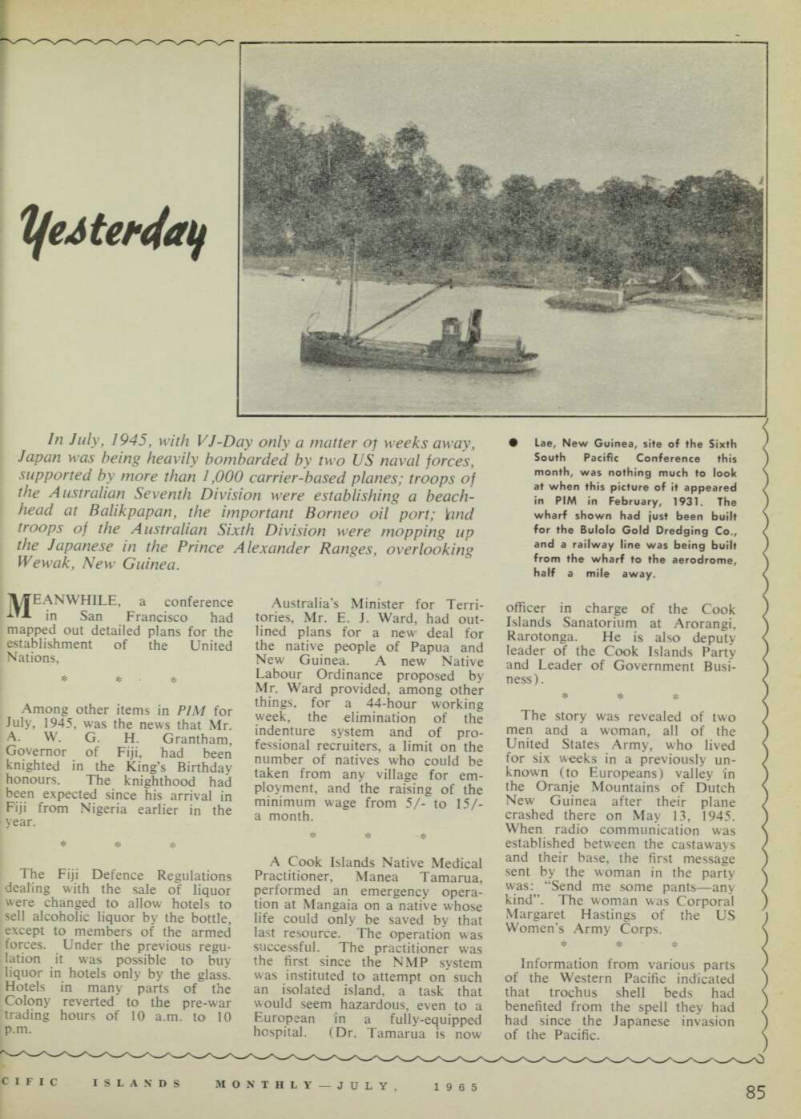
Lae, New Guinea, site of the Sixth South Pacific Conference this month, was nothing much to look at when this picture of it appeared in PIM in February, 1931. The wharf shown had just been built for the Bulolo Gold Dredging Co., and a railway line was being built from the wharf to the aerodrome, half a mile away.