A Piece Of The Pacific In
pp. 84-85 · Read in the full issue
The Mid-Indian Ocean
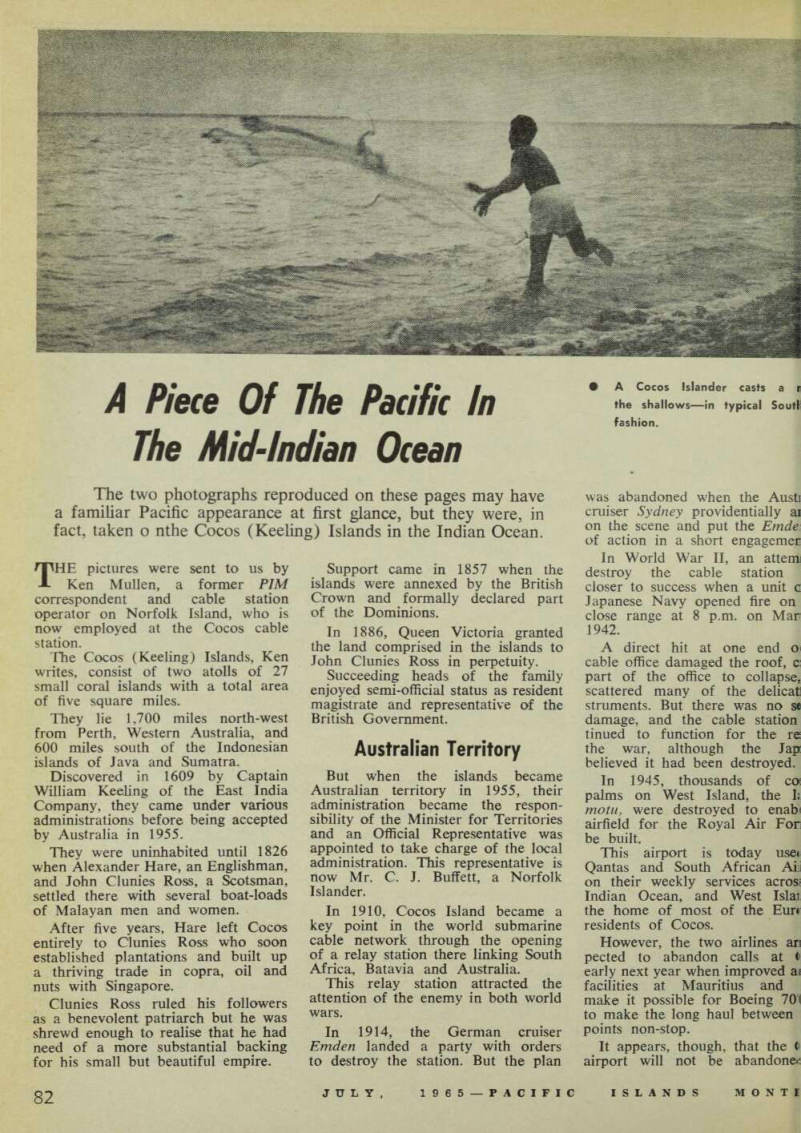
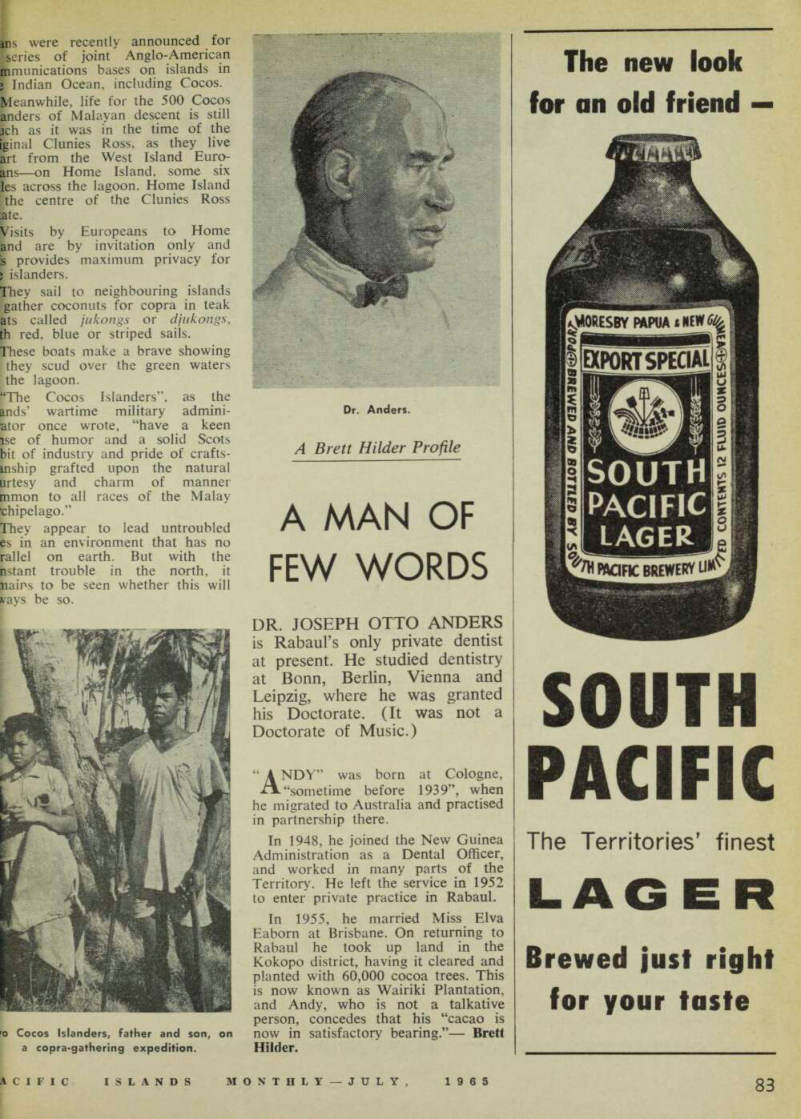
The two photographs reproduced on these pages may have a familiar Pacific appearance at first glance, but they were, in fact, taken o nthe Cocos (Keeling) Islands in the Indian Ocean.
THE pictures were sent to us by Ken Mullen, a former PIM correspondent and cable station operator on Norfolk Island, who is now employed at the Cocos cable station.
Fhe Cocos (Keeling) Islands, Ken writes, consist of two atolls of 27 small coral islands with a total area of five square miles.
They lie 1,700 miles north-west from Perth, Western Australia, and 600 miles south of the Indonesian islands of Java and Sumatra.
Discovered in 1609 by Captain William Keeling of the East India Company, they came under various administrations before being accepted by Australia in 1955.
They were uninhabited until 1826 when Alexander Hare, an Englishman, and John Clunies Ross, a Scotsman, settled there with several boat-loads of Malayan men and women.
After five years, Hare left Cocos entirely to Clunies Ross who soon established plantations and built up a thriving trade in copra, oil and nuts with Singapore.
Clunies Ross ruled his followers as a benevolent patriarch but he was shrewd enough to realise that he had need of a more substantial backing for his small but beautiful empire.
Support came in 1857 when the islands were annexed by the British Crown and formally declared part of the Dominions, In 1886 j Queen v ictoria granted the land comprised in the islands to John Clunies Ross in perpetuity, Succeeding heads of the family enjoyed semi-official status as resident magistrate and representative of the British Government,
Australian Territory
7 But when the islands became Australian territory in 1955, their administration became the respon sibility of the Minister for Territories and an Official Representative was appointed to take charge of the local administration. This representative is now Mr- C. J. Buffett, a Norfolk Islander.
In 1910, Cocos Island became a key point in the world submarine cable network through the opening of a relay station there linking South Africa, Batavia and Australia, This relay station attracted the attention of fhe enemy in both world wars.
In 1914, the German cruiser Emden landed a party with orders to destroy the station. But the plan
was abandoned when the Austi cruiser Sydney providentially ai on the scene and put the Emde. of action in a short engagemer In World War 11, an attem destroy the cable station closer to success when a unit c Japanese Navy opened fire on close range at 8 p.m. on Mar 1942.
A direct hit at one end o cable office damaged the roof, c part of the office to collapse, scattered many of the delicat struments. But there was no se damage, and the cable station tinued to function for the re the war, although the Jap believed it had been destroyed.
In 1945, thousands of ccx palms on West Island, the I; motu, were destroyed to enab* airfield for the Royal Air For be built.
This airport is today use* Qantas and South African Aii on their weekly services acros; Indian Ocean, and West Islai the home of most of the Him residents of Cocos.
However, the two airlines an pected to abandon calls at early next year when improved ai facilities at Mauritius and make it possible for Boeing 701 to make the long haul between points non-stop.
It appears, though, that the 0 airport will not be abandonee
A Cocos Islander casts a the shallows—in typical South fashion.
ms were recently announced for [series of joint Anglo-American mmunications bases on islands in ; Indian Ocean, including Cocos.
Meanwhile, life for the 500 Cocos anders of Malayan descent is still ich as it was in the time of the iginal Clunies Ross, as they live art from the West Island Euro ans—on Home Island, some six les across the lagoon. Home Island [the centre of the Clunies Ross late.
Visits by Europeans to Home and are by invitation only and is provides maximum privacy for I islanders.
They sail to neighbouring islands [gather coconuts for copra in teak ats called jukongs or djukongs, th red, blue or striped sails.
These boats make a brave showing [they scud over the green waters the lagoon. [The Cocos Islanders”, as the finds’ wartime military admini ator once wrote, “have a keen ise of humor and a solid Scots bit of industry and pride of crafts |mship grafted upon the natural lirtesy and charm of manner mmon to all races of the Malay
jthipelago.”
They appear to lead untroubled es in an environment that has no rallel on earth. But with the hstant trouble in the north, it hains to be seen whether this will pays be so.
o Cocos Islanders, father and son, on a copra-gathering expedition.