cfn ts"ly imaginefh
pp. 79-83 · Read in the full issue


Eiao: Where Pigs
And Sheep Fight
Over The Last
Blades Of Grass
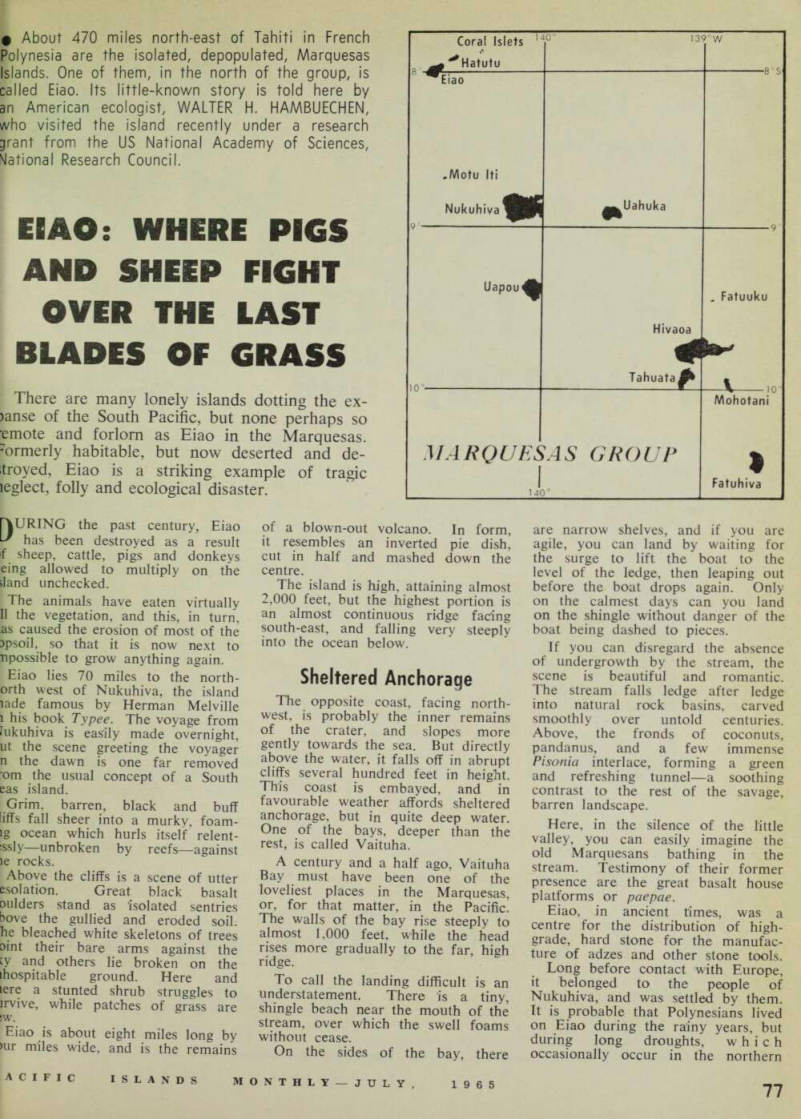
About 470 miles north-east of Tahiti in French Polynesia are the isolated, depopulated, Marquesas Islands. One of them, in the north of the group, is called Eiao. Its little-known story is told here by an American ecologist, WALTER H. HAMBUECHEN, who visited the island recently under a research grant from the US National Academy of Sciences, National Research Council.
There are many lonely islands dotting the ex >anse of the South Pacific, but none perhaps so emote and forlorn as Eiao in the Marquesas. 7 ormerly habitable, but now deserted and de itroyed, Eiao is a striking example of tragic leglect, folly and ecological disaster.
TOURING the past century, Eiao has been destroyed as a result f sheep, cattle, pigs and donkeys eing allowed to multiply on the dand unchecked.
The animals have eaten virtually 11 the vegetation, and this, in turn, as caused the erosion of most of the >psoil, so that it is now next to npossible to grow anything again.
Eiao lies 70 miles to the northorth west of Nukuhiva, the island lade famous by Herman Melville i his book Typee. The voyage from lukuhiva is easily made overnight, ut the scene greeting the voyager n the dawn is one far removed ■om the usual concept of a South eas island.
Grim, barren, black and buff liffs fall sheer into a murky, foam- Slv oCe u„ n br^i Ch h b UrlS relent ; K 3? b k by ree^s against le ,[°f v ks ,. . , Above the cliffs is a scene of utter isolation. Great black basalt oulders stand as isolated sentries bove the gullied and eroded soil. he bleached white skeletons of trees If and trvive, Fian is ahniit i u mr ° - -a eig T - mil f s long PV i es wi e, and is the remains
of a blown-out volcano. In form, it resembles an inverted pie dish, cut in half and mashed down the centre.
The island is high, attaining almost 2,000 feet, but the highest portion is an almost continuous ridge facing south-east, and falling very steeply I°*° ocean below.
Sheltered Anchorape
The opposite coast, facing northwes t, is probably the inner remains *he cra ter, and slopes more gjmfiy towards the sea. But directly a j .£ ve wa t er » it falls off in abrupt £l|. severa l hundred feet in height.
Jms coast is embayed, and in favourable weather affords sheltered anc horage but in quite deep water.
Sr ifca Id Va y i S ,uh d a eePer ‘ han ““ res ‘’ called V j a,tul ’ a it . , A centu /y and a half ago, Vaituha Ba Y must have been one of the loveliest places in the Marquesas, or, for that matter, in the Pacific.
The walls of the bay rise steeply to a lmost 1,000 feet, while the head X gradUa " y ‘° h, ' Bh f° - - difficult is an st r eam , over which the swell foams without cease.
On the sides of the bay, there
are narrow shelves, and if you are agile, you can land by waiting for the surge to lift the boat to the level of the ledge, then leaping out before the boat drops again. Only on the calmest days can you land on the shingle without danger of the boat being dashed to pieces. if y OU can disregard the absence of undergrowth by the stream, the scene is beautiful and romantic, The stream falls ledge after ledge into natural rock basins, carved smoothly over untold centuries, Above, the fronds of coconuts, pandanus, and a few immense Pisonia interlace, forming a green and refreshing tunnel—a soothing contrast to the rest of the savage, barren landscape, Here in the silence of the
cfn ts"ly imaginefh
old Marquesans bathing in the stream. Testimony of their former presence are the great basalt honsp platforms or vaepfe Eiao in ancient times was a centre for the distribution ’ of bipb grade hard stone for the manufac
‘-eof’fdzewHd mSef Lne Tcflt
it
S Po^stfd
on Eiao during the rainy years, but during long droughts which occasionally occur in the northern
Marquesas, the inhabitants probably ’eturned to the higher islands of the louth, [ From the number of house re hains found on the island, it is mown that the population was never arge. But the little bay of Vaituha, dthough very steep, must have been veil planted, especially near the tream. The remnants of various iconomic plants indicate this fact.
But even more significant is the lescription of Eiao given by Captain foseph Ingraham, an American lading captain, to whom the Euro lean discovery of the island in 1791 s attributed, Ingraham wrote: “The island is ibout six or seven leagues in circuit; t appears fertile and pleasant to the ye on all sides; but more particu arly on the west and north-west ides, which are well-wooded and lave many fine groves of coconut rees”.
No People
Captain Ingraham sailed away without landing because of the rough eas. He saw some houses, but no •eople, so his visit probably took dace when the inhabitants had re timed to their native island.
There were still no people on Eiao /hen Lieutenant Richard Hergest nd the astronomer John Gooch anded there from HMS Daedalus a the following year, but Hergest eported finding coconut trees and xcellent water in Vaituha.
Little is known of Eiao’s history uring the next 60 or 70 years, but o doubt the Nukuhivans and parties rom other islands visited and ccupied it from time to time. They robably continued to plant it, and o the vegetation prospered.
Then, around 1870, an American lanter, John Hart, introduced sheep 5 the island, and it was not long efore the weathering and eroding of iiao’s grass-covered upper slopes egan.
Hart apparently obtained the heep from Nukuhiva, where he had pme large holdings.
But it seems that he was not
responsible for bringing them to the Marquesas, for C. J. Lambert, an English visitor to Hart’s plantations on Nukuhiva in 1881, recorded that although sheep, goats, pigs, fowls and cattle were running wild all over that island, no one seemed to know where the sheep and cattle had come from. Lambert added, how ever, that the animals had “very likely” come from Mexico.
Anyway, there is no doubt that Hart introduced the sheep to Eiao, as Bob McKittrick, a well-known trader, who still lives at Taiohae Bay, Nukuhiva, once saw some memoranda written by Hart on his ventures in the Marquesas, and he distinctly recalls that these notes mentioned the introduction of the sheep. (The notes, by the way, were then in the possession of a trader
called McGrath, but their present location is unknown).
It is not certain how long Hart’s sheep-raising venture on Eiao lasted, but after it was abandoned, the sheep were left to multiply un checked—there being nobody to slaughter them, and no animals to prey on them. By the turn of the century, their numbers had reached 10,000.
It was not long before they were “eating themselves out of house and home”. This process was further aided later by the introduction of cattle, horses, donkeys, and pigs.
It was impossible for the vegeta tion to withstand their onslaught, particularly because the island has regular dry seasons, and occasionally suffers droughts.
McKittrick says that in 1916 there
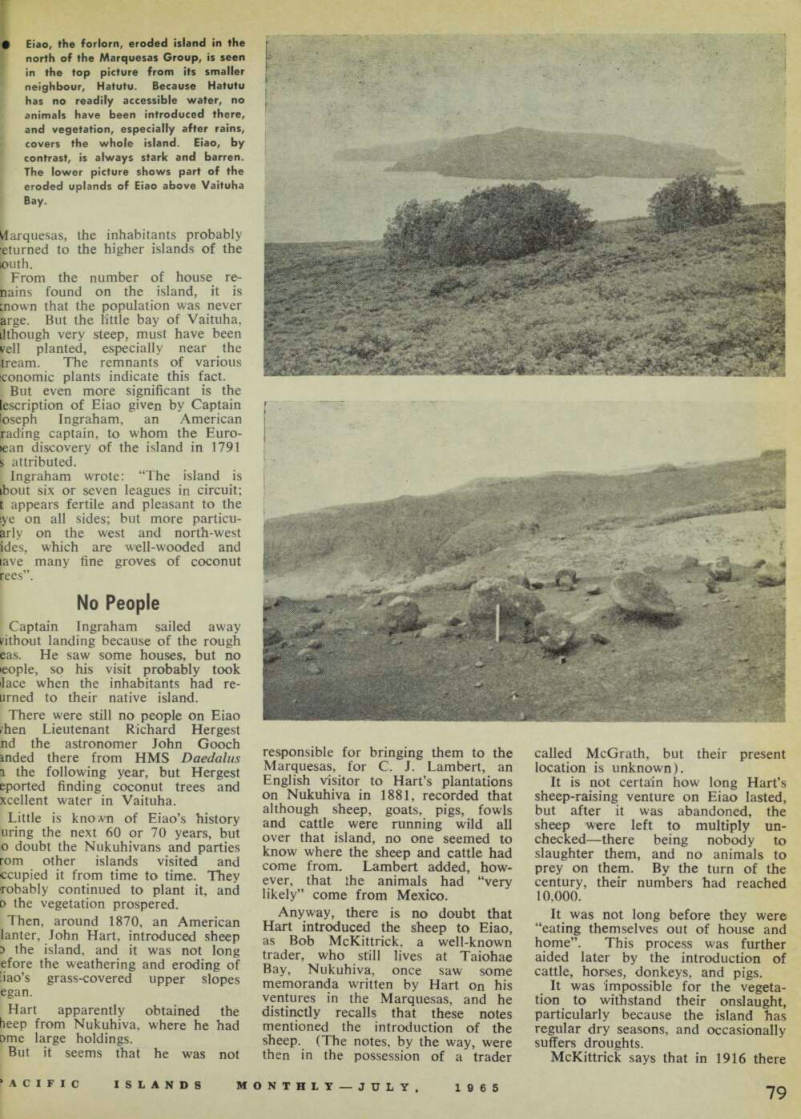
Eiao, the forlorn, eroded island in the north of the Marquesas Group, is seen in the top picture from its smaller neighbour, Hatutu. Because Hatutu has no readily accessible water, no animals have been introduced there, and vegetation, especially after rains, covers the whole island. Eiao, by contrast, is always stark and barren.
The lower picture shows part of the eroded uplands of Eiao above Vaituha Bay.
ere 3,000 sheep in the Vaituha alley alone —this being the only (hnanent source of water.
It was in this year that a man imed Verhag, of Papeete, was given lease of Eiao to butcher sheep for e Tahiti market. But lack of ipping and other complications icmed the venture to failure.
Eiao then became a penal settle pnt and Marquesas criminals were it there to serve their sentences, iturally, they killed a few sheep d pigs, but not nearly enough to ve the island’s vegetation.
In 1927, a Frenchman named an leased the island for coconut mting. Cattle were also intro ced around this time.
By then, the estimated number of sep on the island was 6,000, and i island was looking like a desert, hardly a single tree or blade of iss had a chance of escaping the ngry thousands.
Osan’s labourers planted most of t plateau with coconuts, but the jep immediately attacked the trees, an therefore asked the French Iministration for permission to kill t sheep, but this was refused. In speration, he put up miles and les of barbed wire to keep them t; and although this proved xessful, his venture failed, like j previous one, because of shipping ficulties.
Although much of Osan’s barbed
wire is still in place today, the sheep have breached it, and they now reign supreme over what is left of the vegetation.
These sheep have adapted them selves to climb like goats to get to the last remaining plants, but these are so few, that the sheep are dying from starvation.
Meanwhile, the cattle introduced about 1927 have all died through lack of grass and their inability to get to water in the steep Vaituha Valley; and the donkeys have dwindled to about five head. These five, in their struggle to survive, are eating the bark of the few remain ing trees, girdling them, and killing them.
Savage Predators
As for the pigs, they have become savage predators. They hunt stray sheep and lambs in bands, run them down, bring them to the ground by breaking their legs with their power ful jaws, and then devour them.
The pigs are vicious, razor-backed, red and black creatures. They subsist on whatever they can find—pandanus seeds, candlenuts, roots, bark, and occasional fruit from the nono tree.
Their special habitat is the Opituha canyon, a long, winding former stream canyon, now barren and dry because the life-giving, water-holding topsoil on its watershed was washed
and blown away after its plant life was destroyed.
Opituha resembles a canyon in the desert country of Arizona.
In contrast to the barreness of Opituha and other parts of Eiao is the small island of Hatutu (three miles long by less than one wide), which is separated from Eiao by a channel three miles wide.
Because no readily accessible water exists on this island, no animals have been introduced, and almost no economic plants are to be found.
But other plants grow in every nook and cranny of Hatutu’s 1,400 ft high plateau, and cling to the steepest places on the wild, high coast. After rains, Hatutu is a picture of green—emerald green— bursting with vigorous plants grow ing in soils that attain over 20 inches in depth. On barren Eiao, on the other hand, few places have even one inch of topsoil.
The contrast between the two islands is dramatic proof of what foraging animals can do if they are not controlled. The sum of their destruction and official indifference adds up to the total economic loss of an island, which, before the intro duction of the sheep and other animals could undoubtedly have supported more than 1,000 people, especially with the addition of modern water storage facilities.
Today, it is doubtful if Eiao could support even one family.
McKittrick, the Nukuhiva trader, who vided some of the details about Eiao's ep. He is holding a couple of Mar quesan tikis.