Territories TALK-TALK
pp. 47-51 · Read in the full issue

With Tolala
The following quote from a New Guinea newspaper is the sort of thing that makes you sigh and go “Tsk, tsk!” when you read of the wonderful House of Assembly of Papua and New Guinea: “Speaker of the House of Assembly, Mr. Horrie Niall, on Monday told native members they would have to find for themselves people who could assist them with the translation and explanation of documents and reports presented in the House.”
NATIVE members had complained in the House they could not understand the World Bank Report and other documents.
Muriso Wareba, of the Okapu Open electorate, had said he was now invited to address the House on the World Bank Report, but he could not read it. He said if they were advised of the contents of the report they would be able to participate in the debates.
That seems a fair enough request to come from the people who are, to say the least, the most interested, i If we are sincere in our drive towards integration (call it what you will) how come we create these iifficulties in such a glaring manner?
It is hard to see how the Speaker, with his long experience in New Guinea, should adopt such a >ontifical attitude.
If education means what I think t means (and there’s no need for i capital “E”) there is no greater )pportunity for putting it to practical ise than in telling a member, repre lenting thousands of native people, iomething about the subject on which le is expected to debate in the ■louse.
Who are you batting for, Horrie?
View Britain's
Administrative H.Q.
r’S nice to know that Administra tive centres, other than those in J ort Moresby, are being opened, and hat some of the same amenities as mjoyed long since in the sacred wecincts of Konedobu, are now ivailable to centres on less-hallowed pound.
God knows these neglected servants ►f the public have not only earned his recognition for adequate office pace under reasonable conditions
but, especially in Rabaul, are entitled to amenities commensurate with the centre’s productive potentialities.
Noticed in the local paper’s report of the opening that “the contractors still have to balance the air con ditioning”.
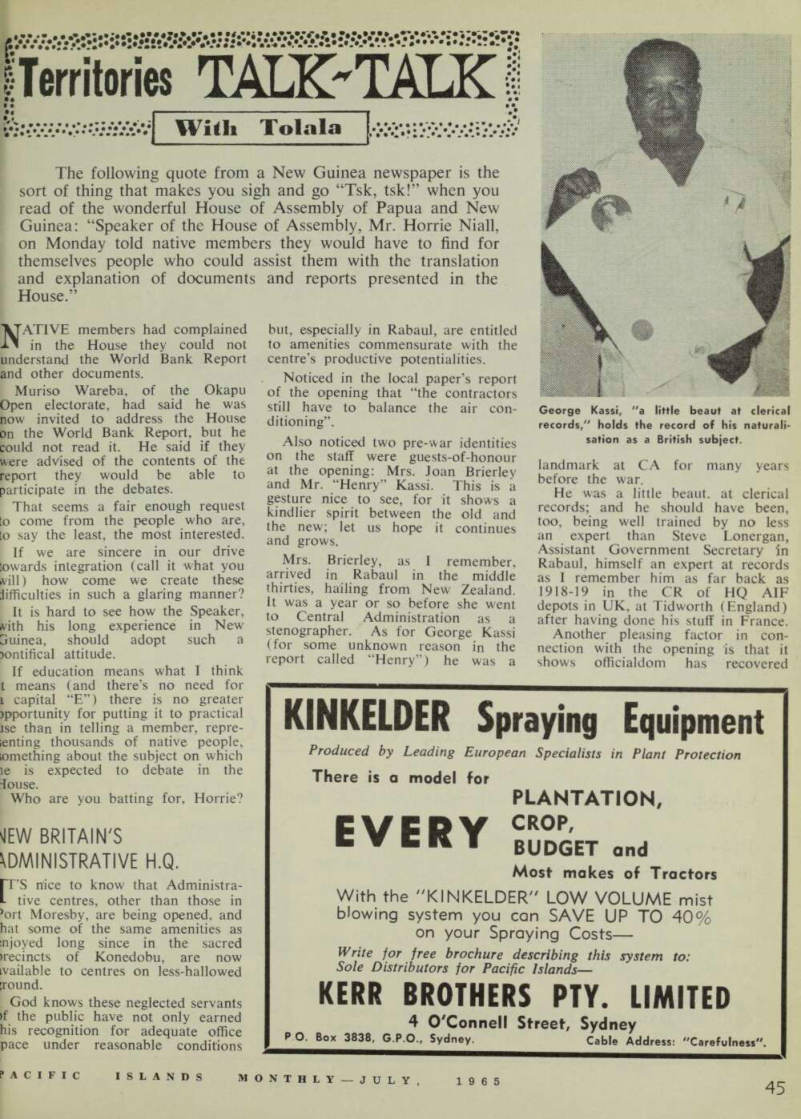
Also noticed two pre-war identities on the staff were guests-of-honour at the opening: Mrs. Joan Brierley and Mr. “Henry” Kassi. This is a gesture nice to see, for it shows a kindlier spirit between the old and the new; let us hope it continues and grows.
Mrs. Brierley, as 1 remember, arrived in Rabaul in the middle thirties, hailing from New Zealand.
It was a year or so before she went to Central Administration as a stenographer. As for George Kassi (for some unknown reason in the report called “Henry”) he was a
landmark at CA for many years before the war.
He was a little beaut, at clerical records; and he should have been, too, being well trained by no less an expert than Steve Lonergan, Assistant Government Secretary in Rabaul, himself an expert at records as I remember him as far back as 1918-19 in the CR of HQ AIF depots in UK, at Tidworth (England) after having done his stuff in France.
Another pleasing factor in con nection with the opening is that it shows officialdom has recovered
George Kassi, "a little beaut at clerical records," holds the record of his naturali sation as a British subject.
sufficiently from its qualms over the safety of Rabaul insofar as eruptions and all that sort of thing are con cerned. If you remember: There was Billy Hughes’ selection of Salamaua as “the new capital” in 1937; the transfer of officials and iepartments to Lae in 1941, and then, after the war, the selection of Rapopo as New Britain’s future ;apital.
I I hope this changed optimism regarding Rabaul’s future has not lessened the need for routine seismic/ Ihermal readings which are an ever kecessary precaution where Tavurvur |nd Vulcan are concerned, j As is customary in these days, the report carries no description of the irchitectural aspect of the building; Nothing of its aesthetic beauty (if my), but the cost—as usual—gets i mention: “in excess of £144,000”. fhe odd £44,000 was just about what t cost to clean up Rabaul after the 1937 eruption!
\ Graduate From Nodup
LAST month I mentioned some of the ex-pupils from J. H. L.
Waterhouse’s Nod u p School.
Itrangely enough I had a telephone ing from one such pupil a few days ifterwards. He is Thomas To lunbun, a senior school teacher now, ind president of the Rabaul Workers’
Association for the past three years; le was en route to Geneva to attend in ILO conference. This is the first ime that P-NG representatives have iccompanied an Australian delega ion to the ILO at Geneva.
How I Lost My Pants: It was rom To Bunbun I learned of a very indly gesture which was made by lim and his father to me when I Fas in the Jap boob in Rabaul dur- Qg the war.
His father gave him a pair of kussie Army pants and some fruit o give me in the Rabaul freezer, /here I was chief cook and bottle washer. It appears a Jap guard ►ulled up the 15-year-old To Bunbun, ic was arrested and charged with tealing. Nothing daunted, To lunbun (with the agile brain irobably trained on mental rithmetic in the Nodup school) told he Kempei Tai the trousers and fruit /ere owned by his father who had sked him to take them to a apanese guard, whose name he did ot know.
“OK, OK!” said the Japs, com aandeering the pants and fruit, and eleasing him. And that’s how I early got a pair of pants and some ruit when such luxuries were at a Ternium.
But perhaps it was just as well
it ended as it did. I heard of several cases where natives had taken presents to our POW’s or internees in Rabaul and both the giver and the receiver had been severely dealt with. Artie Schmidt, the teacher at the Malaguna Government School, was one who suffered disciplinary action” by the police for receiving some fruit from an old pupil, who was also put in the calaboose. There were numerous others who paid dearly for any friendly tokens or gestures from the native people.
From a true appreciation of what racial discrimination means give me the man, or women, who has been interned in a black country by an Asian invader.
It is the actions during the war of people like To Bunbun and his father which proved to me how solid are the ties between friends, no matter what the colour.
Thank you, To Bunbun. Ma a bona Winawana uro Geneva. Yoko!
Jap War Aims
TN Editors' Mail Bag ( PIM, June, A p. 53) I see where one, “Mercator”, infers that the Japanese did not intend to attack Australia, It was “in accordance with Australian mythology but not with the facts”, says “Mercator”.
I can make no comment on such
pressions of self-assured know jge of the Japanese war plans in (42-44. During that period 1 was terned in Rabaul, and there ►served and heard the general talk I the common Jap soldiers as they ed to collect all Australian money ►ssible and sought details of the Lot spots” in Sydney where they ►uld see women. .“Mercator,” apparently, has a eater credence in the war histories, ritten in the temperate climate of p post-war cooling-off period, than ■ the direct statements made by panese troops when the fur was
Ing.
As an internee, cut off from the ftuence of any Australian “myth” ft viewpoint, my opinions were sed entirely on my observations d contacts with Japanese officers, ivate soldiers, Taiwan clerks and 10-sen labourers, all of whom pressed the hope that eventually ty would land in Australia.
As for the sting in the tail of his ter about Aussies not having a her understanding of Japanese ns, “Mercator” should know that e of the last things an Aussie ►rries about is international politics i overseas trade.
Tosphates Wanted
fATIONAL Development Minister I Fairbairn is reported as saying i search for phosphate deposits in istralia and its Territories was in sasing. He added, “phosphate has io been found in Papua”.
It might still be worthwhile to have look at the islands in the Purdy oup (south-west of Manus). In esting deposits were found on these es in old German days, but at the ae they were said to be of no com jrcial value.
With the passing of 50 or 60 years,
improved working machinery, added scientific knowledge and the effluxion of time—for they do say phosphate. like wine, improves with age—it should be an idea worth toying with.
CSIRO would probably come up with something if they were asked and given the chips to do it with. It might also solve the Nauru puzzle as well.
Death Of A Strong Man
AUSTRALIAN strong man Don Athaldo died on May 24 at his home at Ettalong (NSW). Obituaries
made mention of his early years of ill health and that he was “six times rejected for the AIF”. They did not mention, however, that “Tiger”
Lyons, as he was known in his early days, was a corporal in a reinforce ment to the AN&MEF and was stationed in Rabaul in a Pioneers’ unit for some time in World War I.
During this time he started what I imagine was his first physical school —he taught the native boys employed in the blacksmith shop (where Tiger was a striker) how to box and develop their muscles. “Tiger” was 70 when he died.